
VST Tapes
|
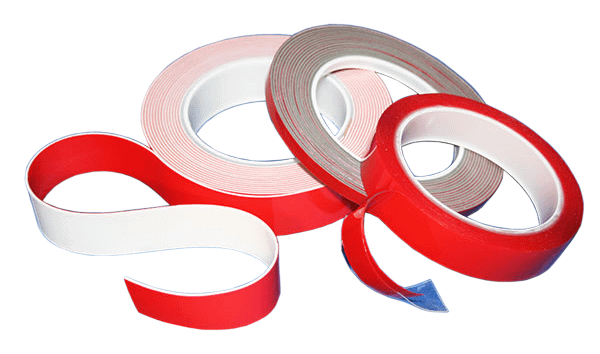
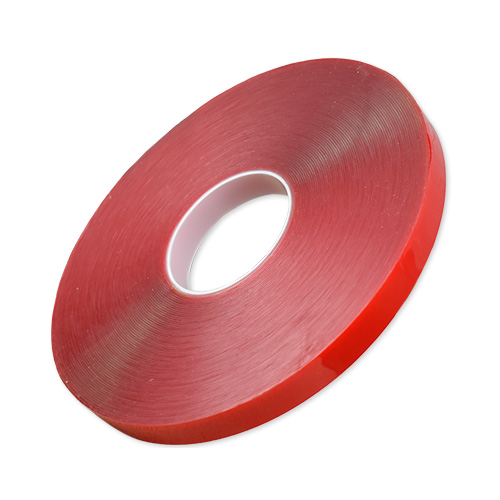
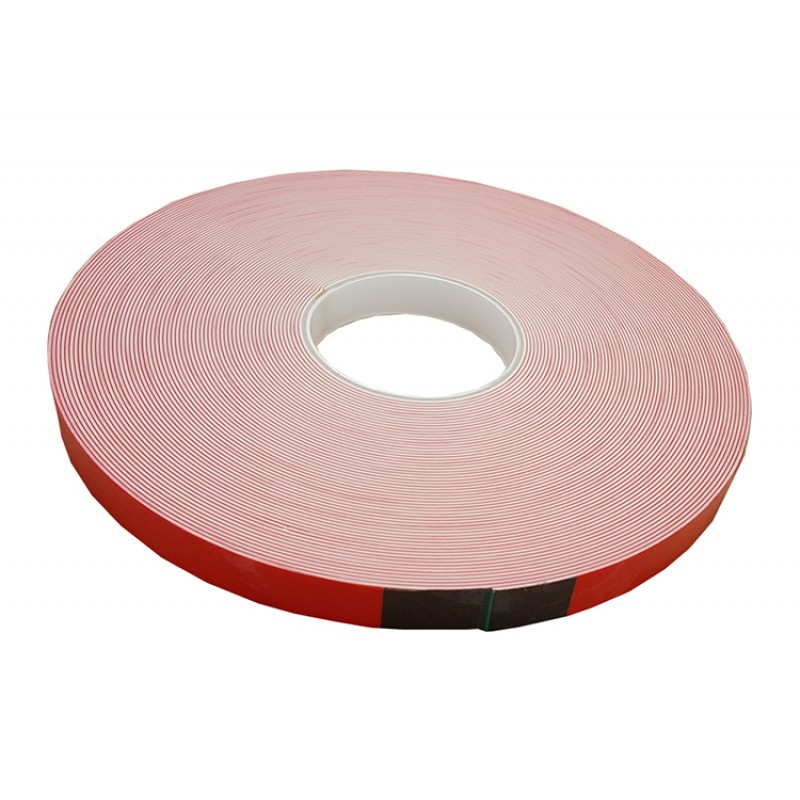
High Bond Acrylic Foam Tape Chem-Set VST Acrylic Foam TapesFifteen grades from 0.010 to 0.063 inch, cross-referenced to 3M VHB™ by thickness, color, and construction. Permanent structural bonding on metals, plastics, glass, and composites. Replaces rivets, screws, spot welds, and liquid adhesive where a visible fastener is unacceptable. Sold by the single roll, no case minimum, in-stock orders placed by 2pm Eastern ship the same day. |
 |
Find your 3M VHB™ equivalent
Matched on thickness, color, and construction. A cross reference is a starting point for selection, not a statement that two products perform the same. Qualify the tape in your own joint before changing a production process. Thicknesses are listed in inches with mils in parentheses, since a mil is one thousandth of an inch and both notations turn up on prints and purchase orders.
| Chem-Set | Thickness | Color | Built For | Closest 3M Grade |
|---|---|---|---|---|
| VST3025 | 0.010 in (10 mil) | Clear | Visible joints, die-cut parts | 9473, F9473PC |
| VST3050 | 0.020 in (20 mil) | Clear | Visible joints | VHB 4905 |
| VST6100 | 0.040 in (40 mil) | Clear | Visible joints | VHB 4910 |
| VST6150 | 0.060 in (60 mil) | Clear | Visible joints | VHB 4915 |
| VST6364 | 0.025 in (25 mil) | Gray, white | General purpose | VHB 4936, RP25 |
| VST6110 | 0.031 in (31 mil) | Gray, white | General purpose | VHB RP32 |
| VST6120 | 0.047 in (47 mil) | Gray, white | General purpose | VHB 4941, RP45 |
| VST6160 | 0.063 in (63 mil) | Gray, white | General purpose | VHB 4956, RP62 |
| VST7816 | 0.016 in (16 mil) | Black, gray, white | Powder coat, LSE plastics | VHB 5915 |
| VST7825 | 0.025 in (25 mil) | Black, gray, white | Powder coat, LSE plastics | VHB 5925, LSE-060WF |
| VST7831 | 0.031 in (31 mil) | Black, gray, white | Powder coat, LSE plastics | VHB 5930 |
| VST7847 | 0.047 in (47 mil) | Black, gray, white | Powder coat, LSE plastics | VHB 5952, LSE-110WF |
| VST7863 | 0.063 in (63 mil) | Black, gray, white | Powder coat, LSE plastics | VHB 5962, LSE-160WF |
| VST8247 | 0.047 in (47 mil) | Gray, white | Cold shop application | VHB 4951 |
| VST8262 | 0.062 in (62 mil) | Gray | Cold shop application | VHB 4957 |
3M’s LSE family only comes in 0.025, 0.045, and 0.062 inch, so the 0.016 and 0.031 inch rows cross to their 5952 family instead. Both cover powder coat and lower surface energy work. Working from a number that isn’t here? Call (800) 220-1966, our full cross reference also covers the automotive, structural glazing, and transfer tape grades.
Which tape do I need?
Two questions get you there. What are you bonding, and how rigid are the parts?
1. Start with your substrate
|
General Purpose Aluminum, stainless, galvanized steel, glass, PVC, ABS, nylon, polyester, epoxy paint, ceramic. 6364, 6110, 6120, 6160. Bonds after an isopropanol wipe, no primer. |
Clear Glass, acrylic (PMMA), polycarbonate, anywhere the bond line is visible through the part. 3025, 3050, 6100, 6150. Clear on both faces, no read-through. |
Powder Coat & LSE Powder coated surfaces, polypropylene, polyethylene, TPO, TPE, acetal, polystyrene. 7816 to 7863. General purpose grades need a primer here. These don’t. |
Two exceptions. Applying below 65°F needs the low temperature grades, 8247 or 8262, which bond from 32°F up. Porous materials like wood, particleboard, and concrete have to be sealed first, and silicone, PTFE, and EVA won’t hold with any acrylic foam tape.
2. Then match thickness to how rigid your parts are
This runs opposite to how most people guess. Acrylic foam conforms to surface irregularity but does not flow to fill a gap. Two rigid parts can’t flex to meet each other, so the tape has to make up the flatness mismatch. Rigid assemblies want thicker tape. Flexible parts bend to meet the tape themselves, so thinner works.
| Your Parts | Thickness | Movement It Takes | Grades |
|---|---|---|---|
| Thin gauge or flexible. Trim, appliques, tight clearance. | 0.010 to 0.025 in | about 0.075 in | 3025, 3050, 6364, 7816, 7825 |
| Semi-rigid with good flatness control. | 0.031 to 0.040 in | about 0.120 in | 6110, 6100, 7831 |
| Rigid panel to rigid frame. The default for structural panel bonding. | 0.045 to 0.047 in | about 0.140 in | 6120, 7847, 8247 |
| Rigid with real flatness variation, or long spans with big temperature swings. | 0.060 to 0.063 in | about 0.190 in | 6150, 6160, 7863, 8262 |
Movement figures use the industry rule of thumb that an acrylic foam bond tolerates differential movement in the shear plane of roughly three times the tape thickness. Check your longest bonded span against its temperature swing, because a joint that is strong enough can still fail on movement.
Getting the bond right
Surface prep and pressure
Acrylic foam tape does not dry or cure. It builds strength as the adhesive flows into the microscopic texture of the surface, so the bond you get is decided almost entirely by prep and pressure.
Clean. Fingerprints and light oil come off with a 50:50 isopropyl alcohol and water wipe. Heavy oil, grease, or mold release needs a degreaser first, then the IPA wipe. Wipe in one direction with lint free tissue so contamination leaves the part instead of moving around on it. Mill finish aluminum and stainless benefit from light abrasion followed by a solvent wipe. Surface test inks will tell you whether your cleaner is actually working, which matters more on production parts than most shops expect.
Press. Roll or press so the tape sees at least 15 psi across the full bond area. On rigid parts you may need two or three times that applied force to get 15 psi at the tape. Pressure is what pushes the adhesive into the surface, and a tape that is placed but not pressed reaches a fraction of its rated strength.
Design for shear or tension. Peel and cleavage loads concentrate stress on one edge and start a failure that walks across the joint. When you need more capacity, widen the tape rather than thickening it. Thickness is for conforming to the parts, width is for carrying the load.
How long until full strength, and how much tape a hanging load needs
Handling strength is immediate. Ultimate strength arrives on a curve: roughly 50% at 20 minutes, 90% at 24 hours, 100% at 72 hours at room temperature. That is why you’ll see both 24 and 72 hours quoted for the same tape. They are two points on one wet-out curve, not a contradiction. Warmth speeds it up, an hour at 150°F gets you most of the way. Cold slows it substantially.
A hanging load needs far more tape than a load that comes and goes, because acrylic foam creeps under weight that sits on the joint continuously. The published rule of thumb for static loads is roughly four square inches of tape per pound of supported weight. That is a starting point, not a specification. Apply your own safety factor and call us before you commit if the joint carries weight permanently.
Design against static shear, not dynamic shear. Every VST grade holds 1000 g at 72°F and 500 g at 200°F on a 312 mm² area for more than a week. Dynamic shear describes a fast pull to failure and will overstate what a hanging load can do.
Why thinner tape shows higher shear strength
Because the foam core is the compliant part of the bond line. Less foam means less give under a shear or tensile load, so the thin grades report higher numbers on those tests. Across the VST general purpose line, dynamic shear runs 97 lb/in² at 0.025 inch down to 86 lb/in² at 0.047 inch.
The tradeoff runs the other way on peel, where the thicker grades win because the extra foam spreads load away from the edge instead of concentrating it. The same inversion shows up across 3M’s published data, so it is a property of acrylic foam rather than a quirk of one product line.
Neither end of the range is stronger overall. Pick thickness on how well your parts fit, then check which direction your load runs.
VHB, high bond, acrylic foam: are they the same thing?
Yes. Acrylic foam tape, high bond tape, double sided structural tape, and VHB tape all describe the same category. VHB is 3M’s trademark for their line, so other manufacturers call it high bond or acrylic foam tape instead.
One distinction worth keeping straight: high bond acrylic foam tape is not the same as a double sided foam tape. A mounting foam tape uses a polyethylene or urethane carrier with a rubber adhesive and is built for light, temporary holding. Acrylic foam tape is 100% acrylic through the core, carries structural load, and is permanent. They look similar on a shelf and behave nothing alike in a joint.
Gray and grey are the same thing too. Our part numbers use G for gray, W for white, and B for black on the LSE series.
|
Still not sure? Tell us what you’re bonding, the joint size, and whether it lives indoors or out. We’ll tell you which grade and send a roll to test. Or run it through the Tape Wizard yourself. |
 |
Buy by the roll, not by the case. Comparable grades commonly ship in case quantities from four to thirty-six rolls with lead times measured in weeks. Every VST grade sells as a single roll with volume pricing when you need it, and in-stock orders placed by 2pm Eastern ship the same day from Huntingdon Valley, Pennsylvania. Custom slit widths from 4 mm up to 250 mm and jumbo log rolls are available.
3M and VHB are trademarks of 3M Company. Chemical Concepts is not affiliated with, authorized by, or endorsed by 3M. Third party part numbers are referenced for product identification and cross reference purposes only.
|
High Bond Acrylic Foam Tape Chem-Set VST Acrylic Foam TapesFifteen grades from 0.010 to 0.063 inch, cross-referenced to 3M VHB™ by thickness, color, and construction. Permanent structural bonding on metals, plastics, glass, and composites. Replaces rivets, screws, spot welds, and liquid adhesive where a visible fastener is unacceptable. Sold by the single roll, no case minimum, in-stock orders placed by 2pm Eastern ship the same day. |
|
Find your 3M VHB™ equivalent
Matched on thickness, color, and construction. A cross reference is a starting point for selection, not a statement that two products perform the same. Qualify the tape in your own joint before changing a production process. Thicknesses are listed in inches with mils in parentheses, since a mil is one thousandth of an inch and both notations turn up on prints and purchase orders.
| Chem-Set | Thickness | Color | Built For | Closest 3M Grade |
|---|---|---|---|---|
| VST3025 | 0.010 in (10 mil) | Clear | Visible joints, die-cut parts | 9473, F9473PC |
| VST3050 | 0.020 in (20 mil) | Clear | Visible joints | VHB 4905 |
| VST6100 | 0.040 in (40 mil) | Clear | Visible joints | VHB 4910 |
| VST6150 | 0.060 in (60 mil) | Clear | Visible joints | VHB 4915 |
| VST6364 | 0.025 in (25 mil) | Gray, white | General purpose | VHB 4936, RP25 |
| VST6110 | 0.031 in (31 mil) | Gray, white | General purpose | VHB RP32 |
| VST6120 | 0.047 in (47 mil) | Gray, white | General purpose | VHB 4941, RP45 |
| VST6160 | 0.063 in (63 mil) | Gray, white | General purpose | VHB 4956, RP62 |
| VST7816 | 0.016 in (16 mil) | Black, gray, white | Powder coat, LSE plastics | VHB 5915 |
| VST7825 | 0.025 in (25 mil) | Black, gray, white | Powder coat, LSE plastics | VHB 5925, LSE-060WF |
| VST7831 | 0.031 in (31 mil) | Black, gray, white | Powder coat, LSE plastics | VHB 5930 |
| VST7847 | 0.047 in (47 mil) | Black, gray, white | Powder coat, LSE plastics | VHB 5952, LSE-110WF |
| VST7863 | 0.063 in (63 mil) | Black, gray, white | Powder coat, LSE plastics | VHB 5962, LSE-160WF |
| VST8247 | 0.047 in (47 mil) | Gray, white | Cold shop application | VHB 4951 |
| VST8262 | 0.062 in (62 mil) | Gray | Cold shop application | VHB 4957 |
3M’s LSE family only comes in 0.025, 0.045, and 0.062 inch, so the 0.016 and 0.031 inch rows cross to their 5952 family instead. Both cover powder coat and lower surface energy work. Working from a number that isn’t here? Call (800) 220-1966, our full cross reference also covers the automotive, structural glazing, and transfer tape grades.
Which tape do I need?
Two questions get you there. What are you bonding, and how rigid are the parts?
1. Start with your substrate
|
General Purpose Aluminum, stainless, galvanized steel, glass, PVC, ABS, nylon, polyester, epoxy paint, ceramic. 6364, 6110, 6120, 6160. Bonds after an isopropanol wipe, no primer. |
Clear Glass, acrylic (PMMA), polycarbonate, anywhere the bond line is visible through the part. 3025, 3050, 6100, 6150. Clear on both faces, no read-through. |
Powder Coat & LSE Powder coated surfaces, polypropylene, polyethylene, TPO, TPE, acetal, polystyrene. 7816 to 7863. General purpose grades need a primer here. These don’t. |
Two exceptions. Applying below 65°F needs the low temperature grades, 8247 or 8262, which bond from 32°F up. Porous materials like wood, particleboard, and concrete have to be sealed first, and silicone, PTFE, and EVA won’t hold with any acrylic foam tape.
2. Then match thickness to how rigid your parts are
This runs opposite to how most people guess. Acrylic foam conforms to surface irregularity but does not flow to fill a gap. Two rigid parts can’t flex to meet each other, so the tape has to make up the flatness mismatch. Rigid assemblies want thicker tape. Flexible parts bend to meet the tape themselves, so thinner works.
| Your Parts | Thickness | Movement It Takes | Grades |
|---|---|---|---|
| Thin gauge or flexible. Trim, appliques, tight clearance. | 0.010 to 0.025 in | about 0.075 in | 3025, 3050, 6364, 7816, 7825 |
| Semi-rigid with good flatness control. | 0.031 to 0.040 in | about 0.120 in | 6110, 6100, 7831 |
| Rigid panel to rigid frame. The default for structural panel bonding. | 0.045 to 0.047 in | about 0.140 in | 6120, 7847, 8247 |
| Rigid with real flatness variation, or long spans with big temperature swings. | 0.060 to 0.063 in | about 0.190 in | 6150, 6160, 7863, 8262 |
Movement figures use the industry rule of thumb that an acrylic foam bond tolerates differential movement in the shear plane of roughly three times the tape thickness. Check your longest bonded span against its temperature swing, because a joint that is strong enough can still fail on movement.
Getting the bond right
Surface prep and pressure
Acrylic foam tape does not dry or cure. It builds strength as the adhesive flows into the microscopic texture of the surface, so the bond you get is decided almost entirely by prep and pressure.
Clean. Fingerprints and light oil come off with a 50:50 isopropyl alcohol and water wipe. Heavy oil, grease, or mold release needs a degreaser first, then the IPA wipe. Wipe in one direction with lint free tissue so contamination leaves the part instead of moving around on it. Mill finish aluminum and stainless benefit from light abrasion followed by a solvent wipe. Surface test inks will tell you whether your cleaner is actually working, which matters more on production parts than most shops expect.
Press. Roll or press so the tape sees at least 15 psi across the full bond area. On rigid parts you may need two or three times that applied force to get 15 psi at the tape. Pressure is what pushes the adhesive into the surface, and a tape that is placed but not pressed reaches a fraction of its rated strength.
Design for shear or tension. Peel and cleavage loads concentrate stress on one edge and start a failure that walks across the joint. When you need more capacity, widen the tape rather than thickening it. Thickness is for conforming to the parts, width is for carrying the load.
How long until full strength, and how much tape a hanging load needs
Handling strength is immediate. Ultimate strength arrives on a curve: roughly 50% at 20 minutes, 90% at 24 hours, 100% at 72 hours at room temperature. That is why you’ll see both 24 and 72 hours quoted for the same tape. They are two points on one wet-out curve, not a contradiction. Warmth speeds it up, an hour at 150°F gets you most of the way. Cold slows it substantially.
A hanging load needs far more tape than a load that comes and goes, because acrylic foam creeps under weight that sits on the joint continuously. The published rule of thumb for static loads is roughly four square inches of tape per pound of supported weight. That is a starting point, not a specification. Apply your own safety factor and call us before you commit if the joint carries weight permanently.
Design against static shear, not dynamic shear. Every VST grade holds 1000 g at 72°F and 500 g at 200°F on a 312 mm² area for more than a week. Dynamic shear describes a fast pull to failure and will overstate what a hanging load can do.
Why thinner tape shows higher shear strength
Because the foam core is the compliant part of the bond line. Less foam means less give under a shear or tensile load, so the thin grades report higher numbers on those tests. Across the VST general purpose line, dynamic shear runs 97 lb/in² at 0.025 inch down to 86 lb/in² at 0.047 inch.
The tradeoff runs the other way on peel, where the thicker grades win because the extra foam spreads load away from the edge instead of concentrating it. The same inversion shows up across 3M’s published data, so it is a property of acrylic foam rather than a quirk of one product line.
Neither end of the range is stronger overall. Pick thickness on how well your parts fit, then check which direction your load runs.
VHB, high bond, acrylic foam: are they the same thing?
Yes. Acrylic foam tape, high bond tape, double sided structural tape, and VHB tape all describe the same category. VHB is 3M’s trademark for their line, so other manufacturers call it high bond or acrylic foam tape instead.
One distinction worth keeping straight: high bond acrylic foam tape is not the same as a double sided foam tape. A mounting foam tape uses a polyethylene or urethane carrier with a rubber adhesive and is built for light, temporary holding. Acrylic foam tape is 100% acrylic through the core, carries structural load, and is permanent. They look similar on a shelf and behave nothing alike in a joint.
Gray and grey are the same thing too. Our part numbers use G for gray, W for white, and B for black on the LSE series.
|
Still not sure? Tell us what you’re bonding, the joint size, and whether it lives indoors or out. We’ll tell you which grade and send a roll to test. Or run it through the Tape Wizard yourself. |
|
Buy by the roll, not by the case. Comparable grades commonly ship in case quantities from four to thirty-six rolls with lead times measured in weeks. Every VST grade sells as a single roll with volume pricing when you need it, and in-stock orders placed by 2pm Eastern ship the same day from Huntingdon Valley, Pennsylvania. Custom slit widths from 4 mm up to 250 mm and jumbo log rolls are available.
3M and VHB are trademarks of 3M Company. Chemical Concepts is not affiliated with, authorized by, or endorsed by 3M. Third party part numbers are referenced for product identification and cross reference purposes only.
Items 1–12 of 21
-

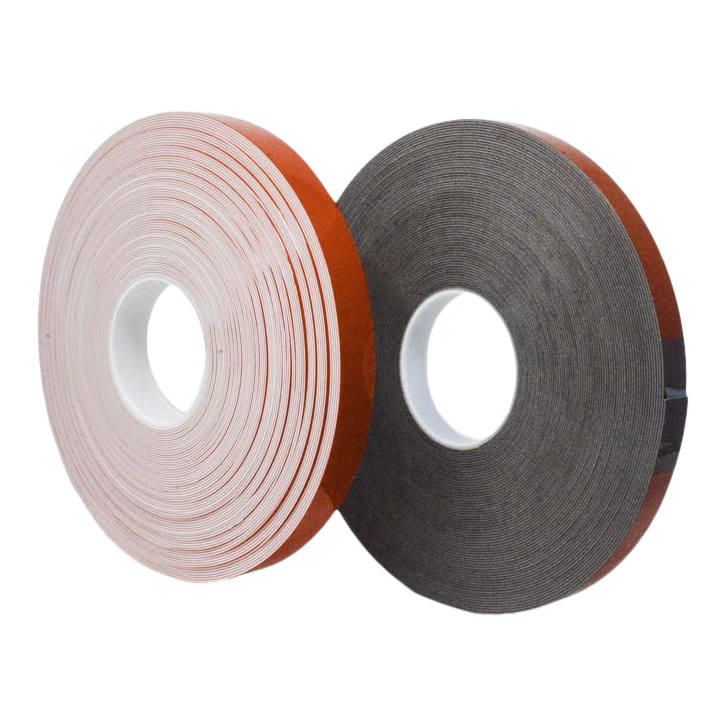
Chem-Set VST6120 High Bond Tape, 47 mil, Gray or White
SKU CCT-VST6120 Our Price Starting at $32.84 View ProductChem-Set VST6120 High Bond Tape, 47 mil, Gray or White
Gray or white 47 mil acrylic foam high bond tape in 36 yd rolls for PVC, ABS, metal, and glass. Cross-references to 3M VHB 4941. Sold by the roll.
Our Price Starting at $32.84 -

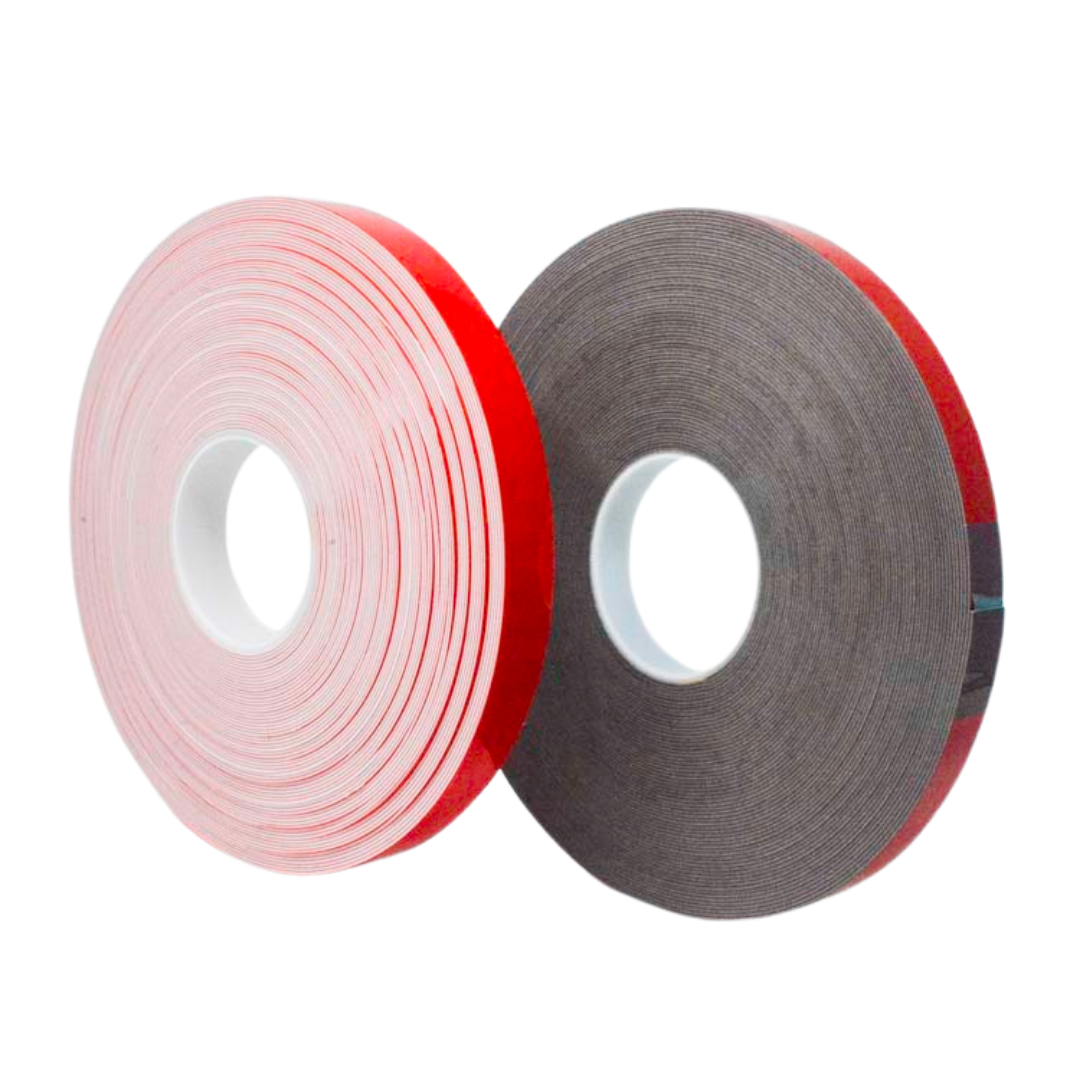
Chem-Set VST6364 General Purpose Acrylic Foam High Bond Tape, 25 mil, Gray or White
SKU CCT-VST6364W Our Price Starting at $34.59 View ProductChem-Set VST6364 General Purpose Acrylic Foam High Bond Tape, 25 mil, Gray or White
Gray or white 25 mil acrylic foam high bond tape in 36 yd rolls for PVC, ABS, metal, and glass. Cross-references to 3M VHB RP25. Sold by the roll.
Our Price Starting at $34.59 -

Chem-Set VST3025 Clear Ultra-Thin High Bond Tape, 10 mil
SKU CCT-VST3025C Our Price Starting at $66.73 View ProductChem-Set VST3025 Clear Ultra-Thin High Bond Tape, 10 mil
Clear 10 mil ultra-thin bonding tape in 60 yd rolls for die-cut parts, nameplates, and electronics. Cross-references to 3M 9473. Sold by the roll.
Our Price Starting at $66.73 -
Chem-Set VST6100C Clear Acrylic Foam High Bond Tape, 40 mil
SKU CCT-VST6100C Our Price Starting at $27.37 View ProductChem-Set VST6100C Clear Acrylic Foam High Bond Tape, 40 mil
Clear 40 mil acrylic foam high bond tape in 36 yd rolls for glass, acrylic, and polycarbonate. Cross-references to 3M VHB 4910. Sold by the roll.
Our Price Starting at $27.37 -
Chem-Set VST3050C Clear High Bond Tape (20 mil)
SKU CCT-VST3050C Our Price Starting at $17.30 View ProductChem-Set VST3050C Clear High Bond Tape (20 mil)
Clear 20 mil (0.020″) high bond tape in 108 ft (36 yd) rolls for glass and plastics. Strong, UV resistant, and ideal as a VHB 4905 alternative.
Our Price Starting at $17.30 -
Chem-Set VST6100C Clear High Bond Tape – 1/2 in x 108 ft (40 mil)
SKU CCT-VST6100C-1/2 Our Price Starting at $27.37
You save View ProductChem-Set VST6100C Clear High Bond Tape – 1/2 in x 108 ft (40 mil)
Clear 0.040″ (40 mil) high bond tape in 1/2 in x 108 ft roll. Ideal for narrow bonding applications requiring strength and clean appearance.
Our Price Starting at $27.37
You save -
Chem-Set VST6110 General Purpose Acrylic Foam High Bond Tape, 31 mil, Gray or White
SKU VST 6110 Our Price Starting at $36.54 View ProductChem-Set VST6110 General Purpose Acrylic Foam High Bond Tape, 31 mil, Gray or White
Gray or white 31 mil acrylic foam high bond tape in 36 yd rolls for PVC, ABS, metal, and glass. Cross-references to 3M VHB RP32. Sold by the roll.
Our Price Starting at $36.54 -
Chem-Set VST6160 High Bond Tape, 63 mil, Gray or White
SKU VST 6160 Our Price Starting at $35.93 View ProductChem-Set VST6160 High Bond Tape, 63 mil, Gray or White
Gray or white 63 mil acrylic foam high bond tape in 36 yd rolls for PVC, ABS, metal, and glass. Cross-references to 3M VHB 4956, RP62, and CV62.
Our Price Starting at $35.93
Featured Products
-
UltraLok® 9102 A/B Panel Bonding Epoxy
Ultralok 9102 epoxy adhesive is engineered for strong, reliable honeycomb and composite panel bonding with fire safety and thermal resistance.
Our Price Starting at $90.16 -
CarbonBar Versatile Flat Stock
Cut and drill like wood. Support like steel. Replace heavy, expensive custom metal fabrication with aerospace-grade carbon fiber structural blanks.
- 4X stronger & 5X lighter than steel.
- Customize on-site with standard carbide tools.
- 100% weatherproof and corrosion-proof.
↑ Select your Bar Length and Profile above ↑
Our Price Starting at $25.00 -
Chem-Set VST M1V38 Male High Bond Tape Fastener – M1-V38-1/4-20×1″
SKU CCH-M1V38-1/4-20X1P Our Price Starting at $1.80
You save View ProductChem-Set VST M1V38 Male High Bond Tape Fastener – M1-V38-1/4-20×1″
Our Price Starting at $1.80
You save


-
 Expert Support.
 -
 Same-Day Shipping.
 -
 50+ Years of Service
 Expert Support.
  Same-Day Shipping.
  50+ Years of Service
 Chemical-Concepts is a leading supplier of adhesives, chemicals and hardware for nearly every market in the industrial, government and defense sectors. Whatever your industry, we have all the hardware and adhesives you need to hold things together and keep things in place.