




Description
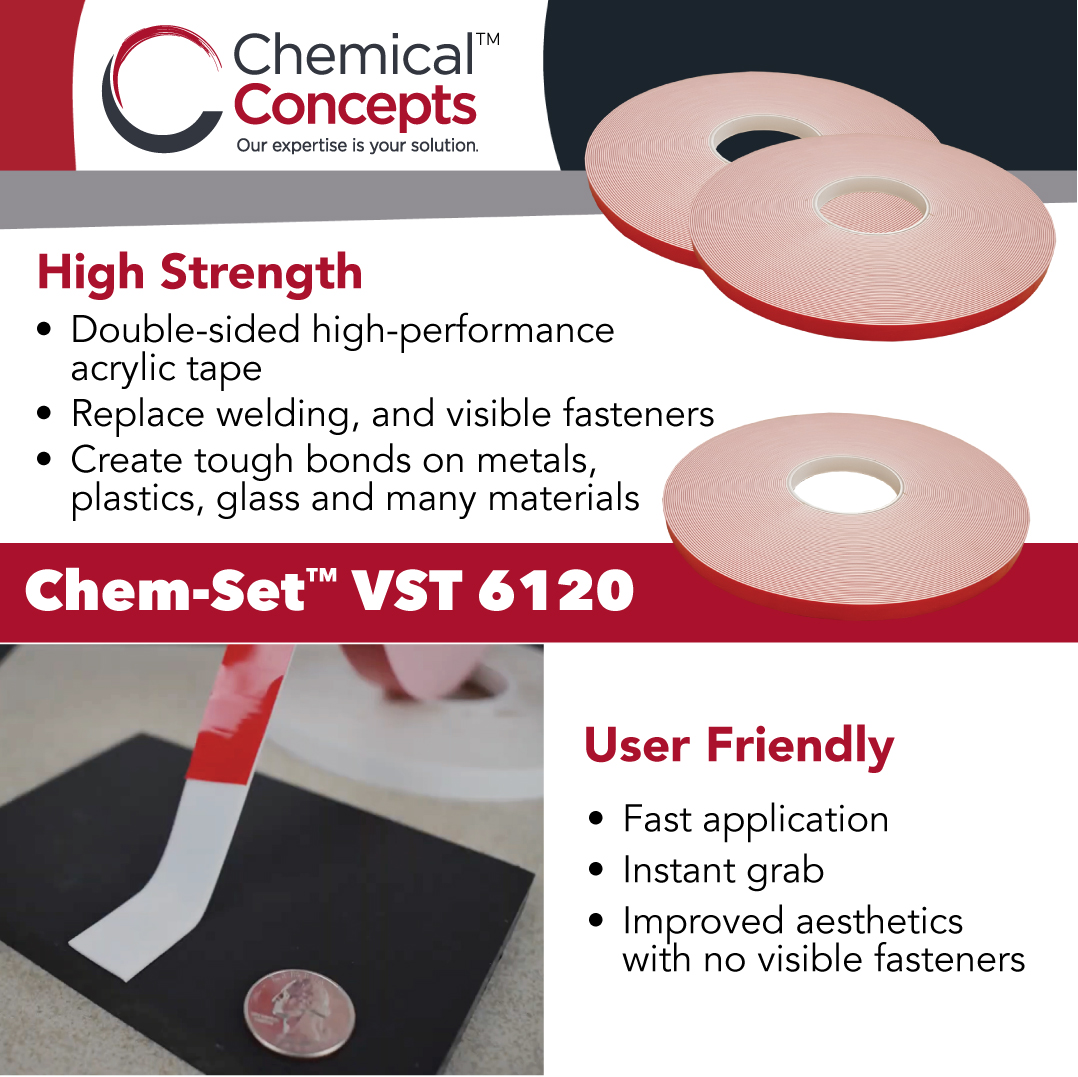
Chem-Set VST6120 is a 47 mil acrylic foam tape used as a 3M VHB 4941 alternative for bonding panels, trim, and assemblies without visible fasteners. It’s the all-rounder in the VST line, designed for high and medium surface energy materials including PVC, ABS, glass, steel, aluminum, and ceramic. High initial tack means it grabs on contact and the part keeps moving down the line, with no cure time, no mixing, and no dispensing equipment.
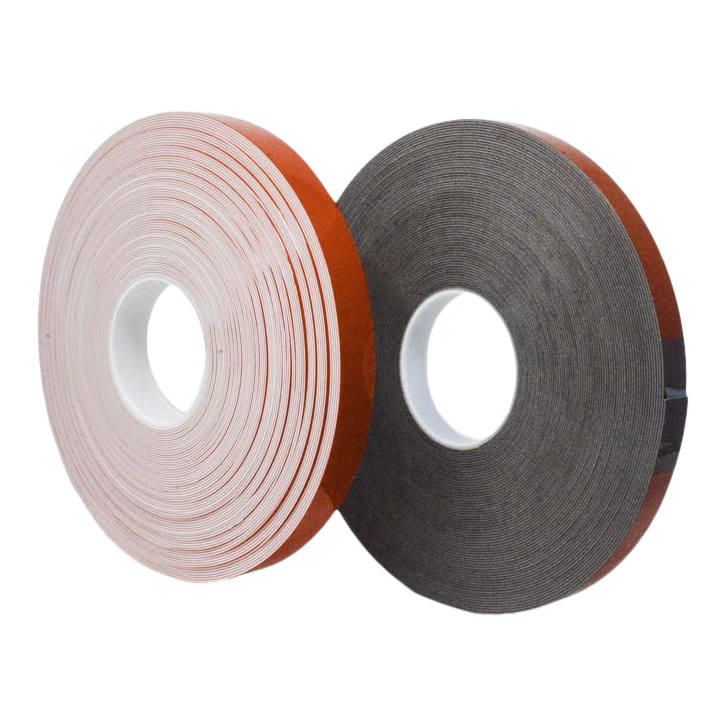
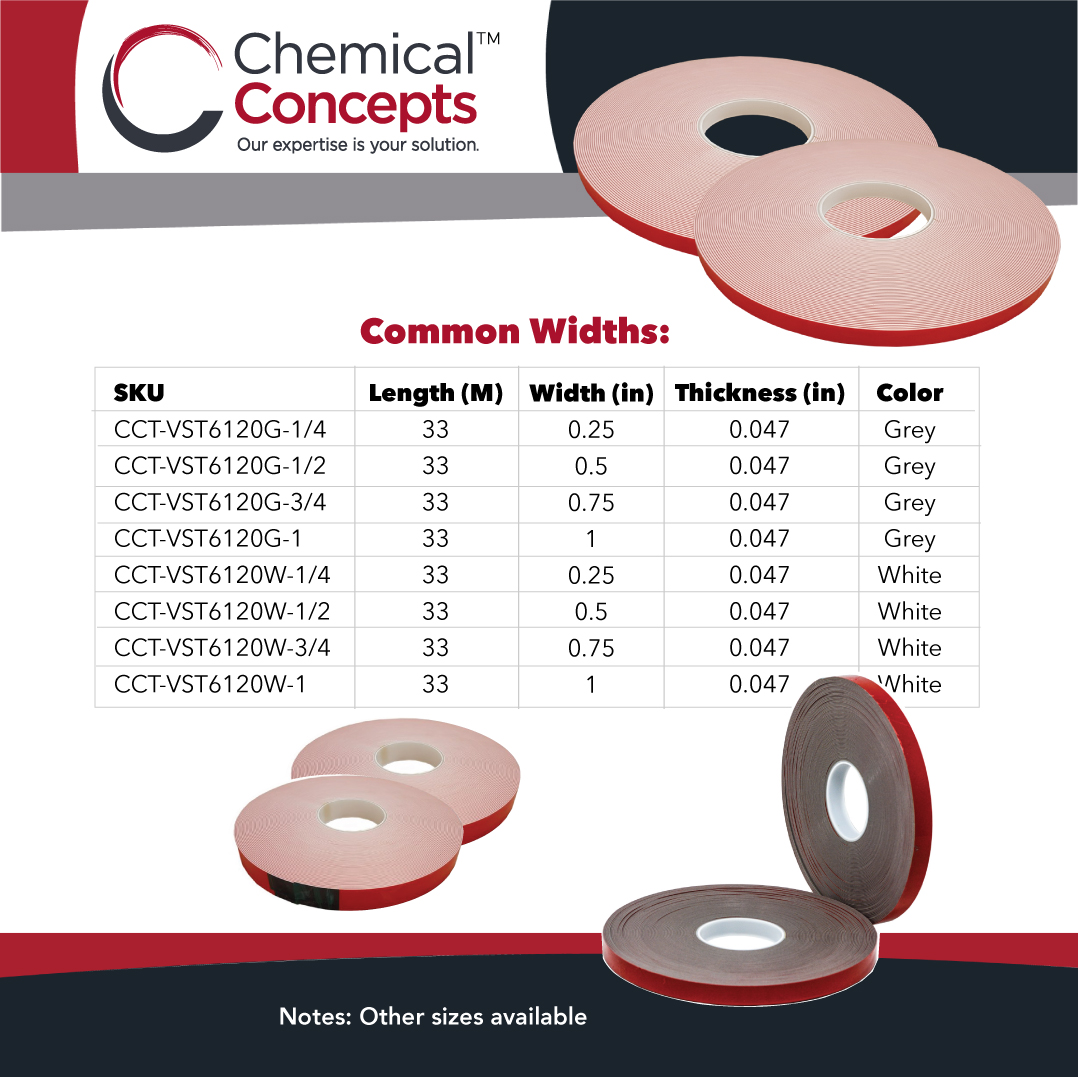
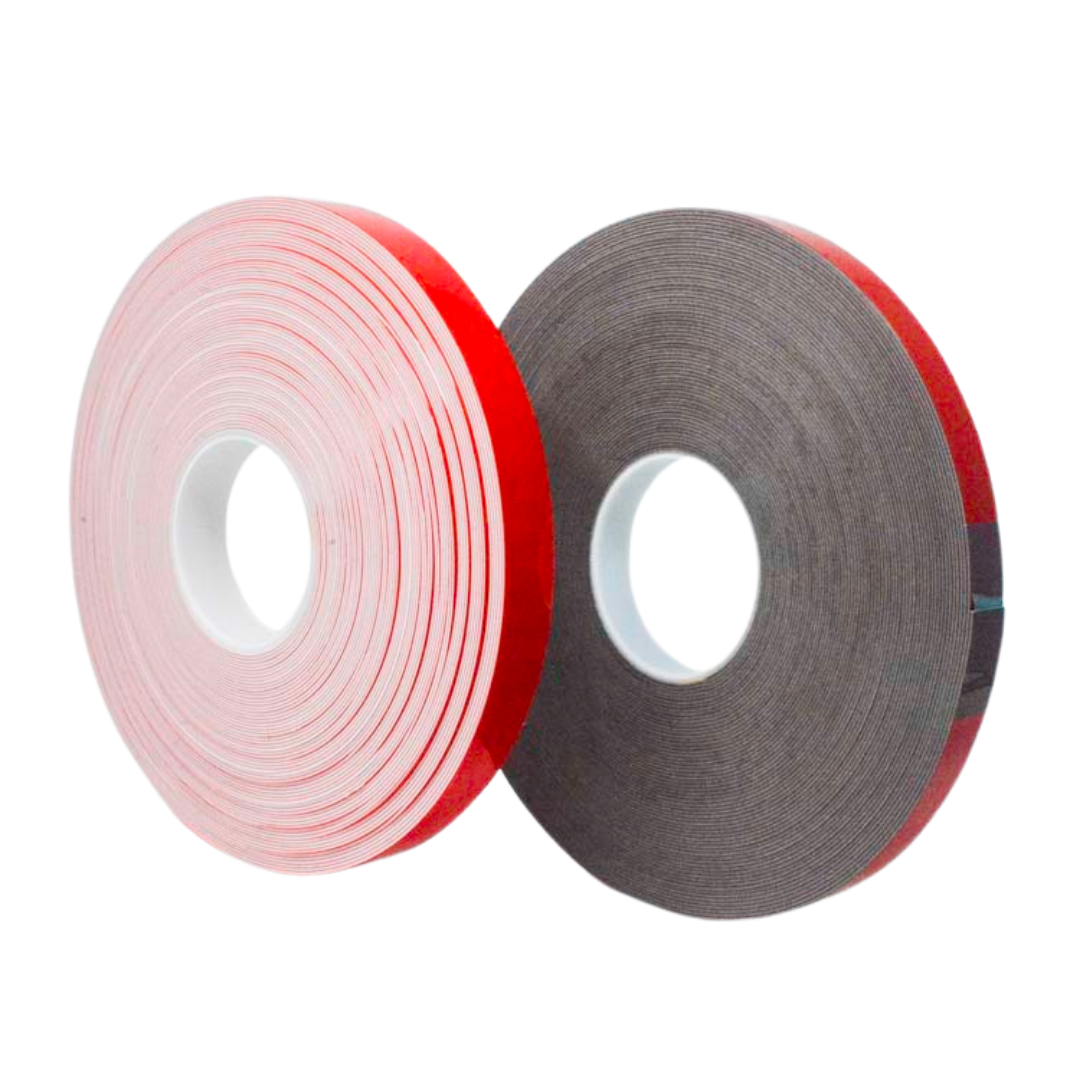
Available in gray and white. The conformable acrylic foam core absorbs the differential expansion between materials that grow and shrink at different rates, which is what makes it work for bonding aluminum to plastic or steel to composite across a temperature swing. Supplied in 1/2 in, 3/4 in, and 1 in widths on 36 yd rolls with a red PE liner. Sold by the individual roll with no case minimum, and PFAS and PFOS free per the manufacturer.
Key Product Details
Gray and white share the same construction and the same published performance values. Color is a selection choice, not a performance choice. A mil is one thousandth of an inch, so 47 mil is 0.047 in. Both notations turn up on prints and purchase orders.
| Property | Value |
|---|---|
| Chem-Set Part Numbers | VST6120G (gray), VST6120W (white) |
| Tape Type | General purpose double sided acrylic foam tape |
| Core | Conformable acrylic foam |
| Adhesive | Acrylic coating 40, both faces |
| Thickness | 0.047 in (1.2 mm / 47 mil), tolerance ±10% |
| Color | Gray or white |
| Liner | Red PE film. Siliconised paper liner available |
| Density | 52 lb/ft³ (840 kg/m³) |
| 90° Peel Adhesion | 23 lb/in (41 N/10mm), ASTM D3330 |
| Dynamic Shear Strength | 86 lb/in² (590 kPa), ASTM D1002 |
| Normal Tensile | 86 lb/in² (590 kPa), ASTM D897 |
| Static Shear Strength | Holds 1000 g at 72°F, 500 g at 150°F, 500 g at 200°F for more than 10,000 minutes (about 7 days) on 312 mm², ASTM D3654 |
| Service Temperature, Long Term | 212°F (100°C) |
| Service Temperature, Short Term | 320°F (160°C) |
| Minimum Service Temperature | -40°F (-40°C) |
| Minimum Application Temperature | 65°F (18°C) |
| Solvent Resistance | Excellent, per manufacturer |
| UV Resistance | Excellent, per manufacturer |
| Water Resistance | Excellent, per manufacturer |
| PFAS / PFOS | Free, per manufacturer |
| Standard Roll Length | 36 yd (33 m / 108 ft) |
| Core Diameter | 3 in (76.2 mm) |
| Shelf Life | 24 months from date of manufacture, red PE liner |
| Storage | 40 to 95°F (5 to 35°C), avoid condensing humidity |
| Country of Manufacture | South Korea |
What VST6120 Bonds To
VST6120 is designed for high and medium surface energy materials. On these substrates it bonds directly after cleaning, with no primer:
- PVC and ABS, the two the data sheet calls out specifically
- Glass, with or without silane coating
- Steel, including stainless, galvanized, and enameled
- Aluminum, including mill finish and anodized
- Polycarbonate and acrylic
- Ceramic
- PBT, glass/epoxy, and nickel coated ABS
- Composites and other high and medium surface energy plastics
Low surface energy plastics need a primer. Polypropylene, polyethylene, and similar low surface energy materials will not hold reliably on a clean-and-stick process. Prime them first with LORD 459X Adhesion Enhancer, which is made for TPE, TPO, and EPDM surfaces and is documented for use with double-sided tapes. If low surface energy plastic is your main substrate and you’d rather not add a priming step at all, the VST 78xx grades are formulated for it. Call us and we’ll tell you which route makes more sense for your part.
Painted and powder coated surfaces need a primer, and which primer depends on the coating. A coated panel is whatever the coating is as far as the adhesive is concerned, and paint chemistries land all over the surface energy range. Powder coat in particular sits at the low end. Call us with the coating system you’re running and we’ll work out the right prep or point you to a grade built for it.
Porous materials need to be sealed first. Wood, particleboard, concrete, and masonry do not present a unified surface for the adhesive to flow onto. Seal them before bonding, or use a different fastening method.
How Acrylic Foam Tape Bonding Works
Acrylic foam tape does not dry or cure. It builds strength as the adhesive flows into the microscopic texture of the surface, which means the bond you get is decided almost entirely by surface prep, pressure, and dwell time. The steps below are the ones that determine whether the joint holds.
- Get the conditions right. Bring the parts and the tape to at least 65°F before you apply. Below that the adhesive is too firm to flow, and no amount of pressure fixes it. Between 32°F and 65°F, use the VST low temperature grades instead.
- Clean the surface. Fingerprints and light oil come off with an isopropanol wipe. Grease and mold release need a stronger non-polar cleaner first. Use lint free tissue and wipe in one direction so contamination leaves the part instead of moving around on it. Surface test inks will tell you whether the cleaner you’re using is actually working, which matters more on production parts than most shops expect.
- Abrade or prime where the surface calls for it. Mill finish aluminum and stainless benefit from light abrasion followed by a solvent wipe. Low surface energy plastics, painted surfaces, and powder coat all need a primer or activator. Apply primer only where the tape lands and wipe the excess immediately.
- Lay the tape, then pull the liner. Apply the tape to one part first, position the assembly, then remove the red liner and mate the parts right away. Once the liner is off, the open face picks up airborne dust fast.
- Apply real pressure. Roll the joint in one direction at 10 to 50 N/cm, around 30 N/cm for most work, at about 24 in/min. Faster roller speeds need more pressure. Pressure is what pushes the adhesive into the surface, and a tape that is placed but not pressed reaches a fraction of its rated strength.
- Let the bond build. Handling strength is immediate thanks to the high initial tack. Full strength develops over about 24 hours at ambient temperature, and warmth speeds it up. Plan shipping and load bearing service around that window rather than loading the joint the same hour it was made.
Joint design matters as much as prep. Design the bond so load runs in shear or tension across the full tape area. Peel and cleavage loads concentrate stress on one edge and start a failure that walks across the joint. When you need more capacity, widen the tape rather than thickening it. Thickness is for conforming to the parts, width is for carrying the load.
Performance in Production
- 86 lb/in² dynamic shear means a 1 in wide strip across a 3 in bond gives roughly 258 lb of shear capacity before you apply a safety factor. Size the bond area off the load, not off the tape thickness.
- 23 lb/in 90° peel is higher than any of the thinner general purpose and clear VST grades, which helps on assemblies where a panel edge sees wind load or handling stress.
- The static shear numbers are the ones to design against for hanging loads. It holds 500 g at 200°F for a week, so a joint that carries weight continuously in a hot environment stays put rather than creeping.
- High initial tack grabs on contact, so panels hold position while you work instead of needing clamps or temporary fasteners.
- Rigid parts can’t flex to close a gap, so the tape has to. The 1.2 mm conformable core is what makes 47 mil the default for rigid panel work with normal flatness, rather than a step up from something thinner.
- Bonding rather than spot welding thin gauge material avoids heat distortion, burn-through, and the grinding and refinishing that follows a weld seam.
- The continuous bond line seals as it bonds and puts no dissimilar metal in contact, so there’s no galvanic corrosion path the way there is with a steel fastener through aluminum.
- 24 month shelf life at 40 to 95°F. Keep rolls out of a hot truck bay or an unconditioned mezzanine, and avoid conditions where condensation forms on the roll.
- Test on your own substrate in your own process before you run production. Published values come from lab panels, and surface finish, coating, and cleaning practice all move the result.
Common Applications
- Sign and display: sign cabinet and raceway assembly, PVC and ACM panel bonding, trim attachment, point of purchase displays and retail fixtures
- Trailer and specialty vehicle: body and side skirt panel bonding, interior ABS and PVC panels, rub rail and exterior trim attachment, badge and applique mounting
- Metal fabrication: steel and aluminum panel assembly, stiffener and hat channel bonding, replacing spot welds and rivets on thin gauge material where distortion or read-through is a problem
- Cladding and facade: ACM and rainscreen panel attachment to subframe, trim, closures, and reveal details
- PVC trim and millwork: bonding PVC trim, moldings, and fabricated components where the data sheet calls out PVC directly
- General manufacturing: appliance panels, enclosure and cabinet assembly, machine guarding, decorative trim
- Bonding dissimilar materials that expand and contract at different rates, where a rigid fastener would fatigue the joint
For load bearing structural glazing and metal cladding, the dedicated Chem-Set structural glazing and structural cladding grades are the right specification rather than a general purpose tape. Call and we’ll get you to the correct grade.
Working From a 3M Part Number
If you are specced into a 3M gray or white general purpose VHB™ grade and need another source, the closest Chem-Set matches are below. The cross reference is matched on construction, color, and thickness.
| Chem-Set Grade | Color | Thickness | Closest 3M Grade |
|---|---|---|---|
| VST6120G (this product) | Gray | 0.047 in (47 mil) | 3M VHB 4941, RP45 |
| VST6120W (this product) | White | 0.047 in (47 mil) | 3M VHB 4945 (now 4946) |
| VST6364G / VST6364W | Gray or white | 0.025 in (25 mil) | 3M VHB 4936, RP25 |
| VST6110G / VST6110W | Gray or white | 0.031 in (31 mil) | 3M VHB RP32 |
| VST6160G / VST6160W | Gray or white | 0.0625 in (62.5 mil) | 3M VHB 4956, RP62 |
A cross reference is a starting point for selection, not a statement that two products perform the same. The specifications above are ours, published from the current manufacturer data sheet. Read both data sheets and test the tape in your own joint before you commit a production process. Working from a 3M number that isn’t listed here? Call us, our full cross reference covers the low temperature, low surface energy, automotive, and structural grades as well.
Most shops calling us about a 47 mil general purpose tape are calling about how it’s sold, not how it performs. VST6120 is stocked here in Huntingdon Valley in both colors and all three widths. Buy one roll or a hundred, volume pricing kicks in when you need it, and in-stock orders placed by 2pm Eastern ship the same day.
Available Sizes and SKUs
| Size | Gray SKU | White SKU | Best For |
|---|---|---|---|
| 1/2 in x 36 yd | CCT-VST6120G-1/2 | CCT-VST6120W-1/2 | Narrow flanges and trim |
| 3/4 in x 36 yd | CCT-VST6120G-3/4 | CCT-VST6120W-3/4 | General panel and assembly work |
| 1 in x 36 yd | CCT-VST6120G-1 | CCT-VST6120W-1 | More bond area to carry the load |
Every size sells as a single roll with volume pricing at higher quantities. Custom slit widths from 4 mm up to 250 mm, longer 66 m rolls, and jumbo log rolls are available. Call for lead time.
Related Products
- LORD 459X Adhesion Enhancer for priming TPE, TPO, and EPDM before taping
- Chem-Set VST6364 High Bond Tape, 25 mil, Gray or White for thinner bond lines on flexible parts that can follow the joint on their own
- Chem-Set VST6100C Clear High Bond Tape, 40 mil when the bond line will be visible through glass or clear plastic
- Full Chem-Set VST tape line for the 31 mil and 62.5 mil general purpose grades, the low temperature grades for cold shop conditions, the low surface energy grades for polypropylene and polyethylene, and the complete cross reference chart
- Metal bonding adhesives if a structural two part adhesive is a better fit than tape for your joint
Frequently Asked Questions
What is Chem-Set VST6120 used for?
VST6120 is a 47 mil general purpose double sided acrylic foam tape used to bond panels, trim, and assemblies without visible fasteners. Typical work is sign cabinets and raceways, trailer body and interior panels, steel and aluminum panel assembly in metal fabrication, ACM and rainscreen cladding, PVC trim, and appliance and enclosure assembly. It replaces rivets, screws, spot welds, and liquid adhesive.
What is the difference between gray and white VST6120?
Only the color. Gray (VST6120G) and white (VST6120W) share the same construction, thickness, density, adhesive, and published performance values. Choose based on appearance at the joint: white for white or light colored panels where a gray line would show, gray for everything else. Both are stocked in all three widths. Note that this is specific to VST6120, other grades in the VST line do publish different values by color.
Does VST6120 bond polypropylene or polyethylene?
Only with a primer. VST6120 is formulated for high and medium surface energy materials such as PVC, ABS, glass, steel, aluminum, polycarbonate, and ceramic, and it bonds those directly after cleaning. Polypropylene, polyethylene, and similar low surface energy plastics need a primer or activator first. LORD 459X is what we usually recommend there. If low surface energy plastic is your primary substrate and you’d rather skip the priming step entirely, the VST 78xx low surface energy grades are built for it. Call us with your substrate and we’ll tell you which route fits your process.
Will VST6120 stick to painted or powder coated metal?
Not without prep, and the right prep depends on the coating. As far as the adhesive is concerned a coated panel is whatever the coating is, and paint chemistries run from high surface energy down to the low end, with powder coat sitting near the bottom. That means a primer or activator matched to your specific coating system rather than a general recommendation. Call us with the coating you’re running and we’ll work out the prep or point you to a grade built for it.
Can VST6120 replace 3M VHB 4941 or RP45?
VST6120G is the closest Chem-Set match to 3M VHB 4941 and RP45, and VST6120W is the closest match to 4945, which 3M now lists as 4946. All are general purpose acrylic foam tapes in 36 yd rolls on a 3 in core. It is not a 3M approved substitution and the two manufacturers do not publish identical test conditions, so the right answer for your assembly comes from testing it in your own joint. Call us for a sample roll.
Which VST thickness should I use?
Pick the thickness off how rigid your parts are and how much the joint has to move, then size the bond area off the load. Rigid parts with normal flatness want 0.045 in (45 mil) or more, which is why VST6120 at 0.047 in (47 mil) is the default for structural panel work rather than a step up from something thinner. Thinner grades suit flexible substrates that can follow the bond line on their own. The general purpose line runs 0.025 in (25 mil, VST6364), 0.031 in (31 mil, VST6110), 0.047 in (47 mil, VST6120), and 0.0625 in (62.5 mil, VST6160). Acrylic foam conforms to surface irregularity, but it will not flow to fill a gap, so a joint with a real gap in it needs a thicker grade or a different fastening method. When you need more capacity, widen the tape rather than thickening it.
Can I buy one roll, or do I have to buy a full case?
You can buy one roll. Every width and both colors are stocked and sold individually with volume pricing if you need more, and in-stock orders placed by 2pm Eastern ship the same day.
How cold can it be when I apply the tape, and how cold can the finished assembly get?
Apply at 65°F (18°C) or warmer. Below that the adhesive is too firm to flow into the surface and the bond will underperform no matter how much pressure you use. Between 32°F and 65°F, use the VST low temperature grades. Service temperature is a different question: once the bond is properly made, the assembly holds from -40°F up to 212°F continuous and 320°F short term.
Where is Chem-Set VST6120 made?
VST6120 is manufactured in South Korea and stocked at our warehouse in Huntingdon Valley, Pennsylvania. In-stock orders placed by 2pm Eastern ship the same day.
Questions on fit for your panel bonding or assembly application, or working from a 3M part number you can’t get? Call (800) 220-1966 or email [email protected].
3M and VHB are trademarks of 3M Company. Chemical Concepts is not affiliated with, authorized by, or endorsed by 3M. Third party part numbers are referenced for product identification and cross reference purposes only.



Reviews
There are no reviews yet.