
Permabond TA46XX Polyolefin Bonding Adhesives
|
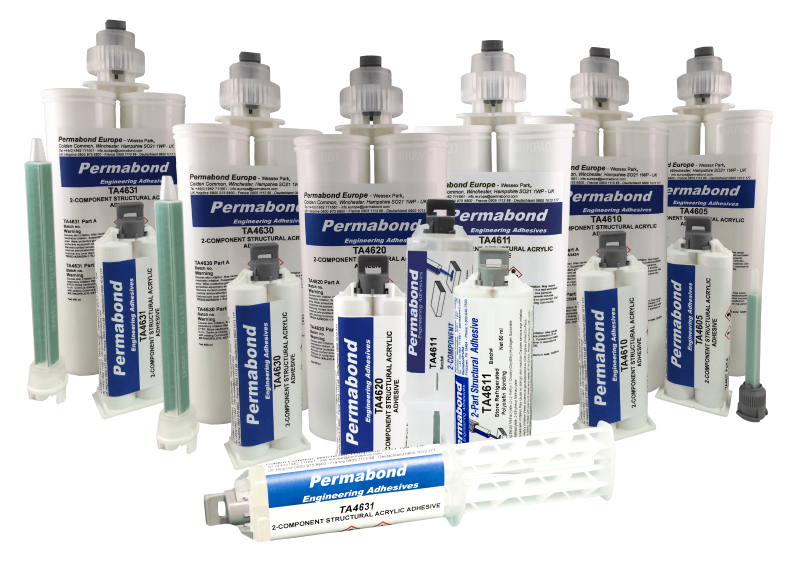
Adhesives for HDPE, Polypropylene, UHMW & PTFEBonding slick, waxy low surface energy plastics has historically meant flame, corona or plasma pre-treatment. The Permabond TA4600 series removes that step. Four grades bond untreated polypropylene, polyethylene (HDPE, LDPE, UHMW) and PTFE with no primer and no surface treatment, and they bond those plastics to steel, aluminium and composites. Pick your grade below. All four are stocked, there is no order minimum, and every cartridge ships with a static mixer. No primer required1:1 mix ratioRoom temperature cureSolvent freeNo order minimum |
+TA4605 — Fastest fixture, 5 to 10 minutes
The speed grade. Fixtures in 5 to 10 minutes and fully cures in 24 hours, the fastest in the series. Contains microparticles for a controlled bond line up to 1 mm. Choose it when throughput matters and the joint has a measurable gap. Note that the TA4605 data sheet publishes no steel figures, so for plastic-to-steel joints look at TA4611 or TA4631.
- Fixture 5 to 10 min, handling 20 to 25 min, full cure 24 hours
- Mixed viscosity 125,000 cP, thixotropic, holds position on vertical joints
- Maximum gap 1 mm (0.04 in), contains microparticles
- HDPE 15 N/mm² (2175 psi), the highest in the series alongside TA4610
- Also available in 20 kg bulk for meter-mix equipment
Buy: 50ml | 400ml | 20 kg Part A | 20 kg Part B | Full TA4605 specs
+TA4610 — Large components and underwater bonding
The large-assembly grade. Fixture at 12 to 15 minutes with handling strength at 40 to 50 minutes gives an operator time to position and clamp an awkward part before the joint locks. Heaviest in the series at 210,000 cP mixed, so the bead holds on vertical and overhead work. Also bonds underwater with published water resistance, which TA4605 does not claim.
- Fixture 12 to 15 min, handling 40 to 50 min, full cure 48 hours
- Mixed viscosity 210,000 cP, thixotropic
- Maximum gap 1 mm (0.04 in), contains microparticles
- HDPE 15 N/mm² (2175 psi), PTFE to mild steel 2 N/mm² with substrate failure
- Bonds underwater. Documented on PTFE to stainless steel in marine service
Buy: 50ml | 400ml | Full TA4610 specs
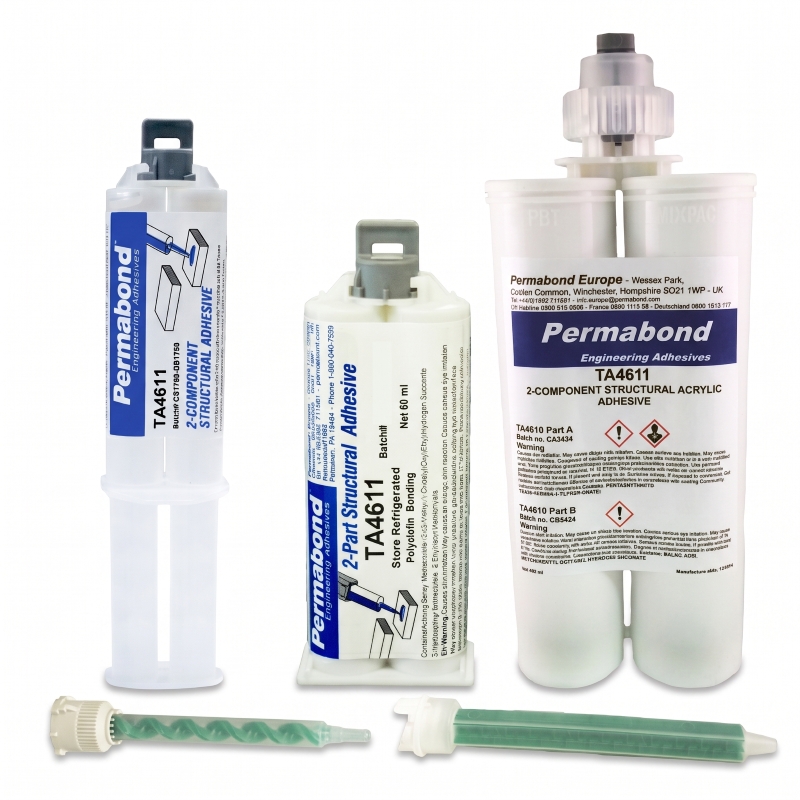
+TA4611 — Tight-fitting joints and steel bonding
No micro beads, so nothing holds the joint open and parts seat as designed. That drops maximum gap to 0.5 mm, which is the tradeoff. At 21,500 cP mixed it flows freely and is easy on the hand through a manual gun, though it will run on overhead work. TA4611 publishes 11 N/mm² on mild steel and 9 N/mm² on stainless, the highest stainless figure in the series.
- Fixture 10 to 16 min, handling 40 to 50 min, full cure 24 to 36 hours
- Mixed viscosity 21,500 cP
- Maximum gap 0.5 mm (0.02 in), no micro beads
- Mild steel 11 N/mm² (1595 psi), stainless steel 9 N/mm² (1305 psi)
- Carbon fibre 14 N/mm² (2030 psi), epoxy FRP 13 N/mm² (1885 psi)
- 25ml hand syringe available, no dispensing gun required
Buy: 25ml | 50ml | 400ml | Full TA4611 specs
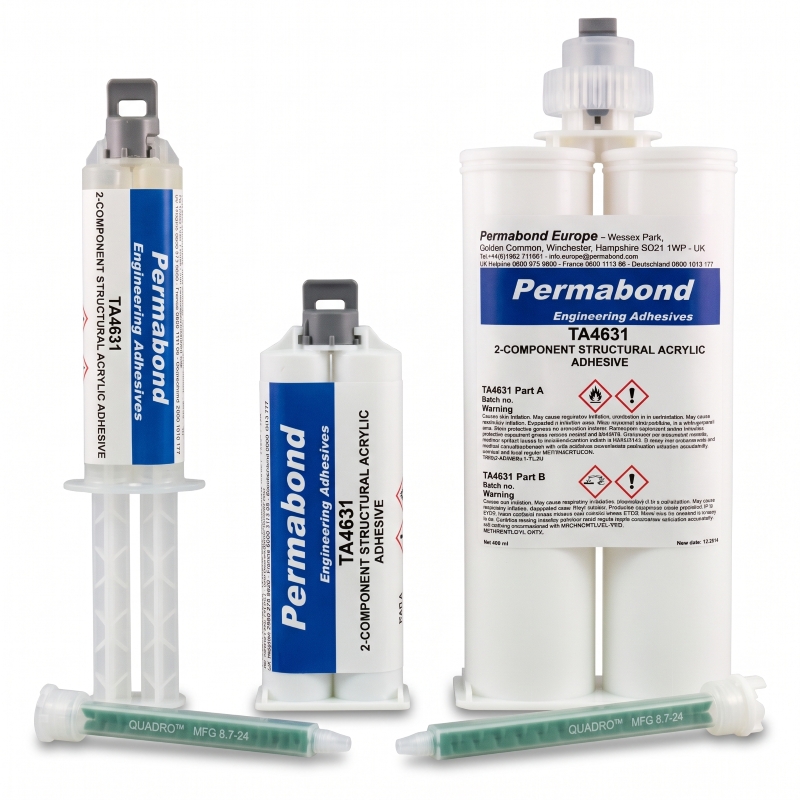
+TA4631 — No perceptible odor, strongest on mild steel
The odor grade. Permabond reports no perceptible odor detected by testing panel members, which is the answer for enclosed cells, indoor assembly, and any line where operators have pushed back on methacrylate smell. Like TA4611 it skips the micro beads. It also publishes the strongest mild steel figure in the series at 14 N/mm², bonds underwater, and is the only grade with published data on acetal, PET and PEEK.
- Fixture 12 to 18 min, handling 40 to 50 min, full cure 24 to 36 hours
- Mixed viscosity 21,500 cP
- Maximum gap 0.5 mm (0.02 in), no micro beads
- Mild steel 14 N/mm² (2030 psi), carbon fibre 14 N/mm² (2030 psi)
- Acetal 5 N/mm², PEEK 7 N/mm², PET-P 4 N/mm², published only on this grade
- Bonds underwater. 25ml hand syringe available, no gun required
Buy: 25ml | 50ml | 400ml | Full TA4631 specs
+Side by Side Comparison
Cure Times, Viscosity and Sizes
| Grade | Fixture | Full Cure | Viscosity | Max Gap | Sizes |
|---|---|---|---|---|---|
| TA4605 | 5 to 10 min | 24 hr | 125,000 cP | 1 mm | 50ml, 400ml, bulk |
| TA4610 | 12 to 15 min | 48 hr | 210,000 cP | 1 mm | 50ml, 400ml |
| TA4611 | 10 to 16 min | 24 to 36 hr | 21,500 cP | 0.5 mm | 25ml, 50ml, 400ml |
| TA4631 | 12 to 18 min | 24 to 36 hr | 21,500 cP | 0.5 mm | 25ml, 50ml, 400ml |
Shear Strength by Substrate
| Grade | Polypropylene | HDPE | Mild Steel | Stainless | PTFE |
|---|---|---|---|---|---|
| TA4605 | >1200 psi* | 2175 psi | Not published | Not published | 220 psi |
| TA4610 | 1200 psi* | 2175 psi | Not published | 725 psi | 290 psi* |
| TA4611 | >1160 psi* | 1160 psi | 1595 psi | 1305 psi | >290 psi* |
| TA4631 | >1160 psi* | 1160 psi | 2030 psi | 870 psi | >290 psi* |
All grades are 1:1 mix ratio, cure at room temperature, are solvent free and non-hazardous for transport, and serve from -55°C to +100°C. An asterisk indicates the substrate failed before the bond line. Values are guideline figures from current Permabond data sheets, not a specification.
+What You Need to Dispense It
Every cartridge ships with one static mixer. Order spares separately, since adhesive cures inside the mixer and each dispensing stop needs a fresh nozzle. Ordering the wrong mixer is the most common reason a first trial fails.
| Package | Static Mixer | Dispensing Gun |
|---|---|---|
| 25ml (TA4611, TA4631) | MBQ 05-16L | None. Hand syringe format |
| 50ml (all grades) | MBQ 05-16L | Chem-Set PAK-50 with 1:1 / 2:1 plunger |
| 400ml (all grades) | MFQ 08-24T | Albion B26T400 manual, or DP2X 400 pneumatic |
| 20 kg bulk (TA4605) | Meter-mix equipment | Automated dispensing. Call for specification |
The 25ml is the simplest way to run a first trial. It needs no gun at all, so you can order one cartridge and be bonding the same day.
+What These Adhesives Bond
The TA4600 series was built for polyolefins, but its range is wider than most buyers expect.
- Low surface energy plastics: polypropylene, polyethylene, HDPE, LDPE, UHMW, PTFE
- Engineering plastics: nylon, PMMA, EVA, TPO, PBT, polyurethane, ABS, PVC, polycarbonate, and on TA4631 acetal, PET-G, PET-P and PEEK
- Metals: mild steel, stainless steel, aluminium, e-coated metals
- Composites: carbon fibre, epoxy FRP, polyester GRP
- Rubbers: EPDM, nitrile, neoprene and butyl. Not silicone
- Other: wood and concrete
EPDM contains polypropylene, which is why the polyolefin chemistry works on it. Silicone rubber is the one material this range will not bond.
+Surface Preparation and How to Apply
- Surfaces must be clean, dry and grease-free. That is the whole prep on the plastic side.
- Molded polyolefin parts often carry residual mold release. Wipe with isopropanol and let it fully evaporate before bonding.
- On metals, aluminium and copper alloys benefit from light abrasion with emery cloth to remove the oxide layer.
- No primer, flame, corona or plasma treatment is needed on the polyolefin. That is the point of this range.
Applying it
- Apply a thin bead pre-mixed through the static mixer nozzle.
- Assemble and clamp.
- Hold pressure until handling strength is reached. Time varies with joint design and substrates.
- Allow the grade’s full cure time before applying full design load.
- Adhesive squeezed outside a closed joint cures more slowly and may feel soft from air contact. Material inside the joint cures solid.
+Why HDPE and Polypropylene Are So Hard to Bond
HDPE, polypropylene and PTFE have extremely low surface energy. Their slick, chemically resistant surfaces make it nearly impossible for a standard adhesive to wet out. Poor wetting means the adhesive sits on top of the plastic instead of biting into it, and the joint fails easily.
The traditional fix is to raise the plastic’s surface energy artificially with flame, corona or plasma treatment, or with a primer. All of that costs equipment, floor space and process time. The TA4600 series chemistry wets out and grips untreated polyolefin directly, which is why the plastic often tears before the bond does.
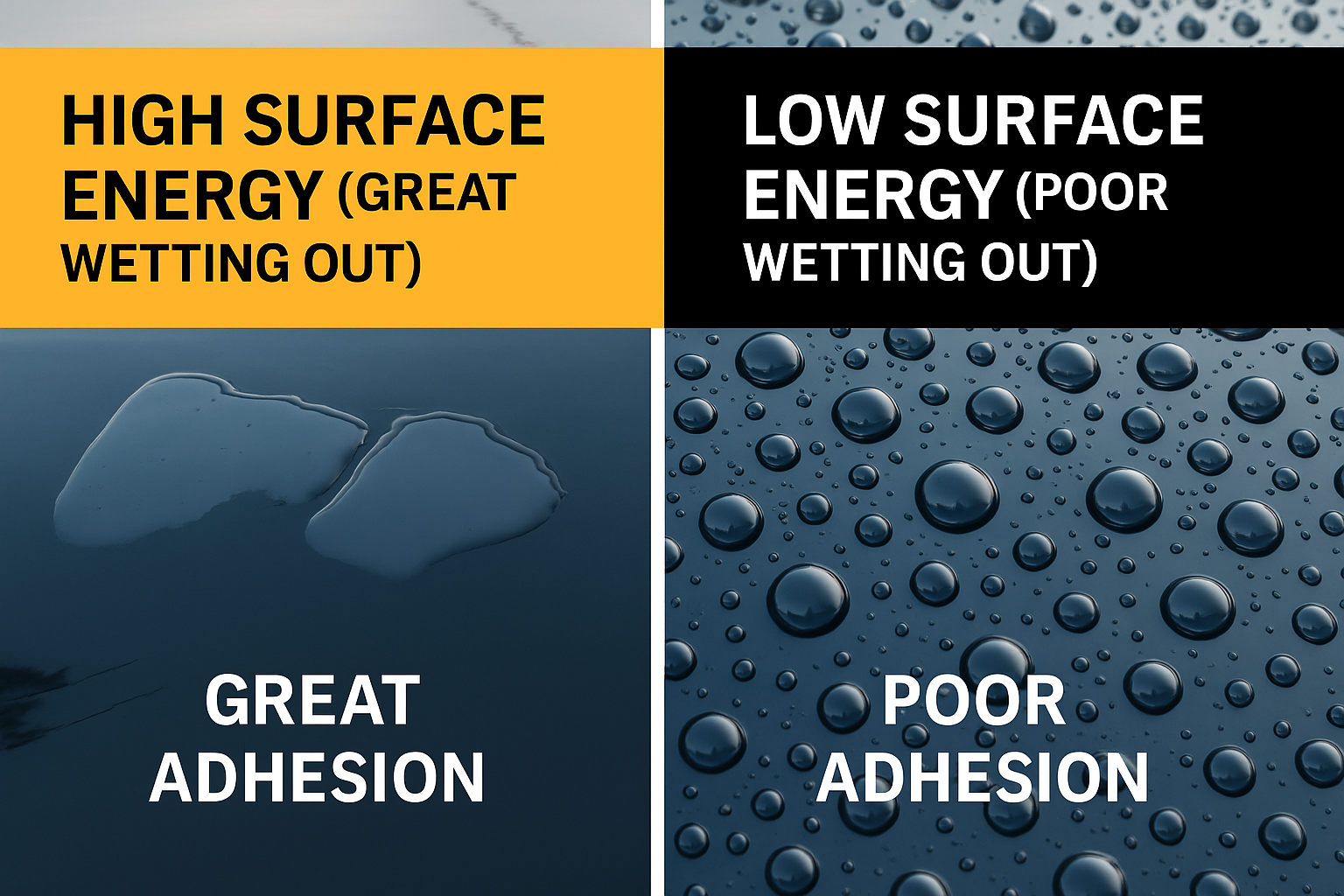
Left: high surface energy, good wetting. Right: low surface energy, poor wetting.
+Polyolefin Bonding FAQ
Do I really not need to flame or plasma treat first?
Correct. No primer or pre-treatment on the polyolefin. Surfaces still need to be clean, dry and grease-free, and molded parts should get an IPA wipe to remove mold release.
Which grade should I start with?
If the joint has a gap and you want speed, TA4605. Large or awkward assembly, TA4610. Parts that seat tight, TA4611. Odor in the work area or water exposure, TA4631. If you are unsure, the 25ml TA4611 or TA4631 syringe is the cheapest way to find out, since it needs no gun.
What does no micro beads actually change?
TA4605 and TA4610 contain microparticles that hold a minimum bond line around 1 mm. Useful for a controlled gap, a problem when parts are meant to seat tight. TA4611 and TA4631 have none, so parts close as designed, and maximum gap drops to 0.5 mm as a result.
Which grade is strongest on metal?
TA4631 at 2030 psi on mild steel, the highest published figure in the series. TA4611 leads on stainless at 1305 psi. TA4605 publishes no steel values at all.
Can any of these bond underwater?
TA4610 and TA4631 both list underwater bonding and water resistance as published features. TA4605 and TA4611 do not.
Will they bond PTFE?
Yes, though PTFE is non-stick by design so the figures are modest. TA4610, TA4611 and TA4631 all publish 290 psi or better with substrate failure observed. TA4605 is lowest at 220 psi.
Is there an order minimum?
No. Order a single cartridge for a trial or full cases for production, whatever the job needs.
+Resources
|
Not sure which grade fits your joint? Tell us the plastics, whether you are bonding to steel or aluminium, how much gap the joint has, and how fast you need to fixture. We will tell you which grade to run and what mixer and gun you need with it. Email technical sales or call 800-220-1966 |
|
|
Adhesives for HDPE, Polypropylene, UHMW & PTFEBonding slick, waxy low surface energy plastics has historically meant flame, corona or plasma pre-treatment. The Permabond TA4600 series removes that step. Four grades bond untreated polypropylene, polyethylene (HDPE, LDPE, UHMW) and PTFE with no primer and no surface treatment, and they bond those plastics to steel, aluminium and composites. Pick your grade below. All four are stocked, there is no order minimum, and every cartridge ships with a static mixer. No primer required1:1 mix ratioRoom temperature cureSolvent freeNo order minimum |
+TA4605 — Fastest fixture, 5 to 10 minutes
The speed grade. Fixtures in 5 to 10 minutes and fully cures in 24 hours, the fastest in the series. Contains microparticles for a controlled bond line up to 1 mm. Choose it when throughput matters and the joint has a measurable gap. Note that the TA4605 data sheet publishes no steel figures, so for plastic-to-steel joints look at TA4611 or TA4631.
- Fixture 5 to 10 min, handling 20 to 25 min, full cure 24 hours
- Mixed viscosity 125,000 cP, thixotropic, holds position on vertical joints
- Maximum gap 1 mm (0.04 in), contains microparticles
- HDPE 15 N/mm² (2175 psi), the highest in the series alongside TA4610
- Also available in 20 kg bulk for meter-mix equipment
Buy: 50ml | 400ml | 20 kg Part A | 20 kg Part B | Full TA4605 specs
+TA4610 — Large components and underwater bonding
The large-assembly grade. Fixture at 12 to 15 minutes with handling strength at 40 to 50 minutes gives an operator time to position and clamp an awkward part before the joint locks. Heaviest in the series at 210,000 cP mixed, so the bead holds on vertical and overhead work. Also bonds underwater with published water resistance, which TA4605 does not claim.
- Fixture 12 to 15 min, handling 40 to 50 min, full cure 48 hours
- Mixed viscosity 210,000 cP, thixotropic
- Maximum gap 1 mm (0.04 in), contains microparticles
- HDPE 15 N/mm² (2175 psi), PTFE to mild steel 2 N/mm² with substrate failure
- Bonds underwater. Documented on PTFE to stainless steel in marine service
Buy: 50ml | 400ml | Full TA4610 specs
+TA4611 — Tight-fitting joints and steel bonding
No micro beads, so nothing holds the joint open and parts seat as designed. That drops maximum gap to 0.5 mm, which is the tradeoff. At 21,500 cP mixed it flows freely and is easy on the hand through a manual gun, though it will run on overhead work. TA4611 publishes 11 N/mm² on mild steel and 9 N/mm² on stainless, the highest stainless figure in the series.
- Fixture 10 to 16 min, handling 40 to 50 min, full cure 24 to 36 hours
- Mixed viscosity 21,500 cP
- Maximum gap 0.5 mm (0.02 in), no micro beads
- Mild steel 11 N/mm² (1595 psi), stainless steel 9 N/mm² (1305 psi)
- Carbon fibre 14 N/mm² (2030 psi), epoxy FRP 13 N/mm² (1885 psi)
- 25ml hand syringe available, no dispensing gun required
Buy: 25ml | 50ml | 400ml | Full TA4611 specs
+TA4631 — No perceptible odor, strongest on mild steel
The odor grade. Permabond reports no perceptible odor detected by testing panel members, which is the answer for enclosed cells, indoor assembly, and any line where operators have pushed back on methacrylate smell. Like TA4611 it skips the micro beads. It also publishes the strongest mild steel figure in the series at 14 N/mm², bonds underwater, and is the only grade with published data on acetal, PET and PEEK.
- Fixture 12 to 18 min, handling 40 to 50 min, full cure 24 to 36 hours
- Mixed viscosity 21,500 cP
- Maximum gap 0.5 mm (0.02 in), no micro beads
- Mild steel 14 N/mm² (2030 psi), carbon fibre 14 N/mm² (2030 psi)
- Acetal 5 N/mm², PEEK 7 N/mm², PET-P 4 N/mm², published only on this grade
- Bonds underwater. 25ml hand syringe available, no gun required
Buy: 25ml | 50ml | 400ml | Full TA4631 specs
+Side by Side Comparison
Cure Times, Viscosity and Sizes
| Grade | Fixture | Full Cure | Viscosity | Max Gap | Sizes |
|---|---|---|---|---|---|
| TA4605 | 5 to 10 min | 24 hr | 125,000 cP | 1 mm | 50ml, 400ml, bulk |
| TA4610 | 12 to 15 min | 48 hr | 210,000 cP | 1 mm | 50ml, 400ml |
| TA4611 | 10 to 16 min | 24 to 36 hr | 21,500 cP | 0.5 mm | 25ml, 50ml, 400ml |
| TA4631 | 12 to 18 min | 24 to 36 hr | 21,500 cP | 0.5 mm | 25ml, 50ml, 400ml |
Shear Strength by Substrate
| Grade | Polypropylene | HDPE | Mild Steel | Stainless | PTFE |
|---|---|---|---|---|---|
| TA4605 | >1200 psi* | 2175 psi | Not published | Not published | 220 psi |
| TA4610 | 1200 psi* | 2175 psi | Not published | 725 psi | 290 psi* |
| TA4611 | >1160 psi* | 1160 psi | 1595 psi | 1305 psi | >290 psi* |
| TA4631 | >1160 psi* | 1160 psi | 2030 psi | 870 psi | >290 psi* |
All grades are 1:1 mix ratio, cure at room temperature, are solvent free and non-hazardous for transport, and serve from -55°C to +100°C. An asterisk indicates the substrate failed before the bond line. Values are guideline figures from current Permabond data sheets, not a specification.
+What You Need to Dispense It
Every cartridge ships with one static mixer. Order spares separately, since adhesive cures inside the mixer and each dispensing stop needs a fresh nozzle. Ordering the wrong mixer is the most common reason a first trial fails.
| Package | Static Mixer | Dispensing Gun |
|---|---|---|
| 25ml (TA4611, TA4631) | MBQ 05-16L | None. Hand syringe format |
| 50ml (all grades) | MBQ 05-16L | Chem-Set PAK-50 with 1:1 / 2:1 plunger |
| 400ml (all grades) | MFQ 08-24T | Albion B26T400 manual, or DP2X 400 pneumatic |
| 20 kg bulk (TA4605) | Meter-mix equipment | Automated dispensing. Call for specification |
The 25ml is the simplest way to run a first trial. It needs no gun at all, so you can order one cartridge and be bonding the same day.
+What These Adhesives Bond
The TA4600 series was built for polyolefins, but its range is wider than most buyers expect.
- Low surface energy plastics: polypropylene, polyethylene, HDPE, LDPE, UHMW, PTFE
- Engineering plastics: nylon, PMMA, EVA, TPO, PBT, polyurethane, ABS, PVC, polycarbonate, and on TA4631 acetal, PET-G, PET-P and PEEK
- Metals: mild steel, stainless steel, aluminium, e-coated metals
- Composites: carbon fibre, epoxy FRP, polyester GRP
- Rubbers: EPDM, nitrile, neoprene and butyl. Not silicone
- Other: wood and concrete
EPDM contains polypropylene, which is why the polyolefin chemistry works on it. Silicone rubber is the one material this range will not bond.
+Surface Preparation and How to Apply
- Surfaces must be clean, dry and grease-free. That is the whole prep on the plastic side.
- Molded polyolefin parts often carry residual mold release. Wipe with isopropanol and let it fully evaporate before bonding.
- On metals, aluminium and copper alloys benefit from light abrasion with emery cloth to remove the oxide layer.
- No primer, flame, corona or plasma treatment is needed on the polyolefin. That is the point of this range.
Applying it
- Apply a thin bead pre-mixed through the static mixer nozzle.
- Assemble and clamp.
- Hold pressure until handling strength is reached. Time varies with joint design and substrates.
- Allow the grade’s full cure time before applying full design load.
- Adhesive squeezed outside a closed joint cures more slowly and may feel soft from air contact. Material inside the joint cures solid.
+Why HDPE and Polypropylene Are So Hard to Bond
HDPE, polypropylene and PTFE have extremely low surface energy. Their slick, chemically resistant surfaces make it nearly impossible for a standard adhesive to wet out. Poor wetting means the adhesive sits on top of the plastic instead of biting into it, and the joint fails easily.
The traditional fix is to raise the plastic’s surface energy artificially with flame, corona or plasma treatment, or with a primer. All of that costs equipment, floor space and process time. The TA4600 series chemistry wets out and grips untreated polyolefin directly, which is why the plastic often tears before the bond does.
Left: high surface energy, good wetting. Right: low surface energy, poor wetting.
+Polyolefin Bonding FAQ
Do I really not need to flame or plasma treat first?
Correct. No primer or pre-treatment on the polyolefin. Surfaces still need to be clean, dry and grease-free, and molded parts should get an IPA wipe to remove mold release.
Which grade should I start with?
If the joint has a gap and you want speed, TA4605. Large or awkward assembly, TA4610. Parts that seat tight, TA4611. Odor in the work area or water exposure, TA4631. If you are unsure, the 25ml TA4611 or TA4631 syringe is the cheapest way to find out, since it needs no gun.
What does no micro beads actually change?
TA4605 and TA4610 contain microparticles that hold a minimum bond line around 1 mm. Useful for a controlled gap, a problem when parts are meant to seat tight. TA4611 and TA4631 have none, so parts close as designed, and maximum gap drops to 0.5 mm as a result.
Which grade is strongest on metal?
TA4631 at 2030 psi on mild steel, the highest published figure in the series. TA4611 leads on stainless at 1305 psi. TA4605 publishes no steel values at all.
Can any of these bond underwater?
TA4610 and TA4631 both list underwater bonding and water resistance as published features. TA4605 and TA4611 do not.
Will they bond PTFE?
Yes, though PTFE is non-stick by design so the figures are modest. TA4610, TA4611 and TA4631 all publish 290 psi or better with substrate failure observed. TA4605 is lowest at 220 psi.
Is there an order minimum?
No. Order a single cartridge for a trial or full cases for production, whatever the job needs.
+Resources
|
Not sure which grade fits your joint? Tell us the plastics, whether you are bonding to steel or aluminium, how much gap the joint has, and how fast you need to fixture. We will tell you which grade to run and what mixer and gun you need with it. Email technical sales or call 800-220-1966 |
Showing all 4 results
-

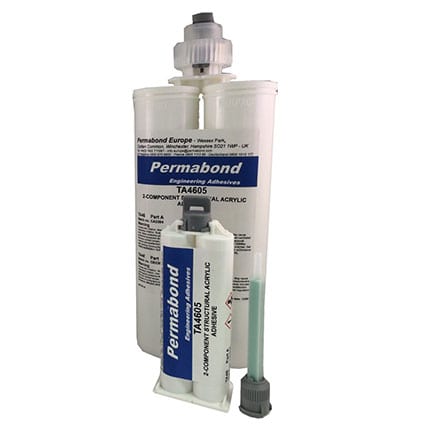
Permabond TA4605 Polypropylene & HDPE Structural Acrylic Adhesive
SKU PERTA04605 Our Price Starting at $59.85 View ProductPermabond TA4605 Polypropylene & HDPE Structural Acrylic Adhesive
Fast-set two-part acrylic that bonds untreated polypropylene, HDPE, PE, PTFE and EPDM with no primer or surface treatment. Fixtures in 5 to 10 minutes.
Our Price Starting at $59.85 -
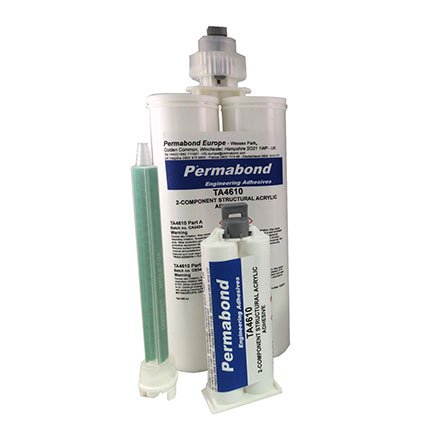
Permabond TA4610 HDPE & Polyolefin Structural Acrylic Adhesive
SKU PERTA04610 Our Price Starting at $57.07 View ProductPermabond TA4610 HDPE & Polyolefin Structural Acrylic Adhesive
Two-part acrylic that bonds untreated HDPE, polypropylene, PE and PTFE with no primer. Longer open time for large assemblies, and bonds underwater.
Our Price Starting at $57.07 -

Permabond TA4611 Polypropylene & HDPE Structural Acrylic Adhesive
SKU PERTA04611 Our Price Starting at $39.98 View ProductPermabond TA4611 Polypropylene & HDPE Structural Acrylic Adhesive
Two-part acrylic that bonds untreated polypropylene, HDPE, PE and PTFE with no primer. No microbeads, so it suits tight-fitting parts and thin bond lines.
Our Price Starting at $39.98 -
Permabond TA4631 Low Odor Polyolefin Structural Acrylic Adhesive
SKU PERTA04631 Our Price Starting at $41.17 View ProductPermabond TA4631 Low Odor Polyolefin Structural Acrylic Adhesive
Two-part acrylic with no perceptible odor that bonds untreated polypropylene, HDPE, PE and PTFE. Bonds underwater, and the strongest metal figures in the series.
Our Price Starting at $41.17
Featured Products
-
UltraLok® 9102 A/B Panel Bonding Epoxy
Ultralok 9102 epoxy adhesive is engineered for strong, reliable honeycomb and composite panel bonding with fire safety and thermal resistance.
Our Price Starting at $90.16 -
CarbonBar Versatile Flat Stock
Cut and drill like wood. Support like steel. Replace heavy, expensive custom metal fabrication with aerospace-grade carbon fiber structural blanks.
- 4X stronger & 5X lighter than steel.
- Customize on-site with standard carbide tools.
- 100% weatherproof and corrosion-proof.
↑ Select your Bar Length and Profile above ↑
Our Price Starting at $25.00 -

Chem-Set VST M1V38 Male High Bond Tape Fastener – M1-V38-1/4-20×1″
SKU CCH-M1V38-1/4-20X1P Our Price Starting at $1.78
You save View ProductChem-Set VST M1V38 Male High Bond Tape Fastener – M1-V38-1/4-20×1″
Our Price Starting at $1.78
You save


-
 Expert Support.
 -
 Same-Day Shipping.
 -
 50+ Years of Service
 Expert Support.
  Same-Day Shipping.
  50+ Years of Service
 Chemical-Concepts is a leading supplier of adhesives, chemicals and hardware for nearly every market in the industrial, government and defense sectors. Whatever your industry, we have all the hardware and adhesives you need to hold things together and keep things in place.