



Description
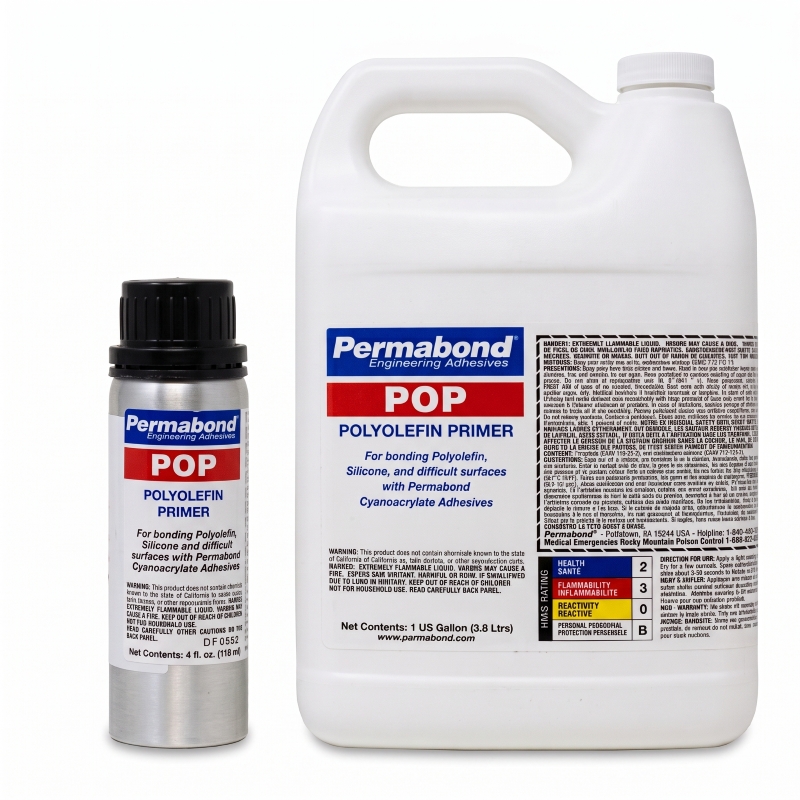
Permabond POP polyolefin primer is a low-viscosity adhesion promoter that makes polypropylene, polyethylene, PTFE, acetal, and silicone bondable with a cyanoacrylate. Those plastics have surface energy too low for a CA to wet out and grip, so an unprimed joint peels apart at the glue line. Wipe, dip, or spray POP on the low energy side, give it 30 seconds to flash off, then bond. On polypropylene, Permabond’s own testing takes a 4mm PP joint from 0.5 MPa with adhesive failure to 7.1 MPa with substrate failure, meaning the plastic tears before the bond lets go. POP is a primer, not an accelerator. It does not speed cure and it will not help an epoxy, a UV adhesive, or a structural acrylic.
Key Product Details
| Property | Value |
|---|---|
| Product Type | Polyolefin primer and adhesion promoter for Permabond cyanoacrylate adhesives |
| Appearance | Colorless liquid |
| Viscosity @ 25°C | 0.6 mPa.s (cP) |
| Specific Gravity | 0.7 |
| Drying Time @ 23°C | 30 seconds |
| Boiling Point | 98°C (208°F) |
| Flash Point | -4°C (25°F) |
| Evaporation Rate | 2.8 (butyl acetate = 1) |
| UV Fluorescence | Yes, for inspection and quality control |
| Biocompatibility | ISO 10993-5 Cytotoxicity |
| Storage Temperature | 5 to 25°C (41 to 77°F) |
| Compatible Adhesives | Permabond cyanoacrylate adhesives only |
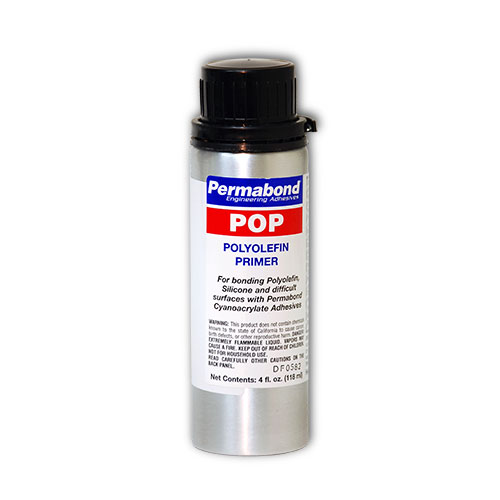
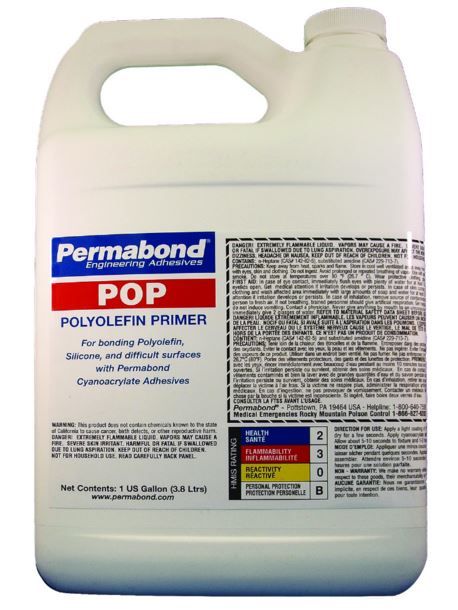
| Available Sizes | 4 oz (118 ml) aluminum bottle with pump sprayer, 1 gallon jug |
| Country of Manufacture | Italy |
| Source Document | Permabond POP Global TDS Revision 5, 19 June 2020 |
How Priming Low Surface Energy Plastic Works
Polypropylene, polyethylene, and PTFE are slick at the molecular level. A cyanoacrylate needs a surface it can wet out and chemically grab, and these plastics do not offer one, which is why an unprimed CA joint on PP comes apart in your hands. POP lays down a very thin chemically active film that the CA can react with. The whole step adds about a minute to the bench.
- 1. Clean the parts. Surfaces must be clean, dry, and grease-free. Wipe molded parts with isopropanol first to pull off mold release, which is the most common reason a primed joint still fails.
- 2. Apply POP to the low energy side only. Wipe it on with a clean cloth or brush, dip the part, or spray it. A thin film is the goal. Do not flood the joint.
- 3. Let it flash off. Components must dry at ambient temperature before bonding. Drying time is 30 seconds at 23°C.
- 4. Bond with a Permabond cyanoacrylate. On polyolefins you have up to 2 hours of open time after treatment, and less than that on some PP and PE blends. On PTFE, bond immediately after the primer dries.
- 5. Handle when it holds. Handling time depends on the substrate and which CA you selected, not on the primer.
- 6. Let it cure out. For maximum bond strength, allow 24 hours at 23°C.
Never mix POP directly into the cyanoacrylate. It is a surface treatment applied to the part, and mixing it into the adhesive will not work.
The process runs on polypropylene (PP), polyethylene (HDPE and LDPE), PTFE and other fluoropolymers, silicone rubber, acetal (POM), PBT, PMP, PPS, polystyrene, and polyurethane.
Substrate Response to POP
| Substrate | Effect on Cyanoacrylate Bond Strength |
|---|---|
| Polyolefins (PE, PP) | Significant improvement |
| Silicone | Significant improvement |
| Fluoropolymers (PTFE, FEP, PFA, ETFE) | Bond strength increasing |
| PBT, PMP, PPS, polystyrene, polyurethane | Significant improvement |
| Acetal (POM) | Significant improvement, per Permabond’s published POP guidance rather than the TDS table |
| ABS | No improvement in bond strength |
| DAP, polyamide (nylon) | Strength may decrease |
POP is formulated to minimize attack on plastics, but Permabond still recommends testing for compatibility before running it in production.
Bond Strength With and Without POP
| Joint | Untreated | Treated with POP |
|---|---|---|
| 4mm polypropylene, Permabond 105 | 0.5 MPa (73 psi), adhesive failure | 7.1 MPa (1,030 psi), substrate failure |
| 4mm polypropylene, Permabond 2050 | 0.27 MPa (39 psi), adhesive failure | 7.0 MPa (1,015 psi), substrate failure |
| 2mm polypropylene, Permabond 105 | 0.11 MPa (16 psi), adhesive failure | 3.5 MPa (508 psi), substrate failure |
| 2mm polypropylene, Permabond 2050 | 0.15 MPa (22 psi), adhesive failure | 3.4 MPa (493 psi), substrate failure |
| 2mm polyethylene, Permabond 2050 | 0 MPa, adhesive failure | 2.7 MPa (392 psi), substrate failure |
| 6mm PTFE to mild steel, Permabond 105 | 0 MPa, adhesive failure | 4.0 MPa (580 psi), adhesive failure |
Values are from the Permabond POP TDS in MPa. The psi figures are converted. This data is guideline information and does not constitute a specification.
Performance in Production
- Substrate failure instead of adhesive failure on primed PP means the joint is no longer the weak point. On 4mm PP the plastic tears at 7.1 MPa while the unprimed joint let go at 0.5 MPa, so the part geometry becomes the design limit rather than the glue line.
- 0.6 mPa.s viscosity is close to water, so it wicks into texture and flows off vertical faces. Spray or wipe a thin film and move on. Puddling does not buy extra strength.
- 30 second dry time at 23°C keeps it in a hand-assembly cycle. One operator can prime a tray of parts and start bonding before the last one is done.
- Up to 2 hours of open time on polyolefins lets you prime a batch ahead of the bonding station instead of priming part by part. Some PP and PE blends give less, so validate the window on your own resin.
- PTFE gets bonded immediately after the primer dries, which means PTFE work has to be set up as prime-and-bond at the same station.
- UV fluorescence lets QC put a black light on the part and confirm the primer actually went down before the joint closed, which catches the missed-surface reject before it ships.
- -4°C flash point and a 5 to 25°C storage range mean flammable-liquid handling and storage out of a hot shop. Do not leave it on a sunlit rack in July.
Common Applications
- Bonding molded polypropylene and polyethylene parts with an instant adhesive instead of buying flame, corona, or plasma treatment equipment
- Silicone rubber bonding, including silicone tubing, gaskets, seals, and keypads
- PTFE and fluoropolymer bonding, including PTFE to metal joints
- Acetal (POM) assembly where a CA alone will not hold
- HDPE and LDPE tank, fitting, and fixture repair on the maintenance bench
- Low volume and prototype work on low surface energy plastics where surface treatment equipment is not justified
- Medical device assembly on primed polyolefin and silicone components, supported by the ISO 10993-5 cytotoxicity listing on the current TDS
Cross-Reference: Other Polyolefin Primers
If you are currently buying one of these, Permabond POP cross-references to it by function. All of them are solvent-carried adhesion promoters wiped, dipped, or sprayed onto low surface energy plastic before an instant adhesive. Chemistries, dry times, and open times are not the same, so test on your own substrate and with your own CA before changing over.
| Product | Type | Notes |
|---|---|---|
| Permabond POP | Polyolefin primer for cyanoacrylates | Stocked here in 4 oz with pump sprayer and 1 gallon. UV fluorescent. ISO 10993-5 cytotoxicity listed on the current TDS. |
| 3M Scotch-Weld Instant Adhesive Primer AC77 | Polyolefin primer for cyanoacrylates | Also written AC 77. Published for PP, PE, and PTFE. |
| Loctite SF 770 | Polyolefin primer for cyanoacrylates | Published for PE, PP, PTFE, and thermoplastic rubber. |
| Loctite SF 7701 | Polyolefin primer for cyanoacrylates, medical device grade | Same substrate list as SF 770, offered as the medical device grade. |
Each of these primers is designed to work with its own manufacturer’s instant adhesives. Permabond specifies POP with Permabond cyanoacrylates. Call us if you want help matching a primer and CA pair to your substrate.
Available Sizes
| Size | Container | Permabond Part Number |
|---|---|---|
| 4 oz (118 ml) | Aluminum bottle with pump sprayer | CAPOP000004Z4101 |
| 1 gallon | Jug | CAPOP000001G1001 |
The 4 oz bottle ships with the pump sprayer installed, so it is the one to buy for bench work and spot priming. The gallon is for dip tanks, refilling shop sprayers, and production lines running primed parts daily.
Related Products
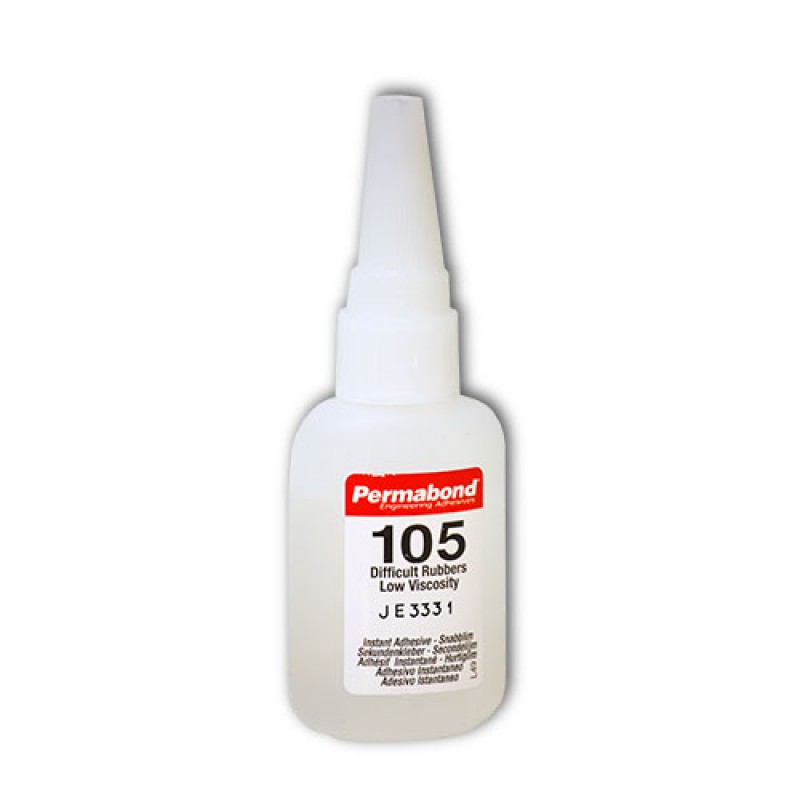
- Permabond 105 Instant Adhesive, the low viscosity CA used in the POP test data for close-fitting joints
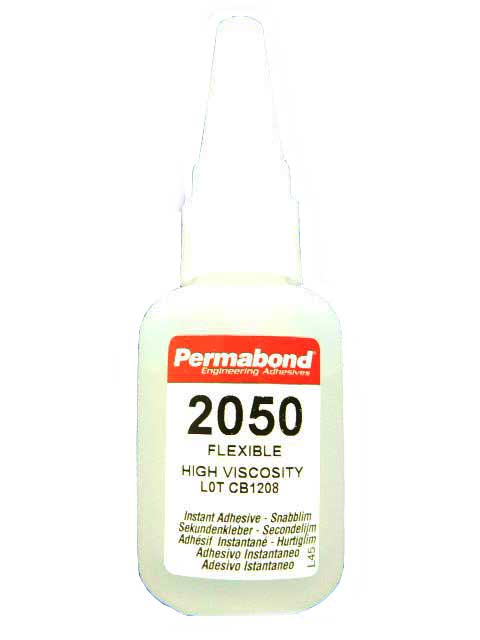
- Permabond 2050, the higher viscosity CA used in the POP test data where the joint needs more flexibility
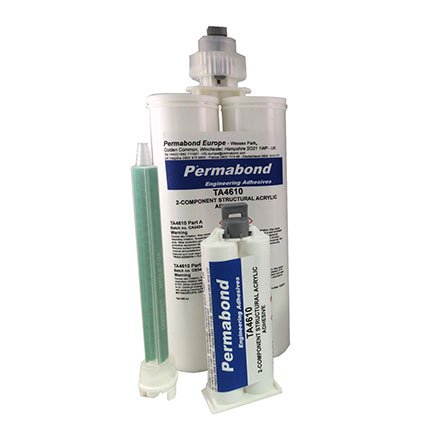
- Permabond TA4610 Structural Acrylic, a two-part alternative that bonds untreated HDPE, PP, PE, and PTFE with no primer step at all
- Permabond TA46XX polyolefin adhesive line, for comparing the primer-plus-CA route against a primerless structural acrylic
Frequently Asked Questions
What does Permabond POP primer do?
POP raises the bondability of low surface energy plastic so a cyanoacrylate can grip it. On polypropylene, polyethylene, PTFE, acetal, and silicone, priming the surface takes the joint from adhesive failure at almost no load to substrate failure, meaning the plastic gives out before the bond does. It is applied to the part and allowed to dry, then the CA goes on.
Is POP primer an accelerator?
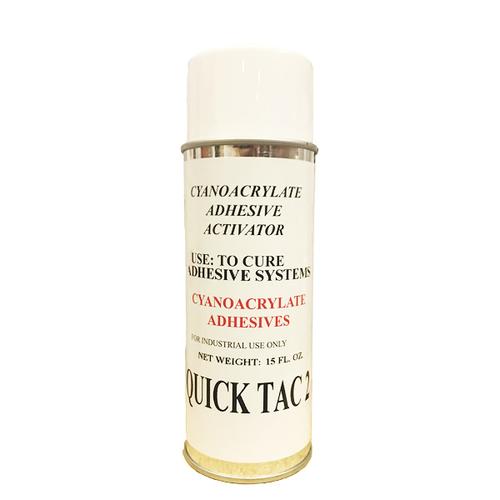
No. POP is a primer and adhesion promoter, not an accelerator. It does not increase cure speed and it does not change the pH of an acidic surface such as wood. If you need faster cure on a normal substrate, you want a CA accelerator instead.
Which plastics does POP not help?
ABS gets no improvement, and DAP and polyamide (nylon) can actually lose strength with POP. Use it on polyolefins, fluoropolymers, silicone, acetal, PBT, PMP, PPS, polystyrene, and polyurethane. On anything else, test before production.
How long after applying POP can I bond the parts?
Up to 2 hours on polyolefins, and immediately on PTFE. The 2 hour window can be shorter depending on the specific PP or PE blend, so verify it on your own material. Bonding as soon as practical always gives the best result.
Will POP improve an epoxy or UV adhesive bond?
No. POP works with cyanoacrylates only. It will not increase bond strength for epoxies, UV adhesives, or structural acrylics. If you are bonding polyolefins with a two-part adhesive, look at the Permabond TA46XX structural acrylics, which bond untreated PP and HDPE without any primer.
Can I mix POP into the cyanoacrylate?
No. Permabond specifically says not to mix POP directly with cyanoacrylate adhesives. It has to be applied to the surface and allowed to dry before the adhesive goes on.
Is Permabond POP a cross-reference for 3M AC77 or Loctite SF 770?
POP cross-references to 3M Scotch-Weld Instant Adhesive Primer AC77 and Loctite SF 770 and SF 7701 by function. All are solvent-carried primers applied to low surface energy plastic ahead of an instant adhesive, and all are published for PP, PE, and PTFE. The formulations are different and each manufacturer specifies its primer with its own CA line, so run a test on your substrate before you switch.
Where is Permabond POP made?
The POP we stock is imported from Italy. Permabond is an ISO certified manufacturer with operations in Europe, the Americas, and Asia.
What sizes does POP come in?
Two: a 4 oz (118 ml) aluminum bottle with a pump sprayer already installed, and a 1 gallon jug. The 4 oz covers bench and repair work. The gallon is for dip tanks, sprayer refills, and daily production.
Questions on fit for your plastic bonding process? Call (800) 220-1966 or email [email protected].


Reviews
There are no reviews yet.