

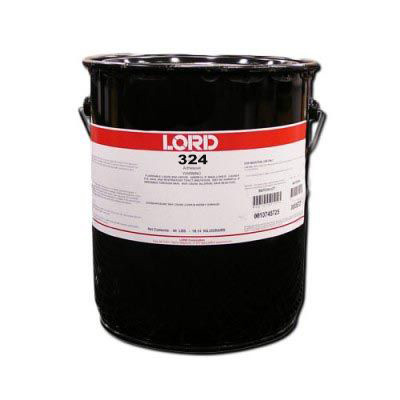



Description
LORD 324 is the hardener component of the LORD 320/324 two-part epoxy adhesive system. Published Parker LORD data for 324 covers the 320/324 pairing, so this hardener is specified for use with LORD 320 resin. The mixed system is formulated for primerless adhesion to automotive sheet molded compound (SMC) and also bonds prepared metals, rubber, fiberglass reinforced plastics (FRP), polyester thermosets, and thermoplastics. It can be room temperature cured or heat cured for faster processing.
This pail is hardener only. LORD 320 resin is sold separately.
LORD 324 Hardener Specifications
| Component | Hardener, used with LORD 320 resin |
| Appearance | Grey paste |
| Density | 9.45 to 10.35 lb/gal (1132 to 1240 kg/m3) |
| Flash Point | Above 200°F (93°C), closed cup |
| Package | 5 gallon pail |
| Net Weight | 45 lb |
| Shelf Life | Two years from date of manufacture, stored at 60-80°F (16-27°C) in the original unopened container |
| Manufacturer Part Number | 3023744 |
LORD 320/324 Mixed System
| Chemistry | Two-component epoxy |
| Mix Ratio, General Purpose (mixed stress, -40 to 400°F) | 1:1 by volume, 1.2:1 by weight |
| Mix Ratio, High Temperature (shear stress, 50 to 400°F) | 1.5:1 by volume, 1.8:1 by weight |
| Mix Ratio, Low Temperature (peel stress, -40 to 100°F) | 1:1.5 by volume, 1:1.2 by weight |
| Solids Content | 100 percent |
| Working Time @ 75°F (24°C) | 20 to 40 minutes, 54 g mass |
| Time to Handling Strength | 2 to 4 hours |
| Full Cure | Approximately 24 hours at 65°F (18°C) or higher. 45 to 60 minutes when heated at 180°F (82°C) |
| Maximum Bond Line Temperature During Cure | 325°F (162°C) |
| Mixed Appearance | Grey paste |
| Cured Appearance | Grey |
| Tensile Strength at Break | 3000 psi (20.7 MPa), ASTM D882-83A modified |
| Elongation | 3 percent, ASTM D882-83A modified |
| Young’s Modulus | 120,000 psi (800 MPa), ASTM D882-83A modified |
| Glass Transition Temperature | 158°F (70°C), ASTM E1640-99 by DMA |
| Postbake Resistance | Up to 400°F (204°C) |
Bond Performance, Tested at Room Temperature
Lap shear and peel values from the 320/324 technical data sheet, 1:1 by volume, 72 hours at room temperature:
| Substrates | Test | Result | Failure Mode |
|---|---|---|---|
| Cold rolled steel to cold rolled steel | Lap shear | 2898 psi (19.9 MPa) | Adhesive |
| Aluminum to aluminum | Lap shear | 2325 psi (16 MPa) | Cohesive |
| SMC to SMC | Lap shear | 400 psi (2.8 MPa) | Fiber tear |
| Natural rubber to cold rolled steel | 45 degree peel | 63 pli (11.0 N/mm) | Rubber failure |
Metal substrates were MEK wiped, grit blasted, and MEK wiped again. SMC was sanded with 320-grit and dry rag wiped. Natural rubber was primed with LORD 7701.
Performance in Production
- Bulk pails are meant for automatic meter, mix, and dispense equipment. When mixing by hand, the operator controls the ratio, so verify it against the joint design you are running.
- Paste consistency helps hold bond line position during assembly. Recommended film thickness is 0.02 to 0.03 inch (0.51 to 0.76 mm).
- Exotherm between the two components shortens working time. Mix smaller batches to limit heat buildup and do not use adhesive that has started to cure.
- Elevated temperature cure produces the highest bond strengths and impact resistance.
- Impact resistance down to -40°F (-40°C). Resists humidity, sunlight, salt spray, and temperature extremes.
- Solvent resistant when cured. Phosphatizing and ELPO (e-coat) processes do not affect the adhesive or its bond strength. Continuous immersion in solvents is not recommended.
- Contains no solvent, nonflammable, and virtually odorless.
- Cured adhesive can be filed, sanded, machined, painted, lacquered, or coated.
Surface Preparation
- Remove soil, grease, oil, fingerprints, dust, mold release agents, and rust by solvent degreasing or alkaline cleaning.
- On oxidation-free metal, wipe with isopropyl alcohol. Abrade to remove tarnish if needed, then clean a second time to remove loose particles.
- Cured rubber: apply LORD 7701 and allow it to flash off before bonding.
- Glass and ceramic: prime with LORD AP-134.
Cleanup
Clean uncured adhesive off parts and equipment with hot water and detergent or a ketone solvent. Cured adhesive softens at 400°F (204°C) or above, which allows parts to be separated. Commercial epoxy strippers may also work.
Common Applications
- Primerless bonding of automotive sheet molded compound (SMC)
- Bonding cold rolled steel and aluminum
- Bonding fiberglass reinforced plastics (FRP)
- Bonding polyester thermosets and thermoplastics
- Bonding natural rubber to metal when primed with LORD 7701
- Production bonding through meter, mix, and dispense equipment
Available Sizes
- 5 gallon pail, 45 lb net (hardener only, this page)
Related Products
- LORD 320 Epoxy Resin – 5 Gallon Pail
- LORD 7701 adhesion enhancer and surface modifier for cured rubber
- LORD AP-134 adhesion enhancer and surface modifier for glass and ceramic


Reviews
There are no reviews yet.