

How to Bond Difficult Plastics: A Guide to Low-Surface-Energy Materials
Polyethylene, polypropylene, PTFE and other low-surface-energy plastics offer an impressive combination of toughness, chemical resistance and durability. Those same characteristics, however, can make these materials some of the most challenging substrates to bond with adhesives.
The key to solving the problem is understanding surface energy, wetting and adhesive selection.
In this guide, based on Chemical Concepts’ Difficult to Bond Substrates: Engineered Adhesive Solutions for the Most Challenging Applications webinar, we examine why these plastics are difficult to bond and three approaches for creating stronger adhesive joints.
Why Are Some Plastics So Difficult to Bond?
Successful adhesive bonding depends on interaction between the liquid adhesive and the surface of the substrate.
One of the most important factors controlling that interaction is surface energy.
Surface energy describes the degree of attraction or repulsion that a material surface exerts on another material. For an adhesive to develop a strong bond, it needs to spread across—or wet—the substrate.
A high-surface-energy material creates greater attraction and generally allows an adhesive to wet the surface more effectively.
A low-surface-energy material creates less attraction. Instead of spreading across the substrate, the adhesive can remain beaded on the surface, limiting contact between the adhesive and substrate.
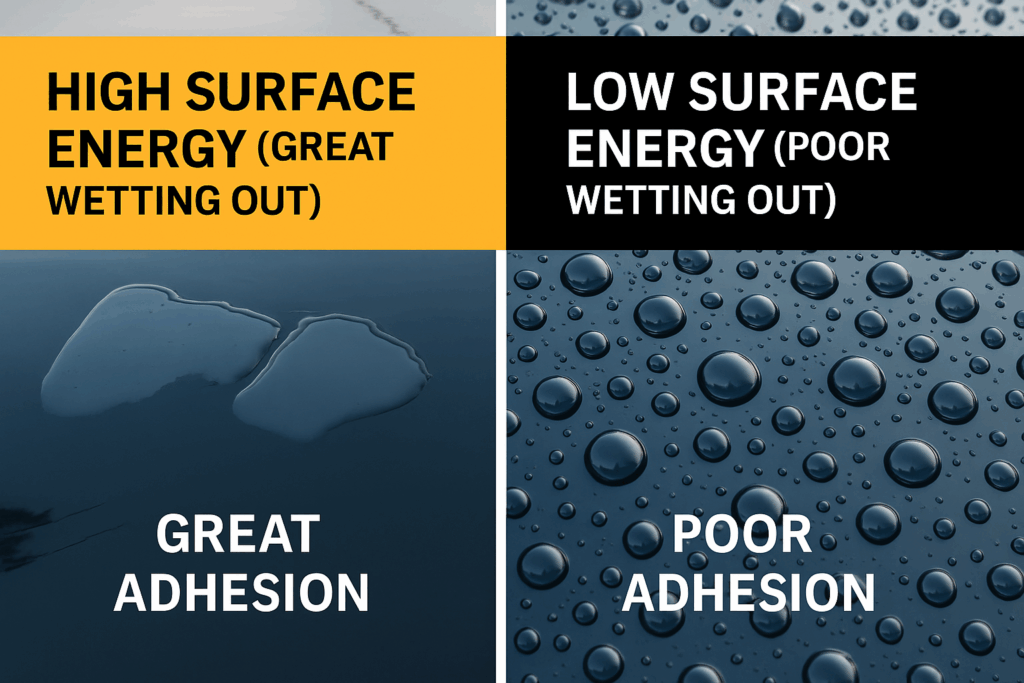
Think about water on two different surfaces. On one surface, the water beads into droplets. On another, it spreads into a thin film.
The second surface demonstrates better wetting.
For adhesive bonding, maximizing this surface contact is critical.
Measuring Surface Energy and Wetting
Surface energy can be expressed in units including mJ/m², mN/m and dyn/cm.
One practical method for evaluating a surface is a dyne pen.
A dyne pen contains a liquid with a known surface tension. When applied to a substrate, its behavior provides an indication of the substrate’s surface energy.
If the liquid beads or retracts, the substrate has insufficient surface energy for that dyne level. If it wets the surface, the test indicates a higher surface energy.
Another method is contact-angle measurement. Contact angle measures the angle where the interface between a liquid and air meets the substrate.
The shape of the droplet provides information about wetting behavior: better spreading produces a lower contact angle, while poor wetting produces a more pronounced bead.
Comparing High- and Low-Surface-Energy Materials
Metals generally sit on the high end of the surface-energy spectrum, making them comparatively receptive to adhesive wetting.
Many commonly used plastics have substantially lower surface energies.
Examples discussed in the webinar include:
- ABS: approximately 42 mN/m
- Polycarbonate: approximately 42 mN/m
- Rigid PVC: approximately 39 mN/m
- Acrylic: approximately 38 mN/m
- Polyethylene: approximately 31 mN/m
- Polypropylene: approximately 29 mN/m
- PTFE: approximately 18 mN/m
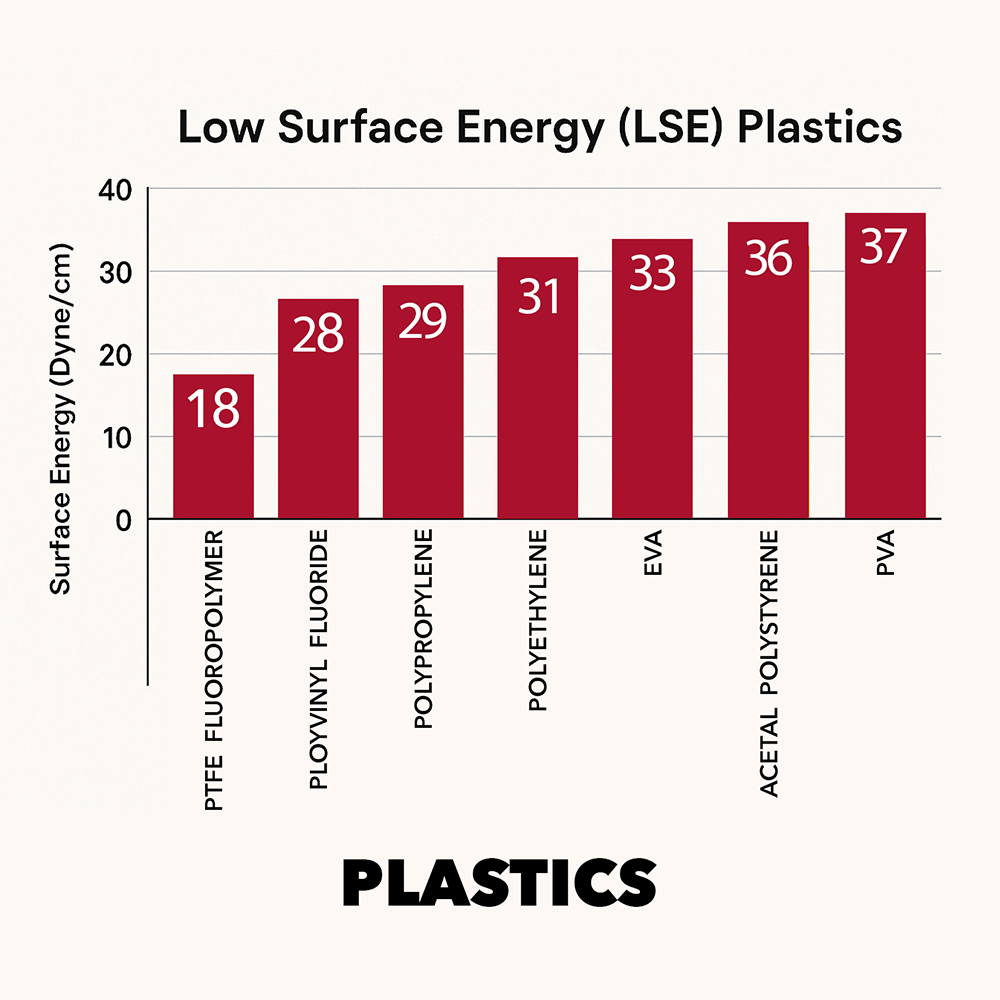
The lower values for polyethylene, polypropylene and PTFE help explain why conventional adhesive approaches can struggle with these substrates.
The Most Difficult Plastics to Bond
Two important groups of low-surface-energy plastics are polyolefins and fluoropolymers.
Common polyolefins include:
- Polyethylene (PE)
- High-density polyethylene (HDPE)
- Polypropylene (PP)
PTFE is one of the best-known fluoropolymers.
These materials have stable molecular structures that resist interaction with other substances. This contributes to useful characteristics such as chemical resistance—but also makes adhesive interaction with the surface more difficult.
Why Use Low-Surface-Energy Plastics?
If these plastics are so difficult to bond, why use them?
Because they provide valuable engineering properties.
Polyolefins and fluoropolymers can offer:
- High toughness
- Thermal resistance
- Chemical resistance
- Low-friction surfaces
- Cost advantages for certain applications
The engineering challenge isn’t avoiding these materials. It is finding a bonding process that works with them.
Three Approaches to Bonding Low-Surface-Energy Plastics
The webinar outlines three primary strategies:
- Modify the substrate through surface treatment.
- Use Permabond POP with a compatible cyanoacrylate.
- Use a Permabond TA4600-series two-part acrylic designed to bond difficult substrates without a separate surface-treatment process.
The appropriate approach depends on the substrates, joint design, production process, environmental exposure and performance requirements.
Start With Good Surface Preparation
Before selecting a specialized treatment or adhesive, basic surface preparation remains important.
Bond surfaces need to be clean and dry. Contamination, grease and debris can prevent the adhesive from making direct contact with the substrate.
The webinar recommends solvent cleaning where appropriate. Acetone is discussed for metal substrates, while isopropanol is presented as a gentler option for plastics because acetone can attack certain plastics.
When abrasion is appropriate, clean the surface before and after abrasion so contamination and loose material are removed.
The objective is simple: bond to the substrate itself rather than contamination sitting on top of it.
Option 1: Increase Surface Energy Through Surface Treatment
One approach to difficult-to-bond plastics is changing the surface before adhesive application.
The webinar discusses several methods:
Flame Treatment
Flame treatment briefly exposes the surface to a controlled flame to modify the substrate surface.
Process control is important. Excessive exposure can damage or deform a plastic component.
Corona Treatment
Corona treatment applies a high-voltage electrical discharge to the surface.
This process modifies the surface and increases its surface energy, improving its ability to interact with an adhesive.
Plasma Treatment
Plasma treatment uses an ionized gas to modify the surface.
Like corona treatment, the objective is to increase surface energy and improve wetting.
Chemical Etching
Chemical etching can be used on substrates such as PTFE. The webinar discusses sodium-based treatment of the bonding surface.
Primers
A primer can provide a chemical bridge between a difficult substrate and an adhesive. The webinar describes primers with multifunctional reactive groups in which one site interacts with the substrate and another interacts with the adhesive.
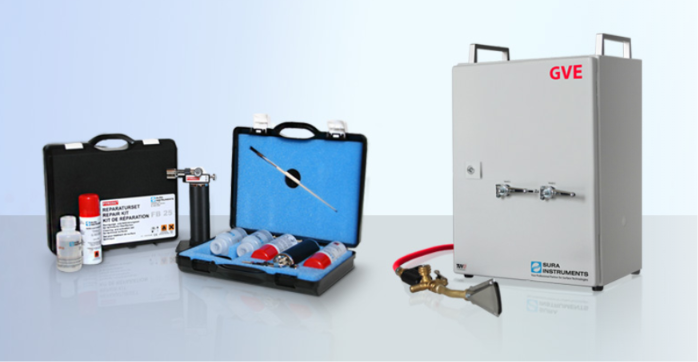
These processes can significantly increase surface energy and expand the adhesive technologies available for an application.
The tradeoff is additional processing.
Surface treatment can require equipment, labor, process controls and additional production time.
How Do You Know Surface Treatment Worked?
After treating a substrate, verify that the process produced the desired surface change.
Dyne pens provide one practical method.
Compare wetting before and after treatment. A properly treated surface demonstrates improved wetting behavior.
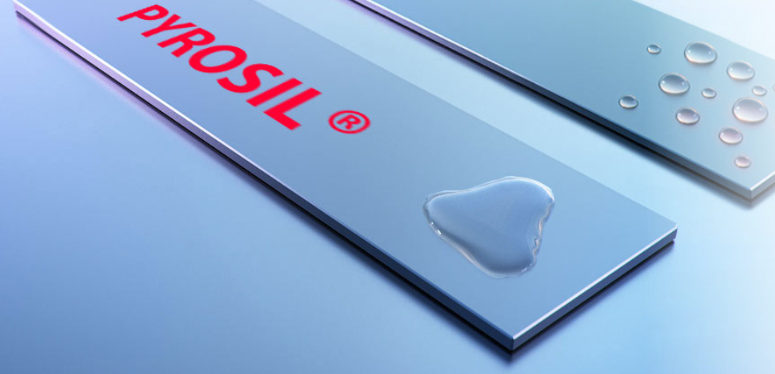
This visual difference provides a useful reminder of what surface treatment is trying to accomplish: creating a surface that allows much greater interaction with the adhesive.
Option 2: Permabond POP and Cyanoacrylate
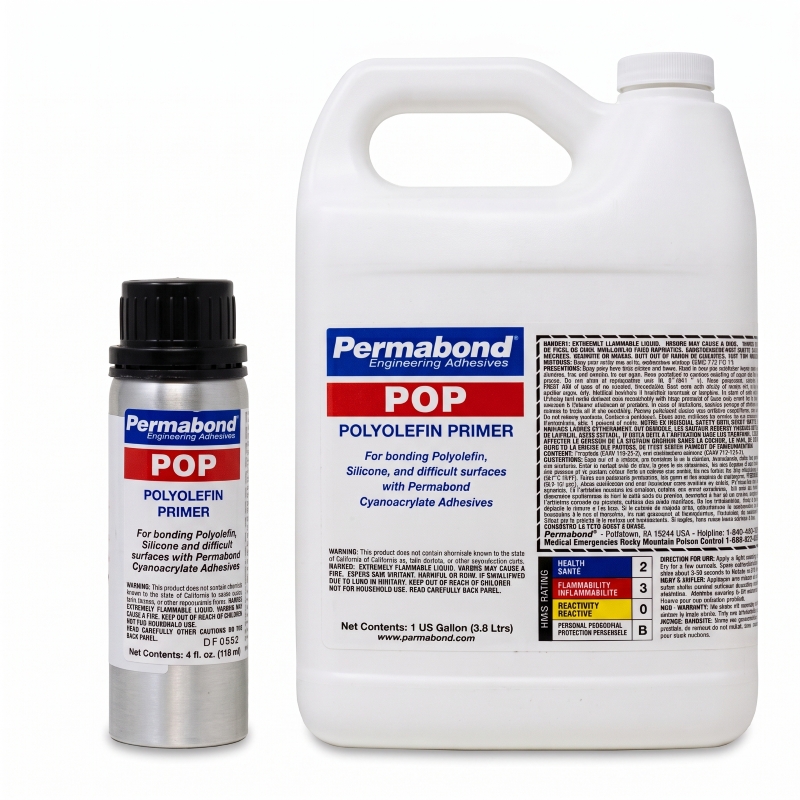
Another approach uses Permabond POP, a primer/surface treatment/adhesion promoter designed for use with Permabond cyanoacrylates.
POP is discussed for difficult substrates including:
- Polyethylene
- Polypropylene
- PTFE and other fluoropolymers
- Acetal/POM
- Silicone rubber
The webinar also identifies PBT, PMP, PPS, polystyrene and polyurethane as materials where POP can improve bond strength.
POP can be applied by spraying, wiping or dipping. The entire bonding surface needs to be covered.
After application, allow the POP to dry and assemble the components as soon as possible. The webinar specifies bonding within two hours of treatment.
An important limitation is that POP is specifically recommended for Permabond cyanoacrylates. It is not presented as a universal primer for other adhesive chemistries.
The presentation also identifies substrates where POP is not beneficial. Bond strength decreases on polyamide when POP is used, while ABS shows no appreciable increase.
That makes substrate identification an important part of adhesive selection.
Understanding the Limits of Cyanoacrylates
Cyanoacrylates offer several useful characteristics, including rapid bonding and a range of available formulations.
The webinar discusses formulations designed for higher-temperature performance, improved toughness and increased flexibility.
However, adhesive selection also needs to account for the environment and stresses on the joint.
Applications involving significant structural loading, outdoor exposure, moisture or demanding mechanical stresses can call for a more durable structural adhesive system.
That leads to the third approach.
Option 3: TA4600-Series Structural Acrylics
The webinar presents the Permabond TA4600 series as a two-part, 1:1-mix acrylic adhesive family designed for difficult-to-bond substrates.
A major process advantage is the ability to bond low-surface-energy materials without flame, corona or plasma treatment.
The presentation identifies features including:
- Two-part, 1:1 mix ratio
- Adhesion to difficult low-surface-energy materials
- Resistance to water and chemicals
- Impact resistance
- Environmental durability
- Weathering resistance
- Manual or automated dispensing
- Strength on PTFE
The webinar discusses several grades in the family, including TA4605, TA4610, TA4611 and TA4631, along with TA4620 as a slower-curing grade available on request.
TA4631 is identified as a low-odor version.
A Note About the TA4600-Series Appearance and Cure
The webinar points out a few processing characteristics worth understanding.
Uncured TA4605 and TA4610 can appear gritty because they contain microparticles used to control the bond gap. These microspheres create an induced gap intended to produce optimal results.
TA4611 does not contain those microparticles.
Another characteristic is the difference between adhesive inside and outside the joint.
Excess material exposed to air outside a closed joint can cure more slowly and remain softer, while adhesive inside the assembled joint cures solid.
These characteristics are important when evaluating a bonded assembly and determining whether the adhesive has cured correctly.
Storage Matters
Storage conditions also affect these products.
The presentation specifies:
- TA4605 and TA4610 in 50 mL and 400 mL sizes: 4-month shelf life when stored at 5–25°C (41–77°F)
- TA4611: 9 months
- TA4631: 6 months
- Larger sizes: 3 months
The webinar emphasizes avoiding excessive heat during storage.
Real-World Applications for Difficult-to-Bond Plastics
Low-surface-energy bonding isn’t a laboratory-only problem. These materials appear throughout manufacturing.
Applications discussed during the webinar include:
- Workbenches
- Exterior cabinets
- Outdoor furniture
- Helmets
- Automotive radar assemblies
- Solar-panel trackers
- Agricultural growing benches
- Mist sensors
- Artificial trees
- EPDM gaskets
- Signage
- Plastic pallets
The presentation also examines PTFE-to-metal pipe supports.

In this type of application, PTFE provides a low-friction surface that allows a pipe to move as the system experiences thermal expansion and contraction.
For a marine pipe-support application involving PTFE bonded to stainless steel, the webinar discusses TA4610 as the selected solution where outdoor exposure and durability were important considerations.
This example highlights an important point: adhesive selection isn’t based on substrate alone.
You also need to understand the conditions surrounding the joint.
Questions to Ask Before Choosing an Adhesive
When evaluating a difficult-to-bond substrate, start by identifying:
- What are the two substrates?
- Is the exact plastic grade known?
- What size is the bonding area?
- What type of stresses will the joint experience?
- Will it be exposed to water or humidity?
- Will it be used indoors or outdoors?
- What temperatures will it experience?
- Will it encounter chemicals?
- Is surface treatment practical in the production process?
- What fixture and cure time does production require?
- How will the adhesive be dispensed?
- Are regulatory certifications or approvals required?
The answers determine whether surface treatment, a primer-assisted cyanoacrylate system or a structural acrylic approach is appropriate.
The Bottom Line
Polyethylene, polypropylene, PTFE and other low-surface-energy plastics are difficult to bond because their surfaces resist interaction with adhesives.
The solution begins with surface energy and wetting.
There are three main paths covered in this webinar:
Treat the surface. Flame, corona, plasma, chemical etching and primers can increase surface energy and improve adhesive wetting.
Use a compatible primer and cyanoacrylate. Permabond POP provides another route for selected low-surface-energy substrates when used with compatible Permabond cyanoacrylates.
Use an adhesive engineered for untreated low-surface-energy plastics. The Permabond TA4600 series provides a structural acrylic approach without requiring flame, corona or plasma treatment.
There is no substitute for testing the complete bonded assembly under the actual conditions it will experience.
Need Help With a Difficult-to-Bond Application?
Chemical Concepts works with manufacturers to evaluate substrates, adhesive technologies, surface preparation and dispensing requirements.
Bring us the application details—including your substrates, environmental exposure, joint design and production requirements—and our team can help evaluate the available bonding approaches.

