Comparing One-Component and Two-Component Adhesives
If your business incorporates manufacturing processes that benefit from adhesive usage, you may face the question: is it better to use a one-component adhesive or a two-component adhesive? In other words, will it just be one liquid, or will there be two that are mixed together in some fashion?
Many adhesive users assume that one-component processes are easier to control and are, ultimately, more efficient. Though this may be true in many circumstances, don’t underestimate the flexibility of process that two-component adhesives offer.
One-component adhesives typically cure via moisture, heat, and light. So although the adhesive itself is considered one-component, they usually come with a secondary component: the external factor that affects the cure. Two- component adhesives cure when they are combined and generally require no external factor (like the aforementioned light, heat or moisture.)
Single component adhesives may have a shorter shelf life and require care to protect against moisture, heat or light.
Key Features and Benefits of One-Component Epoxies
- High shear, impact, and peel strength increases joint design versatility.
- Excellent chemical, temperature, and environmental resistance.
- A good alternative to welding or brazing (which can help to reduce costs).
One-component epoxies are ideal for use in heavy wear-and-tear applications such as bonding tungsten carbide tools and machinery. Their use is widespread in the heat exchanger bonding market for sealing heat exchanger tubes and end-plates.
Let’s take a closer look at just one example of many one-component epoxies from PERMABOND.
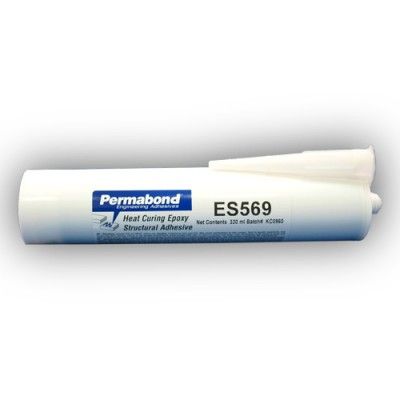 PERMABOND® ES569 is a single-part heat cured epoxy adhesive that offers excellent adhesion to metal surfaces as well as composite materials. The high-bond strength of this adhesive allows it to replace mechanical fastening, soldering, brazing or welding. ES569 has been designed to be non-sagging, allowing the product to be used in large gaps and on vertical surfaces. It is also ideal for bonding electronic components as it has high wet strength and is non-stringing. This one-component epoxy adhesive produces an excellent drop profile as well as withstanding solder reflow processes.
Features and Benefits to Expect with ES569
- Excellent adhesive strength.
- Strong resistance to vibration.
- Easy to use – no mixing required.
- High shear and peel strength.
- High temperature resistance.
- Good resistance to chemicals.
- Non-sag, thixotropic.
Key Features and Benefits of Two-Component Epoxies
- High peel strength for design versatility.
- Easily dispensed with static mix nozzles.
- Excellent chemical and environmental durability.
- No curing equipment required,
- Generally speaking, two component adhesives have a longer shelf life at ambient temperatures.
Two-component epoxies can be used in diverse applications. A few examples include bonding handles onto tools, aerospace structures, kitchen counter tops, motor housings and mounting brackets.
Let’s take a closer look at just one example of many two-component epoxies from PERMABOND.
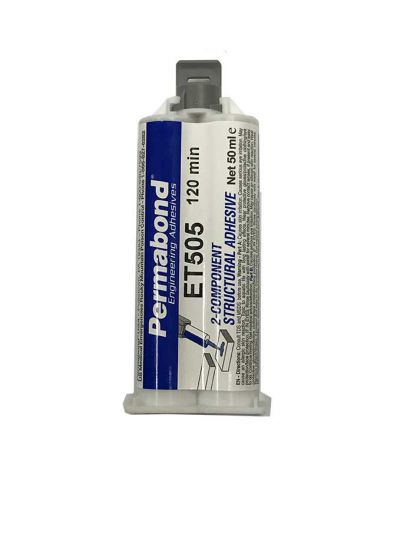 PERMABOND® ET505 is a two-part, 1:1 mixable epoxy adhesive. ET505 is a semi-flexible toughened epoxy adhesive with good adhesion to a variety of substrates such as wood, metal, ceramics and some plastics and composites. This epoxy adhesive forms tough bonds that offer high peel resistance and high shear strength. The extended work life of this product allows for adjustment and makes it more suitable for larger applications.
Features and Benefits to Expect with ET505
- Adhesion to a wide variety of substrates.
- Full cure at room temperature.
- Easy to apply.
- High shear and peel strength.
- Good impact strength.
- Good chemical resistance.
View all PERMABOND products carried by Chemical Concepts here.
Our experienced sales team can talk about epoxy adhesives all day – and they can answer the questions you have about what epoxy adhesives will work best for your particular application. Give us a call today to discuss at 800-220-1966 or email us at [email protected]. We’ll be happy to help!