Why Metal Fabricators Are Specifying Structural Acrylic Over Epoxy
When a bond fails on a coated metal assembly, the investigation usually starts with the adhesive, but it should start with the specification. Most failures on coated or lightly contaminated surfaces trace back to epoxy applied to conditions it wasn’t designed to handle cleanly, and fabricators who’ve recognized that pattern aren’t going back to epoxy for those applications.
Why Epoxy Falls Short on the Production Floor
Epoxy performs well on clean, abraded metal at room temperature with adequate cure time built into the schedule. On a fabrication floor running at production pace, those conditions are rarely met.
Metal from the supplier typically carries a factory coating or machining residue that blocks epoxy from bonding without prior degreasing and abrasion. For shops running high-mix production under schedule pressure, that prep requirement adds labor cost that rarely makes it onto a job estimate.
When there isn’t time for it and prep gets skipped, the bond looks fine at assembly, and the failure surfaces after the product ships.
How Structural Acrylic Handles Metal Fabrication Applications
Structural acrylic was built for industrial applications where thorough surface prep is impractical. The chemistry bonds through partial diffusion rather than surface contact alone, working into the substrate during cure instead of sitting on top of it. On a lightly contaminated or coated surface that would cause epoxy to fail, structural acrylic holds.
On most substrates, it achieves tensile strength comparable to epoxy and reaches handling strength in a fraction of the cure time. Removing the prep step and shortening fixture time reduces labor costs and callbacks over the product’s service life.
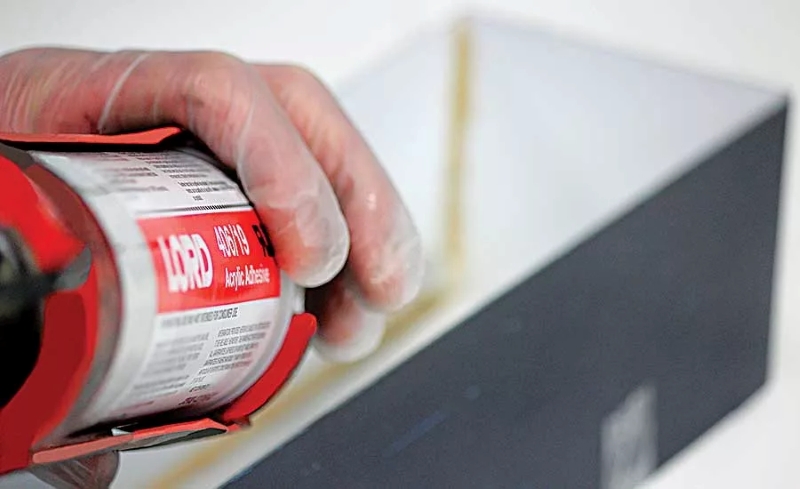
The Permabond TA series, LORD 406 and 410, and other methyl methacrylate (MMA) adhesives are worth evaluating directly against your current epoxy spec if you’re bonding coated or treated metal.
Comparing Epoxies and Structural Acrylics for Metal Fabrication
| Property | Two-Part Epoxy | Structural Acrylic |
| Surface prep | Thorough abrasion and degreasing required | Bonds to lightly contaminated surfaces with minimal prep |
| Fixture time | 5 minutes to several hours | 3 to 15 minutes depending on formulation |
| Bond strength | High | High, equivalent on most coated metal substrates |
| Flexibility | Rigid. Concentrates stress at the bond line under vibration and thermal cycling. | Semi-flexible. Absorbs and redistributes dynamic stresses over time. |
| Coated or pre-treated surfaces | Poor without primer or abrasion | Bonds directly without abrasion |
| Substrate range | Requires surface treatment on composites and low-surface-energy plastics | Bonds to composites, plastics, and mixed-material assemblies without primer |
| Mix ratio | Typically 1:1 or 2:1 | Often 4:1 or 10:1. Verify compatibility with dispensing equipment before switching. |
| Chemical resistance | Excellent | Good |
| Temperature resistance | Up to 200°C for structural grades | Up to 120°C |
| Odor during application | Low to moderate | Strong. Ventilation required in enclosed environments. |
Applications Where Structural Acrylic Outperforms Epoxy
Vehicle Builds and Dynamic Assemblies
Pre-finished aluminum assemblies in vehicle builds need to withstand vibration and thermal cycling throughout the vehicle’s full service life. Those are precisely the conditions where rigid epoxy performs poorly.
Epoxy cures to a rigid matrix. Under sustained dynamic loading, rigidity concentrates stress at the bond line rather than distributing it. Structural acrylic cures semi-flexible, absorbing and redistributing those stresses over time.
That difference doesn’t show up at delivery. It shows up in service when a callback arrives and gets attributed to the adhesive rather than the specification that caused it.
Powder-Coated and Anodized Aluminum
Fabricators working with factory-finished aluminum face the same underlying problem. Epoxy requires an abraded surface to bond reliably, and abrading a factory finish either creates a visible defect or damages the coating in ways that only become apparent after outdoor exposure.
That puts the fabricator in an impossible position: compromise the finish or compromise the bond. Structural acrylic bonds directly to the treated surface without abrading it, eliminating that tradeoff.
Mixed-Material Assemblies
When an application requires bonding metal to a composite panel or plastic component, epoxy’s prep requirement applies to both substrates. Without primer on both sides, the joint frequently fails at the interface.
That failure looks like an adhesive problem until someone traces it back to missing surface treatment. By then, the product has usually already shipped. Structural acrylic handles that interface via diffusion, without the surface-treatment epoxy depends on, which is why it tends to be the default specification for mixed-material assemblies in transportation and sign fabrication.
When Epoxy Is the Right Call
High-Temperature Applications
For assemblies that experience sustained heat above 120°C, structural acrylic’s temperature ceiling makes it the wrong specification, regardless of the substrate condition. Exhaust components and heat-exposed industrial tooling need epoxy’s thermal resistance.
The Huntsman Araldite and LORD structural epoxy lines are built for exactly that range.
High Chemical Resistance Requirements
Prolonged contact with solvents or aggressive process chemicals is the other condition where epoxy has a clear advantage. In fluid-handling and chemical-processing applications where that exposure is an operating constant, epoxy is the right specification regardless of the substrate condition.
Outside those two conditions, structural acrylic handles the vast majority of bonding work on coated and treated metal with less prep overhead and stronger long-term performance than epoxy achieves on those same surfaces.
Choose the Structural Acrylic or Epoxy for your Spec
The specification failure that causes most bond failures on coated metal is not a knowledge gap. Most fabricators know epoxy needs a clean surface. The gap is between what the spec requires and what production actually allows.
Evaluating substrate condition, prep time, load type, and temperature range before selecting an adhesive rather than after a bond fails in service is what closes that gap. The Chemical Concepts team works through that evaluation with fabricators every day.
Bond failures on coated or treated metal are almost always a specification problem, not a product one. Contact the Chemical Concepts team with your substrate and application details and we’ll get back to you with a specific product recommendation.