High Heat Adhesives: How to Choose the Right Option for Industrial Use
Category: Heat Resistant / High Temperature Resistant
Published: December 13, 2025
High heat adhesives are not all the same. When assemblies face bake cycles, elevated service temperatures, or repeated thermal swings, the wrong adhesive can soften, creep, or fail prematurely. This guide explains how to select a heat resistant adhesive for real industrial conditions, then highlights specific Permabond solutions available from Chemical Concepts.
Before choosing an adhesive, define four key factors: continuous service temperature, peak temperature and dwell time, substrate materials, and whether the joint will experience thermal cycling. These inputs quickly narrow the correct chemistry and reduce trial-and-error in production.
Why High Heat Is a Problem for Adhesives
Adhesives are polymer systems made from smaller molecules called monomers. As temperature increases, molecular motion increases. This can cause adhesives to soften, lose strength, or creep under load. Thermoplastic systems may eventually melt.
A critical value in heat resistance is the glass transition temperature (Tg). Tg marks the point where an adhesive transitions from a hard, glassy state to a more rubbery state. In general, higher Tg values support better strength retention at elevated temperatures, but Tg alone does not guarantee success.
Differential thermal expansion is another common cause of failure. Every material has a coefficient of thermal expansion (CTE). When substrates with very different CTE values are bonded together, heating and cooling cycles place stress on the bond line. Over time, this can lead to cracking or peel failure, especially in thermally cycled applications.
A successful high temperature bond depends on both adhesive selection and joint design.
High Heat Adhesive Chemistries and Selection Considerations
Permabond adhesives are based on organic chemistries such as epoxies and acrylics. Most modern high performance adhesives fall into this category. Organic systems have practical temperature limits, and above 300°C (572°F) they will degrade. Many industrial applications, however, operate well below this threshold.
When selecting an adhesive, consider whether your substrates can tolerate heat cure, whether they expand at similar rates, and how the joint is loaded in service. These factors often matter more than published strength values.

Single Part Epoxies
Single part epoxies are ideal when heat cure is available. They bond well to metals, composites, and many engineered substrates. Cure typically occurs between 80 and 150°C (175 to 300°F). Because heat is required for cure, these systems often deliver strong heat resistance once fully cured.
If heat curing is not possible, a two part epoxy or structural acrylic may be a better fit.
- Featured product: Permabond ES5516
- Permabond ES5516 is a one part epoxy developed with the growing EV market in mind. It excels at bonding electric motor magnets, including Class H magnets rated up to 180°C (356°F), as well as other high heat applications such as boilers and sensors.
Read more about Permabond ES5516 here.

Two Part Epoxies
Two part epoxies are widely used in automotive, aerospace, electronics, and general industrial manufacturing. They cure at room temperature and can be heated to accelerate cure and improve hot strength. In many cases, a short post-cure increases crosslink density and improves high temperature performance.
For applications involving paint baking or powder coating, consider not only peak temperature but also dwell time at temperature.
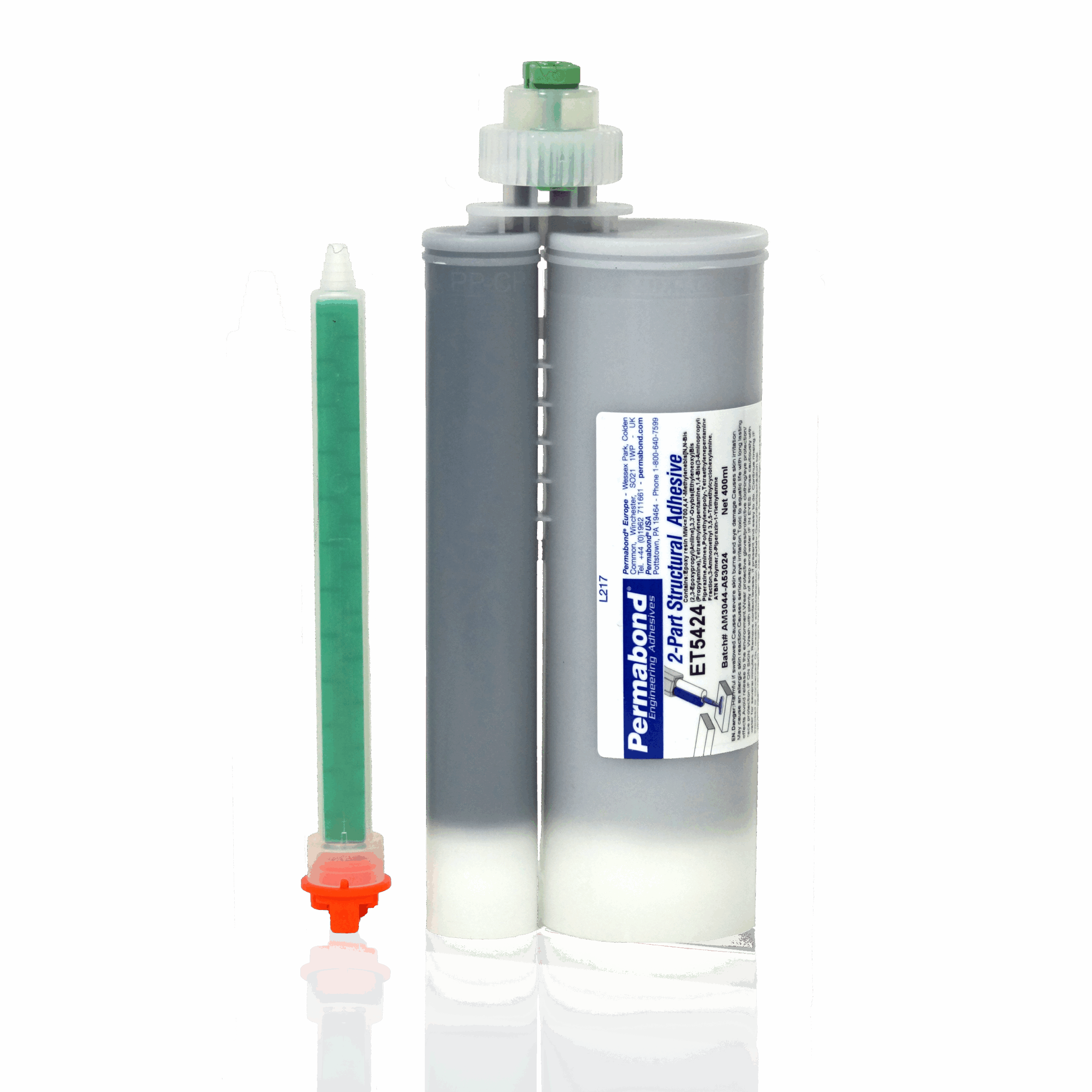
Featured product: Permabond ET5424
Permabond ET5424 cures fully at room temperature while maintaining performance at temperatures up to 230°C (446°F) and as low as minus 40°C (minus 40°F). Unlike many two part epoxies, it does not require oven post-curing to achieve strong performance at elevated temperatures.
Designed for automotive and aerospace applications, ET5424 offers low outgassing and is well suited for paint baking and powder coating processes.
Read more about Permabond ET5424 here.

Structural Acrylic Adhesives

Structural acrylic adhesives are often chosen for magnet bonding and metal assemblies where fast processing and high strength are required. They perform well on metals, ferrites, and ceramics and tolerate elevated temperatures better than many general-purpose adhesives.
Permabond TA437 provides very high strength on motor magnets and metals, retaining excellent performance at temperatures up to 200°C (392°F). It can also cure anaerobically when bonding metal-to-metal in tight fitting joints.
Cyanoacrylates
Cyanoacrylates cure rapidly at room temperature through moisture interaction. They are easy to apply and set within seconds, making them ideal for high throughput production.
Most cyanoacrylates are not designed for high temperature exposure. Many heat resistant grades require post curing, which may not fit fast production environments. Selecting a cyanoacrylate designed for elevated temperatures is critical.
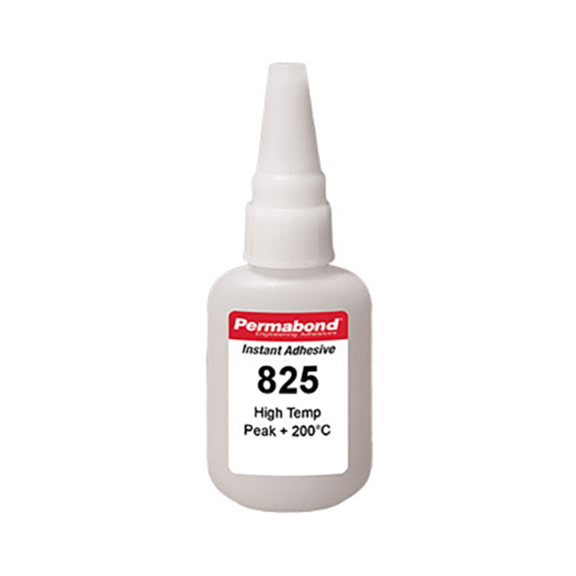
Featured product: Permabond 825
Permabond 825 is a high heat resistant cyanoacrylate that delivers strong performance up to 200°C (392°F). Its low viscosity allows easy application, and it maintains strength during thermal aging, making it suitable for high speed production lines.
Read more about Permabond 825 here.
Other adhesive chemistries can be used in some cases, but the options above are the most frequently recommended for high temperature industrial bonding.
Frequently Asked Questions About High Heat Adhesives
At which temperature are adhesives strongest?
- Adhesives typically perform best at room temperature, between 18 and 25°C (64 to 77°F). Above or below this range, most adhesives experience reduced performance.
Besides choosing a heat resistant adhesive, how can you increase joint durability?
- Select substrates with similar coefficients of thermal expansion.
- Design the bond line to absorb movement, often by using a slightly thicker adhesive layer.
- Where possible, shield or insulate the bond line from direct heat exposure.
Do you have an adhesive that will withstand 500°C?
- No. Because Permabond adhesives are based on organic chemistry, they are not suitable above 300°C (572°F). Applications above this range require inorganic adhesive systems.
Do UV adhesives withstand high heat?
- Most UV adhesives begin to lose performance above 120°C (248°F). Permabond ES5516 is a one part epoxy that includes a UV curing element for tack cure prior to heat cure, improving alignment and reducing adhesive flow before final curing.
Want to Learn More?
If you would like help selecting a high heat adhesive or validating it for your application, contact the technical team at Chemical Concepts. We can help match chemistry, substrates, and process requirements before you commit to production.
This article was inspired by technical content originally published by Permabond and expanded with application guidance and product selection insights from Chemical Concepts.