



Description
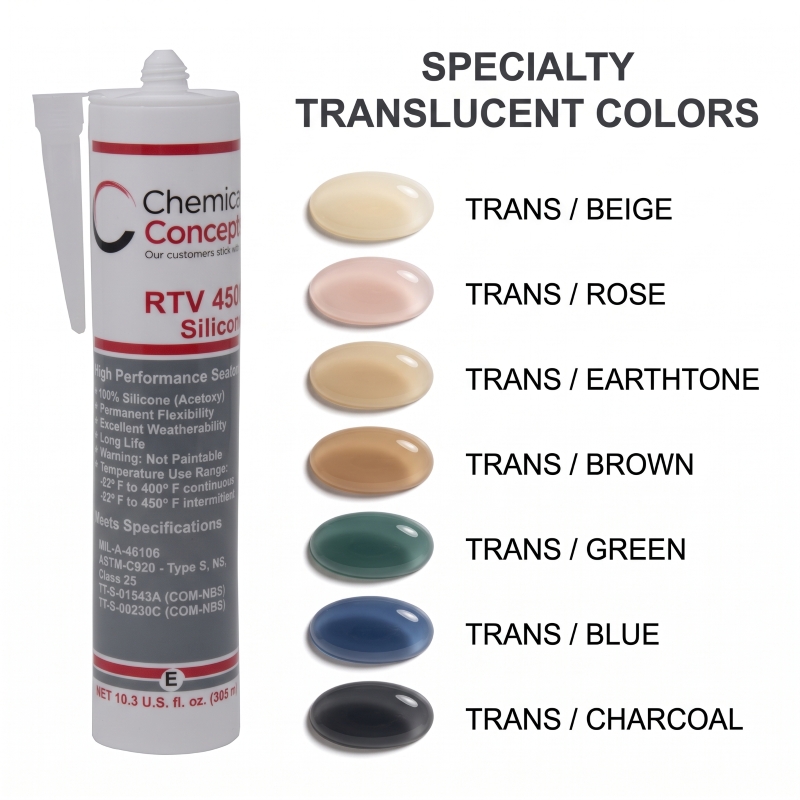
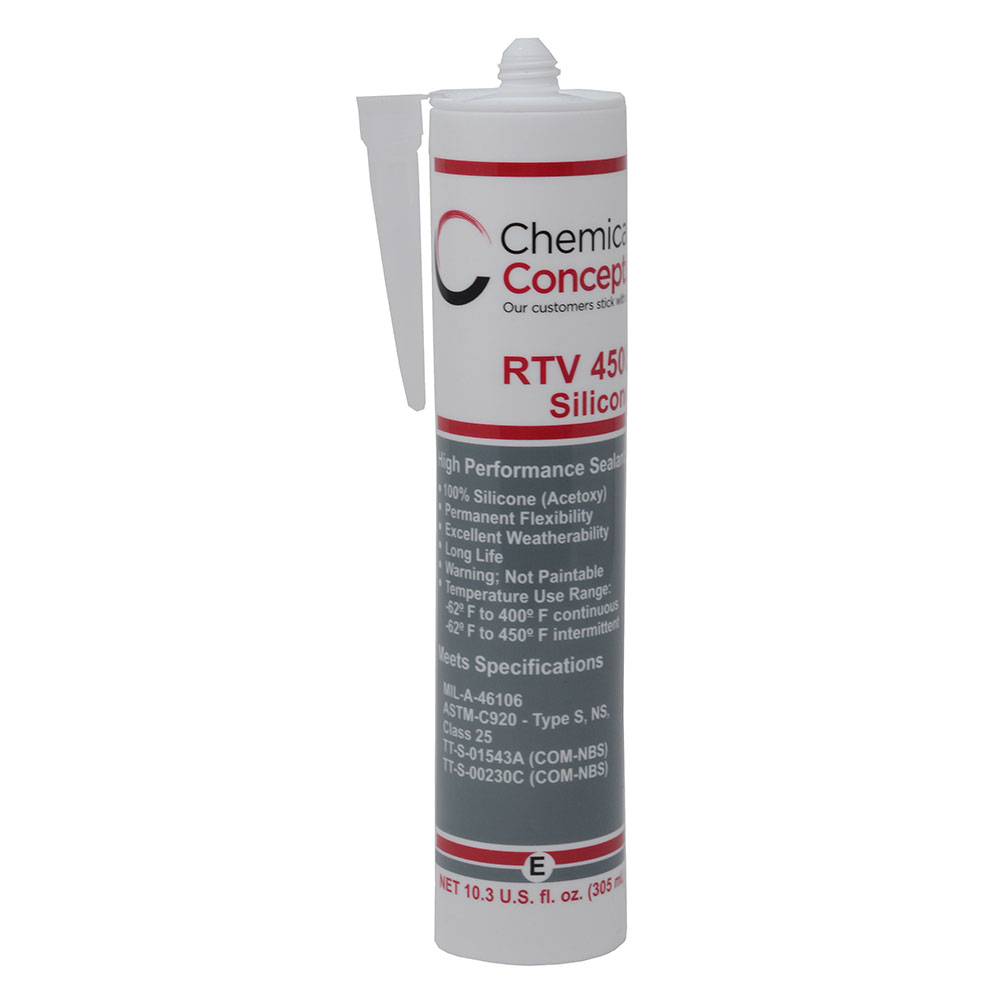
Chem-Set RTV4500 Specialty Translucent Colors are seven tinted translucent shades of the same 100% acetoxy RTV silicone as the standard line. One-component moisture cure, non-slump, and NSF Standard 51 and FDA 21 CFR 177.2600 for incidental food contact. Made in the USA. They are used where a seam is going to be looked at: countertop and backsplash joints, undermount sink perimeters, waterfall and mitered edges, glass and display panel joints, and architectural metal where a solid opaque bead would read as a line drawn across the surface.
Translucent is the whole point. A tinted translucent bead lets light through and picks up the color of the material on either side of it, so it settles into a slab instead of sitting on top of it. That is a different job from color matching. An opaque color tries to equal the surface, and a translucent one tries to disappear into it, which works better on stone with movement and pattern in it than any flat color can.
Key Product Details
| Property | Test Method | Result |
|---|---|---|
| Chemistry | 100% acetoxy RTV silicone, one component | |
| Cure Type | Moisture cure | |
| Colors | 7 specialty translucent, plus 10 standard | |
| Viscosity | Spindle 7, 4 rpm | 902,000 cps |
| Extrusion Rate | CC Test Method | 365 g/min |
| Gun Grade | CC Test Method | Pass (non-slump) |
| Skin Formation Time | 70°F, 50% RH | 10 minutes |
| Typical Cure Rate | CC Test Method | 24 hrs on a 1/8 in bead, strength continues developing through 7 days |
| Hardness | ASTM C661 | 25 Shore A |
| Tensile Strength | ASTM D412 | 264 psi |
| Elongation at Break | ASTM D412 | 500% |
| Joint Movement | ASTM C920 | 25% |
| Application Temperature | CC Test Method | -35°F to 150°F |
| Service Temperature | CC Test Method | -70°F to 400°F, intermittent to 450°F |
| QUV Testing | ASTM G154 | Pass at 10,000 hrs |
| Density | ASTM D1475 | 8.5 lbs/gal |
| VOC | ASTM D2369 | 23 g/L |
| Shelf Life | 70°F, 50% RH | 12 months |
| Paintable | No | |
| Approvals | ASTM C920 Class 25, Type S, Grade NS, Use NT, G, O; TT-S-01543A; TT-S-00230-C; NSF Standard 51; FDA 21 CFR 177.2600 | |
| Packaging | 10.2 oz cartridge, 24 per case | |
| Country of Manufacture | USA | |
| SKU | CCS-RTV4500-TRANSLUCENT |
The Seven Translucent Colors
| Color | Character | Typically used on |
|---|---|---|
| Trans/Beige | Pale warm cream beige | Cream and light tan stone, travertine-toned material |
| Trans/Rose | Pale warm blush pink | Pink-toned granite and marble, rose-cast solid surface |
| Trans/Earthtone | Pale warm sand tan | Sandstone and desert-toned stone, warm tan quartz |
| Trans/Brown | Medium warm tan brown | Brown granite, walnut-toned material, darker tans |
| Trans/Green | Deep muted teal green | Green granite and serpentine, green glass panels |
| Trans/Blue | Muted slate blue, fairly deep | Blue-toned granite, tinted and blue glass |
| Trans/Charcoal | Very dark blue gray, nearly black | Dark gray and charcoal stone, dark quartz, dark metal |
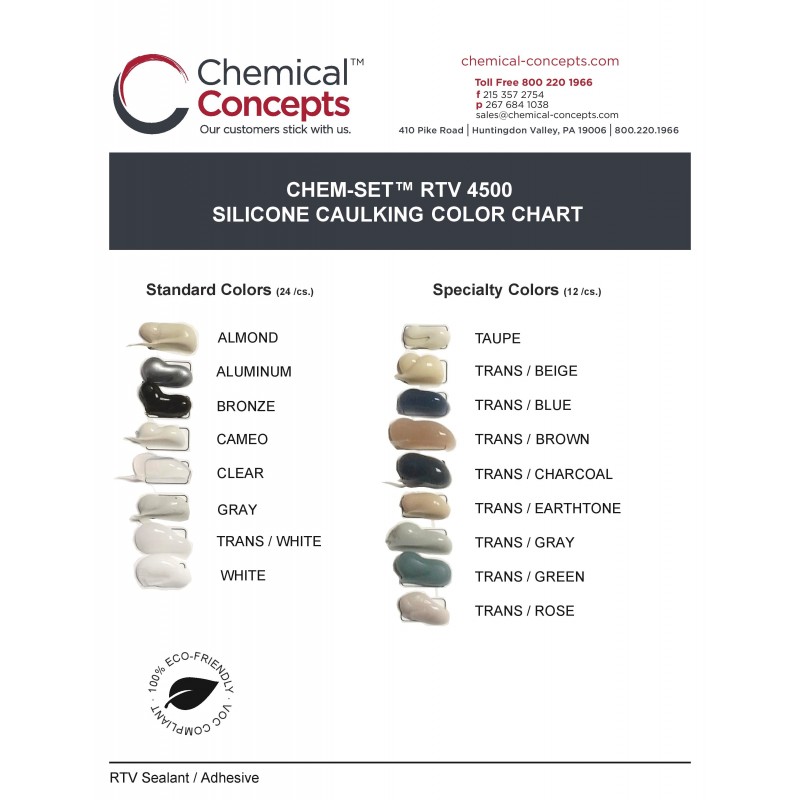
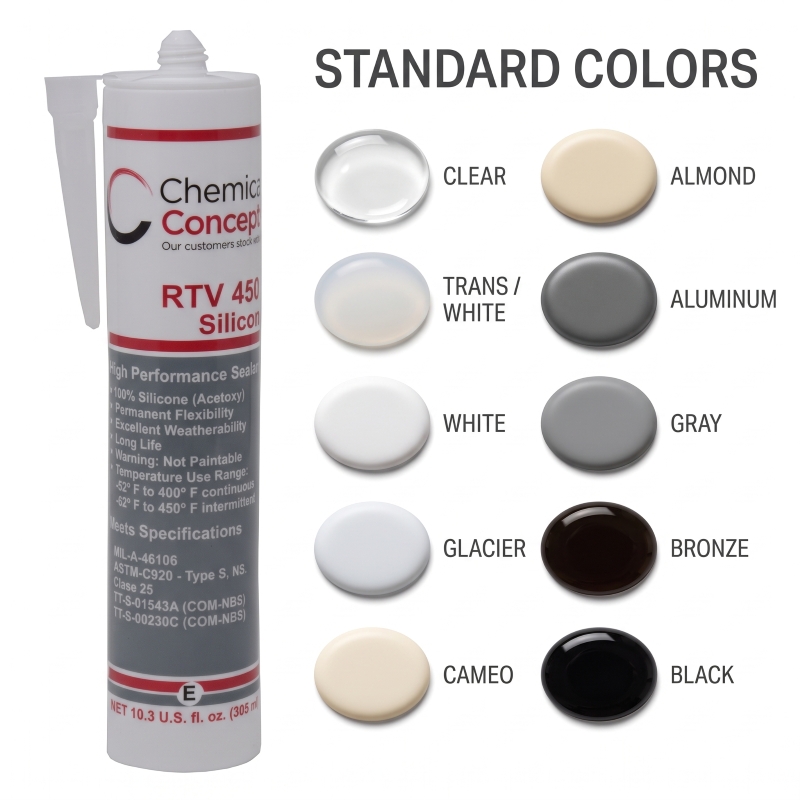
The lighter shades run more transparent and the darker ones read nearly solid at the crown of the bead while still showing translucency at the edges. Ten opaque and translucent white colors including Clear, Trans/White, White, Glacier, Cameo, Almond, Aluminum, Gray, Bronze, and Black are on the Chem-Set RTV4500 standard colors page. Custom colors are available with a minimum order.
How to Pick a Translucent Color for a Seam
Matching a translucent silicone is not the same exercise as matching an opaque one, and the instinct that works for paint gets you the wrong answer here.
- Match the undertone, not the pattern. On stone with a lot of movement, look past the veining and figure out what the base cast is: warm tan, pink, green, blue, or gray. That is what the bead needs to agree with.
- Go one step lighter than you think. A translucent bead darkens as it thickens, so a color that looks right as a thin swatch can read heavier once it fills a 1/8 in joint.
- Bead the actual slab, not a sample board. Translucent silicone takes color from what is underneath it, so a dab on white paper tells you almost nothing about how it will look on granite.
- Judge it cured, not wet. Uncured silicone reads darker and glossier than the finished bead.
- Check it under the lighting the job will live under. A shop fluorescent hides mismatches that a kitchen pendant will show.
- When nothing quite fits, Clear or Trans/White from the standard line is often a better answer than a translucent color that is close but wrong in undertone. A neutral haze is less noticeable than a tint pulling the wrong direction.
Performance in Production
- 25 Shore A with 500% elongation means the cured bead stays soft and stretches with the joint instead of tearing at the edge. The ASTM C920 Class 25 rating covers 25% movement, so a 1/4 in joint absorbs roughly 1/16 in of movement.
- Non-slump at 902,000 cps holds the bead on a vertical seam, a mitered edge, or a waterfall return with no sag while it skins.
- 10 minute skin time at 70°F is the working window, and it matters more on a visible seam than an industrial one. Bead and tool one joint, then move on.
- 365 g/min extrusion rate pushes cleanly out of a manual 10 oz gun, which helps when you are controlling a thin bead on a finished surface.
- Pass at 10,000 hours QUV under ASTM G154 means the tint holds up under UV exposure, which matters on a bead a customer will look at for years.
- 100% silicone with no fillers or extenders. Extended silicones cut with oil and solvent are the ones prone to shrinking and color shift as they age, and on a tinted translucent bead a color shift shows.
- 24 hour cure on a 1/8 in bead, full strength at 7 days. Confined and deep joints take longer because cure needs air moisture to reach the silicone.
Acetoxy or Neutral Cure
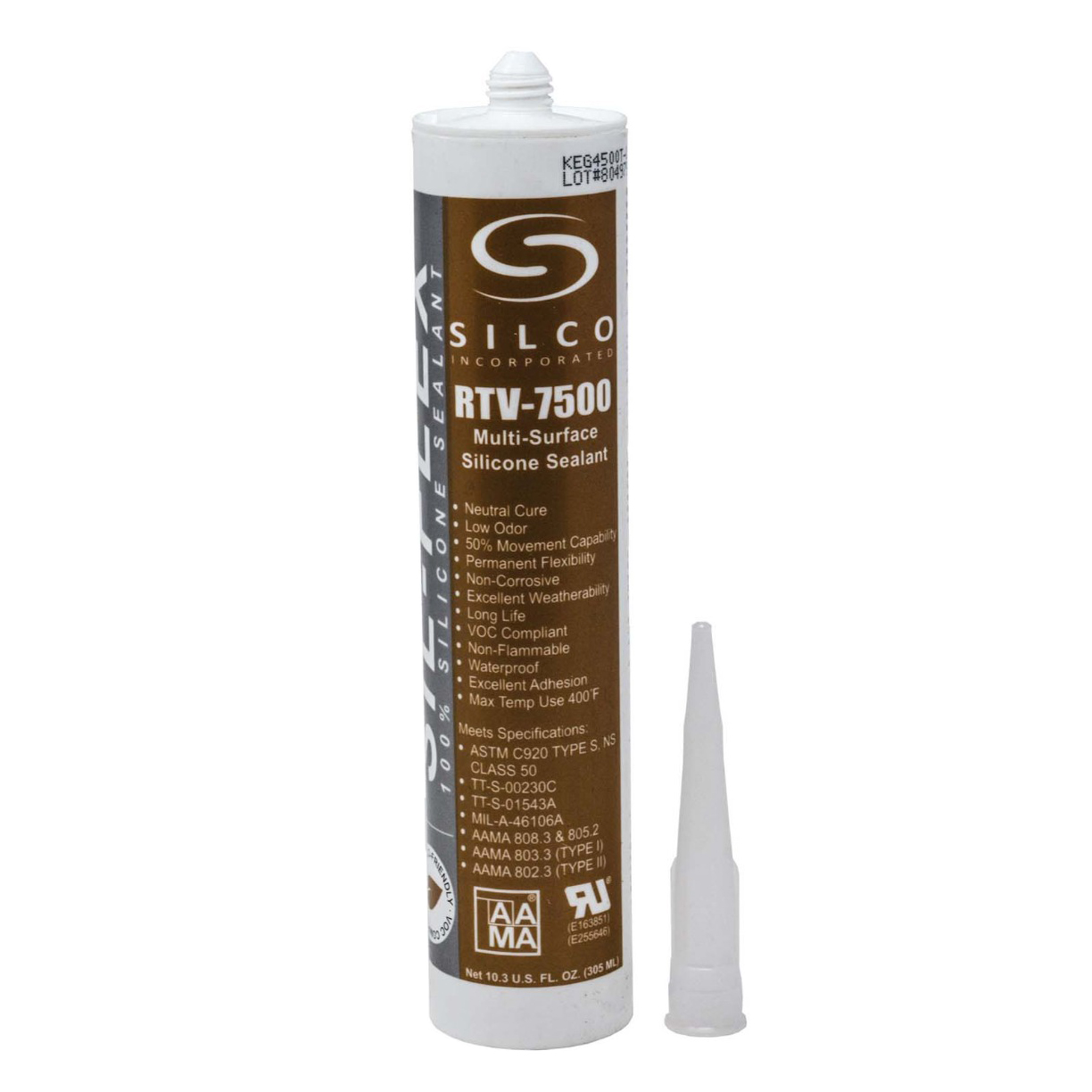
These are acetoxy silicones, which is the right chemistry for quartz, solid surface, glass, metal, tile, and porcelain. On polished marble and quartzite use a neutral cure silicone instead, since our guidance on those two stones is that an acetoxy silicone can cause staining or bleeding. That shows up as a dark shadow line along the joint weeks after the install is signed off, which is the last thing you want on a seam chosen for its appearance. Sil-Flex RTV-7500 is the neutral cure option, with 50% joint movement and low odor.
Common Applications
- Granite, quartz, and solid surface countertop seams
- Undermount sink perimeter sealing
- Waterfall and mitered edge joints
- Backsplash and countertop-to-wall joints
- Glass panel, display case, and lighted panel joints
- Translucent and tinted panel glazing
- Architectural metal and cladding joints in tinted finishes
- Bathroom vanity, shower, and wet zone sealing
- Casework, millwork, and fixture joints where the bead is visible
Limitations
- Not paintable.
- Do not use on porous surfaces such as concrete, mortar, or brick.
- Use a neutral cure silicone on polished marble and quartzite.
- Use only on clean surfaces free of contaminants.
- Cold temperature and low humidity slow curing.
- Partial or total confinement of the sealant lengthens cure time.
- Do not store at elevated temperatures. High heat and high humidity shorten shelf life.
Available Sizes
- 10.2 oz cartridge, CCS-RTV4500-TRANSLUCENT, 24 per case
- Additional formats and custom color matching available on request
See Why Silicone Quality Matters
100% silicone with no fillers or extenders is easy to claim and easy to verify. The float test in this video shows the difference between a true 100% silicone and a filler-extended formula, and it covers the net fill practices that make a cheap tube look cheaper than it is.
More on how to spot an extended silicone: Not All Silicones Are Created Equal.
Related Products
- Chem-Set RTV4500 Standard Colors, ten opaque and translucent white colors including Clear, Trans/White, Glacier, and Cameo
- Sil-Flex RTV-7500 Neutral Cure Silicone, CCS-RTV7500, 50% movement and low odor, for polished marble, quartzite, and joints around finished metal
- Silicone and Caulk Collection
Frequently Asked Questions
What is translucent silicone sealant?
Translucent silicone is a tinted sealant that lets light through rather than curing to a solid opaque line. The cured bead picks up color from the material on either side of it, so it settles into a slab instead of sitting on top of it. That works better than a flat opaque color on stone with pattern and movement in it, which is why fabricators use translucent shades on seams a customer will look at closely.
What translucent silicone colors are available?
Seven: Trans/Beige, Trans/Blue, Trans/Brown, Trans/Charcoal, Trans/Earthtone, Trans/Green, and Trans/Rose. Trans/White is a translucent milky off-white and it sits on the standard colors page along with Clear, which is also translucent. That makes nine translucent options across the RTV4500 line and seventeen colors in total. Custom colors are available with a minimum order.
How do I pick the right translucent color for my countertop?
Match the undertone rather than the pattern. Look past the veining and decide what the base cast of the stone is, warm tan, pink, green, blue, or gray, and pick the translucent shade that agrees with it. Then bead a sample on an offcut of the actual slab, since translucent silicone takes color from whatever is underneath it and a dab on white paper tells you nothing useful. Judge it cured rather than wet, and look at it under the lighting the finished job will live under.
What is the difference between translucent and clear silicone?
Clear is essentially untinted and cures to a hazy near-colorless bead that lets the joint show through. These seven are tinted translucent, so they carry a color while still passing light. On a colored slab a tinted translucent shade usually blends better than Clear, because it agrees with the stone rather than reading as a neutral haze across it. Clear is the better pick on glass and where the bead is functional rather than visible.
Are the translucent colors food safe?
Yes, all seven meet NSF Standard 51 and FDA Regulation 21 CFR 177.2600 for incidental food contact, which covers sanitary seals in commercial kitchens, foodservice equipment, and countertop and sink joints in food prep areas. The approvals apply to the material, so every color across the standard and specialty ranges carries them.
Can translucent silicone be painted?
No. Silicone is not paintable and paint will not bond to the cured bead. That is why the line runs seventeen colors across the standard and specialty ranges. Pick the shade that suits the joint rather than planning to coat it.
How many ounces are in the cartridge, and how many come in a case?
10.2 oz per cartridge and 24 cartridges per case. It fits a standard 10 oz caulk gun. Printed net fill has varied slightly between production runs, so read the tube in front of you if you are speccing an exact volume. Fill across the silicone category commonly runs 9 to 9.8 oz, so compare price per ounce rather than price per tube.
Where are they made and how long do they keep?
Made in the USA. Shelf life is 12 months stored at 70°F and 50% RH, and a hot humid stockroom will cut that down. Chem-Set is the Chemical Concepts house label, and cartridges ship from our warehouse in Huntingdon Valley, Pennsylvania. In-stock items ordered by 2pm EST ship the same day.
Want sample cartridges to check a few shades against your slab before you commit? Call (800) 220-1966 or email [email protected].



Reviews
There are no reviews yet.