

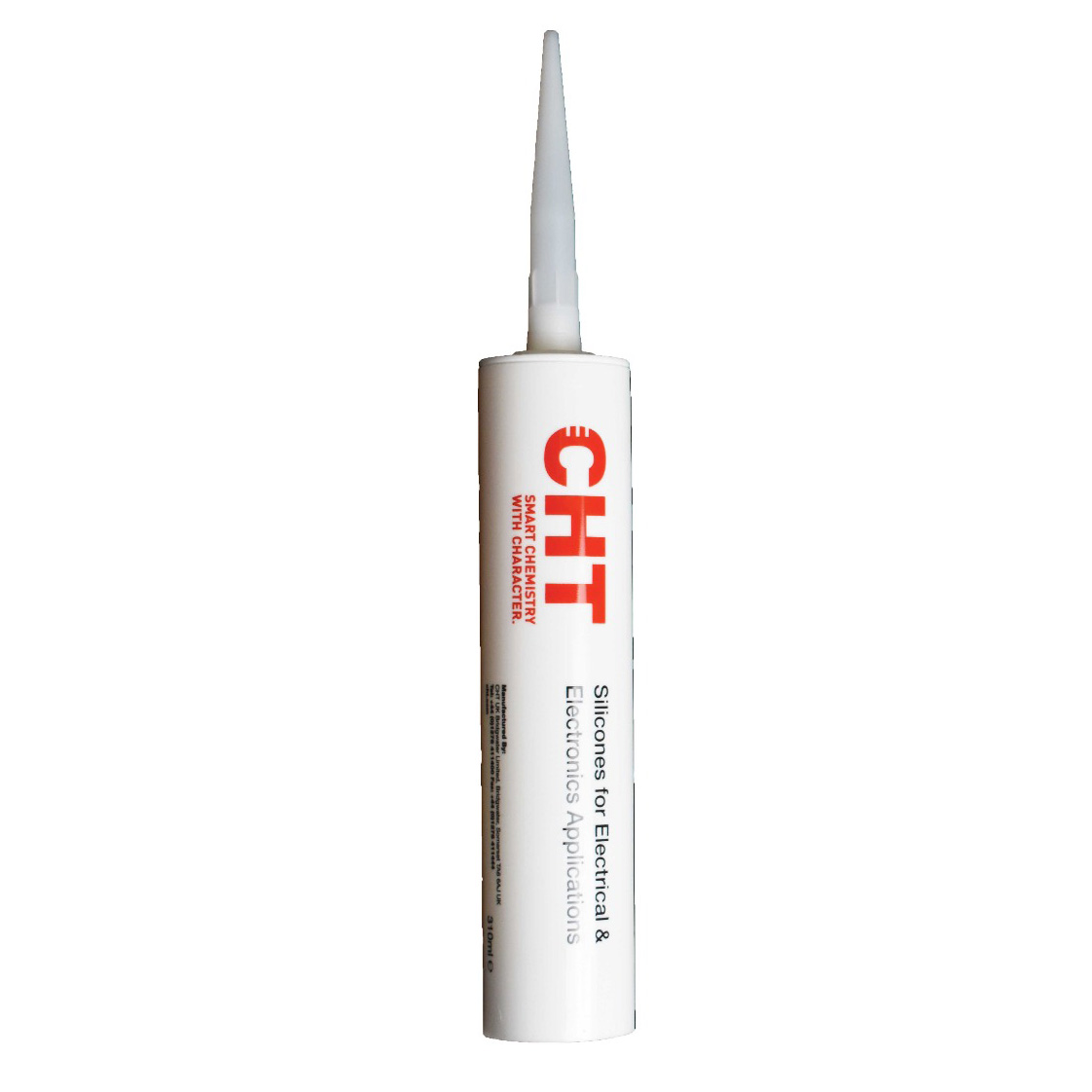


Description
CHT AS1802 is a thermally conductive silicone adhesive sealant that cures at room temperature straight from the cartridge. It is a 1-part, neutral cure RTV (room temperature vulcanizing) with an acetone cure system, used for bonding in PCB assemblies, thermal transfer, and automotive applications. CHT states it will not corrode copper or its alloys, and priming is not normally required.
Moisture in the air drives the cure, so there is no second component to meter or mix. The steps below cover surface prep, dispensing, and cure for a thermally conductive RTV bond.
Key Product Details
| Property | Value |
|---|---|
| Chemistry | Silicone, 1-part RTV |
| Cure Type | Acetone cure (neutral cure, moisture cure at room temperature) |
| Color | Gray |
| Rheology | Self-leveling |
| Viscosity | 350,000 cP (Brookfield) |
| Self Bonding | Yes |
| Tack-Free Time | 4 min at 23 °C (73 °F) |
| Cure Through to 3 mm Depth | 8 hr at 23 ± 2 °C and 65% humidity |
| Full Cure | 7 days |
| Hardness | 67 Shore A (ASTM D2240-95) |
| Tensile Strength | 3.9 N/mm² (566 psi), ISO 37 |
| Elongation at Break | 103% (ISO 37) |
| Young’s Modulus | 3.34 N/mm² (484 psi) |
| Density | 2.04 g/cm³ (BS ISO 2781) |
| Linear Shrinkage | 0.5% |
| Volume Coefficient of Thermal Expansion | 493 ppm/°C |
| Thermal Conductivity | 2.3 W/mK |
| Working Temperature | -50 °C to 220 °C (-58 °F to 428 °F) |
| Dielectric Strength | 20 kV/mm, 508 V/mil (ASTM D149) |
| Dielectric Constant | 3.85 (ASTM D150) |
| Dissipation Factor | 0.002 (ASTM D150) |
| Volume Resistivity | 1.00E+14 ohm-cm (ASTM D257) |
| Comparative Tracking Index | Above 600 V |
| Lap Shear, Aluminum | 7.15 kg/cm² (about 102 psi), ASTM D1002 |
| Lap Shear, Copper | 3.6 kg/cm² (about 51 psi), ASTM D1002 |
| Lap Shear, Stainless Steel 304 | 2.98 kg/cm² (about 42 psi), ASTM D1002 |
| Storage Temperature | 5 °C to 40 °C (41 °F to 104 °F) |
| Shelf Life | 12 months |
| Cured Property Test Conditions | 7 days at 23 ± 2 °C and 50 ± 5% humidity |
| Package | 310ml cartridge |
Performance in Production
- 2.3 W/mK thermal conductivity gives heat a path through the bond line, which matters where the adhesive sits between a heat-generating part and the surface carrying heat away.
- CHT states the sealant will not corrode copper or its alloys, so it can be used next to copper and copper alloy parts in electronic assemblies.
- A 4 minute tack-free time gives a short window to mate parts after dispensing. Plan your fixturing around it.
- Cure-through is 8 hours at 3 mm depth and full cure takes 7 days. CHT calls for leaving joints undisturbed at least 24 hours before they see stress.
- 20 kV/mm dielectric strength, 1.00E+14 ohm-cm volume resistivity, and a comparative tracking index above 600 V give the cured joint electrical insulating properties.
- 67 Shore A hardness with 103% elongation gives a firm but flexible rubber. Low linear shrinkage (0.5%) helps limit stress on bonded parts as the joint cures, and the -50 °C to 220 °C working range suits assemblies that see wide temperature swings.
- Self-leveling rheology suits horizontal joints and flat dispensing. Test a bead on vertical or overhead joints before production.
- Lap shear is highest on aluminum and lower on copper and stainless steel 304. Test your own substrates and loads, and use a structural adhesive or mechanical fastener where the joint carries load.
Common Applications
- Bonding in PCB assemblies
- Thermal transfer applications
- Potting over electronic components with a 1-part thermally conductive RTV
- Automotive applications
- Electronic assemblies with copper and copper alloy parts
- Bonding aluminum, copper, and stainless steel 304 (substrates with published lap shear data)
Available Sizes
- 310ml Cartridge, SKU QTM-AS1802-310ML
Related Products
- CHT AS1803 Electronic Grade Adhesive Sealant is the white acetone cure grade, listed at 1.55 W/mK.
- CHT AS1700 Electronic Grade Adhesive Sealant is the translucent alkoxy cure grade, listed at 0.2 W/mK.
How Thermally Conductive RTV Silicone Bonding Works
AS1802 is a 1-part system, so the process is surface prep, dispense, mate, and cure. These steps follow CHT’s use and cure guidance for AS1802.
- Clean the surfaces. They need to be clean, dry, and free from grease, dirt, and loose material. Priming is not normally required.
- Test your substrates. CHT advises testing on clean, degreased substrates to confirm adhesion. Test polycarbonate and PMMA first, since stress cracking can appear on some grades.
- Dispense from the cartridge with a manual or pneumatic gun. For pneumatic dispensing of a 310ml cartridge, CHT recommends 2.25 to 3.45 bar.
- Apply to one clean surface, then bring the second surface into contact within the 4 minute tack-free time.
- Keep the joint at least 1 mm thick for best bond strength.
- Let atmospheric moisture drive the cure. CHT’s recommended range is 20 to 30 °C and 40% to 70% relative humidity. Cure time depends on joint thickness, humidity, and temperature.
- Leave the joint undisturbed for at least 24 hours, longer where you can. Full cure takes 7 days.
Aluminum, copper, and stainless steel 304 have published lap shear data. For any other substrate, run your own test or call us before you commit to production.
Frequently Asked Questions
What is CHT AS1802 used for?
CHT AS1802 is used for bonding in PCB assemblies, thermal transfer, and automotive applications that need a thermally conductive silicone adhesive sealant. CHT also lists it among its silicone products for potting applications. It is a 1-part RTV, so it cures from moisture in the air with no mixing.
Is AS1802 a neutral cure silicone, and will it corrode copper?
Yes, CHT classifies AS1802 as a non-corrosive, neutral cure RTV with an acetone cure system. CHT states it will not corrode copper or its alloys and describes it as suitable for use with electronic components.
How thermally conductive is AS1802?
AS1802 has a thermal conductivity of 2.3 W/mK. AS1803, the white acetone cure grade in CHT’s range, is listed at 1.55 W/mK, and AS1700 is listed at 0.2 W/mK. Call us if you want help matching a grade to your heat load.
How long does AS1802 take to cure?
The surface skins in 4 minutes at 23 °C, the sealant cures through 3 mm in 8 hours, and full cure takes 7 days. CHT measures cure-through at 23 ± 2 °C and 65% humidity, and cure time changes with joint thickness, humidity, and temperature. CHT recommends leaving joints undisturbed for at least 24 hours.
Does AS1802 need a primer?
Priming is not normally required. CHT describes primerless adhesion to many substrates and calls for clean, dry surfaces free of grease, dirt, and loose material. Test on your own cleaned, degreased substrates before production.
Can I use AS1802 on polycarbonate or acrylic (PMMA)?
Test it first. CHT warns that stress cracking can appear on some grades of polycarbonate and poly(methyl methacrylate), so run an initial compatibility test on your grade. Call us with your substrate and we can help you plan the test.
What size is AS1802 and how do I dispense it?
We sell AS1802 in a 310ml cartridge, SKU QTM-AS1802-310ML. It dispenses with a manual or pneumatic cartridge gun. For pneumatic dispensing, CHT recommends 2.25 to 3.45 bar, and higher pressure can let gas bypass the piston, which causes spluttering at the nozzle and poor bead quality.
Is AS1802 gray or black?
The AS1802 on this page is gray. CHT lists AS1802 Black as a separate product, and this page does not cover it. Call (800) 220-1966 if you need the black grade.
Questions on fit for your electronics bonding or thermal transfer application? Call (800) 220-1966 or email [email protected].


Reviews
There are no reviews yet.