


Description
Please note: Weld-On 3, 4, and 16 are restricted under South Coast Air Quality Management District (SCAQMD) Rule 1168, which caps VOC content for solvent cements. These products cannot be shipped to or used in areas regulated by SCAQMD — Los Angeles, Riverside, San Bernardino, and Orange counties.
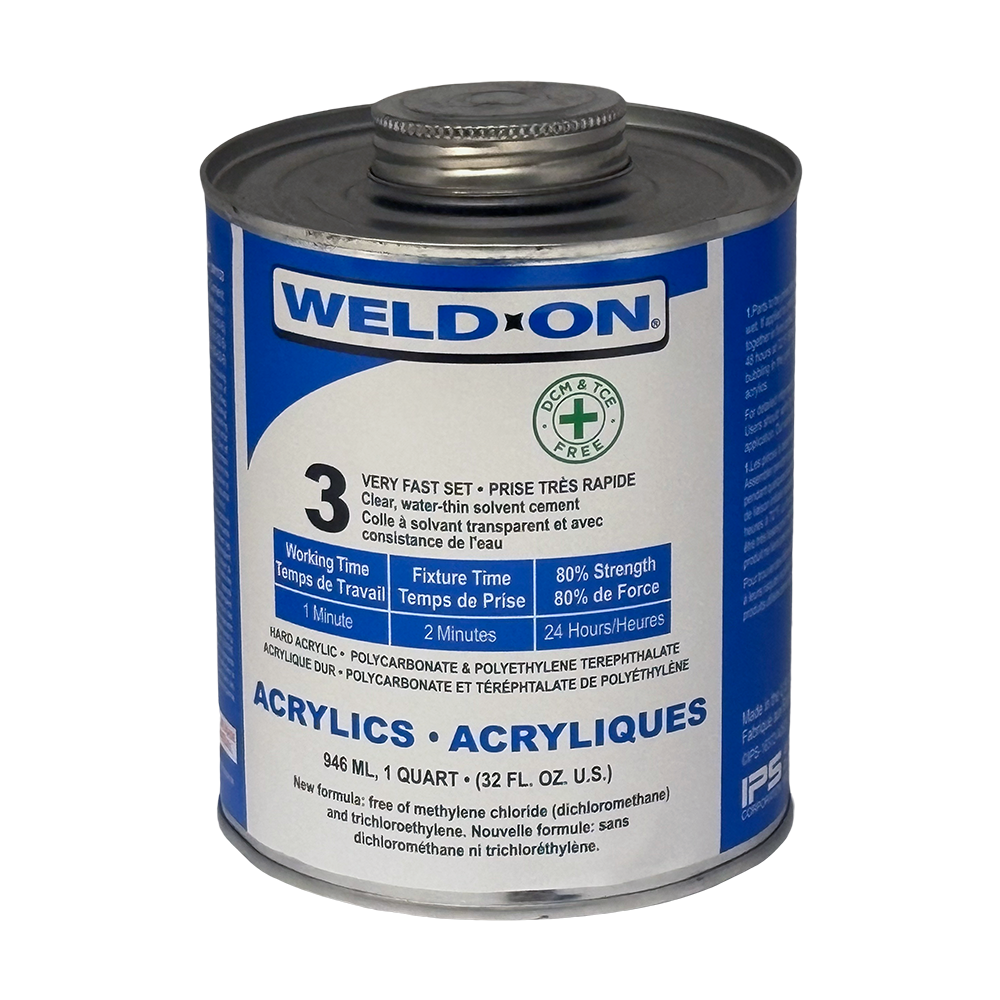
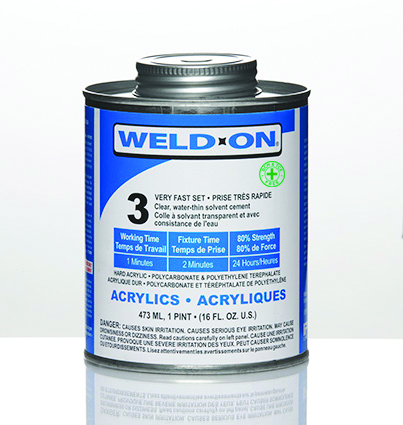
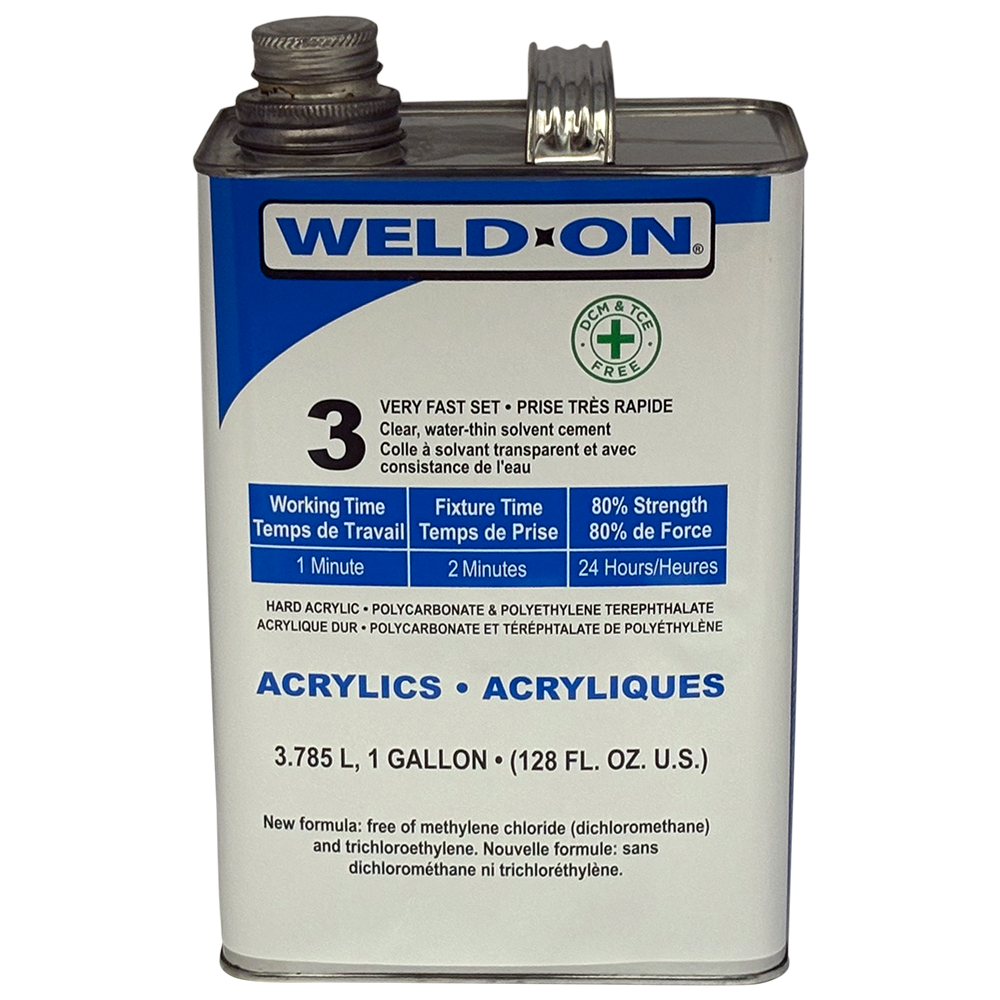
Weld-On® 3 DCM TCE FREE Acrylic Plastic Cement is a clear, water-thin industrial solvent cement formulated for bonding acrylic plastic to itself. Designed for capillary and soak-method application, it softens and fuses closely fitted thermoplastic surfaces to create clear bonds for professional plastic fabrication, sign assembly, display production, and container manufacturing.
Key Features
- Methylene chloride-free and trichloroethylene-free acrylic solvent cement
- Water-thin consistency supports controlled capillary application into closely fitted joints
- Creates clear, fused bonds by softening and joining compatible plastic surfaces
- Develops an initial bond within minutes and gains substantial strength within several hours
- Suitable for bonding cast and extruded acrylic
- Supports capillary and soak-method assembly processes
- Formulated for industrial and professional use
Technical Specifications
| Specification | Value |
|---|---|
| Product Type | Acrylic solvent cement |
| Color | Clear |
| Viscosity | Water-thin |
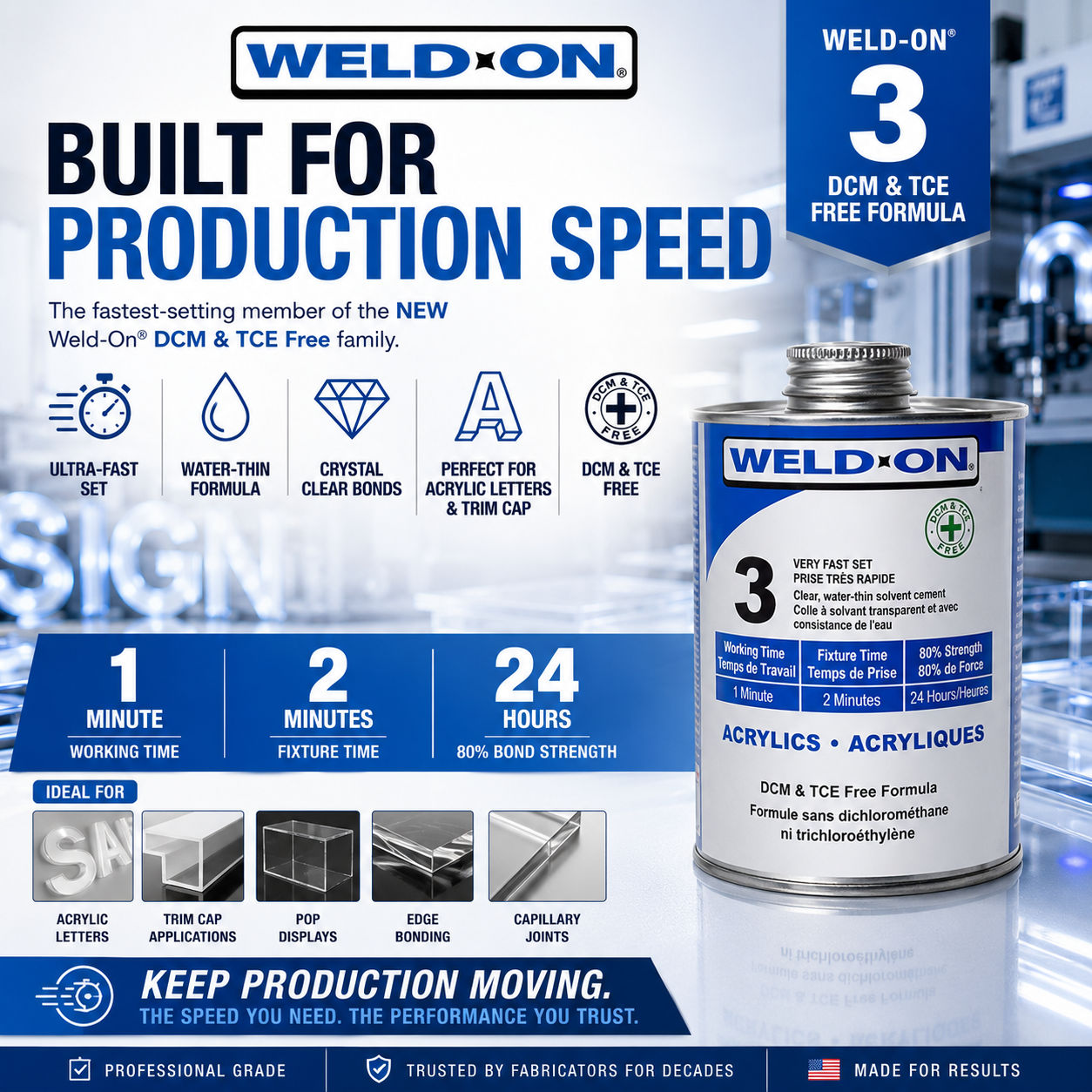
| Working Time at 73°F (23°C) | 1 minute |
| Fixture Time at 73°F (23°C) | 2 minutes |
| Specific Gravity at 73°F (23°C) | 1.218 ± 0.01 |
| Flash Point | 36°F, closed cup |
| Acrylic Bond Strength After 2 Hours | 732 lb/in² (51.5 kg/cm²) |
| Acrylic Bond Strength After 24 Hours | 2,825 lb/in² (198.6 kg/cm²) |
| Acrylic Bond Strength After 1 Week | 2,924 lb/in² (205.6 kg/cm²) |
| Shelf Life | 2 years in tightly sealed containers |
| Recommended Storage Temperature | Below 80°F (27°C), away from direct sunlight |
Compatible Substrates and Materials
- Cast acrylic
- Extruded acrylic
- Acrylic panels and letters
- Butyrate trim capping used with acrylic assemblies
Application Guidance
Surfaces must be clean, dry, closely fitted, and assembled without forcing. Apply the cement with a syringe, eyedropper, or brush and join the parts while the surfaces remain wet. For capillary bonding, lightly position the parts, introduce cement at the joint edge, allow a few seconds for surface softening, and press firmly together. The cement may travel approximately 0.25 in (0.64 cm) through a properly fitted joint. For the soak method, vertically dip the bonding surfaces for approximately 2 to 5 minutes before joining them firmly. The product is not recommended for cross-linked acrylic. High humidity may cause whitening or blushing, and annealing should be considered when crazing is a concern. Do not add thinner to adjust viscosity.
Typical Use Cases
- Bonding acrylic letters to sign panels
- Fabricating point-of-purchase displays
- Joining flat acrylic sheets with butt joints
- Applying butyrate trim capping to acrylic assemblies
- Fabricating plastic containers and bottles
- Assembling acrylic housewares and display components
Target Industries and Buyers
- Sign manufacturers and sign fabrication shops
- Point-of-purchase display producers
- Acrylic and thermoplastic fabricators
- Plastic container and bottle manufacturers
- OEM assembly operations
- Professional model, fixture, and exhibit builders
Performance Advantages
This water-thin acrylic cement flows into closely fitted joints more readily than thicker-bodied adhesives, making it suitable for capillary bonding and precision plastic fabrication. Its solvent-welding action fuses compatible acrylic surfaces rather than forming a separate adhesive layer. The rapid fixture time supports efficient assembly, while bond strength continues to increase after the initial joint has formed.
Ordering Information
| Container Size | Container Type |
|---|---|
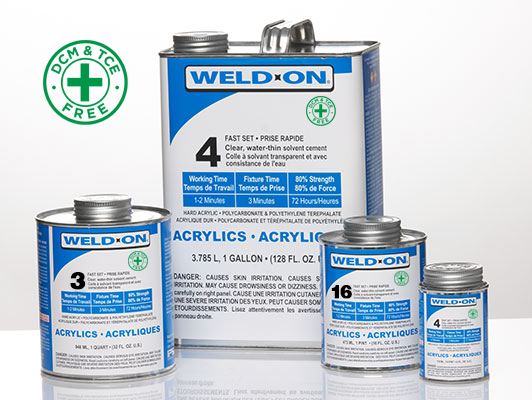
| 1/4 pint (118 mL) | Metal can |
| 1 pint (473 mL) | Metal can |
| 1 quart (946 mL) | Metal can |
| 1 gallon (3.785 L) | Metal can |
Common Questions
Q: What material is Weld-On® 3 DCM TCE FREE designed to bond?
A: It is primarily formulated for bonding acrylic, including cast and extruded acrylic, to itself.
Q: Can it be used on cross-linked acrylic?
A: No. The technical documentation does not recommend it for cross-linked acrylic.
Q: How should the cement be applied?
A: It may be applied with a syringe, eyedropper, or brush. Capillary and soak-method applications are specifically described in the technical documentation.
Q: How quickly does the joint fixture?
A: The listed fixture time is approximately 2 minutes at 73°F (23°C).
Q: Does the product cure clear?
A: It is a clear cement formulated to create clear bonds on compatible thermoplastic surfaces.
Q: Can humidity affect the finished bond?
A: Yes. High humidity may cause a white appearance known as blushing.
Q: Can thinner be added if the cement becomes thick?
A: Adding thinner is not recommended because it may significantly alter the cement’s properties.
Q: What safety precautions are required?
A: This is a highly flammable industrial product that is harmful if inhaled, may cause an allergic skin reaction, and is suspected of causing cancer. Use it only with adequate ventilation, keep it away from ignition sources, wear appropriate protective equipment, and review the current Safety Data Sheet before use.


Reviews
There are no reviews yet.