

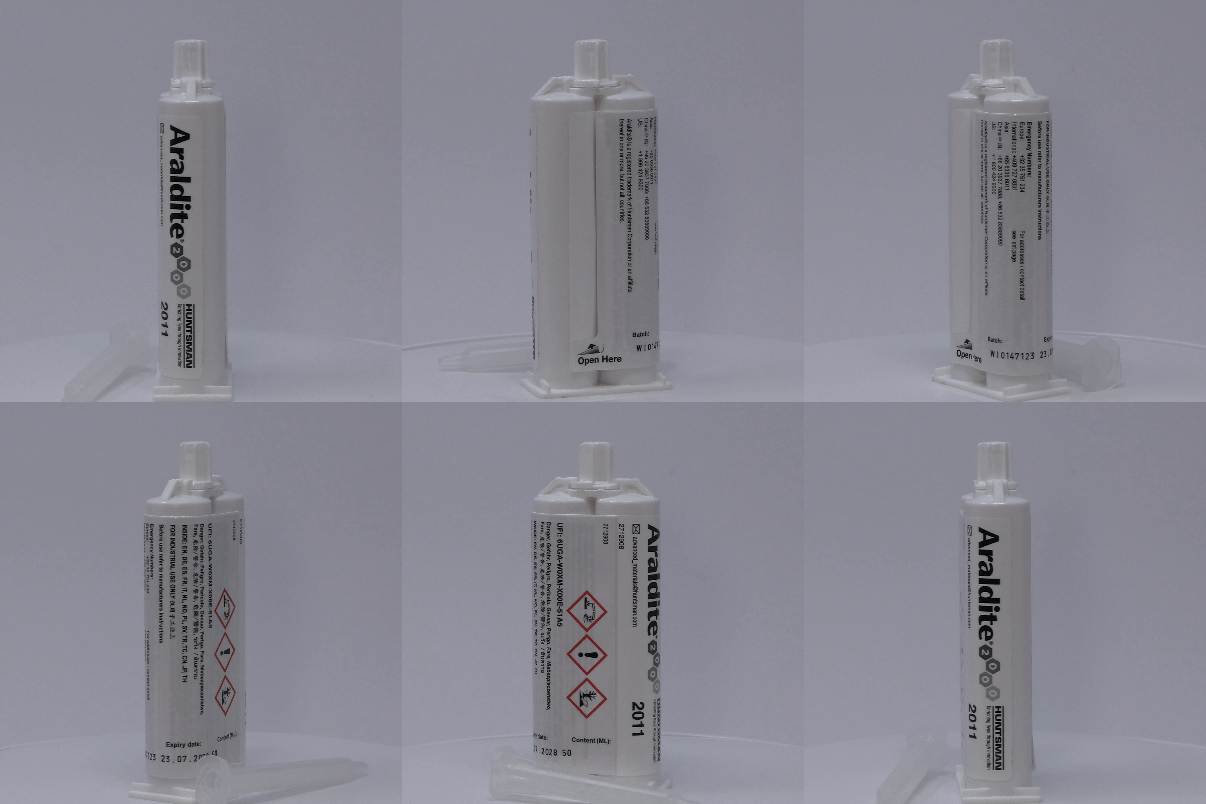


Description
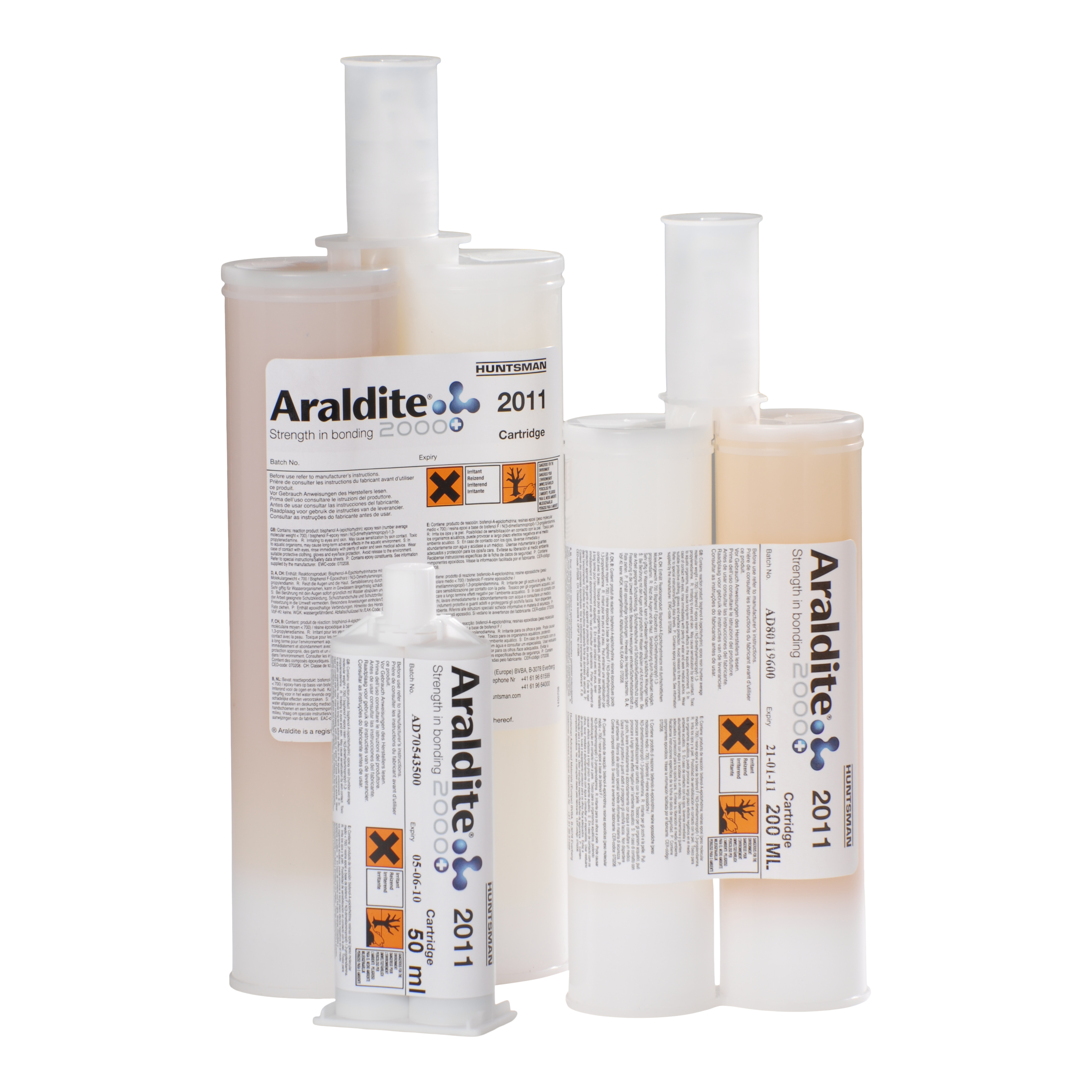
Araldite 2011 epoxy adhesive, also sold as Araldite 2011 A/B, is a two-component, room temperature curing structural epoxy paste from Huntsman Advanced Materials. It is used for industrial assembly and repair where parts need to be positioned before the joint sets, and it bonds metals, ceramics, glass, rubber, and rigid plastics.
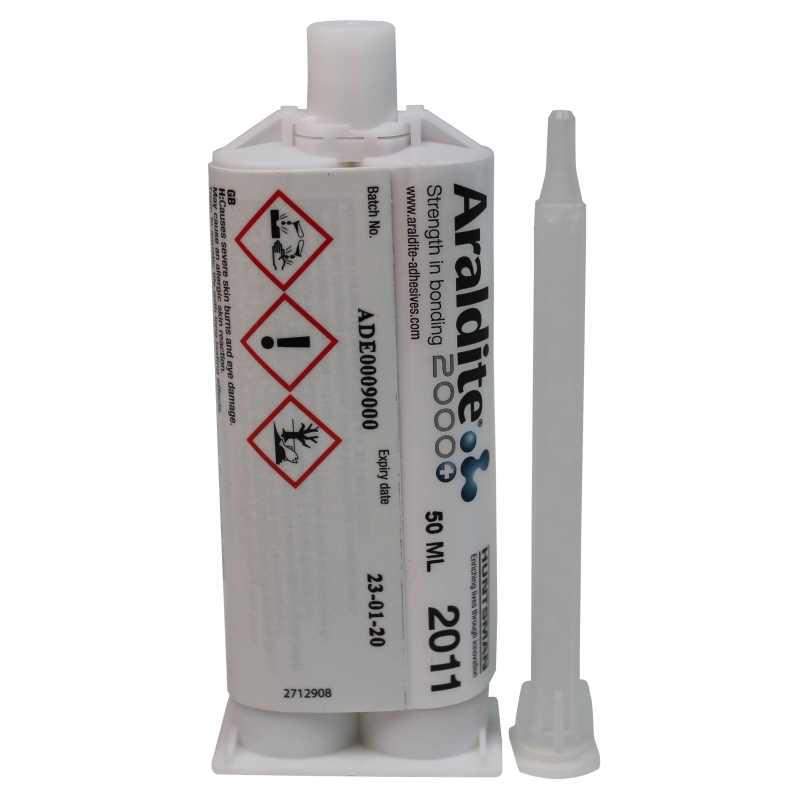
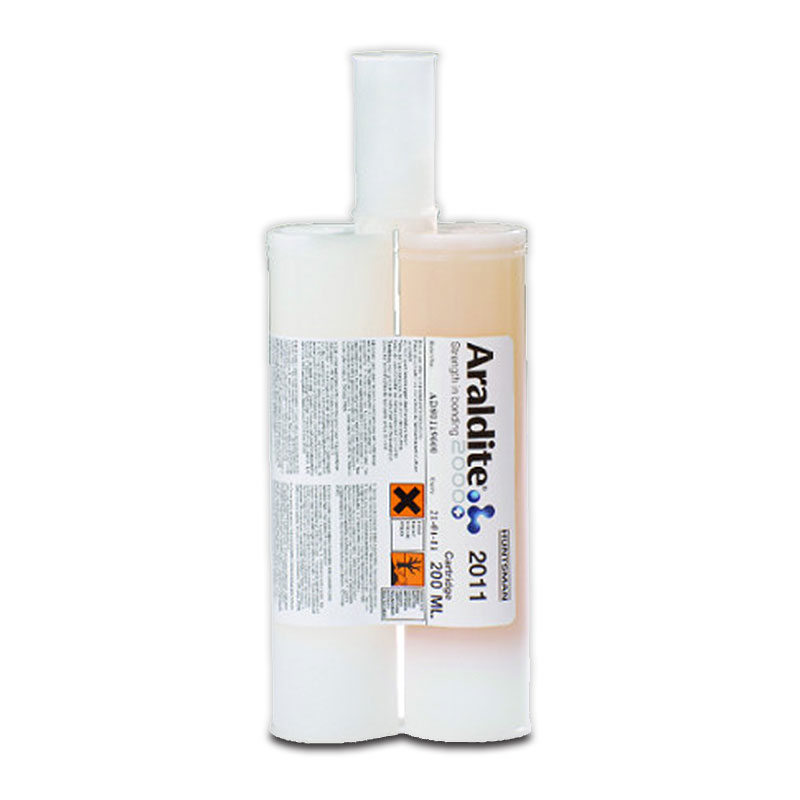
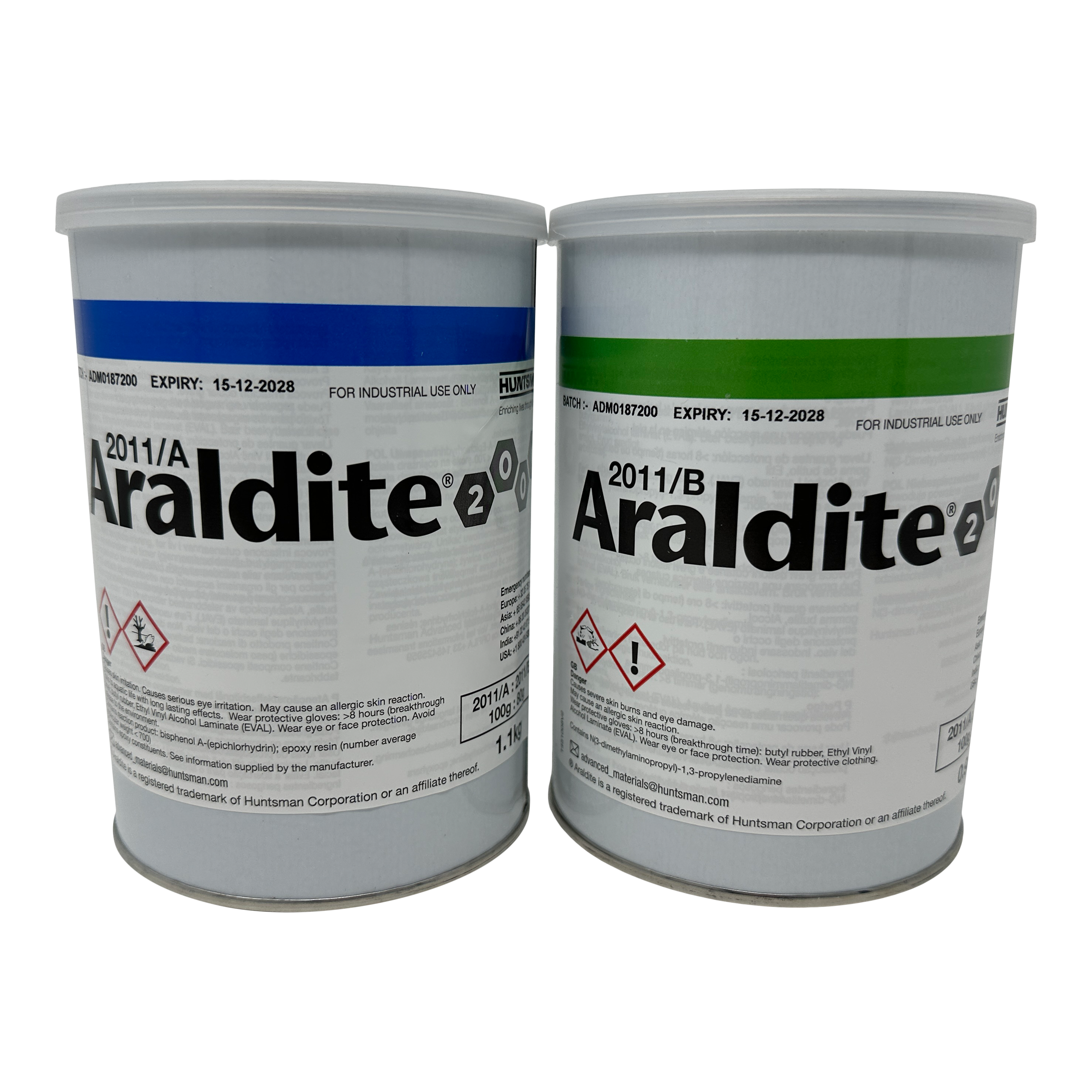
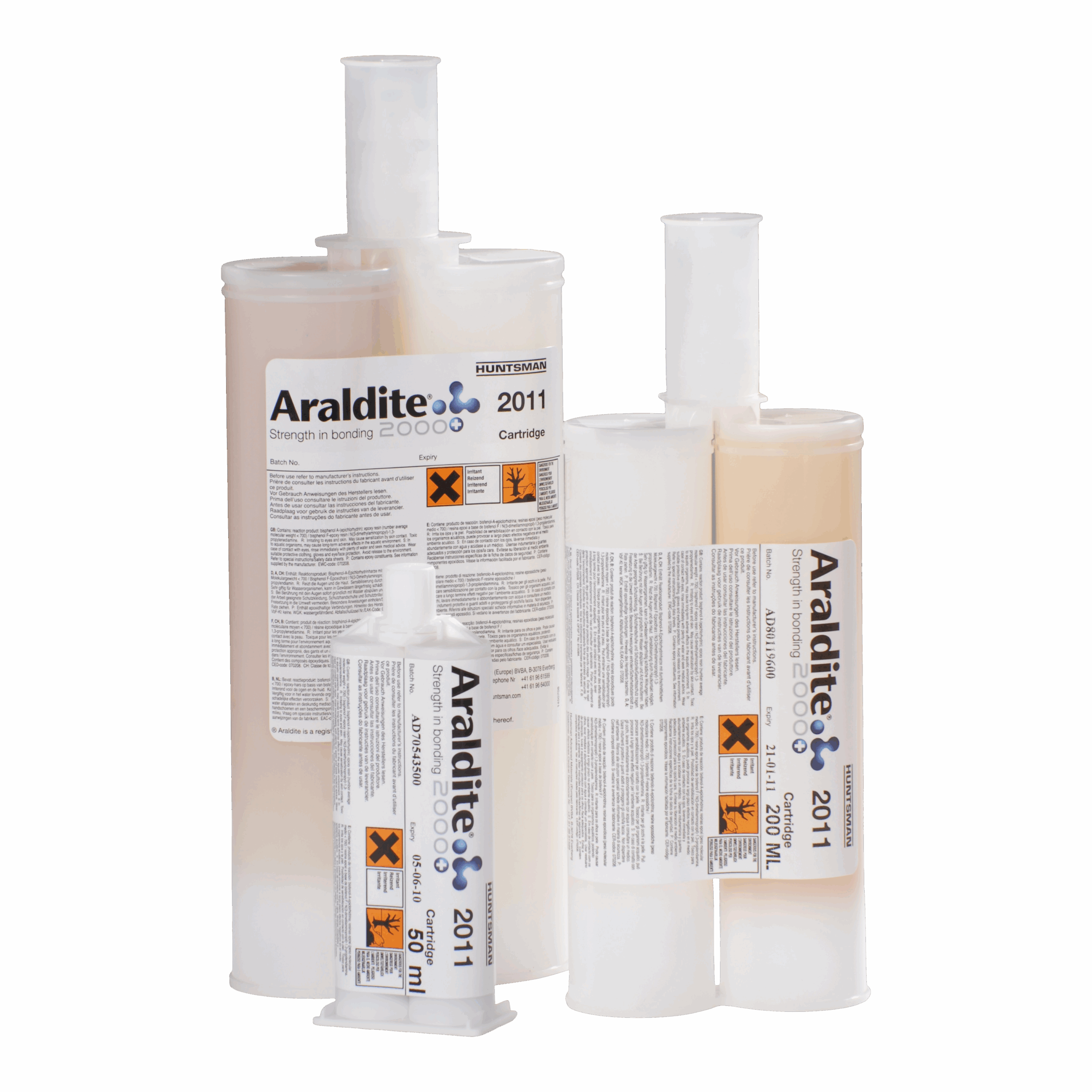
You mix resin and hardener, apply the mix to clean prepared surfaces, fixture the parts, and let the joint cure. Huntsman positions this grade on long working life, low shrinkage, and good resistance to dynamic loading. It comes in 50ml and 200ml cartridges and a 2kg kit.
Key Product Details
| Property | Value |
|---|---|
| Chemistry | Two-component epoxy, structural adhesive |
| Mix Ratio | 100:80 by weight (Part A to Part B), 1:1 by volume |
| Appearance | Part A neutral, Part B pale yellow, mixed system pale yellow paste |
| Density | Part A ~1.15 g/cm³, Part B ~0.96 g/cm³, mixed ~1.05 g/cm³ |
| Viscosity at 77°F (25°C) | Part A 30,000 to 50,000 cP, Part B 20,000 to 35,000 cP, mixed 30,000 to 45,000 cP |
| Pot Life | ~100 minutes at 77°F (25°C), 100 g mass |
| Fixture Time | ~7 hours (420 minutes) to reach 145 psi lap shear at 73°F |
| Processing Temperature | 50 to 104°F |
| Maximum Operating Temperature | 194°F |
| Glass Transition Temperature (DSC) | ~113°F (45°C) |
| Elongation at Break | 9% |
| Tensile Modulus | 275,571 psi |
| Flexural Strength (ISO 178) | 8,760 psi (60.4 MPa) |
| Roller Peel (ISO 4578) | 29 pli (5.0 N/mm) |
| Dielectric Strength (VSM 77170, 50 Hz, 75°F) | 25 to 27 kV/mm instantaneous, 22 to 24 kV/mm 1-minute |
| Water Absorption (ISO 62-80) | 0.8% by weight after 24 hours at 73°F |
| Shelf Life | 6 years from date of manufacture |
| Storage | Dry place, original sealed containers, 36 to 104°F (2 to 40°C), out of direct sunlight. If stored below 60°F, condition at 60 to 77°F before use. |
| OEM Specifications Listed by Huntsman | Airbus ABP 5-1158, Airbus AIMS 10-04-020, Airbus ASNA 4049 |
| Available Sizes | 50ml cartridge, 200ml cartridge, 2kg quart kit |
Performance in Production
- Long working life gives you time to position and fixture multi-part assemblies. Pot life is measured on a 100 g mass at 77°F, so treat it as a reference for your own batch size and shop temperature.
- At room temperature the joint needs most of a shift to build strength, and heat shortens that wait considerably. The cure table below lists every temperature.
- Low shrinkage supports tight-tolerance bond lines. A glue line of 0.002 to 0.004 in (0.05 to 0.10 mm) normally gives the highest lap shear strength.
- Huntsman lists good resistance to dynamic loading, which supports joints that see vibration or cyclic loads.
- Surface preparation drives results. Degrease with acetone, isopropanol for plastics, or a proprietary degreaser. Abrade or chemically etch for the strongest joints, then degrease again. Never use low-grade alcohol, gasoline, or paint thinner.
- Huntsman lists 2011 by viscosity as a paste, not as a thixotropic grade. For vertical or overhead joints where the bead has to stay put, look at Araldite 2014 or Araldite 2015-1, which Huntsman describes as non-sag.
- Clean tools with hot water and soap before residue cures. Cured residue is difficult and time-consuming to remove.
Cure Time by Temperature
| Cure Temperature | Time to 145 psi (1 MPa) Lap Shear | Time to 1,450 psi (10 MPa) Lap Shear |
|---|---|---|
| 50°F | 24 hours | 36 hours |
| 59°F | 12 hours | 18 hours |
| 73°F | 7 hours | 10 hours |
| 104°F | 2 hours | 3 hours |
| 140°F | 30 minutes | 45 minutes |
| 212°F | 6 minutes | 7 minutes |
Huntsman technical data sheet, lap shear strength per ISO 4587.
Lap Shear Strength by Substrate
| Substrate | Lap Shear Strength (psi) |
|---|---|
| Aluminum | 3,771 |
| Steel | 3,626 |
| Stainless steel | 3,191 |
| Galvanized steel | 2,611 |
| Copper | 3,481 |
| Brass | 3,481 |
| GRP | 1,639 |
| CFRP | 2,770 |
| ABS | 798 |
| Polycarbonate | 653 |
| PMMA | 406 |
| PVC | 290 |
Huntsman technical data sheet, ISO 4587. Typical values, cured 16 hours at 104°F and tested at 73°F. Metals were sand blasted. Plastics and composites were lightly abraded and alcohol degreased.
Common Applications
- Industrial assembly and repair across metals, ceramics, glass, rubber, and rigid plastics
- Metal-to-metal bonding on aluminum, steel, stainless steel, copper, and brass
- Composite bonding on GRP and CFRP parts
- Electronic assemblies and electronic components
- Marine applications and wood assembly
- Airplane galley assembly
- Ceramic, glass, and tile surfaces
Available Sizes
- 50ml Cartridge, SKU HUN2859208
- 200ml Cartridge, SKU HUN4938208
- 2kg Quart Kit, SKU HUN3301608 (Part A and Part B, 2kg total)
Related Products
Other Araldite epoxies
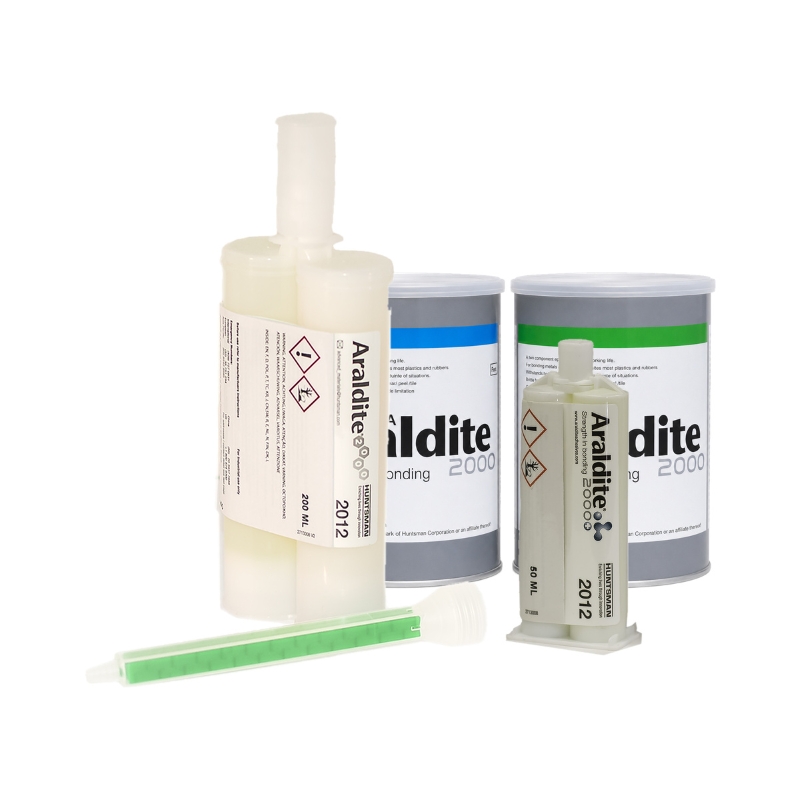
- Araldite 2012, faster-curing
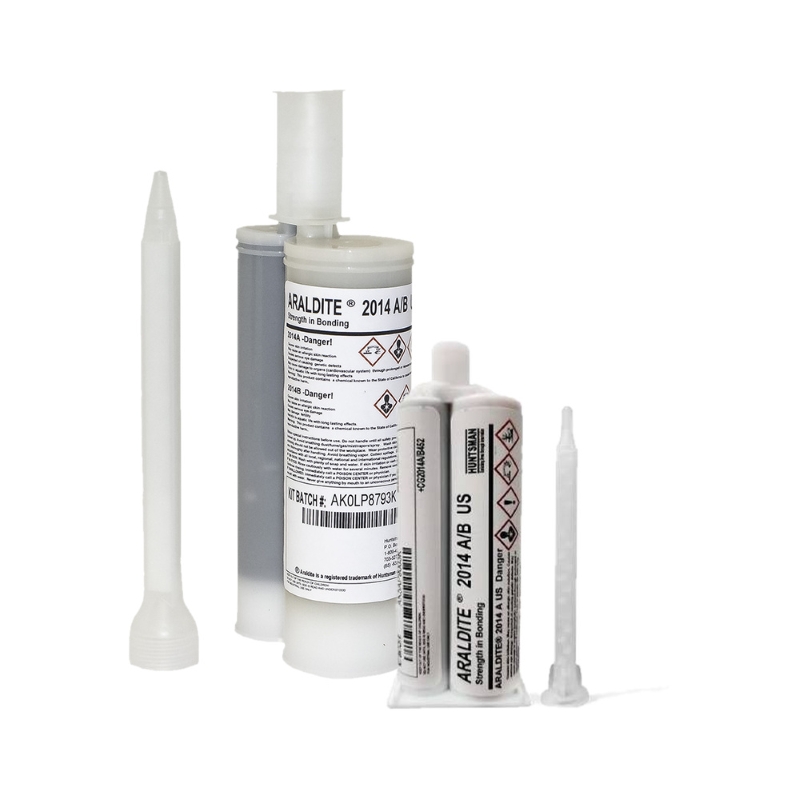
- Araldite 2014 and Araldite 2015-1, non-sag
Bulk Araldite 2011
- Araldite AW 106 Epoxy Resin, 25 kg (Part A)
- Araldite 2011 Hardener, bulk pail (Part B)
Guns and mixers
- 200ml cartridges: DS200 Manual Gun, DS200 Pneumatic Gun, and Araldite 2000+ Mixer, 50 Pack
- 50ml cartridges: Chem-Set PAK-50 Manual Gun, Medmix DMA 51 Manual Gun, and Araldite 2000 Plus Mixer, 50 Pack
How Araldite 2011 Epoxy Bonding Works
Araldite 2011 is a two-part epoxy. Resin and hardener stay separate until mixing, and the reaction between them builds the bond at room temperature. These shop steps follow Huntsman’s data sheet.
- Degrease the joint surfaces with acetone, isopropanol for plastics, or another proprietary degreaser.
- Abrade or chemically etch for the strongest joints, then degrease a second time.
- Mix Part A and Part B 1:1 by volume or 100:80 by weight. Cartridges meter the ratio through the static mixer.
- Apply to the prepared, dry surfaces by hand or robotically, then assemble and secure the parts in a fixed position right away.
- Let the joint cure using the cure table above. Heat shortens the wait.
- Clean tools with hot water and soap before residue cures.
Araldite 2011 vs Other Araldite Epoxies
Pot life and fixture time are in minutes. Fixture time is the time to reach 145 psi lap shear strength. Figures come from the Huntsman Araldite 2000 core range catalog (May 2023).
| Grade | Pot Life (min) | Fixture Time (min) | Max Operating Temp (°F) | Color |
|---|---|---|---|---|
| Araldite 2011 | 100 | 420 | 194 | Pale yellow |
| Araldite 2012 | 6 | 20 | 158 | Yellow |
| Araldite 2014 | 40 | 180 | 284 | Dark gray |
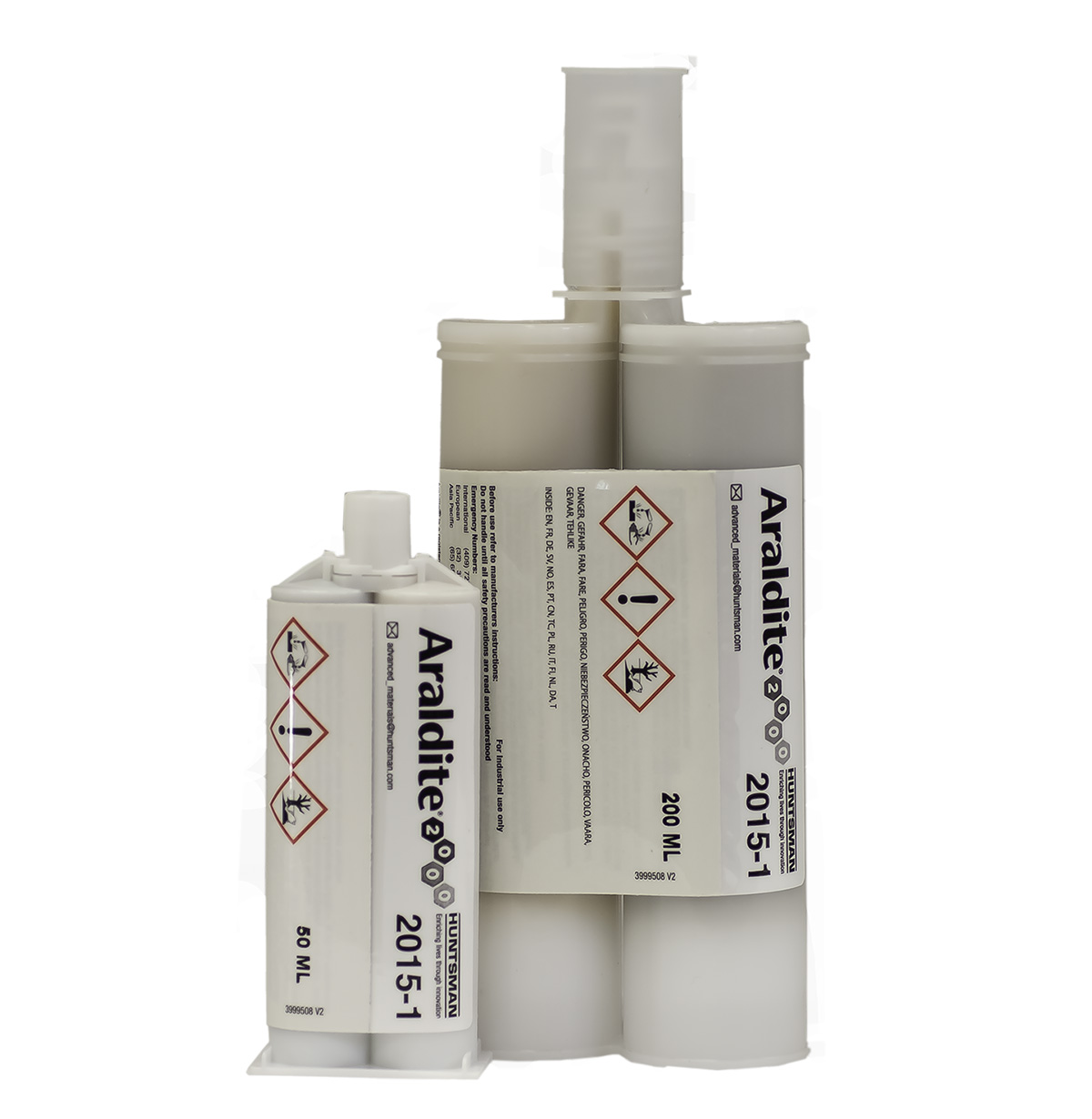
| Araldite 2015-1 | 45 | 240 | 212 | Beige |
| Araldite 2031-1 | 60 | 180 | 212 | Black |
Frequently Asked Questions
What is Araldite 2011 A/B epoxy adhesive used for?
Araldite 2011 is used for industrial assembly and repair where a long working time is needed. Huntsman lists metals, ceramics, glass, rubber, and rigid plastics as bondable materials, and lists airplane galley assembly, electronic components, marine applications, and wood assembly among its end uses. Araldite 2011, Araldite 2011 A/B, and Araldite 2011 epoxy all describe the same product. Lap shear on PVC and PMMA is far below metals, so test those plastics before production or call us.
What is the difference between Araldite 2011 and Araldite 2012?
Both are two-part epoxies, but Araldite 2012 cures much faster. Araldite 2011 has a pot life of about 100 minutes and a fixture time of 420 minutes, while Araldite 2012 has a 6 minute pot life and a 20 minute fixture time. The trade-off is that 2011 is listed for a higher maximum operating temperature (194°F versus 158°F) and a higher elongation at break (9% versus 4%). Choose 2011 when you need time to position parts. Choose 2012 when production speed matters more than open time.
Is there a faster or slower Araldite epoxy than 2011?
Araldite 2011 has one of the longest pot lives in Huntsman’s epoxy line, so the options run faster. Araldite 2012 is the quickest at 6 minutes. Araldite 2014, 2015-1, and 2031-1 sit in between at 40 to 60 minutes and are non-sag. If you need more open time than 2011 offers, call us. Huntsman also makes acrylic grades that cure faster, but acrylic is a different chemistry, so talk to us before switching.
Are all Araldite adhesives epoxies?
No. Huntsman’s Araldite 2000 core range includes epoxies, acrylics, and a polyurethane. Araldite 2011 and 2012 are epoxies. Chemistry changes open time, flexibility, temperature limits, and substrate fit, so call us if you are not sure which grade fits your job.
How long is the pot life and cure time of Araldite 2011?
Pot life is about 100 minutes at 77°F on a 100 g mass. At 73°F the joint reaches 145 psi lap shear strength in about 7 hours and 1,450 psi in about 10 hours. Heat speeds that up and cold slows it down, so use the cure table for your shop temperature.
What is the mix ratio for Araldite 2011?
Araldite 2011 mixes 1:1 by volume, or 100 parts Part A to 80 parts Part B by weight. The 50ml and 200ml cartridges meter the ratio through the static mixer. For the 2kg kit, weigh or measure Part A and Part B to that ratio.
Does Araldite 2011 hold up in water and heat?
It holds up in cool water and loses strength in hot water and after long heat exposure. After 90 days in 73°F water, lap shear measured 3,597 psi, but after 90 days in 194°F water it fell to 290 psi. Heat aging at 176°F gave 2,451 psi after 60 days and 566 psi after 5 years. Test your joint first if it lives in hot water or near the temperature limit.
Is Araldite 2011 the same as Araldite AW 106 and HV 953 U?
Yes, for bulk supply. Per Huntsman’s price list, bulk Araldite 2011 is supplied as Araldite AW 106 resin (Part A) and Hardener HV 953 U (Part B) in separate pails. We list them as Araldite AW 106 Epoxy Resin and Araldite 2011 Hardener.
Questions on fit for your bonding application? Call (800) 220-1966 or email [email protected].





Reviews
There are no reviews yet.