

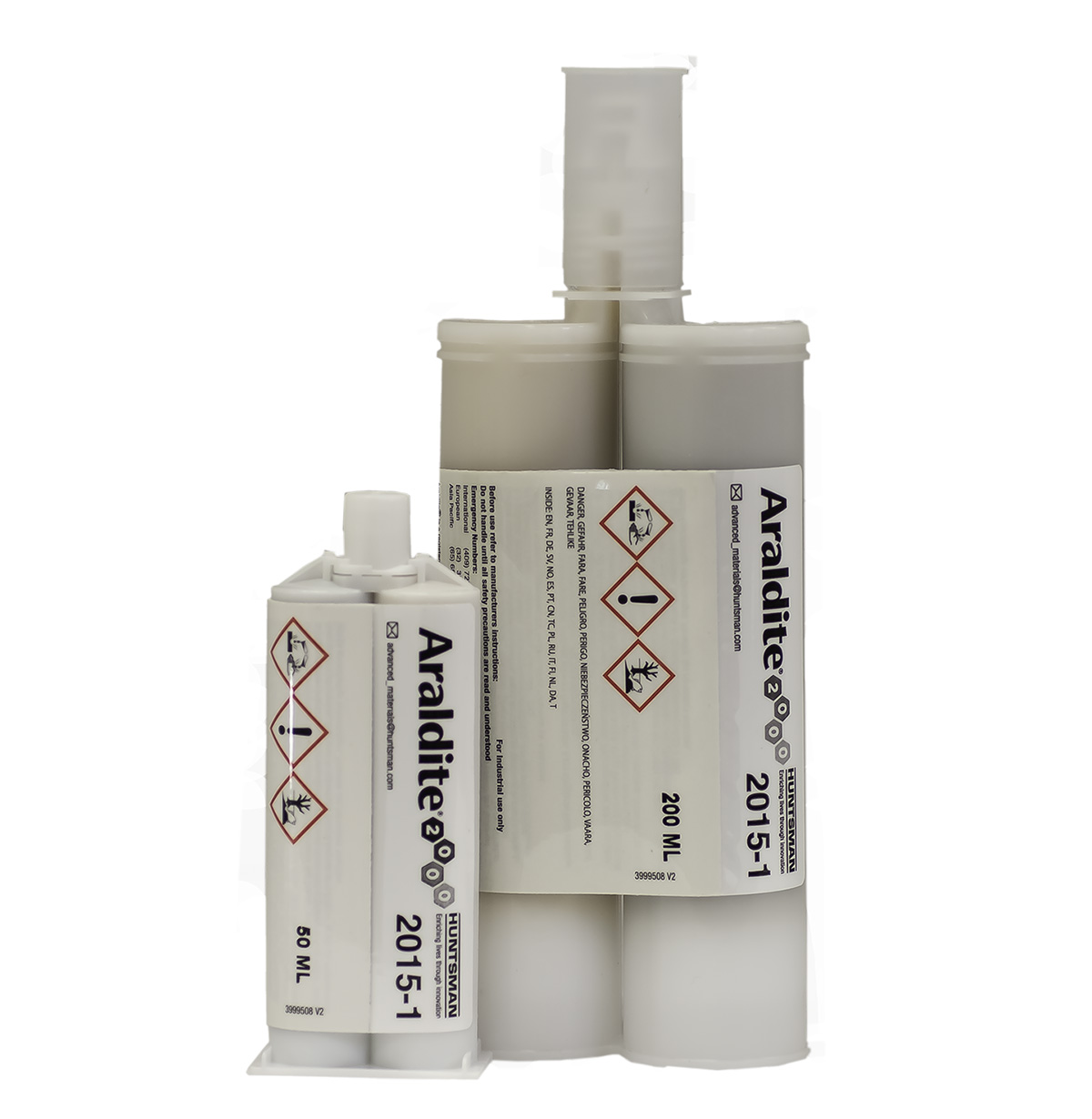


Description
Araldite 2015-1 epoxy adhesive is a two-component, room temperature curing, toughened epoxy paste from Huntsman for bonding GRP, SMC, metals, and dissimilar substrates. It mixes 1:1 by volume and by weight, stays in place on gap fills up to 0.394 in (10 mm), and gives a 45 to 55 minute pot life to position mid-sized and large parts. Huntsman lists it as resistant to dynamic loading and weathering, and as Lloyd’s Register qualified.
Used for hull-to-deck bonding, rail vehicle assemblies, and GRP and SMC panel work, it goes on as a bead through a static mixer from a 1:1 cartridge. The job comes down to surface prep, bead, assemble, and hold. The full walkthrough is further down the page.
Key Product Details
| Property | Value |
|---|---|
| Chemistry | Two-component epoxy, toughened thixotropic paste |
| Mix Ratio | 1:1 by volume and 1:1 by weight (100:100) |
| Appearance | Part A gray soft paste, Part B beige soft paste, mixed gray paste |
| Specific Gravity (ASTM D1475) | 1.4 (Part A, Part B, and mixed) |
| Viscosity (ASTM D2196) | Thixotropic |
| Pot Life | 45 to 55 minutes at 77°F (100 g mass) |
| Fixture Time | 4 hours (240 minutes) to reach 145 psi lap shear at 77°F |
| Handling Strength | Over 150 psi at 4 hours, over 1,500 psi at 6.5 hours (77°F, primed aluminum) |
| Gap Fill | Non-sagging up to 0.394 in (10 mm) |
| Maximum Continuous Operating Temperature | 212°F |
| Glass Transition Temperature | ca. 171°F (77°C) by DMA, cured 1 hour at 176°F (80°C) |
| Tensile Strength (ISO 527) | 31 MPa (4,496 psi) |
| Tensile Modulus | 1,600 MPa (232,060 psi) |
| Elongation at Break | 4.2% |
| Flexural Strength (ISO 178) | 43 MPa (6,236 psi) |
| Flexural Modulus | 1,800 MPa (261,068 psi) |
| Shelf Life | 3 years from date of manufacture, stored at 36 to 104°F in sealed original containers |
| Approvals and Standards | Lloyd’s Register qualified. Conforms to HL3 requirements, Class R1 and R7, of EN 45545-2 (per Huntsman) |
| BPA | BPA free (per Huntsman product flyer) |
| Available Sizes | 50ml cartridge, 200ml cartridge |
Huntsman technical data sheet (June 2021) and product flyer (May 2023). Typical average values for information only, not a product specification. Huntsman defines maximum continuous operating temperature as the temperature where residual lap shear strength is one third of the room temperature value, or 725 psi.
Performance in Production
- A 45 to 55 minute pot life on a 100 g mass gives time to set mid-sized and large parts, which is why Huntsman points this grade at hull-to-deck and rail vehicle bonding. A larger mass or a warmer shop shortens it, so test your own batch size.
- The thixotropic paste fills gaps up to 0.394 in (10 mm) without sagging, so it holds position on vertical and overhead joints during cure.
- It reaches 145 psi lap shear in about 4 hours and over 1,500 psi in about 6.5 hours at 77°F, so parts can be handled and moved the same shift.
- A 4.2% elongation and 1,600 MPa tensile modulus describe a toughened bond that gives some, which Huntsman ties to resistance to dynamic loading in moving assemblies.
- Lap shear on primed aluminum rose after 90 days at 104°F and 92% relative humidity (2,640 to 3,280 psi) and after 90 days at 158°F (2,640 to 3,360 psi), which supports outdoor and warm-service use.
- The 1:1 ratio works with standard equal-volume cartridge guns and static mixers, so there is no mix-ratio math at the bench.
Handling Strength Over Time
| Time at 77°F | Lap Shear Strength (psi) |
|---|---|
| 4 hours | Over 150 |
| 6.5 hours | Over 1,500 |
Huntsman technical data sheet. Primed aluminum to primed aluminum, panels degreased with IPA, cured and tested at 77°F per ASTM D1002. Huntsman publishes handling strength at 77°F only.
Lap Shear Strength: Metals
| Substrate | Lap Shear Strength (psi) |
|---|---|
| Treated steel | 2,390 |
| Stainless steel | 2,720 |
| Primed aluminum | 2,640 |
Panels degreased with IPA, cured 24 hours at 77°F and tested at 77°F per ASTM D1002.
Lap Shear Strength: Plastics
| Substrate | Lap Shear Strength (psi) |
|---|---|
| ABS | 240 |
| PVC | 370 |
| PC | 520 |
| PMMA | 250 |
Panels lightly abraded and degreased with IPA, cured 7 days at 77°F and tested at 77°F per ASTM D3163.
Lap Shear Strength After Aging
| Time | Tropical Weathering, 104°F and 92% RH (psi) | Heat Aging, 158°F (psi) |
|---|---|---|
| Initial | 2,640 | 2,640 |
| After 30 days | 3,080 | 2,980 |
| After 60 days | 3,060 | 3,370 |
| After 90 days | 3,280 | 3,360 |
Primed aluminum panels degreased with IPA, cured 24 hours at 77°F and tested at 77°F per ASTM D1002. Huntsman also publishes lap shear after 30, 60, and 90 days of immersion in gasoline, 10% acetic acid, xylene, and water at 77°F and 158°F. Call us for that table.
Common Applications
- Bonding mid-sized to large metal and composite parts
- Hull-to-deck bonding on boats, including Lloyd’s Register work
- Rail vehicle assemblies, including aluminum door frames
- GRP and SMC bonding, including boat decks, hulls, and sandwich panels
- Bonding dissimilar substrates such as metal to composite or metal to plastic
- Assembly of moving parts that see dynamic loads
- Sensor bonding and lightning conductor installation in wind blades
Huntsman lists these substrates for Araldite 2015-1: aluminum, steel, stainless steel, galvanized steel, copper, brass, ferrite, glass, wood, GRP, SMC, composites, ABS, ASA, SAN, PC, PMMA, PVC, and vinyl ester. Lap shear data is published for steel, stainless steel, aluminum, ABS, PVC, PC, and PMMA. Call us for a substrate not listed.
Available Sizes
| Size | SKU | Notes |
|---|---|---|
| 50ml Cartridge | HUN4919208 | Mixes 1:1 through a static mixer |
| 200ml Cartridge | HUN4938508 | Mixes 1:1 through a static mixer |
Dispensing Equipment for the Cartridges
Araldite 2015-1 mixes 1:1, so use a gun with a 1:1 plunger and a static mixer. These are catalog pairings, so call us to confirm fit before you order.
- 50ml cartridge guns: Chem-Set PAK-50 Manual Gun, Medmix MIXPAC DMA 51 Manual Gun, Medmix Pneumatic 50ml Dispenser
- 200ml cartridge guns: Huntsman DS200 Manual Gun, Huntsman DS200 Pneumatic Gun, Medmix MIXPAC DM2X 200 Manual Gun, Medmix MIXPAC DP2X 200 Pneumatic Gun
- Static mixers: Huntsman Araldite 2000 Plus Mixer for 50ml cartridges, Huntsman Araldite 2000 Mixer for 200ml cartridges
Related Products
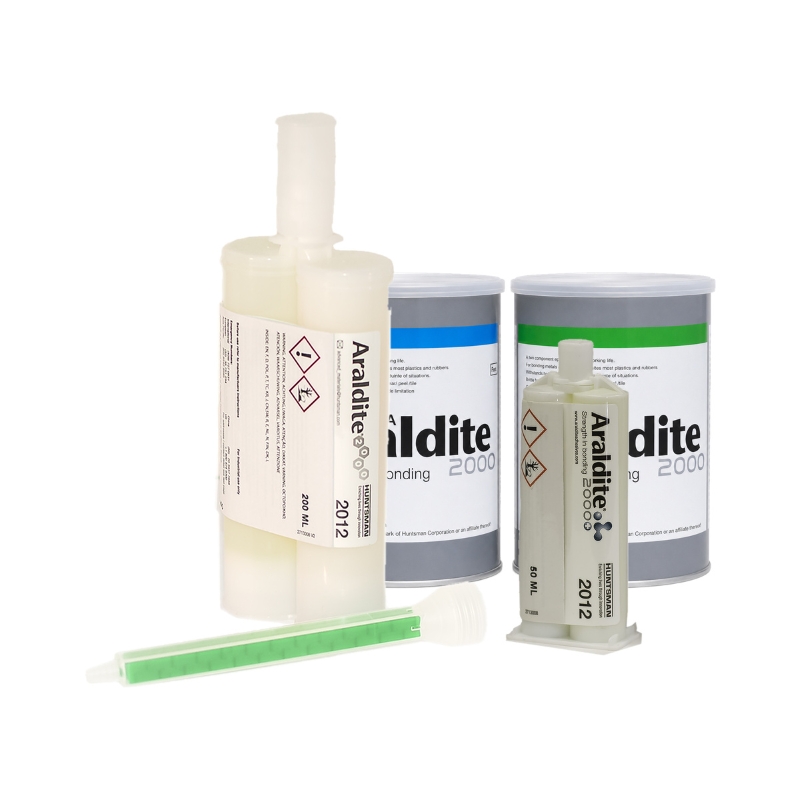
- Araldite 2012, Huntsman’s versatile, fast curing epoxy
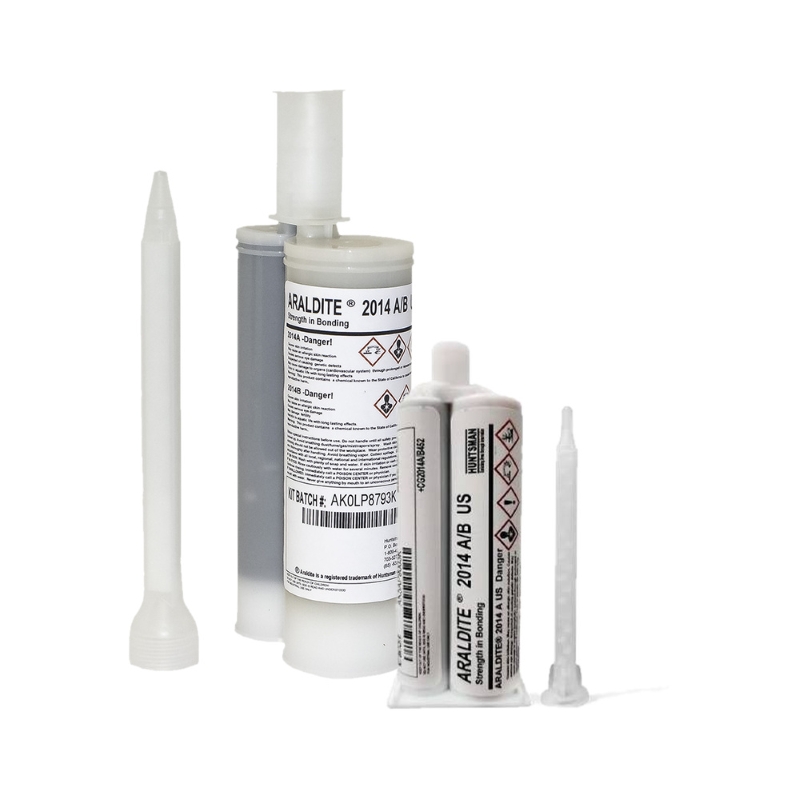
- Araldite 2014, Huntsman’s highly chemical and temperature resistant epoxy
- Araldite 2011, Huntsman’s versatile, long pot life epoxy
How Araldite 2015-1 Bonds GRP, SMC, and Dissimilar Substrates
Bonding with a 1:1 paste epoxy comes down to a clean surface, a metered bead, and a joint held still until it reaches handling strength. This is the sequence Huntsman’s data sheet describes.
- Degrease the joint surfaces with acetone, IPA, or another proprietary degreasing agent to remove oil, grease, and dirt. Never use low-grade alcohol, gasoline, or paint thinner.
- Abrade mechanically or etch chemically for the strongest, most durable joints, then degrease again.
- Load the cartridge into a 1:1 gun and fit a static mixer. Dispense and discard the first bead until the paste is a uniform color.
- Apply to the pretreated, dry surfaces by hand or robotically. A bond line of 0.002 to 0.004 in (0.05 to 0.10 mm) normally gives the greatest lap shear strength.
- Assemble within the pot life of 45 to 55 minutes and secure the parts in a fixed position as soon as the adhesive is applied.
- Hold the joint until it reaches handling strength, about 4 hours to 145 psi at 77°F, then let it cure.
- Clean tools with hot soapy water before the adhesive cures. Cured residue is difficult to remove.
Substrates in this process include GRP, SMC, vinyl ester, aluminum, steel, stainless steel, ABS, PVC, PC, and PMMA. If you store cartridges below 60°F, bring them to 60 to 77°F and let them condition before use. Huntsman’s lap shear tests used primed aluminum, so test your own substrate and surface prep before production.
Frequently Asked Questions
What is Araldite 2015-1 used for?
Araldite 2015-1 is used for bonding GRP, SMC, metals, and dissimilar substrates, including hull-to-deck bonds on boats and mid-sized to large parts on rail vehicles. It is a toughened two-part epoxy paste that fills gaps up to 0.394 in (10 mm) without sagging. Huntsman also lists it for assembly of moving parts that see dynamic loads.
What is the mix ratio of Araldite 2015-1?
Araldite 2015-1 mixes 1:1 by volume and 1:1 by weight (100:100). That differs from Araldite 2014, which mixes 2:1, so check the plunger ratio on your gun before you load a cartridge.
How long is the pot life and cure time of Araldite 2015-1?
Pot life is 45 to 55 minutes at 77°F on a 100 g mass. At 77°F the joint reaches 145 psi lap shear in about 4 hours and over 1,500 psi in about 6.5 hours. Huntsman publishes those handling times at 77°F only, so test at your shop temperature.
Can Araldite 2015-1 bond GRP and SMC?
Yes. Huntsman describes Araldite 2015-1 as particularly suitable for SMC and GRP bonding, and lists vinyl ester, composites, metals, glass, wood, and several plastics among its compatible substrates. Its lap shear data was tested on primed aluminum, steel, stainless steel, ABS, PVC, PC, and PMMA, so call us if you are bonding something not on that list.
What gun and mixer does Araldite 2015-1 use?
It uses a gun with a 1:1 plunger and a static mixer. Catalog pairings for the 50ml cartridge include the Chem-Set PAK-50 and Medmix DMA 51 manual guns. For the 200ml cartridge they include the Huntsman DS200 guns and the Medmix DM2X 200 and DP2X 200. The mixers are the Araldite 2000 Plus for 50ml and the Araldite 2000 for 200ml. Call us to confirm fit.
Is Araldite 2015-1 approved for boat hull-to-deck bonding?
Huntsman lists Araldite 2015-1 as Lloyd’s Register qualified and describes it for hull-to-deck bonding in boat building. Request the current certificate from us for your classification work. Test your own hull and deck materials and surface prep before production, since approvals depend on the full system.
What is the maximum operating temperature of Araldite 2015-1?
Huntsman lists a maximum continuous operating temperature of 212°F. Huntsman defines that as the temperature where residual lap shear strength falls to one third of the room temperature value, or to 725 psi. The glass transition is about 171°F by DMA.
Questions on fit for your bonding application? Call (800) 220-1966 or email [email protected].




Reviews
There are no reviews yet.