



Description
Chem-Set RTV4500 is a 100% silicone sealant, one-component acetoxy RTV that cures with air moisture to a durable rubber. Made in the USA and stocked in 10 standard colors, it is used for countertop and backsplash sealing, undermount sink perimeters, walk-in freezer and refrigeration panels, RV and trailer sealing, HVAC duct work, formed-in-place gaskets, and general industrial sealing. It is non-slump, so it holds a bead on a vertical or overhead joint without sagging, and it carries NSF Standard 51 and FDA 21 CFR 177.2600 for incidental food contact.
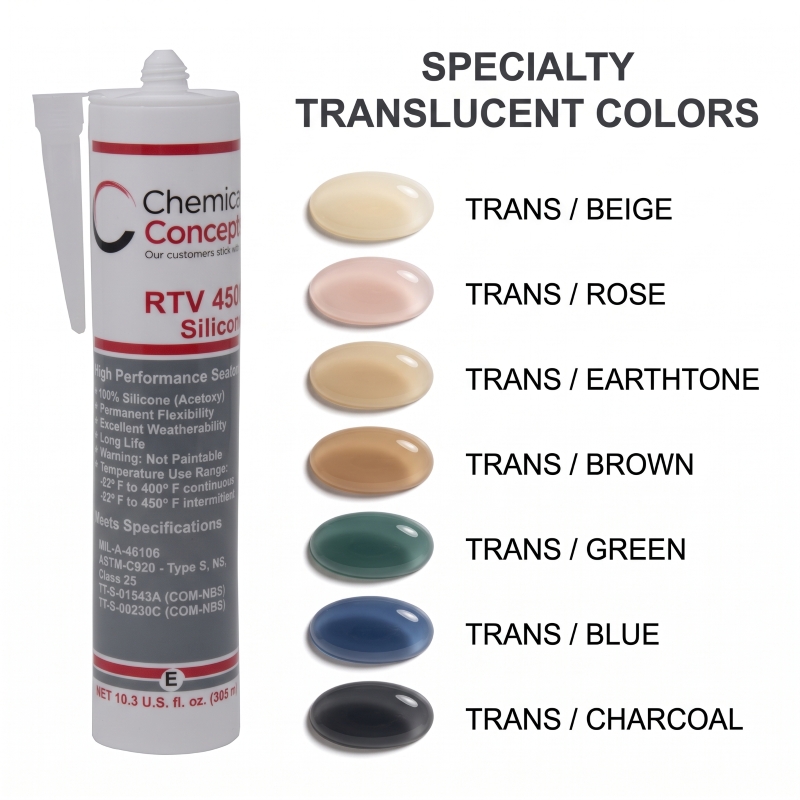
100% silicone means no fillers or extenders. Cartridge fill is 10.2 oz. Fill across the silicone category varies, commonly 9 to 9.8 oz, so comparing price per tube instead of price per ounce can be misleading. Between the 10 standard colors and the 7 specialty translucent shades, the RTV4500 line covers 17 colors.
Key Product Details
| Property | Test Method | Result |
|---|---|---|
| Chemistry | 100% acetoxy RTV silicone, one component | |
| Cure Type | Moisture cure | |
| Colors | 10 standard, plus 7 specialty translucent | |
| Viscosity | Spindle 7, 4 rpm | 902,000 cps |
| Extrusion Rate | CC Test Method | 365 g/min |
| Gun Grade | CC Test Method | Pass (non-slump) |
| Skin Formation Time | 70°F, 50% RH | 10 minutes |
| Typical Cure Rate | CC Test Method | 24 hrs on a 1/8 in bead, strength continues developing through 7 days |
| Hardness | ASTM C661 | 25 Shore A |
| Tensile Strength | ASTM D412 | 264 psi |
| Elongation at Break | ASTM D412 | 500% |
| Joint Movement | ASTM C920 | 25% |
| Application Temperature | CC Test Method | -35°F to 150°F |
| Service Temperature | CC Test Method | -70°F to 400°F, intermittent to 450°F |
| QUV Testing | ASTM G154 | Pass at 10,000 hrs |
| Density | ASTM D1475 | 8.5 lbs/gal |
| VOC | ASTM D2369 | 23 g/L |
| Shelf Life | 70°F, 50% RH | 12 months |
| Paintable | No | |
| Approvals | ASTM C920 Class 25, Type S, Grade NS, Use NT, G, O; TT-S-01543A; TT-S-00230-C; NSF Standard 51; FDA 21 CFR 177.2600 | |
| Packaging | 10.2 oz cartridge, 24 per case | |
| Country of Manufacture | USA | |
| SKU | CCS-RTV4500 |
Available Standard Colors
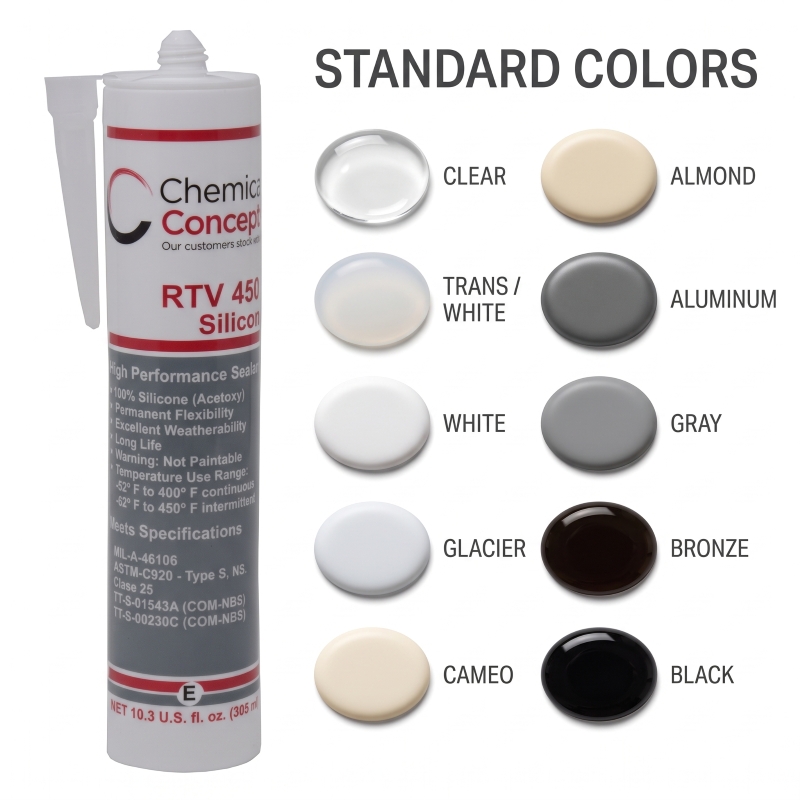
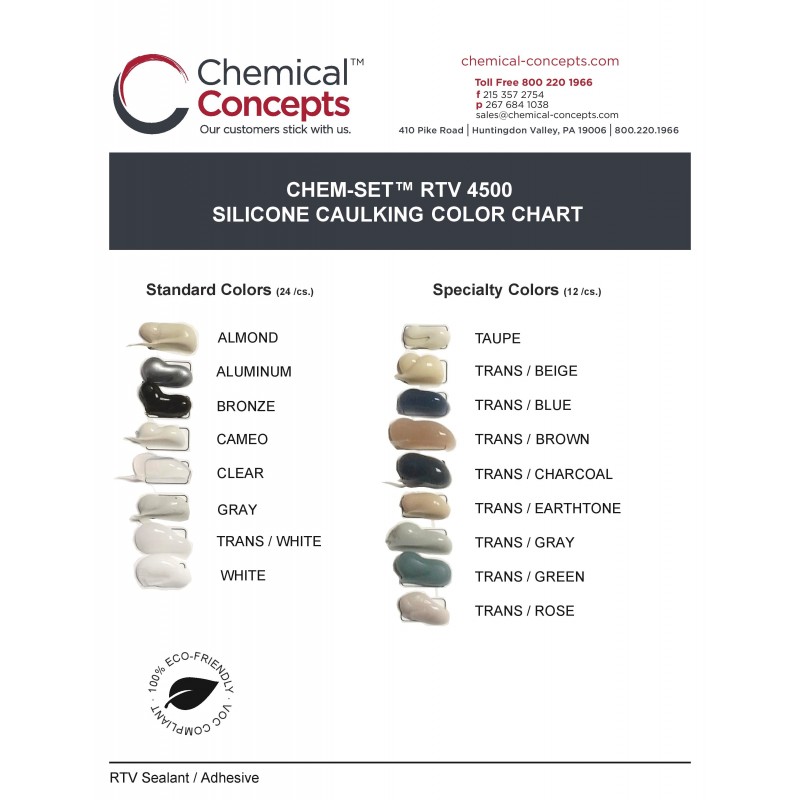
Clear, Trans/White, White, Glacier, Cameo, Almond, Aluminum, Gray, Bronze, and Black. Clear is translucent rather than water clear, so it reads as a soft hazy bead on glass and light stone instead of disappearing. Trans/White, Cameo, and Glacier are the shades stone and solid surface fabricators pull most often for seams and sink perimeters on light slabs. Seven additional specialty translucent shades are available on the Chem-Set RTV4500 Specialty Translucent Colors page.
Color chips reproduce differently on every screen. Request a sample cartridge before committing on a visible seam. One thing worth knowing at the dropdown: Aluminum is darker than Gray, not lighter. The name suggests a light metallic finish, and the color is a flat non-metallic dark gray.
Acetoxy or Neutral Cure: Which One for Your Surface
RTV4500 is an acetoxy silicone, and acetoxy is the right call for quartz, solid surface, glass, metal, tile, porcelain, and painted substrates. On polished marble and quartzite, use a neutral cure silicone instead. Our guidance on those two stones is that an acetoxy silicone can cause staining or bleeding, and that shows up as a dark shadow line along the joint weeks after the install is signed off.
You can identify an acetoxy silicone by the vinegar-type odor as it cures. A neutral cure silicone releases a non-acidic substance instead, so it is close to odor free and non-corrosive, which also makes it the safer choice around plated and finished metal fixtures. The tradeoff is speed: neutral cure sets roughly three times slower.
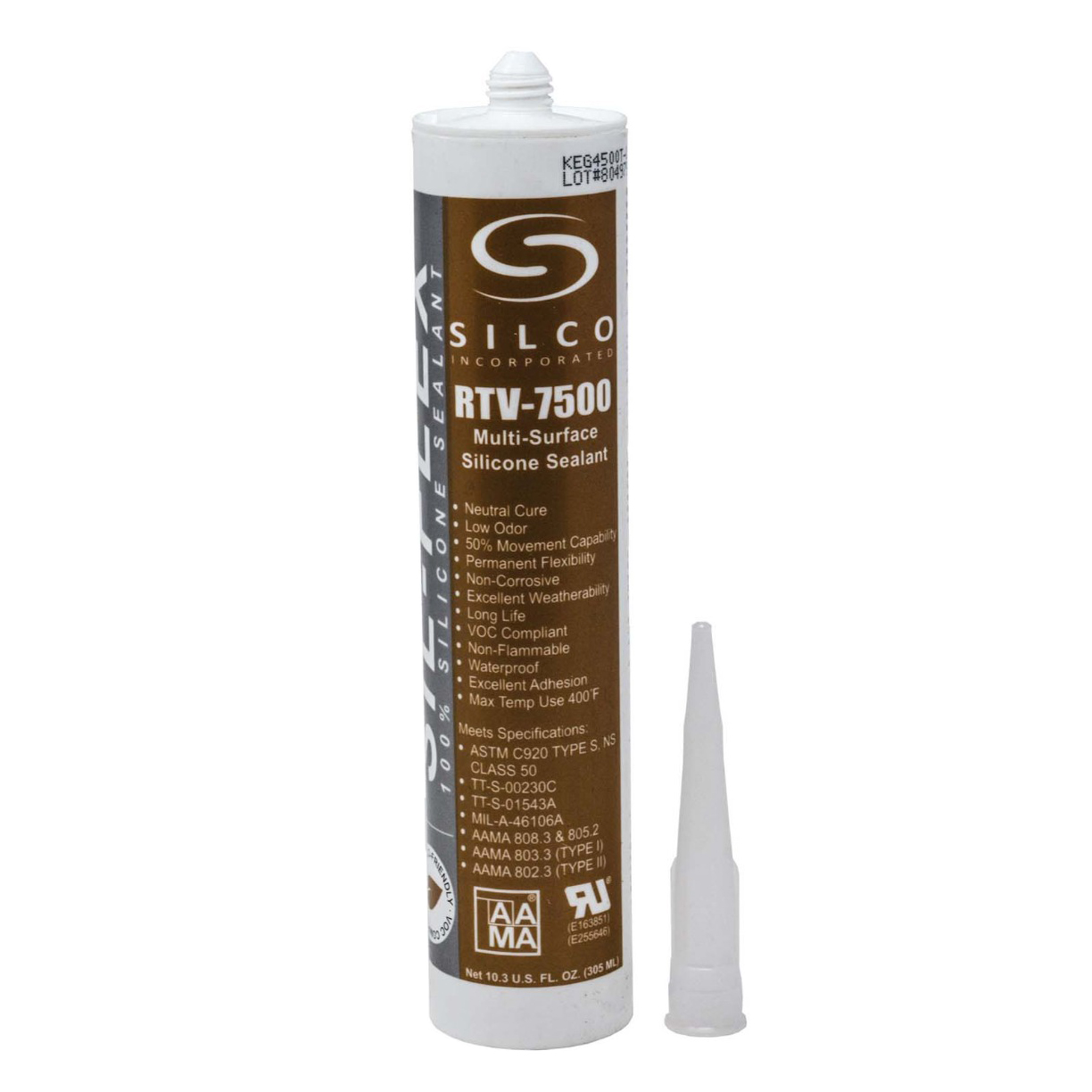
| Chem-Set RTV4500 | Sil-Flex RTV-7500 | |
|---|---|---|
| Cure chemistry | Acetoxy | Neutral cure, low modulus |
| Odor while curing | Vinegar-type | Low odor, non-corrosive |
| Joint movement | 25% | 50% |
| Set speed | Skins in 10 min at 70°F | Roughly 3x slower to set |
| Polished marble, quartzite | Use neutral cure instead | Recommended |
| Quartz, solid surface, glass, metal | Recommended | Suitable |
Shop Sil-Flex RTV-7500 Neutral Cure Silicone, or read more on neutral cure silicones for sensitive surfaces. On any stone you have not run before, put a trial bead on an offcut and give it 7 days before you commit a slab.
How Silicone Sealing Works on a Countertop or Solid Surface Install
Color matched silicone is the last step on a countertop install, and it is the one the homeowner looks at. The sequence below is the same whether you are running a quartz seam, a waterfall return, or a Corian sink deck.
- Confirm the surface first. Polished marble or quartzite means neutral cure, not this product.
- Dry fit the pieces and set your reveal before any sealant comes out of the tube.
- Clean both faces of the joint. 100% IPA or acetone, depending on the substrate. Never a petroleum based solvent, it leaves a film that kills adhesion.
- Let the surfaces dry completely. Cold shops and dry winter air slow the cure, humidity speeds it up.
- Load the cartridge in a standard 10 oz caulk gun. One component, no mixing, no additives, no static mixer.
- Run the bead in one continuous pass. At 902,000 cps and non-slump, it stays where you put it on a vertical edge or an overhead underside.
- Tool before it skins. That is 10 minutes at 70°F and 50% RH, less in a hot humid shop, so work one joint at a time instead of beading the whole top first.
- Let it cure. A 1/8 in bead is through in about 24 hours, and strength keeps building for 7 days. Test adhesion on day 7, not day one.
- Priming is not normally required. If you want to confirm adhesion on an unfamiliar substrate, run a trial bead and give it the full 7 days.
Substrates it is used on: glass, most metals, aluminum, steel, ceramic, tile, porcelain, marble, granite, solid surface countertops, most types of wood, most fiberglass, PVC, some plastics, natural and synthetic fiber, and most painted substrates. Substrates vary by manufacturer, so test yours before a production run.
Cured silicone has to come off mechanically, by cutting, scraping, or abrading. Uncured excess wipes away before it skins, which is another reason to tool inside that 10 minute window.
Performance in Production
- 25 Shore A with 500% elongation means the cured bead stays soft and stretches with the joint instead of tearing at the edge. The ASTM C920 Class 25 rating covers 25% movement, so a 1/4 in joint absorbs roughly 1/16 in of movement.
- Non-slump at 902,000 cps holds the bead on a vertical seam or an overhead joint with no sag while it skins.
- 365 g/min extrusion rate pushes cleanly out of a manual 10 oz gun, including in a cold shop, so hand fatigue stays reasonable on a long day of seams.
- 10 minute skin time at 70°F sets your working rhythm. Bead and tool one joint, then move on. Heat and humidity shorten that window.
- 24 hour cure on a 1/8 in bead gets a part handled the next shift, but full strength takes 7 days. Confined joints and deep beads take longer because cure needs air moisture to reach the silicone.
- Pass at 10,000 hours QUV plus a -70°F to 400°F service range covers exterior joints, walk-in freezer panels, and hot equipment on the same cartridge.
- 264 psi tensile puts this in sealant territory, not structural bonding. For load-bearing joints use a structural adhesive and let the silicone handle movement and weather.
Common Applications
- Quartz and granite countertop installation, seams, and backsplash sealing
- Solid surface countertop seam and sink deck sealing
- Undermount sink perimeter sealing
- Walk-in freezer manufacturing and installation, refrigeration units
- RV and trailer manufacturing and trailer sealing
- HVAC, ductwork, and sheet metal sealing
- Formed-in-place gaskets
- Commercial kitchen and foodservice sanitary seals, plumbing fixtures
- Appliance and fireplace manufacturing
- Bathroom and shower sealing
- Marine sealing and bonding
- Telecom enclosures, including coaxial cable connectors
Limitations
- Not paintable.
- Do not use on porous surfaces such as concrete, mortar, or brick.
- Use a neutral cure silicone on polished marble and quartzite.
- Use only on clean surfaces free of contaminants.
- Cold temperature and low humidity slow curing.
- Partial or total confinement of the sealant lengthens cure time.
- Do not store at elevated temperatures. High heat and high humidity shorten shelf life.
Available Sizes
- 10.2 oz cartridge, CCS-RTV4500, 24 per case
- Squeeze tubes, pails, and drums also stocked
- Quart cartridges, sausage packs, semcos, and pouches available on request
See Why Silicone Quality Matters
100% silicone with no fillers or extenders is easy to claim and easy to verify. Extended silicones are cut with fillers like oil and solvent, which makes them more prone to shrinking, cracking, and color shift as they age. The float test in this video shows the difference, and it covers the net fill practices that make a cheap tube look cheaper than it is.
More on how to spot an extended silicone: Not All Silicones Are Created Equal.
Documents
Related Products
- Chem-Set RTV4500 Specialty Translucent Colors, 7 translucent shades for visible seams on stone, glass, and solid surface
- Sil-Flex RTV-7500 Neutral Cure Silicone, CCS-RTV7500, 50% movement and low odor, for polished marble, quartzite, and joints around finished metal
- Silicone and Caulk Collection
Frequently Asked Questions
What is Chem-Set RTV4500 used for?
It is a 100% silicone sealant for industrial, commercial, and construction sealing where a joint has to move, hold up outdoors, or see food contact. Common jobs are quartz and solid surface countertop seams, undermount sink perimeters, walk-in freezer and refrigeration panels, RV and trailer sealing, HVAC ductwork, formed-in-place gaskets, and sanitary seals in commercial kitchens.
Will silicone stain marble or quartzite?
An acetoxy silicone like RTV4500 can cause staining or bleeding on some natural stone, and quartzite and marble are the two that come up most. Use a neutral cure silicone on those, such as Sil-Flex RTV-7500. Quartz, solid surface, tile, porcelain, glass, and metal are all fine with acetoxy. When the stone is one you have not run before, bead an offcut and give it 7 days before committing a slab.
What is the difference between acetoxy and neutral cure silicone?
Acetoxy releases an acidic byproduct as it cures and neutral cure does not, which is why neutral cure is used on sensitive stone and around finished metal fixtures. The quick field test is your nose: the vinegar-type smell means acetoxy. Acetoxy skins and sets faster, and neutral cure runs roughly three times slower but carries more joint movement. RTV4500 is acetoxy. RTV-7500 is neutral cure at 50% movement.
Is 100% silicone the same thing as RTV silicone, acetoxy silicone, and silicone caulk?
Yes, for this product all of those terms describe the same material. 100% silicone, RTV silicone, acetoxy silicone, silicone sealant, silicone caulk, and silicone caulking all point to Chem-Set RTV4500. RTV stands for room temperature vulcanizing, meaning it cures in open air without heat. Acetoxy describes the cure chemistry. 100% silicone means no fillers or extenders in the formula.
What colors does RTV4500 come in?
Ten standard colors: Clear, Trans/White, White, Glacier, Cameo, Almond, Aluminum, Gray, Bronze, and Black. Seven specialty translucent shades are available on a separate page: Trans/Beige, Trans/Blue, Trans/Brown, Trans/Charcoal, Trans/Earthtone, Trans/Green, and Trans/Rose. That is 17 colors across the line. Custom colors are available with a minimum order.
Is the Clear color water clear?
No. Clear is translucent, not water clear, and the cured bead reads as a soft hazy line rather than invisible. On a light seam that a customer will look at closely, Trans/White or Cameo often blends better than Clear. Get a sample cartridge on the actual slab before you commit.
How many ounces are in an RTV4500 cartridge?
10.2 oz, 24 cartridges per case, and it fits a standard 10 oz caulk gun. Printed net fill has varied slightly between production runs, so read the tube in front of you if you are speccing an exact volume. Either way there is more material in it than in most of what it gets compared against, since fill in this category commonly runs 9 to 9.8 oz. Compare price per ounce, not price per tube.
Where is Chem-Set RTV4500 made, and how long does it keep?
Made in the USA. Shelf life is 12 months stored at 70°F and 50% RH, and a hot humid stockroom will cut that down. Chem-Set is the Chemical Concepts house label, and cartridges ship from our warehouse in Huntingdon Valley, Pennsylvania. In-stock items ordered by 2pm EST ship the same day.
Questions on fit for your sealing application, or need a color sample before you commit? Call (800) 220-1966 or email [email protected].


Reviews
There are no reviews yet.