Non-Flammable Contact Cement Line
The short version. Methylene chloride is banned, and there’s no single drop-in for the bulk, non-flammable contact cements it used to make possible. Chem-Set covers both paths: CMT3079AA and CMT3079 for non-flammable canister spraying (CMT3079AA adds air-assist for fine, even coats on foam), and CMT2540, CMT2464, and CMT307 for bulk drum handling where flammable storage is manageable. CMT3019 and CMT3091 round out the non-flammable canister side for specific volume and VOC needs.
A contact cement that’s worked fine for years quietly disappears from the price list, and the explanation usually traces back to one chemical: methylene chloride.
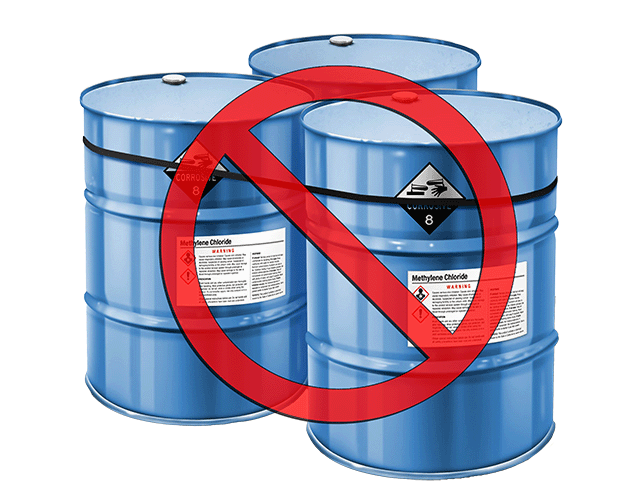
EPA finalized a rule banning it from nearly every commercial and industrial use in April 2024. Products like 300M, AW-300, AW-315, and AW-205 are gone because of it. The Chem-Set line was built specifically to cover what they did, split across two chemistries depending on what your process actually needs.
Why Methylene Chloride Got Banned
- Zero flash point, so bulk liquid adhesive could be non-flammable
- Fast dry and tack, minutes not hours
- Cheap and stable at commercial scale
- Decades of shop familiarity, nobody had to change their process
- At least 85 documented occupational deaths in the U.S., 1985–2020
- Acute inhalation exposure causes central nervous system effects, up to and including death
- Chronic exposure is linked to liver effects and cancer risk
- Final rule under TSCA Section 6(a), published April 2024
EPA’s rule prohibits manufacture, processing, and distribution of methylene chloride for all consumer uses and most industrial and commercial uses, including as a solvent in adhesives, sealants, and caulks. That’s why 300M, AW-300, AW-315, and AW-205 are gone, and why they’re not coming back reformulated.
EPA, Methylene Chloride Final Rule, TSCA Section 6(a), April 2024The Tradeoff You Didn’t Used To Have
Take methylene chloride out of a contact cement and you can’t get a bulk, pourable liquid that’s also non-flammable anymore. Every replacement gives up one property to keep the other, which is why the Chem-Set contact cement line splits into two families instead of offering one universal product.
How to Choose in Three Checks
Storage and Fire Code
If your shop, insurance, or local fire code restricts flammable liquid storage, that decides it before anything else. Stay in the non-flammable canister family.
Spray Pattern and Substrate
General purpose and laminate work runs fine on standard canister spray. Foam and other delicate substrates that can’t take a heavy wet coat do better with air-assist, which is what CMT3079AA is built for.
Regional VOC Limits
SCAQMD Rule 1168 and the OTC model rule cap standard contact adhesive at 80 g/L, with a 250 g/L allowance for special-purpose formulas. Confirm your state’s limit before committing to a SKU, especially with the higher-VOC options in this line.
The Non-Flammable Canister Line
Four SBR contact cements, all non-flammable, all canister-delivered.
CMT3079AA
Non-flammable, low VOC, air-assisted for a fine, even web spray pattern. The CARB-oriented version of the flagship, built for California and similarly strict states. Ships in a torpedo-size canister with a 63 fluid nozzle on a Binks 2100 or Protek 3000 gun.
View product →CMT3079
Non-flammable, low VOC, OTC compliant. The general-purpose replacement for AW-300 and AW-315. Handles laminate, general purpose, and foam work in a standard web spray pattern.
View product →CMT3019
Non-flammable, low VOC SBR built on the same ZF solvent system as the flagship. Available in pails and labeled to order for accounts that don’t need standard canister packaging.
View product →CMT3091
Non-flammable MC-ban replacement built for high-volume non-flam applications. Runs higher VOC than the rest of the line, so confirm your state’s limits before ordering, it isn’t compliant everywhere.
View product →Why Air-Assist Matters for Foam
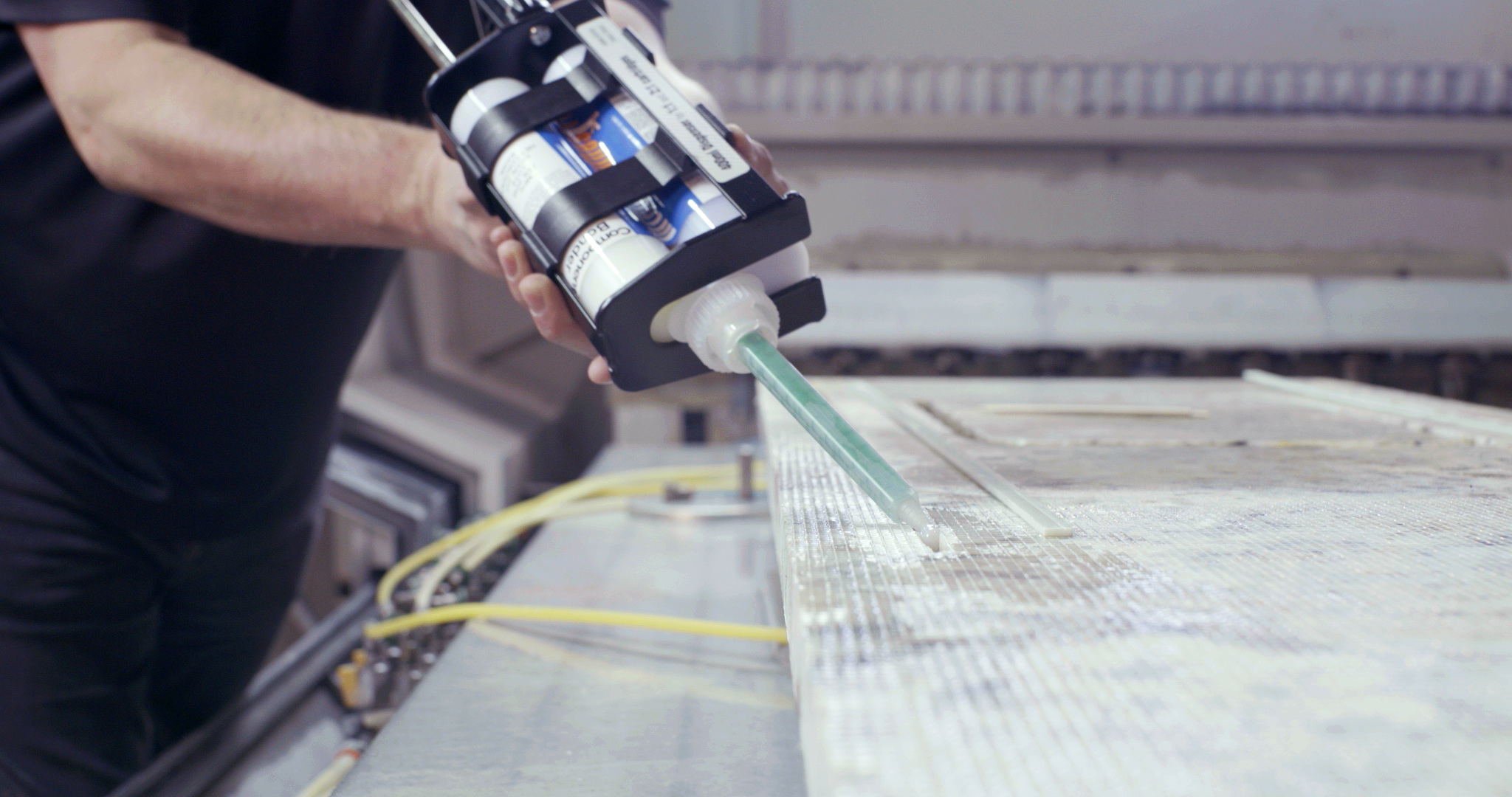
A standard canister spray gun atomizes contact cement using pressure alone, which lays down a coarser, heavier pattern. That’s fine for laminate and general purpose work, but foam substrates can’t take a heavy wet coat without soaking in unevenly, distorting, or wasting adhesive that never contributes to the bond.
CMT3079AA adds compressed air to the spray tip, which breaks the adhesive into a finer, more uniform mist. That gives more even, controllable coverage on foam and other substrates sensitive to a heavy application, without sacrificing the non-flammable, low-VOC profile of the rest of the flagship line.
If you’re spraying foam, insulation, or other substrates that show every flaw in a heavy adhesive coat, ask specifically about CMT3079AA and the air-assist setup. It’s become one of our go-to recommendations on the foam bonding side.
The Flammable Bulk Line
Three neoprene-based contact cements for accounts that need true bulk drum handling.
CMT2540
Fast-drying, quick-setting sprayable polychloroprene (neoprene). OTC compliant, flammable, ships in 5-gallon or 55-gallon drums, clear or red. The direct bulk replacement for AW-205 in OTC states.
View product →CMT2464
A higher-solids neoprene (20%) with more heat resistance than CMT2540. Runs higher VOC, built for the non-OTC-state side of the old AW-205 book. Bulk drum handling, spray application.
View product →CMT307
Low-VOC, OTC-compliant flammable contact cement, available in both bulk and canister formats. The replacement for AW-307. Runs web spray application.
View product →All three are neoprene-based rather than the SBR chemistry used in the non-flammable canister line, which is part of why they hold up well under heat and load in bulk applications.
Compare All Seven at a Glance
“High” VOC products (CMT2464, CMT3091) are not compliant in every state, confirm your local limit before ordering.
Common Questions
Why was my contact cement discontinued?
It almost certainly contained methylene chloride, which EPA banned from nearly all commercial and industrial uses under a TSCA rule finalized in April 2024. Manufacturers discontinued MC-based formulas ahead of the compliance deadlines rather than hold banned inventory.
What replaced 300M, AW-300, AW-315, or AW-205?
There’s no exact reformulation. AW-300 and AW-315 map to CMT3079 or CMT3079AA (non-flammable canister) depending on state, or CMT3019 for made-to-order pail packaging. AW-205 splits into CMT2540 for OTC states and CMT2464 for non-OTC states, both bulk drums.
Which contact cement should I use for spraying foam?
CMT3079AA. It adds air-assist to the standard canister spray, giving a finer, more even mist that suits foam and other substrates that can’t take a heavy wet coat.
Is there a non-flammable contact cement that’s still bulk, in a drum or pail?
Not in a poured bulk-liquid sense, no, that’s what methylene chloride made possible and there’s no substitute solvent that does the same thing. CMT3019 ships in pails but is still a canister-delivered, pressurized product, not a poured bulk liquid.
Are all of these OTC compliant?
Most are. CMT3079AA, CMT3079, CMT2540, and CMT307 are OTC compliant. CMT2464 and CMT3091 run higher VOC and aren’t compliant everywhere, confirm your state’s limit before ordering.
What’s the VOC limit for contact adhesive under SCAQMD Rule 1168?
80 g/L for standard contact adhesive, and up to 250 g/L for special-purpose contact adhesive bonding substrates like metal, melamine, vinyl, or rubber.
Not Sure Which One Fits Your Process?
Tell us your flammable storage situation, substrate, and which states you ship into. We’ll match you to the right Chem-Set CMT number and packaging before you commit to a switch.
800-220-1966 Email Sales