Can Structural Adhesive Survive Powder Coating? LORD Acrylic Test Data
“Do you have an adhesive that can go through powder coat?” is one of the most common questions we get from metal fabricators, trailer and truck body builders, and sign shops. There are two ways to run it, and they use different adhesives:
- Bonding before powder coat. The bonded assembly goes through the oven. This takes a heat-resistant structural acrylic, Maxlok, the 400 series, or the 800 series.
- Bonding to powder coated parts. The parts get coated first, then bonded. Maxlok and the 400 series still work, and the LORD 7542 and 7545 urethanes open up for painted and primed surfaces.
LORD Acrylic Adhesive Lap Shear After a 400°F Powder Coat Bake
Parker LORD’s technical tip TT3068 reports lap shear on 6061-T6 aluminum after each postbake, tested once the parts returned to room temperature. Values are psi with MPa in parentheses.
| Adhesive System | Initial | After 30 min | After 60 min | After 90 min |
|---|---|---|---|---|
| LORD 406/19GB | 2,597 (17.9) | 2,871 (19.8) | 2,840 (19.6) | 2,826 (19.5) |
| Maxlok MX/T6S | 2,884 (19.9) | 2,842 (19.6) | 2,847 (19.6) | 2,819 (19.4) |
| LORD 810S/20GB | 1,728 (11.9) | 2,646 (18.2) | 2,665 (18.4) | 2,630 (18.1) |
| LORD 850S/25GB | 2,721 (18.8) | 2,777 (19.1) | 2,756 (19.0) | 2,740 (18.9) |
Typical values from Parker LORD Technical Tip TT3068, Rev.2 (07/25). Postbake at 400°F (204°C). Not for specification purposes. On a phone, swipe the table left to see every column.
Failure mode on the LORD grades was mostly thin-layer cohesive. That means the adhesive tore within itself instead of letting go of the aluminum, and a few 406/19GB samples broke the metal first. Parker LORD also notes that bonds often come out of the oven stronger than they went in once the assembly cools back to room temperature. The full tech tip runs an unnamed competitive acrylic through the same bake if you want the whole table.
Why Parts Slide Apart in the Powder Coat Oven
The adhesive doesn’t break down at 400°F. It softens. Parker LORD calls this hot tear strength, and in the oven it’s very low. A heavy bracket or a panel hanging on a vertical rack can sag or slide right off its bond line while the oven is at temperature, then cure in the wrong spot.
The fix is mechanical. Hold the assembly in place until it comes out and cools:
- Spot welds are common in production, a few tacks to locate the part while the adhesive carries the load.
- Rivets, clamps, or weights work where welding isn’t an option.
- The heavier the part, the more handling strength you need before it goes in the oven.
- Get parts as flat and smooth as you can before the bake, since the heat softens the adhesive and lets bowed parts shift.
LORD Adhesives for Bonding Before Powder Coat
These are the four grades Parker LORD put through the bake. Every other grade in the table below comes from the same three families, Maxlok, the 400 series, and the 800 series.
 |
LORD Maxlok MX/T6Parker LORD’s recommendation for large or heavy parts, galvanized or zinc-bearing steel, and ovens running 350°F or hotter on longer bake cycles. The tech tip tested the MX/T6S version. Glass beads help control bondline thickness. |
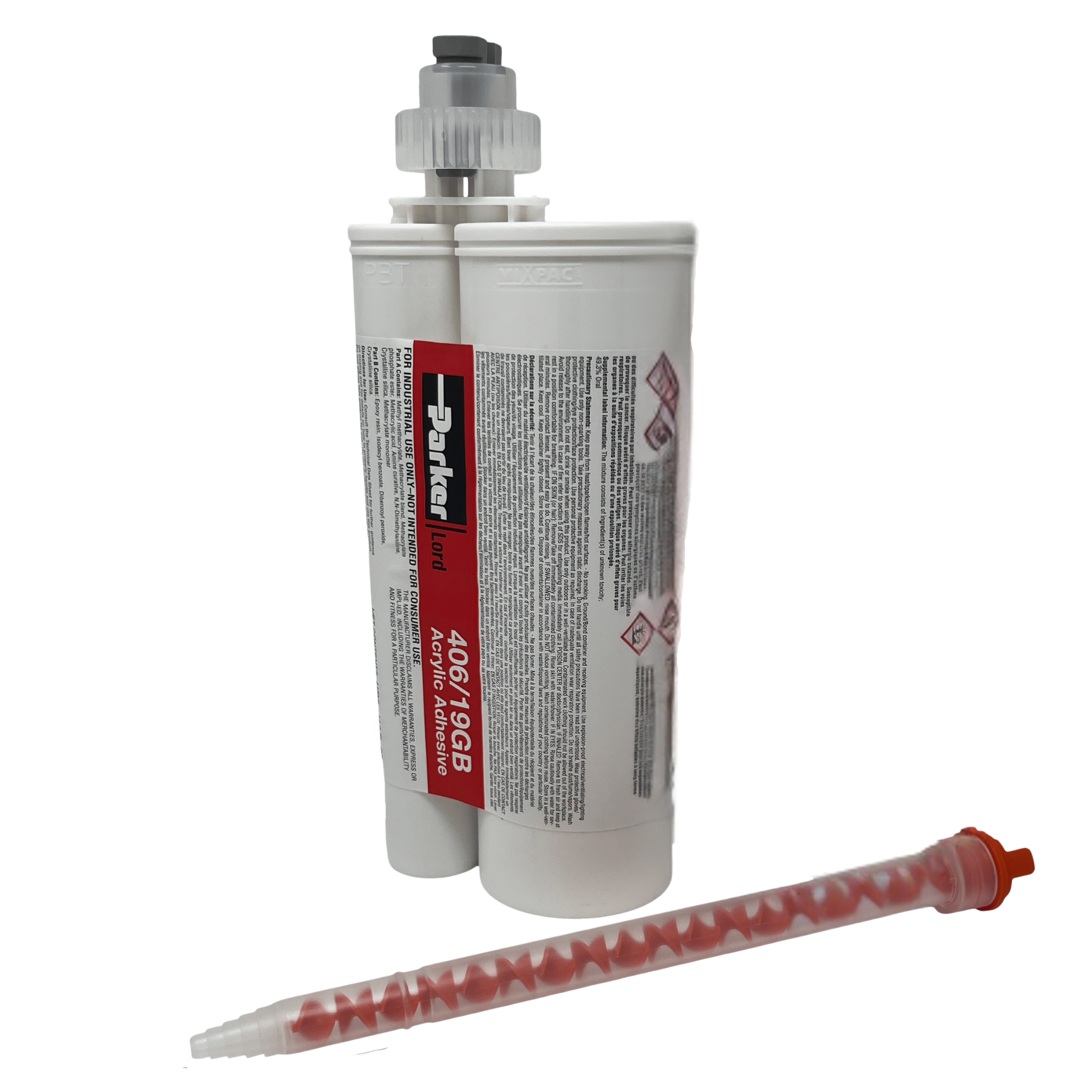 |
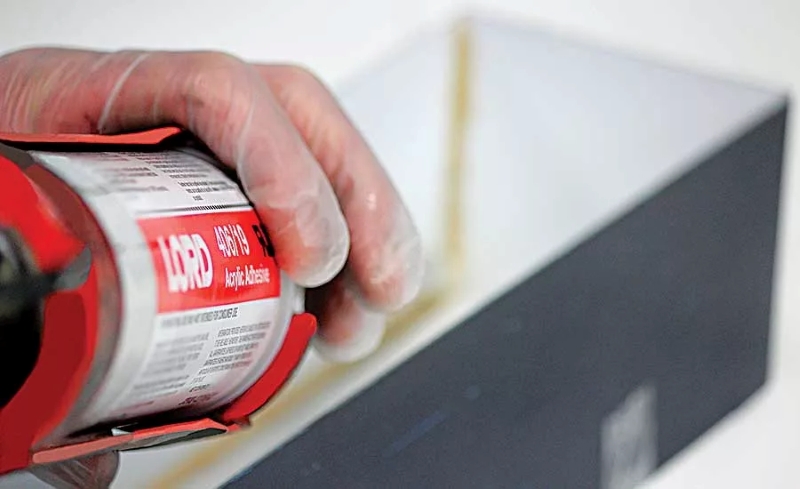
LORD 406/19GBThe 400 series covers most powder coat jobs. The 19GB accelerator carries glass beads for consistent bondline thickness. Sign shops can use the Signlok 400 series, the version Parker LORD developed for sign fabrication. |
 |
LORD 810/20GB Low Read-ThroughA flexible metal bonding adhesive built to keep the bond line from telegraphing through thin-gauge sheet. It started lowest in the test and picked up the most strength in the oven. |
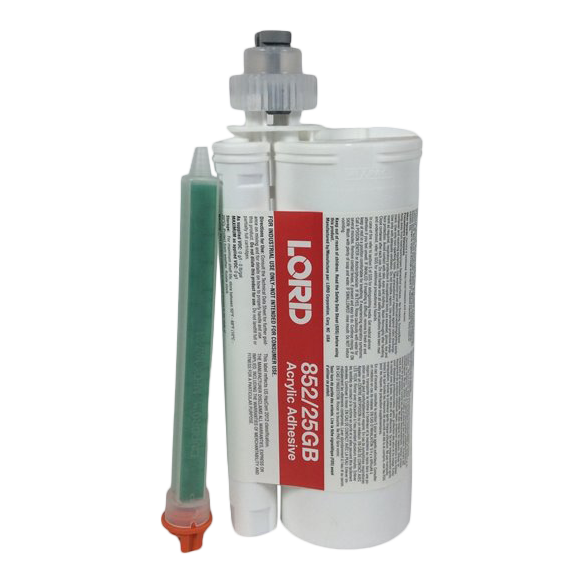 |
LORD 850/25GB ToughenedThe toughened grade for parts that see impact, fatigue, or cold service. It held the flattest line of the four through all three bakes. |
Each family comes in several speeds, and every one below is its own product page. Pick the working time that fits your part size and bead length.
| Adhesive | Type and Mix Ratio | Working Time | Handling Strength | Use It For |
|---|---|---|---|---|
| Maxlok MX/T3 | Acrylic, 4:1 | 3 to 5 min | 6 to 8 min | Fastest Maxlok cycle on heavy or galvanized parts |
| Maxlok MX/T6 | Acrylic, 4:1 | 6 to 9 min | 20 to 24 min | Heavy or galvanized parts, hotter and longer bakes (tested) |
| Maxlok MX/T18 | Acrylic, 4:1 | 18 to 24 min | 48 to 72 min | Longest Maxlok working time for big bond areas |
| LORD 403/19 or 403/19GB | Acrylic, 4:1 | 2 to 4 min | 4 to 6 min | Small parts and fast turnaround |
| LORD 406/19 or 406/19GB | Acrylic, 4:1 | 6 to 10 min | 12 to 17 min | General powder coat work (406/19GB tested) |
| LORD 410/19GB | Acrylic, 4:1 | 20 to 30 min | 60 to 120 min | Larger assemblies that need more working time |
| LORD 810/20GB | Acrylic, 2:1 | 8 to 12 min | 20 to 25 min | Thin-gauge sheet where read-through matters (tested) |
| LORD 850/25GB | Toughened acrylic, 10:1 | 6 to 10 min | 18 to 24 min | Impact, fatigue, or cold service (tested) |
| LORD 852/25GB | Toughened acrylic, 10:1 | 20 to 25 min | 50 to 70 min | Same toughened grade with a longer working time |
Working and handling times at room temperature (70 to 77°F) from Parker LORD selector guide SG1030. Grades marked “tested” appear in TT3068. /19 and /19GB use the same adhesive, and the GB accelerator adds glass beads for bondline control.
Not sure which one fits? Parker LORD lists six things to settle before you choose: the substrates, the weight of the assembly, oven temperature and bake time, the type of powder, how much tack time you need, and any UL requirement on the part. Send us those and we’ll narrow it down. More options are on our metal bonding adhesives page.
How to Bond Parts Before Powder Coating
- Bond before the powder coat. The bond goes into the oven with the part, so the whole assembly gets coated in one pass with no weld seams to grind or fill.
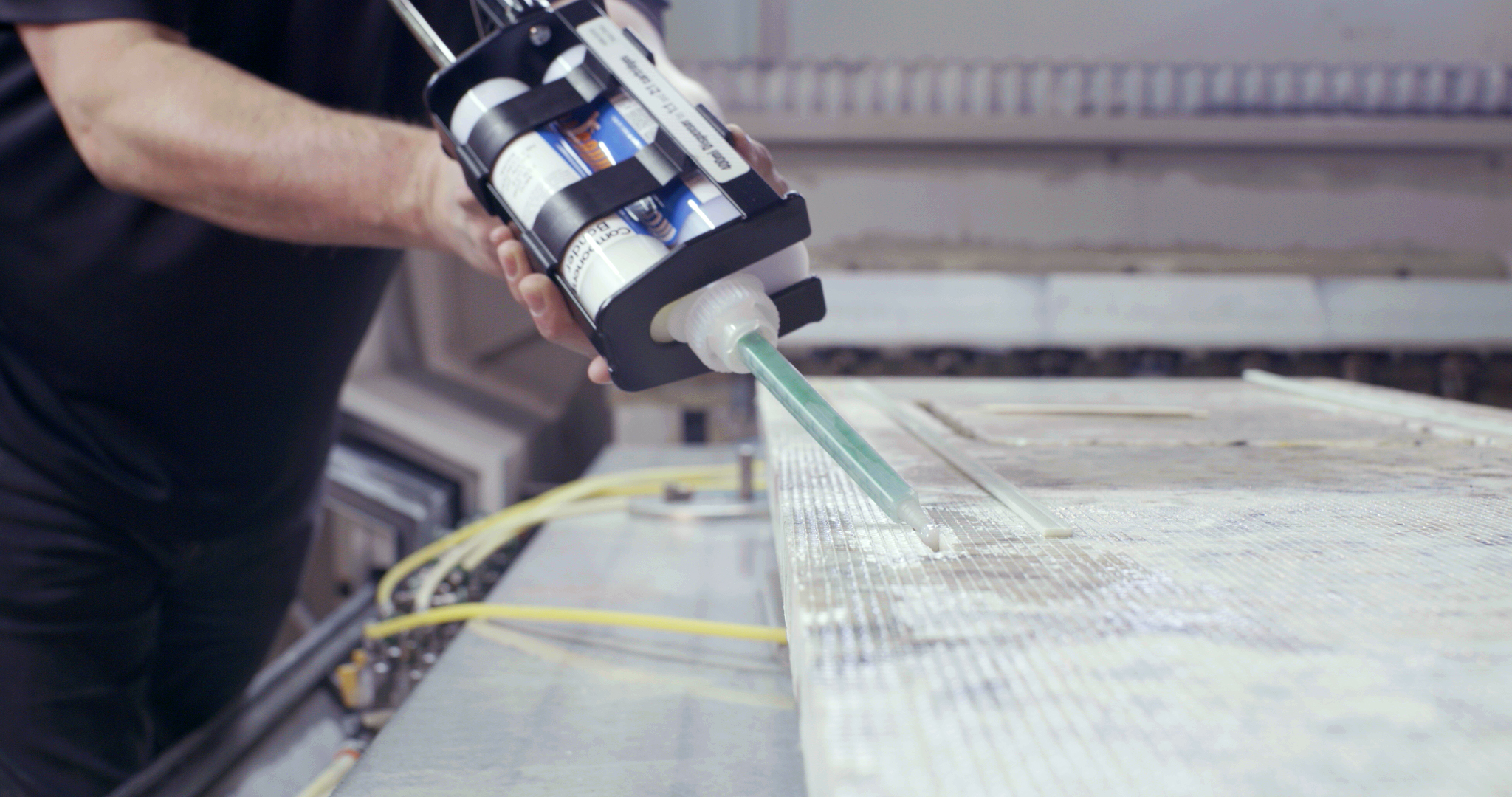
- Check the ratio before you dispense. Run a little adhesive out of a new cartridge until the plungers are level and both sides are flowing. Color that looks off is the first sign the mix is wrong.
- Watch shop temperature. Working time on the TDS is rated at room temperature. A hot shop cuts open time, and a cold shop stretches open time and handling time, so parts stay clamped longer in winter. Miss the open time and you won’t get adhesion.
- Mate the parts once. You want a smooth, even layer. Slide a part to reposition it but never pull it apart. If it separates, wipe both surfaces clean with alcohol and start over.
- Clamp in order. Start at one end and work down, or start in the middle and work out. Random clamping bows the parts and traps air in the bond line.
- Reach handling strength before the oven. Keep the fixturing on until the adhesive has built enough strength for the part’s weight, then leave it on through the bake.
- Check parts after the oven. Look for popped areas or open seams. If you suspect trapped air, drive a wedge into the bond line of a test part and peel it open to see what’s there. That part gets scrapped, so do it on a test piece.
LORD Adhesives for Bonding to Powder Coated Parts
You can also coat first and bond afterward. Start by deciding what you’re bonding to, bare metal or the coating.
- Bare metal is the stronger option. Mask the bond area before coating, or scuff through the coating to bare metal afterward and follow with an alcohol wipe. Use Maxlok or the 400 series here.
- Bonding to the coating is faster and skips the masking, but the bond is only as strong as the coating’s grip on the metal. Epoxy-based coatings give the best bond performance.
- Maxlok and the 400 series bond to paint and can cross-bond to bare metal on the same part.
- LORD 7542 and 7545 are 1:1 urethanes for painted and primed surfaces. 7542 is the lower viscosity, flowable one. 7545 is the higher viscosity, non-sag one for vertical beads. The 7542 TDS recommends priming or powder painting metal before you bond it.
| Adhesive | Type and Mix Ratio | Working Time | Handling Strength | Bonds To |
|---|---|---|---|---|
| Maxlok MX/T3, T6, T18 | Acrylic, 4:1 | 3 to 24 min by grade | 6 to 72 min by grade | Bare metal and painted or primed surfaces |
| LORD 403/19, 406/19, 410/19GB | Acrylic, 4:1 | 2 to 30 min by grade | 4 to 120 min by grade | Bare metal and painted or primed surfaces |
| LORD 7542-A/B | Urethane, 1:1 | 4 to 7 min | 1 to 2 hr | Painted or primed surfaces |
| LORD 7542-A/C | Urethane, 1:1 | 11 to 15 min | 2 hr | Painted or primed surfaces |
| LORD 7542-A/D | Urethane, 1:1 | 20 to 30 min | 3 hr | Painted or primed surfaces |
| LORD 7545-A/G | Urethane, 1:1 | 1.5 min | 10 min | Painted or primed surfaces |
| LORD 7545-A/B | Urethane, 1:1 | 3 to 5 min | 30 min | Painted or primed surfaces |
| LORD 7545-A/C | Urethane, 1:1 | 6 to 8 min | 60 min | Painted or primed surfaces |
| LORD 7545-A/D | Urethane, 1:1 | 11 to 18 min | 90 min | Painted or primed surfaces |
| LORD 7545-A/E | Urethane, 1:1 | 22 to 38 min | 2 to 3 hr | Painted or primed surfaces |
7542 times from the LORD 7542 TDS (DS3444), 7545 times from the LORD 7545 TDS, and acrylic times from Parker LORD selector guide SG1030. 7542 handling times are for a 1/2 inch bead at 75°F. Compare every 7542 and 7545 grade side by side.
From there, mate, fixture, and reach handling strength the same way as above.
UL 746C. The LORD 7542 TDS lists UL 746C certification. Parker LORD’s powder coat webinar also shows UL 746C for the 400 series, the Signlok 400 series, and LORD 810. If your part carries a UL requirement, ask us to confirm the listing for your exact adhesive and accelerator before you order.
Powder Coating and Adhesive FAQ
Can structural adhesive go through a powder coat oven?
Yes. LORD 406/19GB, Maxlok MX/T6S, 810S/20GB, and 850S/25GB were all tested through 400°F (204°C) postbakes of up to 90 minutes and kept their lap shear strength. The parts need to stay fixtured during the bake.
What temperature can LORD acrylic adhesives take in powder coating?
Parker LORD publishes heat resistance data at 400°F (204°C) for up to 90 minutes for its 400, Maxlok, and 800S series acrylics. For hotter ovens or longer cycles, call us before you run parts.
Does powder coating weaken an adhesive bond?
No, not with these grades. Parker LORD reports bond integrity is unchanged after powder coating, and strength often goes up once the assembly cools back to room temperature.
Why did my bonded parts slide apart in the oven?
Acrylic adhesive has very low hot tear strength at powder coat temperatures, so heavy or vertical parts can sag or slip during the bake. Hold them with spot welds, rivets, clamps, or weights until they come out and cool.
Should I bond before or after powder coating?
Either works. Bonding before lets you coat the finished assembly in one pass, and it takes Maxlok, the 400 series, or the 800 series. Bonding after means masking or scuffing to bare metal for the strongest bond, or bonding straight to the coating with Maxlok, the 400 series, 7542, or 7545.
What adhesive works on galvanized steel going through powder coat?
Parker LORD recommends Maxlok for galvanized or zinc-bearing parts, and for large or heavy assemblies. Test on your actual parts before production.
Can I bond directly to powder coated metal?
Yes, but the bond is only as strong as the coating’s adhesion to the metal underneath. Epoxy-based coatings bond best. Maxlok and the 400 series bond to both coated and bare metal. LORD 7542 and 7545 urethanes bond to painted and primed surfaces.
What’s the difference between LORD 7542 and 7545 for powder coated parts?
Both are 1:1 two-part urethanes for painted and primed surfaces, each sold in several working times. 7542 is lower viscosity and flows into the joint, and its TDS lists UL 746C certification. 7545 is higher viscosity and non-sag, so it holds a bead on vertical and overhead work.
Questions on fit for your powder coat process? Call (800) 220-1966 or email [email protected].