




Description
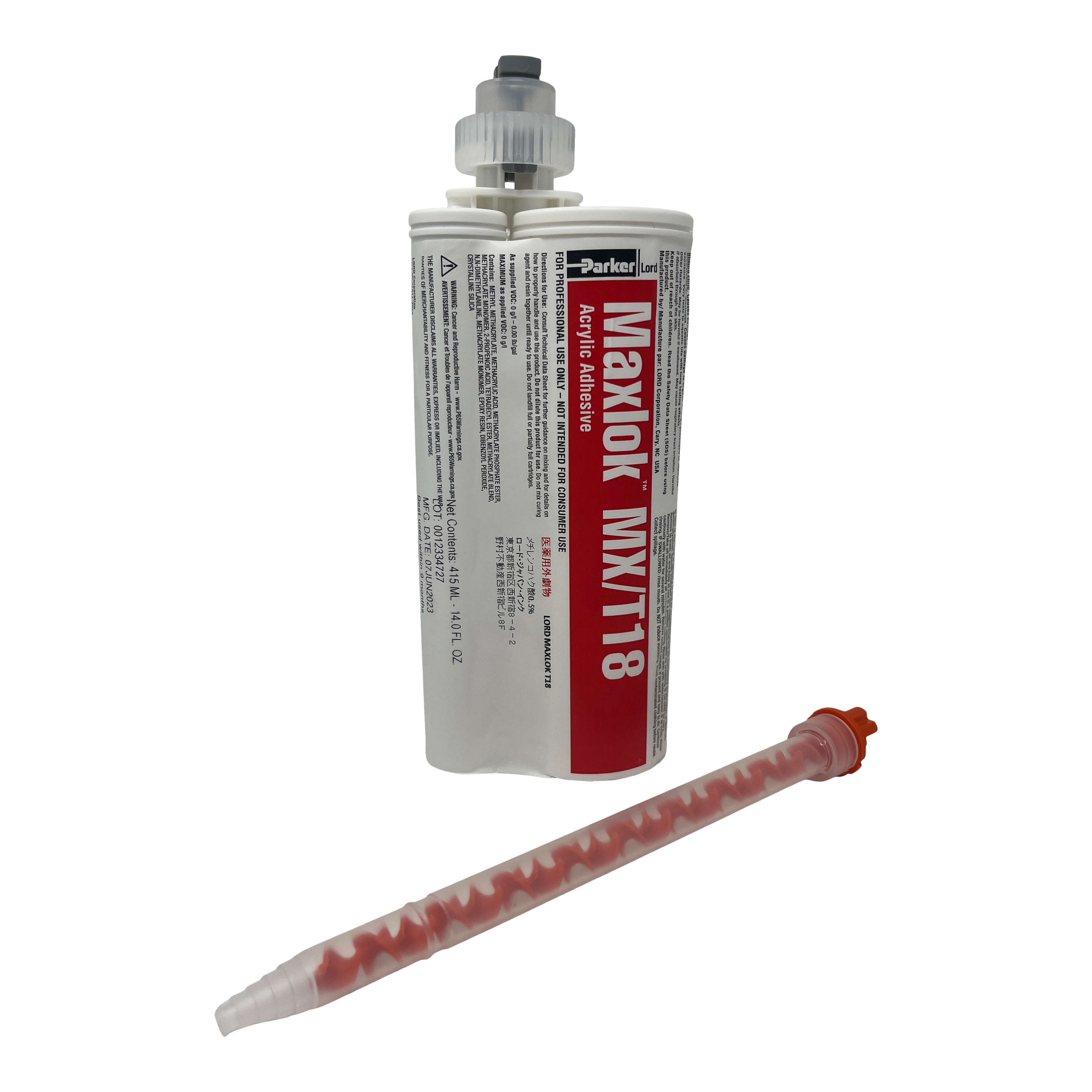
LORD Maxlok MX/T18S structural acrylic adhesive is the slowest grade in the Maxlok family, mixed 4:1 by volume with LORD Maxlok MX accelerator and supplied in a 415ml cartridge. It bonds unprepared metals, composites and plastics with minimal surface preparation, replacing welding, brazing, riveting and mechanical fastening on assemblies that see high impact or high peel loads. Work time is 18 to 24 minutes, roughly five times what T3S gives you, which is what lets a long panel seam get laid, positioned and clamped in one pass. Mixed, it is a grey non-sag paste. Made in the USA.
Key Product Details
| Property | Value |
|---|---|
| Product | LORD Maxlok MX/T18S |
| Chemistry | Two-component structural acrylic (MMA) |
| Mixed Appearance | Grey non-sag paste |
| T18S Adhesive Appearance | Off-white to tan paste |
| MX Accelerator Appearance | Grey paste |
| Mix Ratio | 4:1 by volume, metered automatically by the cartridge |
| Solids Content | 100% |
| Working Time | 18 to 24 minutes at 77°F (25°C) |
| Time to Handling Strength | 48 to 72 minutes at 77°F (25°C), 50 psi shear |
| Full Cure | 24 hours at room temperature |
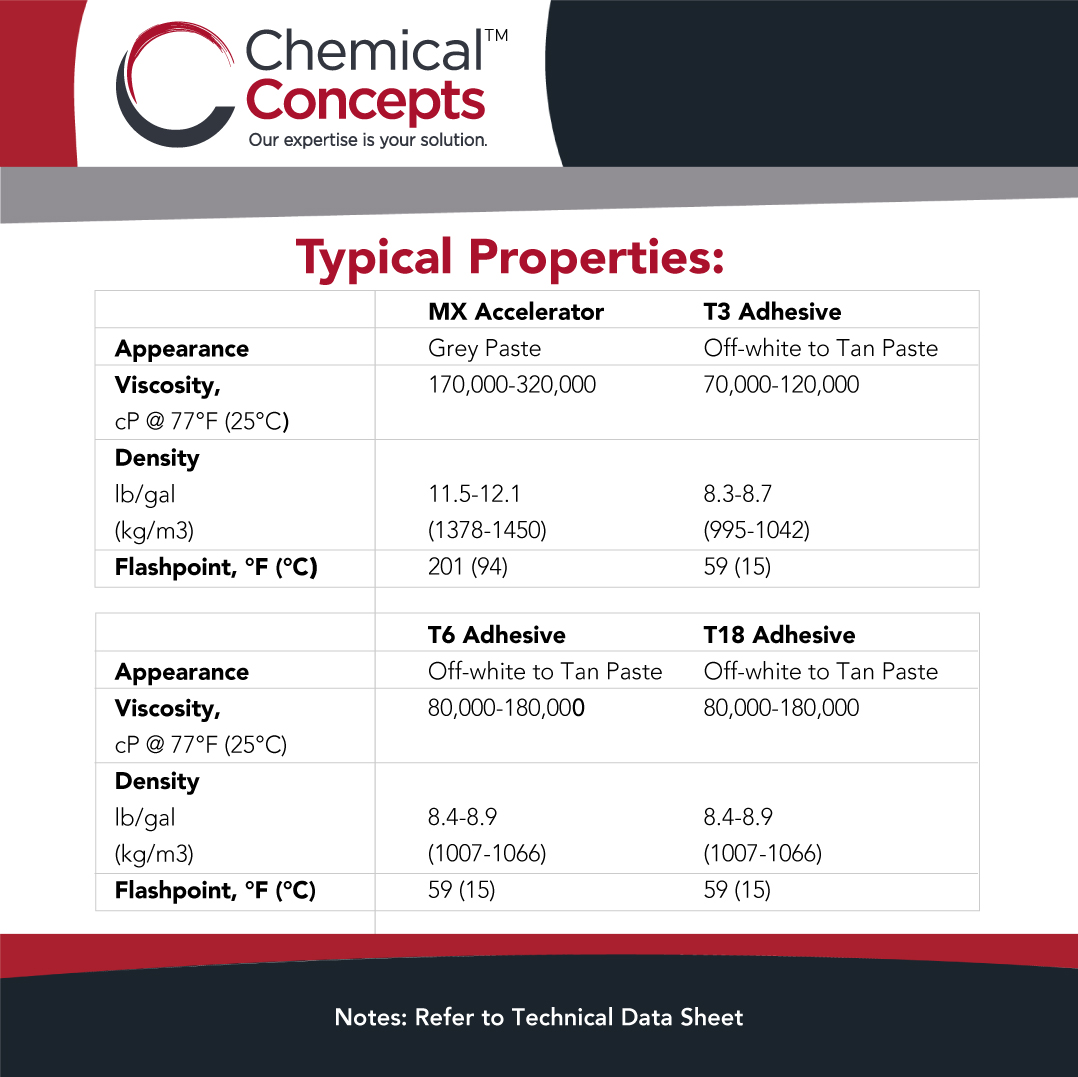
| Viscosity at 77°F (25°C) | T18S: 70,000 to 200,000 cP MX: 100,000 to 500,000 cP |
| Density | T18S: 8.4 to 8.9 lb/gal (1007 to 1066 kg/m³) MX: 11.45 to 12.15 lb/gal (1372 to 1456 kg/m³) |
| Flash Point | T18S: 59°F (15°C) MX: 201°F (94°C) |
| Glass Bead Diameter | 0.01 in (0.025 cm) |
| Service Temperature | -40°F to 300°F (-40°C to 149°C) |
| Shelf Life | 9 months per component, unopened, stored below 80°F (27°C) |
| Available Size | 415ml cartridge |
| Country of Manufacture | United States |
Parker publishes cured properties and bond performance data for the MX/T6S grade only, and states that other adhesive and accelerator combinations should be confirmed with them directly. Those figures are not repeated here. If your design needs tensile, modulus or lap shear numbers specific to T18S, call us and we will get them from Parker.
Performance in Production
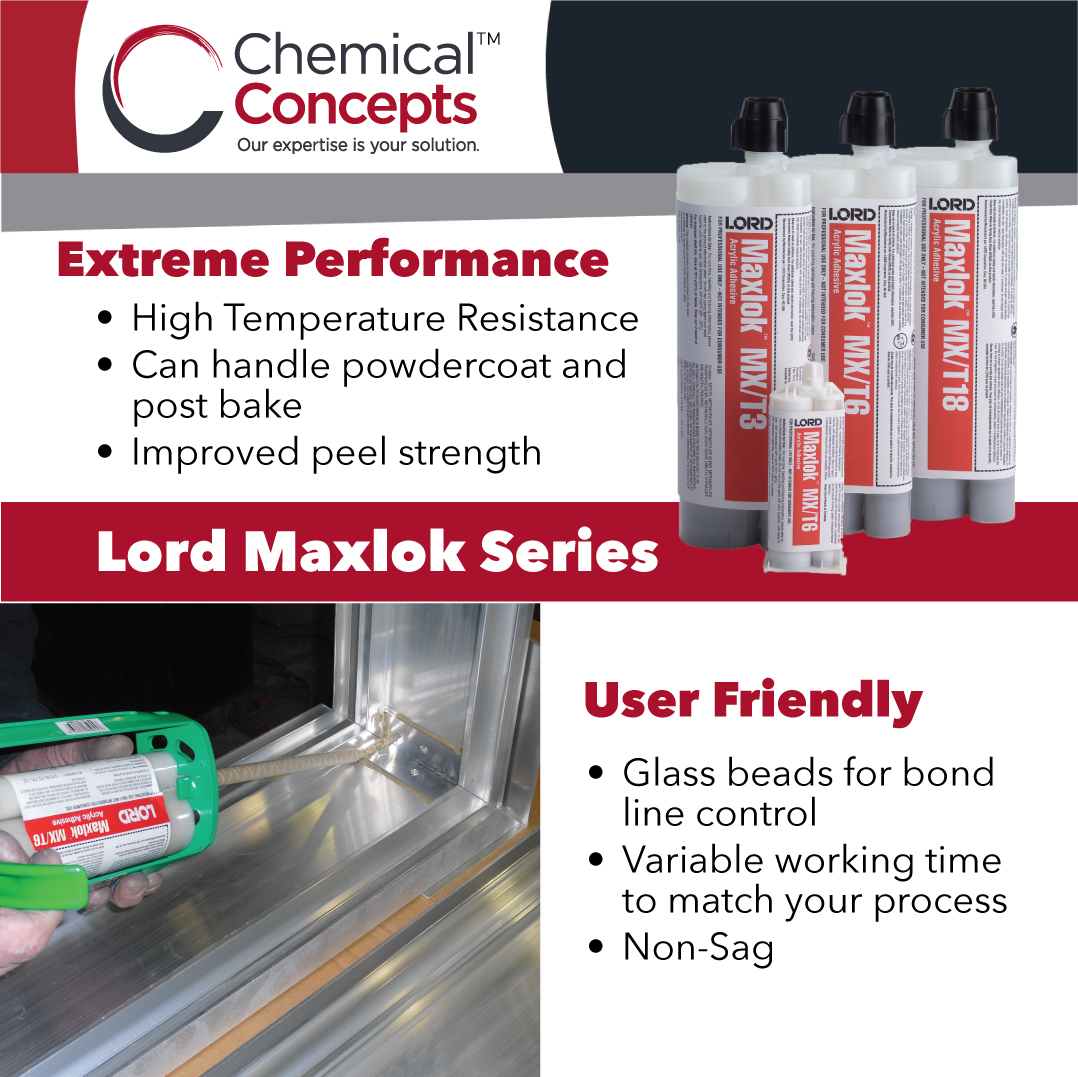
- 18 to 24 minutes of work time is the longest in the Maxlok family by a wide margin, about five times what T3S gives you. On a long panel seam that is the difference between one continuous pass and stopping to let a section set.
- It also buys fitting time. Acrylics do not tolerate being lifted and re-set once mated, so on a large panel the real constraint is getting it right the first time. Twenty minutes lets you land the part, check it against a reference edge and slide it into position without racing anything.
- The cost is fixture turns. At 48 to 72 minutes to handling strength you get roughly one turn an hour, against six to eight on T3S. Long work times need either more fixtures or a slower line.
- Glass beads at 0.01 in diameter hold the bond line at a controlled thickness, so clamping pressure cannot squeeze the joint down to nothing. That same bead layer physically separates dissimilar metals, which is why acrylics like this get specified on aluminum-to-steel joints.
- Bonds unprepared metal. Normal mill oils and drawing compounds usually do not interfere, so parts can often go straight from forming to bonding without a degrease step.
- Non-sag matters more on this grade than the fast ones, because the bead sits unsupported on a vertical or overhead joint for the better part of an hour before it sets.
- Cured adhesive changes color to indicate a full cure, and even color distribution in the bead confirms the mixer is working. Both are visual checks an operator can make without instruments.
- Resists dilute acids, alkalis, solvents, greases, oils, moisture, salt spray and weathering, with good resistance to indirect UV exposure.
Common Applications
- Long continuous panel seams bonded in a single pass
- Large panels that need positioning and adjustment before the adhesive sets
- Trailer sidewall, shiplap and body panel bonding
- Truck body, service body and utility vehicle assembly
- Cross bonding aluminum to galvanized or painted steel on large assemblies
- Replacing long weld seams and rivet lines on sheet metal
- Sign fabrication and architectural metal with large bond areas
- Multi-joint assemblies where several parts are set from one cartridge load
How to Dispense LORD Maxlok MX/T18S
Almost nothing goes wrong on this grade from running out of time. What goes wrong is disturbing a joint that has not set, or pulling the clamps early. Fixture the part and leave it the full 48 to 72 minutes.
- Prep the surfaces. Remove grease, loose contamination and poorly adhering oxides from metal. Normal amounts of mill oils and drawing compounds usually do not present a problem. Most plastics need a simple cleaning, and some need abrading for best performance.
- Load the cartridge in a 4:1 gun sized for 415ml and pull the end caps. Level the plungers by expelling a small amount of material so both sides are even.
- Fit the mixing tip and expel a mixer’s length of adhesive to waste. Watch the color: even grey distribution is what tells you the mix is thorough.
- Apply to the substrate and mate the parts inside the 18 to 24 minute work time. Clamp in position until the adhesive reaches handling strength.
- Do not re-expose the adhesive to air once the parts are mated. If alignment needs correcting, slide the parts into position rather than separating them.
- Hold the parts in contact for the entire cure. Complete cure takes 24 hours at room temperature. Modest heat below 150°F (66°C) will speed it up, which on this grade is worth planning for rather than treating as a fallback. Parker asks that you confirm the maximum temperature with an application engineer for your chosen cure speed.
- Clean tools with isopropyl alcohol, acetone or MEK before cure. Cured adhesive softens at 400°F (204°C) and above if parts have to come apart.
Storage and Handling
Maxlok stores differently from the urethane structural adhesives. Both components carry a nine month shelf life when unopened and kept below 80°F (27°C), and Parker recommends 40 to 50°F (4 to 10°C) storage. Cold-stored material should come back to room temperature before use. Keep it out of direct sunlight. The uncured components are flammable, so Parker’s instruction is not to store or use them near heat, sparks or open flame. Once the adhesive has cured, that no longer applies. Read the SDS before the material goes on the floor.
Maxlok Grades Compared
All three grades run the same MX accelerator at the same 4:1 ratio and share the same chemistry, temperature range and glass bead bondline control. The grade letter changes speed only, so pick by how long your assembly takes.
| Grade | Work Time at 77°F | Handling Strength | Sizes Offered |
|---|---|---|---|
| MX/T3S | 3 to 5 min | 6 to 8 min | 415ml |
| MX/T6S | 6 to 9 min | 20 to 24 min | 50ml, 415ml |
| MX/T18S (this page) | 18 to 24 min | 48 to 72 min | 415ml |
T18S is the grade for large panel work where the assembly itself takes time. If your parts are small and your bottleneck is fixtures rather than fitting, T6S or T3S gives you the same bond with a far faster turn. T6S is also the only grade offered in a 50ml cartridge, so it is the practical choice for a bond trial before committing to T18S in production.
Available Size and Part Number
| Size | Chemical Concepts SKU | Parker Lord Part Number |
|---|---|---|
| 415ml cartridge | LOR3032005 | 3032005 |
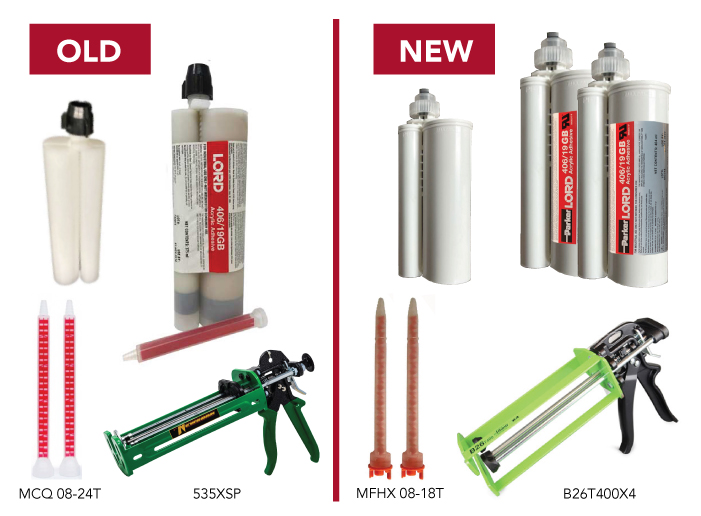
The 415ml cartridge replaced the previous 375ml package (part 3019922). The two are not interchangeable: the 415ml takes a different gun and a different mixing tip. If you are reordering against an old part number, check your dispensing equipment before the material arrives.
Dispensing Equipment
The 415ml cartridge is a 4:1 F-system package. It takes a 4:1 gun built for 400 to 415ml cartridges and an F-system mixing tip. Equipment for the older 375ml package does not carry over.
| Type | Product | Notes |
|---|---|---|
| Static mixer | LORD 3032007 F-style mixing tip | 4:1/10:1, 8 mm, 18 elements. Parker’s own tip for this cartridge. Set of 12. |
| Static mixer | Mixpac MFHX 08-18T | 4:1/10:1 helix, F-system, 8 mm, 18 elements, stepped tip. |
| Manual gun | Albion B26T400X4 | 400 Series B-Line, 4:1, 26:1 thrust ratio. |
| Pneumatic gun | Albion AT400X4 | 400 Series AT-Line air powered, 4:1. Also offered with a suitcase handle. |
| Cordless gun | Albion E18T400X4 | 400 Series cordless, 4:1, 18 V. |
An 18 to 24 minute work time means you can realistically empty most of a 415ml cartridge across one long seam. That makes the powered guns worth more here than on the fast grades, since you are squeezing heavy acrylic paste continuously rather than in short bursts, and hand fatigue over a 20 minute bead shows up as an uneven bond line.
Frequently Asked Questions
What is LORD Maxlok MX/T18S used for?
LORD Maxlok MX/T18S is a two-part structural acrylic adhesive used to replace welding, brazing, riveting and mechanical fastening on metal, composite and plastic assemblies. It is the long-work-time grade of the Maxlok family, built for large panel work where the assembly itself takes time. Structural acrylic, MMA adhesive and methacrylate adhesive all describe the same chemistry.
Why choose T18S over a faster grade?
Because the joint takes time to make. 18 to 24 minutes lets you lay a long seam, land the panel and slide it into position in one pass, where T3S at 3 to 5 minutes would skin partway through. The trade is fixture time: 48 to 72 minutes to handling strength against 6 to 8 on T3S, which is roughly one fixture turn an hour.
What size does LORD Maxlok MX/T18S come in?
The 415ml cartridge, part number 3032005, which is the only size currently offered in this grade. If you need a smaller package, MX/T6S is the only Maxlok grade available in 50ml, with a 6 to 9 minute work time.
What gun and mixing tip does it need?
A 4:1 gun built for 400 to 415ml cartridges and an F-system mixing tip at 8 mm with 18 elements. We stock Parker’s LORD 3032007 tip and the Mixpac MFHX 08-18T, plus Albion 400 Series guns in manual, pneumatic and cordless. Equipment for the older 375ml cartridge will not fit this package.
Do I have to clean or abrade the metal first?
Usually not much. Remove grease, loose contamination and poorly adhering oxides, but Parker states that normal amounts of mill oils and drawing compounds do not typically present a problem in adhesion. That minimal-prep tolerance is the main reason shops move to acrylics from other chemistries. Most plastics need a simple cleaning, and some need abrading for best performance.
Can I reposition parts after mating them?
Only by sliding. Parker’s instruction is not to re-expose the adhesive to air once the parts are mated, so correcting alignment means sliding the parts into position rather than lifting one off and setting it back down. T18S gives you the most time in the family to get that right, which is the main reason to pick it on a large panel.
How do I know it mixed properly?
Look at the color. Parker states that even color distribution visually indicates a thorough mix, so a streaky bead coming out of the tip means the mixer has not cleared yet. Cured Maxlok also changes color to indicate a full cure, with the final color depending on the accelerator used. On a grade with a 48 to 72 minute fixture window, the purge check is worth taking seriously, since you will not find out otherwise until the clamps come off.
How should it be stored, and how long does it last?
Nine months per component, unopened, stored below 80°F (27°C). Parker recommends 40 to 50°F (4 to 10°C), and cold-stored material should return to room temperature before use. Protect it from direct sunlight. Run inventory first in, first out.
Questions on fit for your bonding application? Call (800) 220-1966 or email [email protected].





Reviews
There are no reviews yet.