




Description
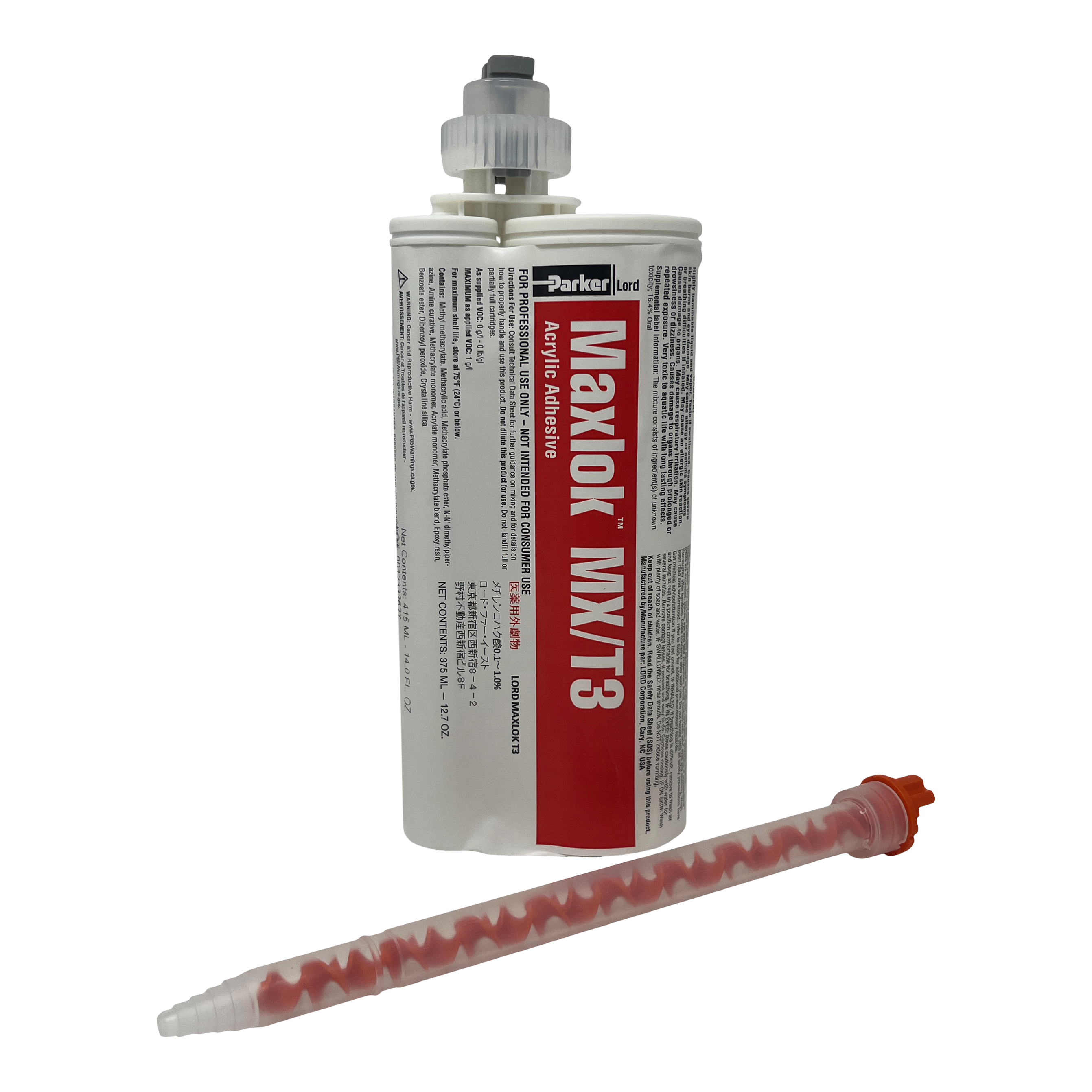
LORD Maxlok MX/T3S structural acrylic adhesive is the fastest grade in the Maxlok family, mixed 4:1 by volume with LORD Maxlok MX accelerator and supplied in a 415ml cartridge. It bonds unprepared metals, composites and plastics with minimal surface preparation, which is the point of the whole line: it replaces welding, brazing, riveting and mechanical fastening on assemblies that see high impact or high peel loads. Work time is 3 to 5 minutes and handling strength comes at 6 to 8 minutes, so a fixture turns several times an hour. Mixed, it is a grey non-sag paste. Made in the USA.
Key Product Details
| Property | Value |
|---|---|
| Product | LORD Maxlok MX/T3S |
| Chemistry | Two-component structural acrylic (MMA) |
| Mixed Appearance | Grey non-sag paste |
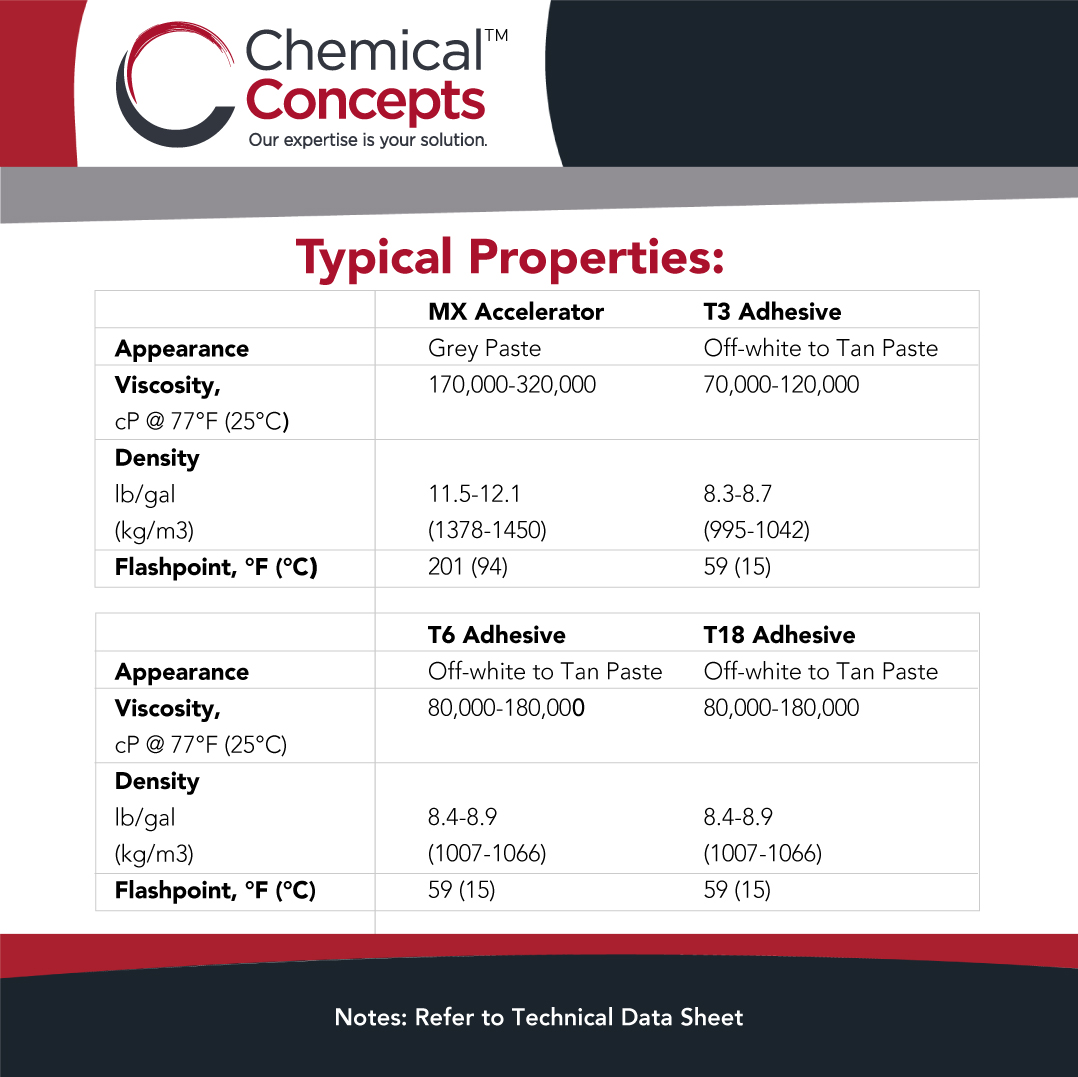
| T3S Adhesive Appearance | Off-white to tan paste |
| MX Accelerator Appearance | Grey paste |
| Mix Ratio | 4:1 by volume, metered automatically by the cartridge |
| Solids Content | 100% |
| Working Time | 3 to 5 minutes at 77°F (25°C) |
| Time to Handling Strength | 6 to 8 minutes at 77°F (25°C), 50 psi shear |
| Full Cure | 24 hours at room temperature |
| Viscosity at 77°F (25°C) | T3S: 70,000 to 200,000 cP MX: 100,000 to 500,000 cP |
| Density | T3S: 8.25 to 8.75 lb/gal (989 to 1048 kg/m³) MX: 11.45 to 12.15 lb/gal (1372 to 1456 kg/m³) |
| Flash Point | T3S: 59°F (15°C) MX: 201°F (94°C) |
| Glass Bead Diameter | 0.01 in (0.025 cm) |
| Service Temperature | -40°F to 300°F (-40°C to 149°C) |
| Shelf Life | 9 months per component, unopened, stored below 80°F (27°C) |
| Available Size | 415ml cartridge |
| Country of Manufacture | United States |
Performance in Production
- 3 to 5 minutes of work time and handling strength at 6 to 8 minutes. That is the fastest cycle in the Maxlok family and the reason to pick T3S: a fixture turns six to eight times an hour instead of twice.
- The tradeoff is positioning. Once parts are mated the adhesive should not be re-exposed to air, and alignment has to be corrected by sliding the parts rather than lifting and re-setting them. On a short fast joint that is fine. On a long panel seam it is not, and that is what T6S and T18S are for.
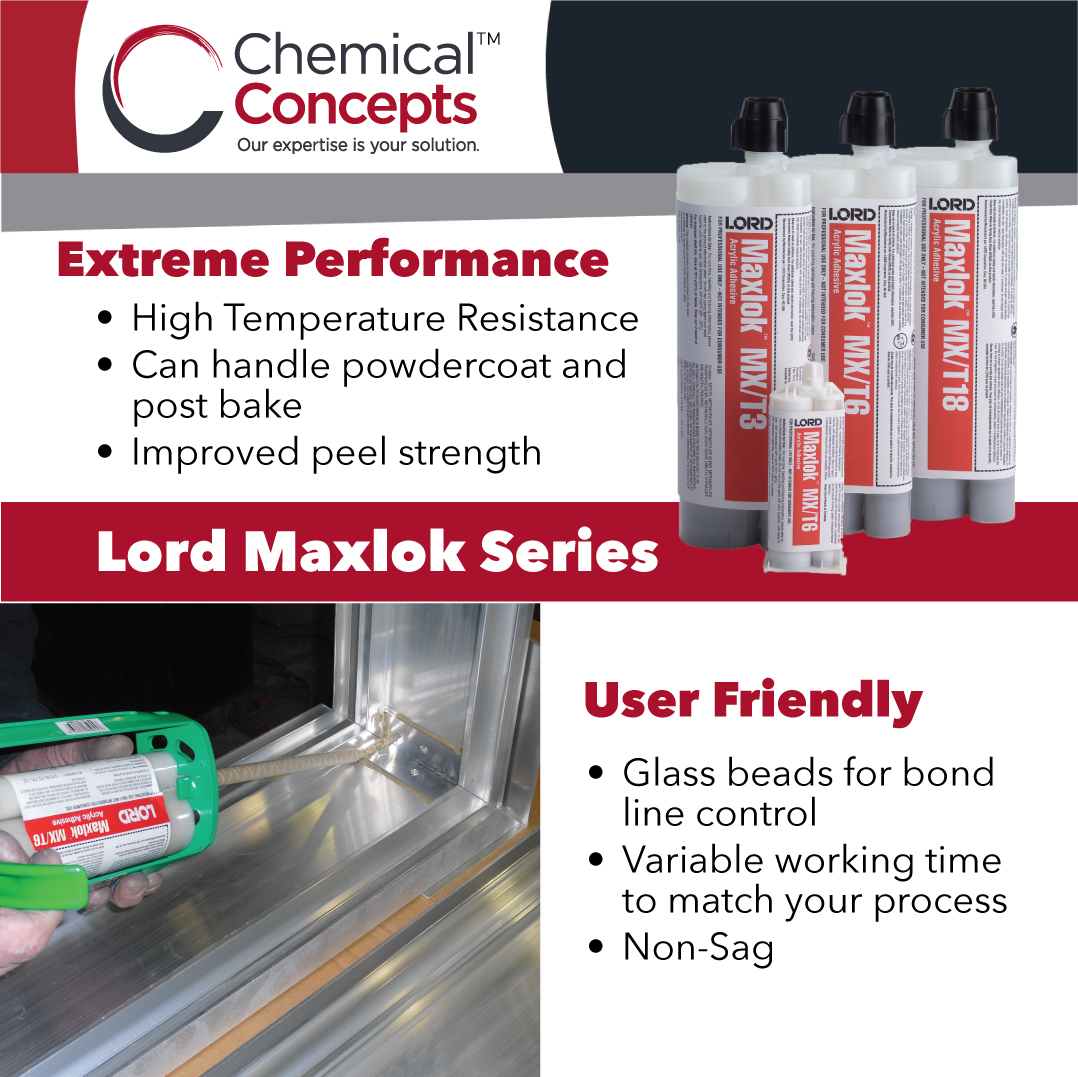
- Glass beads at 0.01 in diameter hold the bond line at a controlled thickness, so clamping pressure cannot squeeze the joint down to nothing. That same bead layer physically separates dissimilar metals, which is why acrylics like this get specified on aluminum-to-steel joints.
- Bonds unprepared metal. Normal mill oils and drawing compounds usually do not interfere, so parts can often go straight from forming to bonding without a degrease step.
- Cured adhesive changes color to indicate a full cure, and even color distribution in the bead confirms the mixer is working. Both are visual checks an operator can make without instruments.
- Resists dilute acids, alkalis, solvents, greases, oils, moisture, salt spray and weathering, with good resistance to indirect UV exposure.
- Non-sag, so the bead holds position on vertical and overhead work.
- Both components are flammable, with the T3S adhesive flashing at 59°F. This is a real difference from urethane structural adhesives and it changes how the material is stored and handled on the floor.
Common Applications
- Replacing spot welds, rivets and mechanical fasteners on sheet metal assemblies
- Bonding aluminum, hot dipped galvanized and electrogalvanized steel
- Cross bonding dissimilar metals where galvanic separation matters
- Trailer, truck body and utility vehicle panel and trim bonding
- Sign fabrication and architectural metal assembly
- Bonding unprepared metal straight off the forming line
- Small parts, brackets, tabs and studs where a fast fixture turn matters
- Vertical and overhead joints where the bead has to hold position
How to Dispense LORD Maxlok MX/T3S
Three to five minutes is a short window, and the bigger constraint is that acrylics do not tolerate being disturbed once mated. Stage the joint, the clamps and the fixture before the mixer goes on.
- Prep the surfaces. Remove grease, loose contamination and poorly adhering oxides from metal. Normal amounts of mill oils and drawing compounds usually do not present a problem. Most plastics need a simple cleaning, and some need abrading for best performance.
- Load the cartridge in a 4:1 gun sized for 415ml and pull the end caps. Level the plungers by expelling a small amount of material so both sides are even.
- Fit the mixing tip and expel a mixer’s length of adhesive to waste. Watch the color: even distribution is what tells you the mix is thorough.
- Apply to the substrate and mate the parts inside the 3 to 5 minute work time. Clamp in position until the adhesive reaches handling strength.
- Do not re-expose the adhesive to air once the parts are mated. If alignment needs correcting, slide the parts into position rather than separating them.
- Hold the parts in contact for the entire cure. Complete cure takes 24 hours at room temperature. Modest heat below 150°F (66°C) will speed it up, and Parker asks that you confirm the maximum temperature with an application engineer for your chosen cure speed.
- Clean tools with isopropyl alcohol, acetone or MEK before cure. Cured adhesive softens at 400°F (204°C) and above if parts have to come apart.
Storage and Handling
Maxlok is flammable and stores differently from the urethane structural adhesives. Both components carry a nine month shelf life when unopened and kept below 80°F (27°C), and Parker recommends 40 to 50°F (4 to 10°C) storage. Cold-stored material should come back to room temperature before use. Keep it out of direct sunlight, and do not store or use near heat, sparks or open flame. Read the SDS before the material goes on the floor.
Maxlok Grades Compared
All three grades run the same MX accelerator at the same 4:1 ratio and share the same chemistry, temperature range and glass bead bondline control. The grade letter changes speed only, so pick by how long your assembly takes.
| Grade | Work Time at 77°F | Handling Strength | Sizes Offered |
|---|---|---|---|
| MX/T3S (this page) | 3 to 5 min | 6 to 8 min | 415ml |
| MX/T6S | 6 to 9 min | 20 to 24 min | 50ml, 415ml |
| MX/T18S | 18 to 24 min | 48 to 72 min | 415ml |
T3S is the only grade where handling strength arrives in under ten minutes. If you need a 50ml cartridge for smaller work, T6S is the only grade offered in that size. Parker publishes its cured property and bond performance data on T6S, so that is also the grade to look at first if your engineering group wants numbers.
Available Size and Part Number
| Size | Chemical Concepts SKU | Parker Lord Part Number |
|---|---|---|
| 415ml cartridge | LOR3031981 | 3031981 |
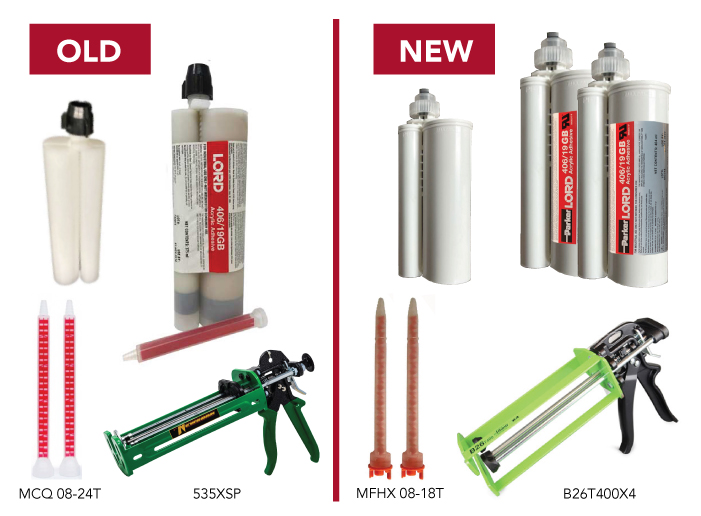
The 415ml cartridge replaced the previous 375ml package (part 3019950). The two are not interchangeable: the 415ml takes a different gun and a different mixing tip. If you are reordering against an old part number, check your dispensing equipment before the material arrives.
Dispensing Equipment
The 415ml cartridge is a 4:1 F-system package. It takes a 4:1 gun built for 400 to 415ml cartridges and an F-system mixing tip. Equipment for the older 375ml package does not carry over.
| Type | Product | Notes |
|---|---|---|
| Static mixer | LORD 3032007 F-style mixing tip | 4:1/10:1, 8 mm, 18 elements. Parker’s own tip for this cartridge. Set of 12. |
| Static mixer | Mixpac MFHX 08-18T | 4:1/10:1 helix, F-system, 8 mm, 18 elements, stepped tip. |
| Manual gun | Albion B26T400X4 | 400 Series B-Line, 4:1, 26:1 thrust ratio. |
| Pneumatic gun | Albion AT400X4 | 400 Series AT-Line air powered, 4:1. Also offered with a suitcase handle. |
| Cordless gun | Albion E18T400X4 | 400 Series cordless, 4:1, 18 V. |
Gun choice matters more on T3S than on the slower grades. A 415ml cartridge of heavy acrylic paste takes real hand effort, and with only 3 to 5 minutes of work time, fatigue partway through a bead turns into an uneven bond line. If you are running these daily, the pneumatic or cordless pays for itself in bead consistency.
Frequently Asked Questions
What is LORD Maxlok MX/T3S used for?
LORD Maxlok MX/T3S is a two-part structural acrylic adhesive used to replace welding, brazing, riveting and mechanical fastening on metal, composite and plastic assemblies. It bonds unprepared metals with minimal surface preparation and holds up across a wide temperature range on joints seeing high impact or high peel loads. Structural acrylic, MMA adhesive and methacrylate adhesive all describe the same chemistry.
Do I have to clean or abrade the metal first?
Usually not much. Remove grease, loose contamination and poorly adhering oxides, but Parker states that normal amounts of mill oils and drawing compounds do not typically present a problem in adhesion. That minimal-prep tolerance is the main reason shops move to acrylics from other chemistries. Most plastics need a simple cleaning, and some need abrading for best performance.
What are the glass beads for?
They control the bond line thickness. The beads are 0.01 in in diameter and act as physical spacers, so clamping cannot squeeze the joint thinner than that. Since the beads sit between the two substrates, they also keep dissimilar metals from touching each other directly, which is the reason acrylics with bead control get specified on joints like aluminum to steel.
What gun and mixing tip does the 415ml cartridge need?
A 4:1 gun built for 400 to 415ml cartridges, with an F-system mixing tip at 8 mm and 18 elements. We stock Parker’s own LORD 3032007 tip and the Mixpac MFHX 08-18T, plus Albion 400 Series guns in manual, pneumatic and cordless. The equipment table above lists what we carry. Equipment for the older 375ml cartridge will not fit this package.
How do I know it mixed properly?
Look at the color. Parker states that even color distribution visually indicates a thorough mix, so a streaky bead coming out of the tip means the mixer has not cleared yet. Cured Maxlok also changes color to indicate a full cure, with the final color depending on the accelerator used. Both checks are visual and need no instruments.
Can I reposition parts after mating them?
Only by sliding. Parker’s instruction is not to re-expose the adhesive to air once the parts are mated, so correcting alignment means sliding the parts into position rather than lifting one off and setting it back down. With a 3 to 5 minute work time on T3S there is not much room for second attempts, which is worth weighing against T6S or T18S if your parts need fitting.
How should it be stored, and how long does it last?
Nine months per component, unopened, stored below 80°F (27°C). Parker recommends 40 to 50°F (4 to 10°C), and cold-stored material should return to room temperature before use. Protect it from direct sunlight. Run inventory first in, first out.
Which Maxlok grade should I use?
Pick by how long your assembly takes. T3S gives 3 to 5 minutes of work time and handling in 6 to 8 minutes, T6S gives 6 to 9 minutes and handling in 20 to 24, and T18S gives 18 to 24 minutes and handling in 48 to 72. Chemistry, temperature range and bondline control are identical across all three, so this is a cycle time decision rather than a performance one.
Questions on fit for your bonding application? Call (800) 220-1966 or email [email protected].




Reviews
There are no reviews yet.