



Description
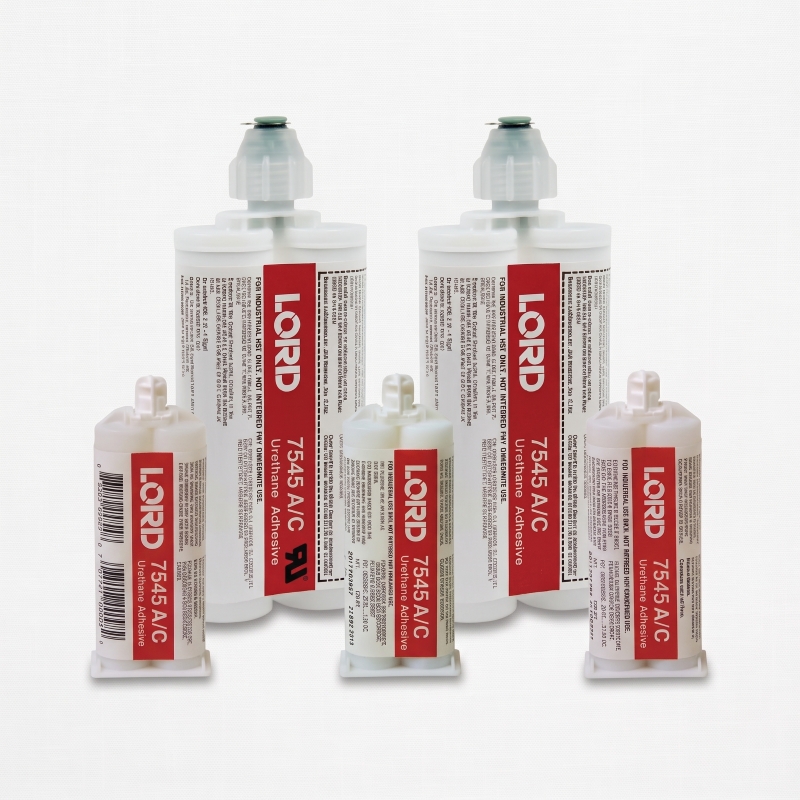
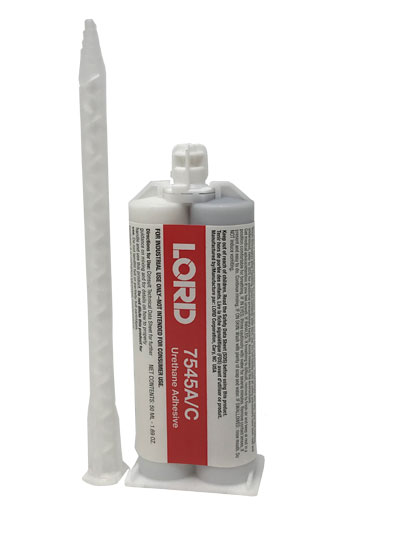
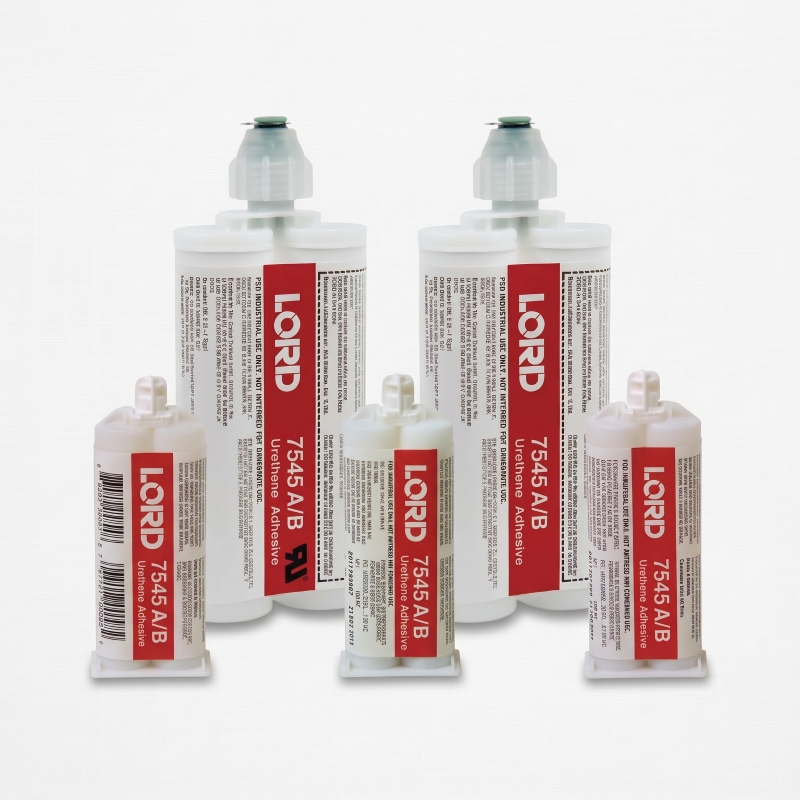
LORD 7545-A/C structural urethane adhesive is the middle grade of the LORD 7545 series, mixed 1:1 by volume and stocked in 50ml, 200ml and 400ml cartridges. It bonds FRP, SMC and other plastics with little surface preparation, plus primed metals and dissimilar substrate combinations. The 6 to 8 minute work time is where most shops land when 7545-A/B feels rushed: enough time to run a longer bead, set more than one part per mix, and reposition without scrapping the joint. Mixed, it is an off-white non-sag paste that holds position on vertical and overhead surfaces. Made in the USA.
Key Product Details
| Property | Value |
|---|---|
| Product | LORD 7545-A/C |
| Chemistry | Two-component polyurethane (urethane) structural adhesive |
| Mixed Appearance | Off-white non-sag paste |
| 7545-A Resin Appearance | Brown paste |
| 7545-C Curative Appearance | Off-white paste |
| Mix Ratio | 1:1 by volume, 1:0.87 by weight |
| Solids Content | 100% by weight |
| Working Time | 6 to 8 minutes at 75°F (24°C) |
| Purge Time | 7 minutes at 75°F (24°C) |
| Time to Handling Strength | 60 minutes at 75°F (24°C) |
| Full Cure | 24 hours at 75°F (24°C) |
| Viscosity at 77°F (25°C) | 7545-A: 25,000 to 70,000 cP 7545-C: 230,000 to 650,000 cP |
| Density | 7545-A: 12.5 to 12.8 lb/gal (1498 to 1534 kg/m³) 7545-C: 10.8 to 11.2 lb/gal (1294 to 1342 kg/m³) |
| Flash Point, Closed Cup | Over 200°F (93°C), both components |
| Elongation | 70% |
| Service Temperature | -40°F to 212°F (-40°C to 100°C) |
| Recommended Bondline Thickness | 0.010 to 0.040 in (254 to 1016 micron) |
| Shelf Life | 8 months from date of manufacture, unopened, stored at 65 to 85°F (18 to 30°C) |
| Available Sizes | 50ml, 200ml and 400ml cartridges |
| Country of Manufacture | United States |
Cured Properties
Parker publishes the following cured properties for the LORD 7545 system. The technical data sheet does not break them out by individual curative, so treat them as series-level and test your own joint before production.
| Property | Value | Test Method |
|---|---|---|
| Hardness, Shore D | 67 | |
| Tensile Strength at Break | 3000 psi (20.7 MPa) | ASTM D882 |
| Young’s Modulus | 22,200 psi (153 MPa) | ASTM D882 |
| Glass Transition Temperature (Tg) | 116°F (47°C) | ASTM D3418 |
| Moisture Absorption | Less than 1% | ASTM D570 |
Bond Performance by Substrate
Lap shear in psi, with failure mode in parentheses. SF is stock failure, meaning the substrate broke before the bond did. COH is cohesive failure, the adhesive itself split. ADH is adhesive failure, the bond released from the surface. Stock failure across most of the CFRP and ABS conditions is the number that matters most here, because it says the joint outlasted the part. Parker publishes this data for the LORD 7545 system without breaking it out by curative.
| Test Condition | CFRP | ABS | PC/ABS | E-Coated Steel |
|---|---|---|---|---|
| Lap shear at 70°F (21°C) | 2900 (SF) | 550 (SF) | 900 (SF) | 2350 (COH) |
| Lap shear at -40°F (-40°C) | 2600 (SF) | 400 (SF) | 550 (SF) | 3300 (ADH) |
| Lap shear at 150°F (65°C) | 1150 (COH) | 350 (COH) | 550 (COH) | 1100 (COH) |
| After 500 hr at 150°F, 85% RH | 2700 (SF) | 550 (SF) | 750 (COH) | 2400 (COH) |
| After 168 hr water immersion at 150°F | 2650 (COH/SF) | 550 (SF) | 650 (COH/SF) | 2450 (COH) |
| After 500 hr salt spray | 2650 (SF) | 550 (SF) | 650 (SF) | 2400 (COH) |
| After 500 hr at 150°F | 2900 (SF) | 550 (SF) | 850 (SF) | 1500 (COH) |
| T-peel, pli | Not tested | Not tested | Not tested | 33 (COH) |
Test specimens: CFRP was 2×2 twill in an epoxy resin matrix, 3 mm thick. ABS and PC/ABS were both 5 mm thick. E-coated steel was 1008 steel, 8 mm thick, coated with PPG E6060C. Your substrate, joint geometry and surface prep will move these numbers, so run your own bond trial.
Performance in Production
- 6 to 8 minutes of work time is the practical difference from A/B. You can run a longer bead, set two or three small parts off one mix, and reposition a panel that lands crooked instead of scrapping it.
- The cost of that time is fixture turns. At 60 minutes to handling strength you get roughly one turn an hour, against two on A/B and six on A/G. If your bottleneck is fixtures rather than bead length, the faster grade wins.
- Stock failure on CFRP at 2900 psi and on ABS across nearly every aged condition means the part gives up before the joint does. On those substrates the adhesive stops being the limiting factor in the design.
- Cold performance splits by substrate. CFRP and ABS lose shear at -40°F while e-coated steel climbs to 3300 psi, so a cross-bonded plastic-to-metal joint gets stiffer and less forgiving in winter service. Design for the plastic side.
- Shear drops roughly 60% at 150°F, expected for a urethane and the reason the service ceiling sits at 212°F. Sustained heat above that belongs on an epoxy.
- At 230,000 to 650,000 cP the curative is a heavy paste. The mixed bead stays put on vertical and overhead work instead of slumping out of the joint.
- 70% elongation and a 22,200 psi modulus give the bond line room to move when two substrates expand at different rates, which is what kills a rigid adhesive on a plastic-to-metal seam.
- 7545-A resin is moisture sensitive. Keep cartridges in the Mylar bag with the desiccant and leave the used mixer in place on a partial as a plug, or the next bead cures short.
Common Applications
- Structural bonding of FRP and SMC panels, covers and enclosures
- Longer bond lines where a 3 to 5 minute work time runs out mid-bead
- Multi-part assemblies where several joints come off one mix
- Truck cap, tonneau cover, running board and toolbox assembly
- Service body and work truck panel, roof and door closure bonding
- Cross bonding plastics and composites to primed, painted or e-coated metal
- Marine and recreational vehicle composite panel bonding
- Panel work that needs repositioning before the adhesive sets
How to Dispense LORD 7545-A/C
Six to eight minutes is a workable window, but the purge time is 7 minutes, which is worth reading together. Material left sitting in the mixer is on the same clock as material on the part. Parker’s instruction is to discard the part if working time is exceeded, because a bead that has begun to skin will not wet the mating surface.
- Prep both surfaces. Plastics and composites get a dry rag wipe or a solvent-dampened rag to pull loose debris and processing fluids. Metals get primed, painted or grit blasted, then solvent washed.
- Load the cartridge in a 1:1 gun sized for that cartridge and pull the end caps. Level the plungers by expelling a little material with no mixer installed, until both sides dispense evenly.
- Fit the right static mixer for the size. Parker calls for at least 20 elements on a 50ml cartridge and at least 24 elements on a 200ml or 400ml. Purge a mixer’s length to waste before the first bead.
- Lay the bead, mate the parts and clamp inside the 6 to 8 minute work time. Target a 0.010 to 0.040 in bondline. Larger gaps can be filled where mating surfaces are irregular.
- Hold the part fixtured 60 minutes at 75°F, then handle. Full strength is 24 hours. Cure can be accelerated with modest heat, up to 250°F (121°C).
- Clean tools with acetone or MEK before cure. Do not use alcohol. Cured adhesive softens at 300°F (149°C) and above if parts have to come apart.
Substrates the process runs on: FRP, GRP, SMC, carbon fiber, ABS, polycarbonate, PC/ABS blends, other engineered plastics, HDU urethane foam, wood, and primed, painted, powder-coated or e-coated metals. Glass, non-porous ceramic and stone need LORD AP-134 first. Vulcanized rubber and elastomers need LORD 7701. TPE and TPO need LORD 459X. Bare aluminum and bare steel are not urethane substrates, so prime them or move to an acrylic.
Choosing a Cartridge Size
Same adhesive in all three. What changes is bead yield, what gun and mixer you need, and how much you lose to purge on a partial.
| Bead Diameter | 50ml | 200ml | 400ml |
|---|---|---|---|
| 1/8 in (3 mm) | 20.7 ft (6.3 m) | 82.5 ft (25.15 m) | 165.5 ft (50.4 m) |
| 1/4 in (6 mm) | 5.1 ft (1.55 m) | 20.7 ft (6.3 m) | 41.4 ft (12.6 m) |
| 3/8 in (9.5 mm) | 2.3 ft (0.7 m) | 9.3 ft (2.8 m) | 18.4 ft (5.6 m) |
| Static mixer elements | 20 minimum | 24 minimum | 24 minimum |
Take the 50ml for repair work, small parts and bond trials. Move to the 200ml once the same joint runs daily, since purge waste per cartridge is about the same either way and you spread it across four times the material. The 400ml is for long continuous bond lines and panel work, and unlike 7545-A/B it is available in the same off-white as the smaller sizes, so you are not trading appearance for volume.
LORD 7545 Series Grades Compared
Every grade runs the same 7545-A resin at the same 1:1 volume ratio. The curative letter changes speed, mixed color and cured elasticity, not the chemistry. Parker states the full range of work times all provide the same bond strength, so pick by how long your assembly actually takes.
| Grade | Mixed Appearance | Work Time at 75°F | Handling Strength | Elongation |
|---|---|---|---|---|
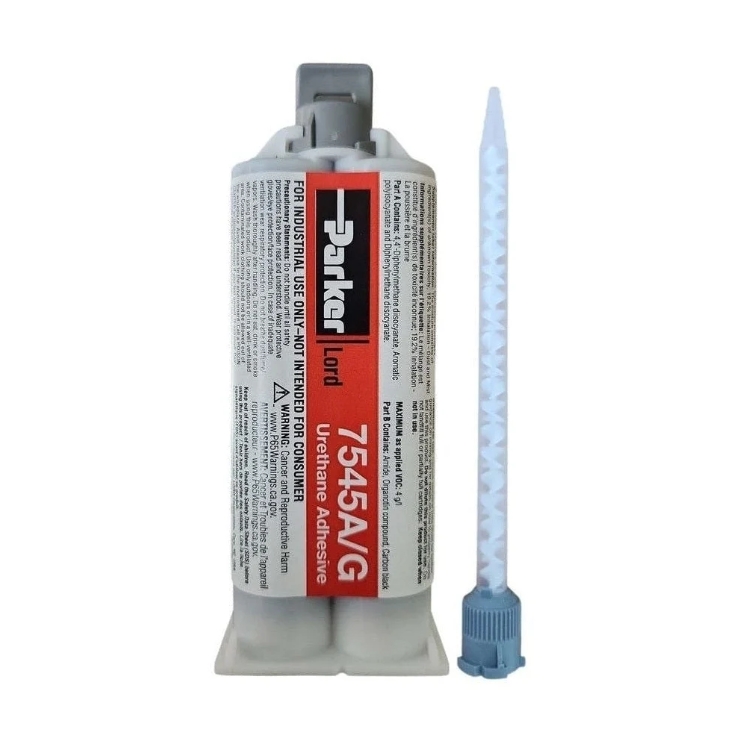
| 7545-A/G | Black paste | 1.5 min | 10 min | 70% |
| 7545-A/B | Off-white or black paste | 3 to 5 min | 30 min | 70% |
| 7545-A/C (this page) | Off-white paste | 6 to 8 min | 60 min | 70% |
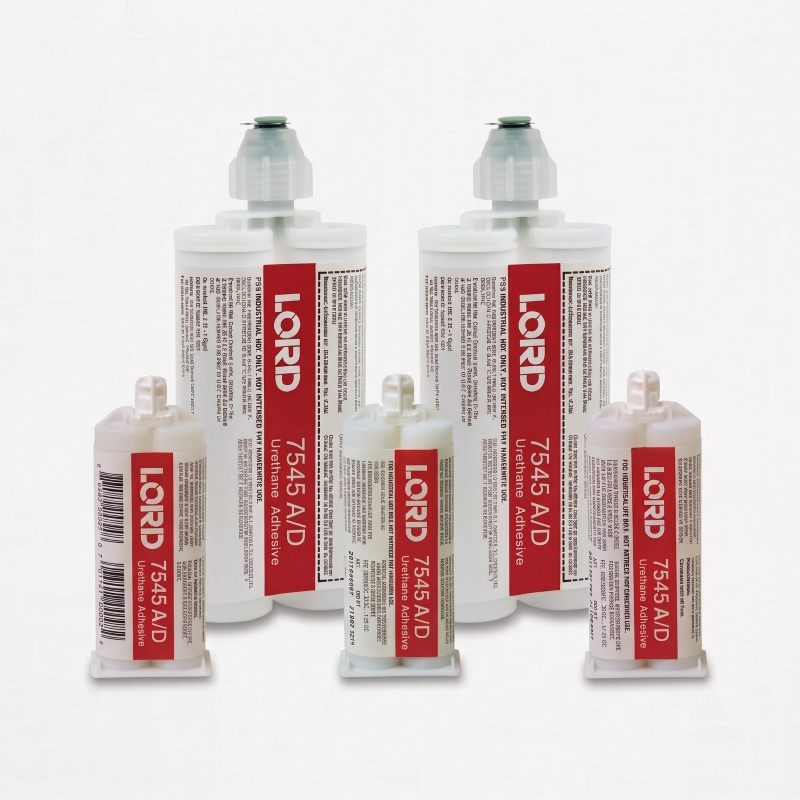
| 7545-A/D | Off-white or black paste | 11 to 18 min | 90 min | Not published |
| 7545-A/E | Off-white paste | 22 to 38 min | 2 to 3 hr | 160% |
| 7545-A/F | Off-white paste | 45 to 65 min | 4 to 5 hr | 145% |
A/C sits in the middle and is the grade to try first if A/B runs out on you mid-bead. Note that A/C is off-white only, so a visible bond line on a dark part means looking at A/B or A/D in black, or A/G if 1.5 minutes is enough time.
Available Sizes and Part Numbers
| Size | Chemical Concepts SKU | Parker Lord Part Number |
|---|---|---|
| 50ml cartridge | LOR3003924 | 3003924 |
| 200ml cartridge | LOR3003915 | 3003915 |
| 400ml cartridge | LOR3018245 | 3018245 |
Dispensing Equipment
Each cartridge size takes its own gun. The mixers below meet Parker’s element minimums, 20 on the 50ml and 24 on the 200ml and 400ml.
| Cartridge | Manual Gun | Pneumatic Gun | Static Mixer |
|---|---|---|---|
| 50ml | Chem-Set PAK-50 | — | Mixpac MBH 06-20T 20 elements |
| 200ml | Newborn VR200XSP | Mixpac DP2X 200 | Medmix MCQ 08-24T 24 elements |
| 400ml | Albion B26T400 | Mixpac DP2X 400 | Medmix MCQ 08-24T 24 elements |
Related Products
Surface modifiers, used when the substrate needs priming before bonding:
- LORD AP-134 adhesion enhancer for glass, non-porous ceramic, stone and concrete
- LORD 459X adhesion enhancer for TPE and TPO
- LORD 7701 surface treatment for vulcanized rubber and elastomers
Frequently Asked Questions
What is LORD 7545-A/C used for?
LORD 7545-A/C is a two-part structural urethane adhesive used to bond FRP, SMC and other plastics with minimal surface preparation, plus primed metals and dissimilar substrate combinations. It is the middle-speed grade of the 7545 family, used across truck and trailer bodies, service vehicles, marine and composite panel assembly. Urethane adhesive, polyurethane adhesive and PU adhesive all describe the same chemistry.
Should I use A/C or A/B?
Use A/C if a 3 to 5 minute work time runs out before you finish the bead or set the part. You get 6 to 8 minutes instead. The trade is fixture time, 60 minutes to handling strength against 30 on A/B, so you turn a fixture about half as often. If your bottleneck is fixtures rather than bead length, stay on A/B.
Does LORD 7545-A/C come in black?
No. A/C is off-white only in all three cartridge sizes. If the bond line will be visible and unpainted against a dark part, look at 7545-A/B or 7545-A/D, both of which are offered with a black curative, or 7545-A/G if a 1.5 minute work time is workable.
Which cartridge size should I order?
Take the 50ml for repairs, small parts and bond trials, the 200ml once the same joint runs daily, and the 400ml for long continuous bond lines and panel work. A 1/4 in bead gets you roughly 5 ft from the 50ml, 20.7 ft from the 200ml and 41.4 ft from the 400ml. Each size takes a different gun.
What gun and mixing tip does each cartridge need?
A 1:1 gun matched to the cartridge size, with a static mixer of at least 20 elements on the 50ml and at least 24 on the 200ml and 400ml. Those minimums come from Parker’s 7545 series application notes, and under-mixing is the most common cause of a bead that never fully cures. The dispensing table above lists what we stock for each size.
What surface prep does LORD 7545-A/C need?
Plastics need a dry rag wipe or a solvent-dampened rag to remove loose debris and processing fluids. Metals should be primed or grit blasted and then solvent washed for optimum bond performance. Glass, non-porous ceramic and stone need LORD AP-134 first, vulcanized rubber needs LORD 7701, and TPE and TPO need LORD 459X. Parker notes plasma treatment can help on hard-to-bond materials in special cases.
How strong is a LORD 7545 bond?
Strong enough that the substrate usually fails first on composites and plastics. Parker’s testing shows stock failure on CFRP at 2900 psi lap shear at room temperature and on ABS across almost every aged condition, meaning the test coupon broke before the bond did. On e-coated steel the failure mode is cohesive at 2350 psi. The full table is above, including salt spray, humidity and water immersion aging.
What is the shelf life, and how should cartridges be stored?
8 months from date of manufacture in the original unopened container stored at 65 to 85°F (18 to 30°C). The resin is moisture sensitive, so keep cartridges in the Mylar bag with the desiccant until you need them, and protect a partial by leaving the used mixer in place as a seal. Run inventory first in, first out.
Questions on fit for your bonding application? Call (800) 220-1966 or email [email protected].



Reviews
There are no reviews yet.