



Description
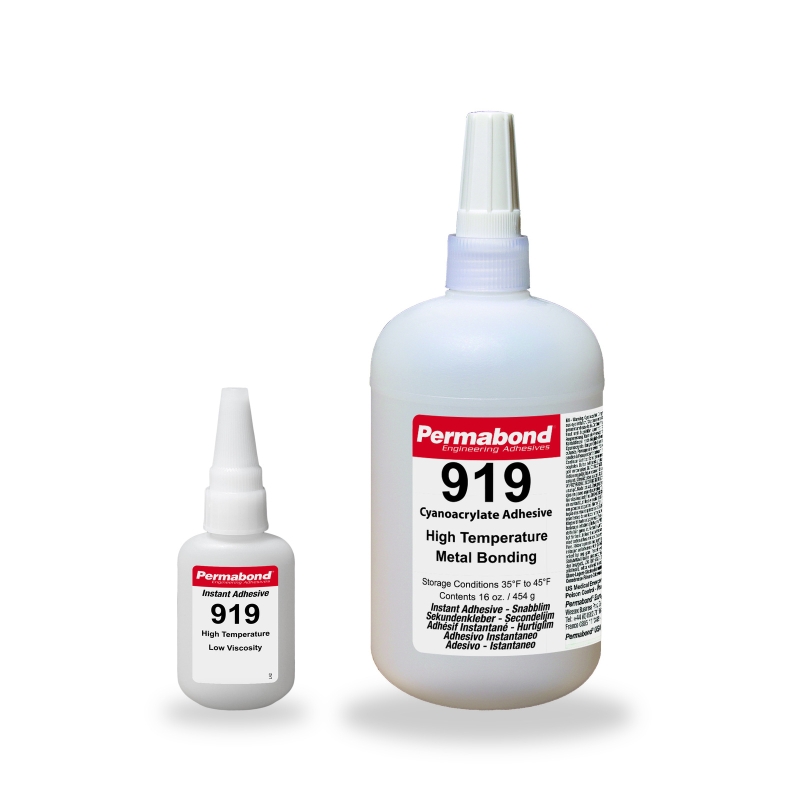
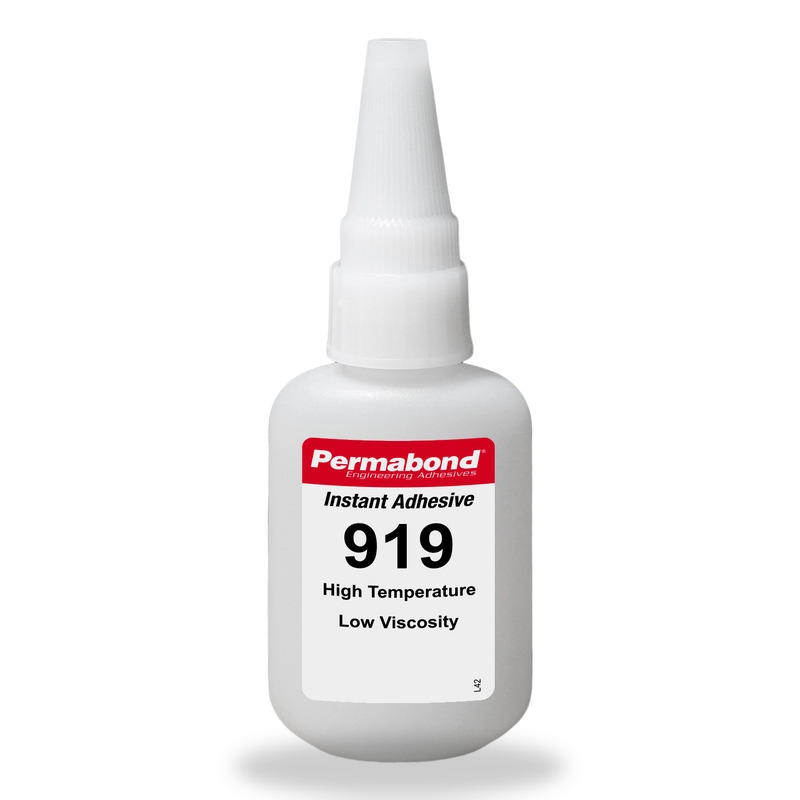
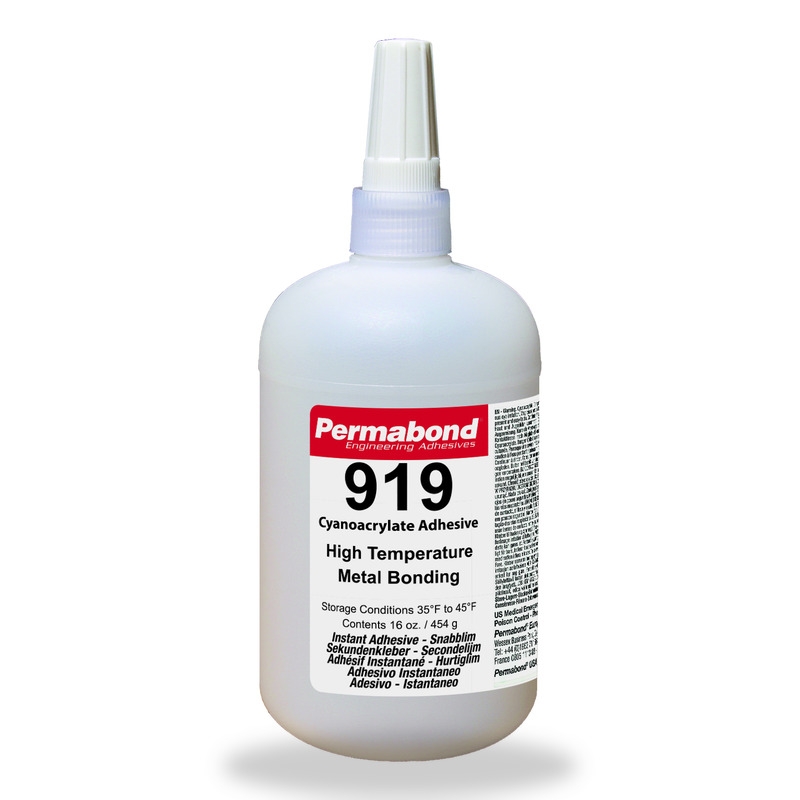
Permabond 919 high-temperature adhesive is a single-part, low-viscosity allyl cyanoacrylate for bonding metals, plastics, and rubber. It is used from name plates and wire tacking to motor lamination stacks. It fixes in seconds at room temperature like any instant adhesive, then gains heat resistance through a secondary cure that a clamped post-cure at 150°C (302°F) activates. Approved to MIL-A-46050C Type V Class 1 (existing designs). Made in Italy. Supplied in 1 oz and 1 lb bottles.
An alternative to Loctite® 4203, 3M™ Scotch-Weld™ PR600, and Permatex® High-Temperature Super Glue. The process is two stages: bond and clamp at room temperature, then heat the clamped parts. The steps are laid out below the specs.
Key Product Details
| Property | Value |
|---|---|
| Chemistry | Allyl cyanoacrylate, one part, no mixing |
| Appearance | Colorless liquid |
| Viscosity @ 25°C | 2-6 mPa.s (cP) |
| Specific Gravity | 1.1 |
| Maximum Gap Fill | 0.05 mm (0.002 in) |
| Fixture Time (0.3 N/mm² shear strength) | <20 sec on steel, <15 sec on NBR rubber, <20 sec on Buna N rubber, <20 sec on phenolic |
| Full Strength | 24 hours |
| High-Temperature Post-Cure | Clamp at room temperature for 4 hours, then heat the clamped parts at 150°C (302°F) for 2 hours |
| Temperature Range | Down to -55°C (-65°F) depending on the materials bonded. Up to 250°C (482°F) after the post-cure |
| Shear Strength, Steel (ISO 4587) | 20-22 N/mm² (2900-3200 psi) |
| Shear Strength, Aluminum | 16-18 N/mm² (2300-2600 psi) |
| Shear Strength, ABS | 4 N/mm² (600 psi) |
| Shear Strength, Polystyrene | 3.5 N/mm² (500 psi) |
| Shear Strength, Polycarbonate | 7 N/mm² (1000 psi) |
| Shear Strength, Phenolic | 14 N/mm² (2000 psi) |
| Shear Strength, Gum Rubber | 2 N/mm² (300 psi) |
| Shear Strength, Valox | 4 N/mm² (600 psi) |
| Impact Strength (ASTM D-950) | 3-5 kJ/m² (1.4-2.4 ft-lb/in²) |
| Hardness (ISO 868) | 85 Shore D |
| Coefficient of Thermal Expansion | 90 x 10-6 mm/mm/°C |
| Thermal Conductivity | 0.1 W/(m.K) |
| Storage Temperature | 2 to 7°C (35 to 45°F) |
| Approvals | MIL-A-46050C Type V Class 1 (existing designs) |
| Country of Manufacture | Italy |
| Available Sizes | 1 oz Bottle, 1 lb (453 g) Bottle |
Performance in Production
- Low viscosity puts 919 in the wicking grade category, so it suits tight-fitting joints and thin gaps between mated parts. Keep the joint at or under the maximum gap fill, since larger gaps slow the cure.
- Fixture times under 20 seconds on steel, phenolic, and Buna N rubber mean parts can be handled right after assembly. Plan on the full 24 hours before the joint carries load.
- The 250°C (482°F) rating applies after the post-cure. Build the 4 hour clamp and the 2 hour, 150°C (302°F) heat step into the process, and use fixtures that hold the parts clamped through the heat cycle.
- Steel and aluminum give the highest shear strength in the table. Plastics and rubber come in lower, so confirm the joint design on your own parts. Strength varies with surface preparation and gap.
- The hot strength curve was run on mild steel and shows strength retention falling as test temperature rises. Size the joint for the strength you need at temperature, not the room-temperature number. Brief excursions such as paint baking or wave soldering are acceptable if the joint is not unduly stressed.
- In Permabond’s 1000 hour immersion testing, strength held in isopropanol, ethanol, and motor oil. Water and 95% relative humidity at 40°C reduced it, so test joints that see sustained moisture. Permabond does not recommend 919 with strong oxidizing materials or polar solvents.
Common Applications
- Metal-to-metal bonding on steel, aluminum, and most other metals
- Name plate bonding
- Wire tacking
- Gasket bonding
- High-temperature industrial and aerospace assemblies
- Electronics and electrical component bonding
- Automotive manufacturing and under-hood assemblies
- Lamination stack bonding for electric motors, generators, and transformers
- Ceramic parts and pre-assembled, close-tolerance parts such as alignment screws and instrument components
- Assemblies that see brief heat excursions such as paint baking or wave soldering
- Rubber and plastic parts, including NBR, Buna N, phenolic, ABS, and polycarbonate
- Medical device component bonding (qualify the adhesive against your own regulatory requirements)
- Precision manufacturing in harsh environments
Available Sizes
- 1 oz Bottle (SKU PERCA009190001Z0101)
- 1 lb (453 g) Bottle (SKU PERCA009190016Z0101)
Alternative to Loctite 4203, 3M Scotch-Weld PR600, and Permatex High-Temperature Super Glue
Buyers who use Loctite® 4203, 3M™ Scotch-Weld™ PR600, or Permatex® High-Temperature Super Glue can consider Permabond 919 as an alternative. It is a different product, so cure and heat requirements are not identical. 919 reaches its 250°C (482°F) rating after the 4 hour clamp and 2 hour, 150°C (302°F) post-cure, so check that your process allows it and test on your own parts before switching.
Related Products
- Other Permabond high-temperature cyanoacrylate grades: Permabond 920 and Permabond 922
- Activators and primers for difficult surfaces: Primers & Accelerators
Permabond 919 for Lamination Stack Bonding
Permabond 919 is one of the adhesives used to bond lamination stacks in electric motors, generators, and transformers. Two properties carry it for this job: a viscosity thin enough to flow between laminations, and a service temperature that reaches 250°C (482°F) after post-cure. Permabond lists these advantages for lamination bonding:
- Fast fixture speed, which shortens manufacturing cycle time
- No welding required, which avoids heat-affected zones and distortion and reduces eddy current
- Vibration resistance that helps prevent lamination buzz, movement, and fretting
- Lower manufacturing energy than welding, with no secondary finishing operations
Keep the gap between laminations within the maximum gap fill, and apply the same clamp and post-cure schedule used on any 919 joint. Run a trial on your own stack before production. Call us about samples and stack design.
How to Bond and Post-Cure with Permabond 919
Permabond 919 bonds in two stages: a room-temperature cure that fixes the part in seconds, then a clamped heat cure that activates its high-temperature mechanism. The steps:
- Clean the surfaces with acetone or isopropanol. They need to be clean, dry, and grease-free. Lightly abrade aluminum, copper, and copper alloys with emery cloth to remove the oxide layer.
- Apply 919 sparingly to one surface.
- Bring the parts together quickly, correctly aligned, and press so the adhesive spreads into a thin film.
- Do not disturb or re-align the parts until the bond sets, normally a few seconds.
- Remove surplus adhesive with Permabond CA solvent, nitromethane, or acetone.
- Clamp the parts at room temperature for 4 hours.
- Heat the clamped parts at 150°C (302°F) for 2 hours. The bond is then thermally resistant up to 250°C (482°F).
Difficult, porous, or acidic surfaces cure slower. A Permabond activator (CSA or QFS 16) helps. On polypropylene, polyethylene, PTFE, or silicone, prime with Permabond Polyolefin Primer (POP) first. The process runs on the substrates in the shear strength table: steel, aluminum, ABS, polystyrene, polycarbonate, phenolic, gum rubber, and Valox.
Keep the bottle refrigerated and let it reach room temperature before opening. Opening it cold lets condensation form inside, which can reduce shelf life.
Frequently Asked Questions
What is Permabond 919 high-temperature adhesive used for?
Permabond 919 is used to bond metals, plastics, and rubber in assemblies that see heat, with a post-cured rating up to 250°C (482°F). Permabond 919, allyl cyanoacrylate, high-temp super glue, and high-temperature instant adhesive all describe the same one-part product. Typical uses include metal-to-metal bonding, name plates, wire tacking, gaskets, electronics, automotive under-hood parts, and motor lamination stacks.
Is Permabond 919 an alternative to Loctite 4203 or 3M Scotch-Weld PR600?
Yes, Permabond 919 is sold as an alternative to Loctite® 4203, 3M™ Scotch-Weld™ PR600, and Permatex® High-Temperature Super Glue. It is a different product, so the cure and heat requirements are not identical. 919 reaches its 250°C (482°F) rating after a 4 hour clamp and a 2 hour, 150°C (302°F) post-cure. Test it on your own parts before switching, and call us and we will help you compare it to the product you use now.
Can Permabond 919 be used for lamination stack bonding in motors and transformers?
Yes, Permabond 919 is used for lamination stack bonding in electric motors, generators, and transformers. It is a 2-6 mPa.s liquid with a 0.05 mm (0.002 in) maximum gap fill and a 250°C (482°F) post-cured rating, so it flows into thin stacks and holds up to motor heat. Run a trial on your own stack and heat cycle before production, and call us to talk through the joint.
How do you post-cure Permabond 919 for 250°C heat resistance?
Clamp the bonded parts at room temperature for 4 hours, then heat the clamped parts at 150°C (302°F) for 2 hours. After the two hours the bond is thermally resistant up to 250°C (482°F). The 250°C rating applies to joints post-cured this way, and Permabond’s TDS says to follow the schedule to enhance high-temperature performance.
How fast does Permabond 919 fix, and what gap can it fill?
Fixture time is under 20 seconds on steel, phenolic, and Buna N rubber and under 15 seconds on NBR rubber, with full strength at 24 hours. Maximum gap fill is 0.05 mm (0.002 in), so it works on tight-fitting parts and not on loose joints. Temperature, humidity, the surface being bonded, larger gaps, and acidic surfaces all change cure speed.
What materials will Permabond 919 bond?
Permabond 919 bonds steel and aluminum at the highest strengths in the table, and it also bonds ABS, polystyrene, polycarbonate, phenolic, gum rubber, and Valox. For polypropylene, polyethylene, PTFE, or silicone, prime with Permabond POP first. For any substrate not listed, call us and we will tell you what we know.
Is Permabond 919 MIL-SPEC approved?
Yes. The TDS lists approval to MIL-A-46050C Type V Class 1 for existing designs. It does not list an approval for new designs, so call us if your drawing calls out a specific type and class.
Where is Permabond 919 made, and what sizes does it come in?
Permabond 919 is made in Italy and comes in a 1 oz bottle and a 1 lb (453 g) bottle. The 1 oz suits trials and small runs, and the 1 lb suits lines that use it regularly. Both are one part and need no mixing.
Questions on fit for your high-temperature bonding application? Call (800) 220-1966 or email [email protected].
Loctite® is a registered trademark of Henkel. 3M™ and Scotch-Weld™ are trademarks of 3M Company. Permatex® is a registered trademark of ITW. Permabond® is a registered trademark of Permabond LLC. Chemical Concepts is not affiliated with these companies. Brand names are used only to identify products and do not imply equivalence.




Reviews
There are no reviews yet.