


Description
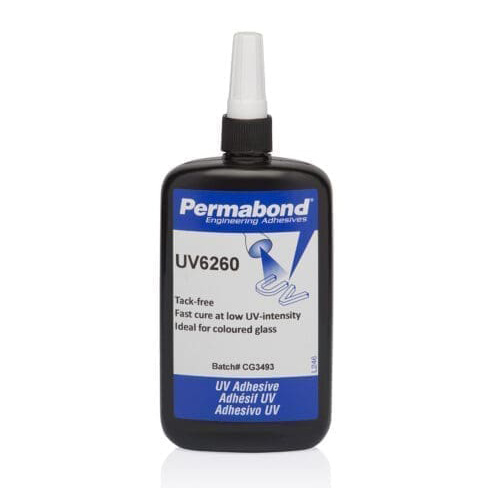
Permabond UV6260 is a single-component urethane acrylate, and it’s the Permabond UV adhesive for colored glass, tinted glass, and UV-stabilized plastics that filter light out of the bond line. It fixtures glass in under a second under a 395nm LED at 150 mW/cm², and still fixtures in six seconds at 0.1 mW/cm². That low-intensity number is the whole point of the grade. Amber, cobalt, green, and smoked glass pass so little light that a standard UV adhesive never fully cures, and the joint comes apart in handling.
The process is straightforward. The adhesive stays liquid until the lamp hits it, so parts get aligned first and cured second, with no pot life running against you. Permabond developed it for a customer bonding metal emblems to tinted glass bottles. Full shop sequence and lamp selection are further down this page.
Key Product Details
| Property | Value |
|---|---|
| Chemistry | Single-component urethane acrylate, UV-curable |
| Appearance | Pale yellow uncured, colorless when cured |
| Viscosity at 25°C (77°F) | 45,000 cP at 2 rpm, 17,000 cP at 20 rpm (thixotropic) |
| Specific Gravity | 1.0 |
| Hardness | 60 Shore D (ISO 868) |
| Tensile Strength | 1,450 psi (10 N/mm², ISO 527) |
| Elongation at Break | 205% (ISO 527) |
| Glass Transition (Tg) | 62°C (144°F), DMA tan delta |
| Water Absorption | 2% after 24 hours at 23°C (73°F), ISO 62 |
| Fixture Time on Glass | Under 1 second at 150 mW/cm², 6 seconds at 0.1 mW/cm² (395nm UV LED) |
| Cure Wavelength | 365 to 420 nm, 395 nm ideal |
| Storage Temperature | 5 to 25°C (41 to 77°F), protect liquid adhesive from room lighting |
| Packaging | 50ml bottle, 250ml bottle, bulk on request |
| Country of Manufacture | Italy |
Bond Strength by Substrate
Overlap shear tested to ISO 4587. “Substrate failure” means the plastic gave out before the bond line did, so the number is a floor set by the part rather than by the adhesive.
| Substrate | Overlap Shear | Notes |
|---|---|---|
| Polycarbonate (PC) | >1,595 psi (>11 N/mm²) | Substrate failure |
| Rigid PVC to PC | >1,450 psi (>10 N/mm²) | Substrate failure |
| PETG | >1,305 psi (>9 N/mm²) | Substrate failure |
| Acrylic | >870 psi (>6 N/mm²) | Substrate failure |
| ABS to PC | 1,160 to 1,740 psi (8 to 12 N/mm²) | |
| Mild steel to PC | 870 to 1,450 psi (6 to 10 N/mm²) | |
| Polysulfone | 580 to 1,160 psi (4 to 8 N/mm²) | |
| Polystyrene to PC | 435 to 870 psi (3 to 6 N/mm²) | |
| PA 6,6 to PC | 290 to 725 psi (2 to 5 N/mm²) |
Block shear to glass, tested to ASTM D4501.
| Joint | Block Shear |
|---|---|
| Aluminum to glass | 1,450 to 2,030 psi (10 to 14 N/mm²) |
| Mild steel to glass | 1,450 to 2,030 psi (10 to 14 N/mm²) |
| ABS to glass | 1,160 to 1,740 psi (8 to 12 N/mm²) |
| PC to glass | 1,015 to 1,595 psi (7 to 11 N/mm²) |
| PMMA to glass | 870 to 1,450 psi (6 to 10 N/mm²) |
Strength results vary with surface preparation and gap. Test on your own parts before committing a production process.
Performance in Production
- The 6-second fixture at 0.1 mW/cm² is the number that matters on dark glass. A grade that only fixtures at high irradiance needs the lamp close and the substrate clear. UV6260 gives you margin when the glass is eating most of the light or the lamp is standing off the joint.
- It cures across the full 365 to 420 nm band rather than at one narrow peak, so most shop UV LED lamps already on the bench will work. That said, 395 nm is where the adhesive performs best and where the published fixture data was measured.
- Thixotropic behavior is real here, not a label. 45,000 cP at 2 rpm holds a bead on a vertical bottle wall, and it thins to 17,000 cP at 20 rpm so it still moves through a dispense tip.
- 205% elongation at 60 Shore D is the combination that survives a glass-to-aluminum joint through a heat cycle. The adhesive takes up the differential expansion instead of transferring it into the glass.
- Liquid until the lamp fires, so alignment happens before cure. On a line, that means the fixture sets the position and the lamp locks it, with no jig time waiting on a chemical cure.
- Substrate failure on PC, rigid PVC to PC, PETG, and acrylic means the design limit is the plastic, not the bond line. Size the joint off the part’s own strength.
- Tg at 62°C (144°F) is where the cured adhesive starts to soften. Water absorption is 2% over 24 hours at 23°C (73°F). Both are worth checking against your service conditions before a wet or warm application.
- Single component, no mix ratio, no mixer, no pot life. It goes straight from the bottle or into automated dispensing equipment.
Common Applications
- Metal emblems, logo plates, and decorative hardware bonded to tinted glass bottles
- Perfume bottle and alcohol bottle assembly
- Decorative and stained glass work, lamps, and lighting fixtures
- Automotive lighting and glazing assemblies
- Lens bonding, POS displays, and outdoor signage
- Solar panel assembly
- Electronics work including encapsulation, glob topping, and wire tacking
- Glazing and architectural glass assemblies where the glass is tinted or coated
Available Sizes
| Size | SKU | Best For |
|---|---|---|
| 50ml Bottle | PERUV00626000050B0101 | Trials, process qualification, hand dispensing, low-volume work |
| 250ml Bottle | PERUV00626000250B0101 | Running production, automated dispensing reservoirs |
| Bulk | Call | High-volume lines. Available on request. |
UV Lights for UV6260
UV6260 needs a UV light source. Anything in the 365 to 420 nm band will cure it, with 395 nm giving the best results. These are the units we stock:
- American Ultraviolet Cool Cure Beam LED Spot Curing System, 395 nm. Cordless spot curing at the wavelength UV6260 runs best on, with a 3 mm circle beam for tacking bond points and curing short beads. Two rechargeable batteries, instant on and off, no warm-up between cycles.
- Chem-Set TrimLok UV Gun Production Light Kit. Pistol grip with a trigger for sustained work rather than spot shots, and it ships with a tripod and mounting box for hands-free curing. The right pick for production runs and higher-volume bonding.
Related Products
- Permabond UV643 Fast Fixturing UV-Curable Adhesive. Higher strength on rigid plastics with lower elongation. Suitable where the substrate passes light and you don’t need the flexibility.
- Permabond UV610 Glass-to-Metal Adhesive. The standard glass-to-metal grade for clear glass.
How UV Bonding Through Colored Glass Works
A UV adhesive cures because photoinitiators in the resin absorb light at a specific wavelength. Every bit of glass or plastic between the lamp and the bond line takes some of that light out. Clear glass takes a little. Amber, cobalt, green, and smoked glass take most of it, and a UV-stabilized plastic can be worse than dark glass because the stabilizer is there specifically to block UV. What you get is a skin that looks cured and a joint underneath that isn’t, which shows up as parts falling apart in handling or failing an aging test weeks later.
UV6260 is built around that problem. It reacts at low irradiance, so the fraction of light that does make it through is enough to drive a full cure. Here’s the shop sequence:
- Clean and degrease both parts. Isopropanol works on most surfaces. Be careful about silicone-based glass cleaners, and if one has been used on the glass previously, get it off. Silicone residue is the single most common reason a glass bond fails for no apparent reason.
- Abrade the oxide layer on aluminum and copper. Aluminum, copper, and copper alloys benefit from light abrasion with emery cloth or similar before bonding.
- Test thermoplastics first. Mold release agents carried over from molding will affect bond strength. Run a sample set before you qualify the process.
- Dispense from the bottle or through automated equipment. Automated dosing gives better volume control. Keep the product’s exposure to ambient light down while you’re working, and keep the bottle protected from room lighting between runs.
- Assemble without trapping air. Bubbles in the joint hurt the finished appearance, and on a visible glass joint that’s the whole ballgame.
- Hold the parts still and expose the joint. Don’t disturb the assembly during cure. Cure time depends on lamp power, spectral output, distance from lamp to joint, and how much light the substrate is passing.
- Pick the lamp. UV6260 cures anywhere from 365 to 420 nm, so a 365 nm unit works. 395 nm is ideal and it’s where the published fixture data was measured, so that’s what to buy if you’re specifying a lamp from scratch.
Substrates this runs on: soda-lime and colored glass, aluminum, mild steel, stainless steel, polycarbonate, PMMA and acrylic, PETG, PET, ABS, rigid PVC, polysulfone, polystyrene, and PA 6,6. One note from the data sheet: keep it away from strong oxidizing materials.
Frequently Asked Questions
What is Permabond UV6260 used for?
Permabond UV6260 bonds glass to metal and rigid plastics in applications where the glass is colored, tinted, or coated and a standard UV adhesive won’t cure through it. Typical work includes metal emblems on tinted bottles, perfume and alcohol bottle assembly, decorative and stained glass, automotive lighting and glazing, lens bonding, POS displays, outdoor signage, and electronics encapsulation.
Will UV6260 cure through colored or tinted glass?
Yes. That’s what the grade was developed for. It fixtures glass in under a second at 150 mW/cm² and still fixtures in six seconds at 0.1 mW/cm² under a 395 nm LED, so the small amount of light getting through dark glass is enough to drive a full cure. Colored glass adhesive, coloured glass adhesive, tinted glass adhesive, dark glass adhesive, and UV adhesive that cures through glass all describe the same requirement. How dark you can go depends on your specific glass, your lamp, and your bond line thickness, so run a test on your own parts.
What UV lamp do I need for UV6260?
Any UV source in the 365 to 420 nm range will cure it, and 395 nm is ideal. A 365 nm lamp works, so if you already have one on the bench you’re covered. If you’re buying a lamp specifically for this adhesive, go 395 nm. Cure speed also depends on lamp intensity, the distance from lamp to joint, and how much light your substrate passes, so call us with your setup and we’ll work through it with you.
Does UV6260 bond PVC?
Yes, rigid PVC. Published overlap shear for rigid PVC to polycarbonate is above 1,450 psi (10 N/mm²) with substrate failure, meaning the plastic gave out before the bond did. Flexible and plasticized PVC is a different material and isn’t covered by the data sheet, so ask us before you assume it carries over.
Is UV6260 clear when cured?
It’s pale yellow in the bottle and colorless once cured, and it resists yellowing over time. It also cures fully tack-free, so there’s no residual surface stickiness picking up dust on a visible joint.
What sizes does Permabond UV6260 come in?
Two stocked sizes, a 50ml bottle and a 250ml bottle, with bulk available on request. The 50ml suits trials and process qualification. The 250ml suits running production and automated dispensing reservoirs.
Can UV6260 replace solvent cementing in a plastics bonding step?
It’s a single-component, 100% solids UV adhesive with no solvent in it, which is why shops working to get methylene chloride out of an acrylic or polycarbonate bonding operation look at UV cure as the alternative. Whether it works in your process depends on joint design, whether at least one substrate passes enough light to the bond line, and your cycle time. Call us and we’ll look at the joint before you commit to a change.
Where is Permabond UV6260 made?
Italy. Permabond is an ISO QMS certified manufacturer.
How should UV6260 be stored?
Between 5 and 25°C (41 and 77°F), and keep the liquid adhesive protected from room lighting. Ambient light will start the reaction slowly, so an open bottle sitting under shop fluorescents is a bottle you’ll be throwing away.
Questions on fit for your UV bonding application? Call (800) 220-1966 or email [email protected].


Reviews
There are no reviews yet.