


Description
|
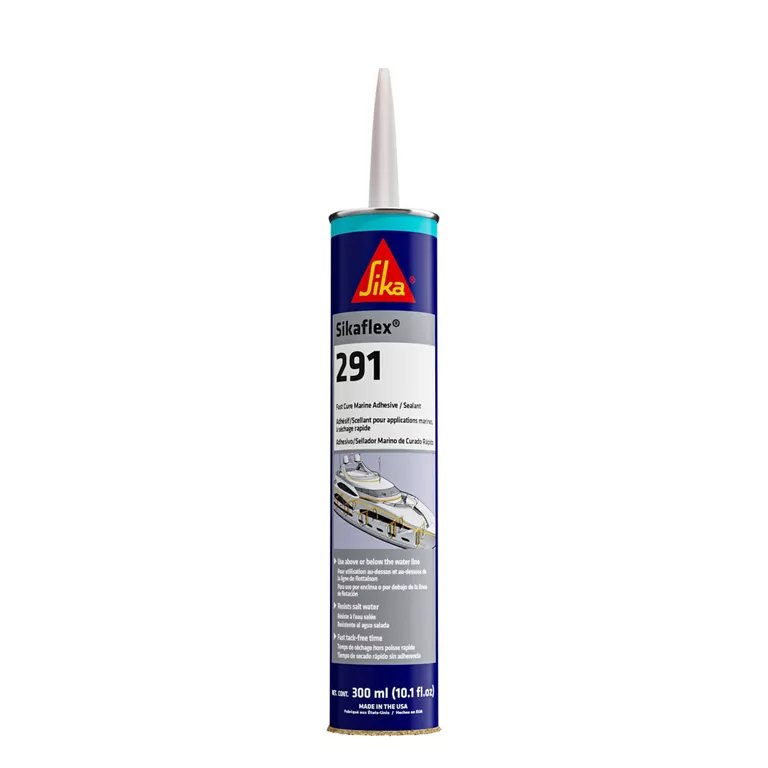
General-Purpose Marine Sealant Sikaflex 291 marine sealant from Sika is a non-sag, 1-component, moisture-curing polyurethane for elastic, vibration-resistant joint seals on boats. It is used for sealing thru-hull fittings and deck hardware, for general marine sealing, and for light-duty bonding on wood, metals, metal primers, 2-component paint coatings, ceramic materials, and GRP. It cures from moisture in the air, so there is nothing to mix, and the cured seal can be sanded and painted. Supplied in white or black in a 300 ml cartridge, made in the USA. Sika positions it against 3M® 4200™ for general marine sealing. The comparison is covered below. |
 |
Key Product Details
| Property | Value |
|---|---|
| Chemical Base | 1-component polyurethane |
| Color | White, black |
| Cure Mechanism | Moisture-curing |
| Density (uncured) | 1.3 kg/l (10.8 lb/gal), depending on color |
| Non-sag Properties | Good |
| Application Temperature | 5 to 40 °C (41 to 104 °F), ambient |
| Skin Time | 60 minutes (A) |
| Open Time | 45 minutes (A) |
| Curing Speed | See Diagram 1 in the TDS |
| Shrinkage | 5 % |
| Shore A Hardness (ISO 48-4) | 40 |
| Tensile Strength (ISO 527) | 1.8 MPa (260 psi) |
| Elongation at Break (ISO 527) | 500 % |
| Tear Propagation Resistance (ISO 34) | 6 N/mm (35 pli) |
| Service Temperature | -50 to 90 °C (-58 to 194 °F). Exposure up to 160 °C (320 °F) for 4 hours or 180 °C (356 °F) for 1 hour. |
| Shelf Life | 12 months (B) |
| NSF Listing | Listed under NSF Proprietary Substances and Nonfood Compounds (black and white) |
| Packaging | 300 ml cartridge |
| Country of Manufacture | USA |
(A) 23 °C (73 °F) / 50 % r.h. (B) Storage below 25 °C (77 °F). Typical values from the Sika product data sheet, version 03.01 (04-2023).
Suitable for experienced professional users only. Test with actual substrates and conditions to confirm adhesion and material compatibility.
Performance in Production
- A Good non-sag rating means the bead holds its shape on vertical joints instead of slumping before the hardware is set.
- A 45 minute open time and 60 minute skin time at 23 °C and 50 % relative humidity set the working window. Tooling and finishing have to be done inside the skin time.
- Shore A 40 with 500 % elongation at break gives a soft, elastic cured seal. That is why Sika specifies 291 for elastic, vibration-resistant joint seals.
- It processes from 5 to 40 °C (41 to 104 °F), a wider range than Sikaflex 292. Substrate and sealant between 15 and 25 °C (59 to 77 °F) is the optimum.
- One component means no mixing. It cures from moisture in the air and runs through manual, pneumatic, or electric piston guns.
- The cured seal can be sanded and painted. Paint adhesion is best after a skin forms, and Sika Aktivator-100 or Aktivator-205 on the joint surface can improve it. Paint is usually less elastic than the sealant and can crack in the joint area, so run a trial first.
Common Applications
- Sealing thru-hull fittings and deck hardware
- Elastic, vibration-resistant joint seals in marine construction
- General-purpose marine sealing and light-duty bonding
- Interior sealing applications in marine construction
- Sealing to wood, metals, metal primers, 2-component paint coatings, ceramic materials, and GRP
- Sealing to gelcoat
- Marine sealing above and below the waterline
Available Sizes and Colors
| Color | Size | Package | SKU |
|---|---|---|---|
| White | 300 ml | Cartridge | SIK90919 |
| Black | 300 ml | Cartridge | SIK90923 |
Sikaflex 291 as an Alternative to 3M 4200
Sika positions Sikaflex 291 against 3M 4200 for general marine sealing, light-duty bonding, and bonding alongside mechanical fasteners. Check your joint against the TDS values above and test on your own substrates. When the joint needs structural bonding, Sika points to Sikaflex 292 instead.
Related Products
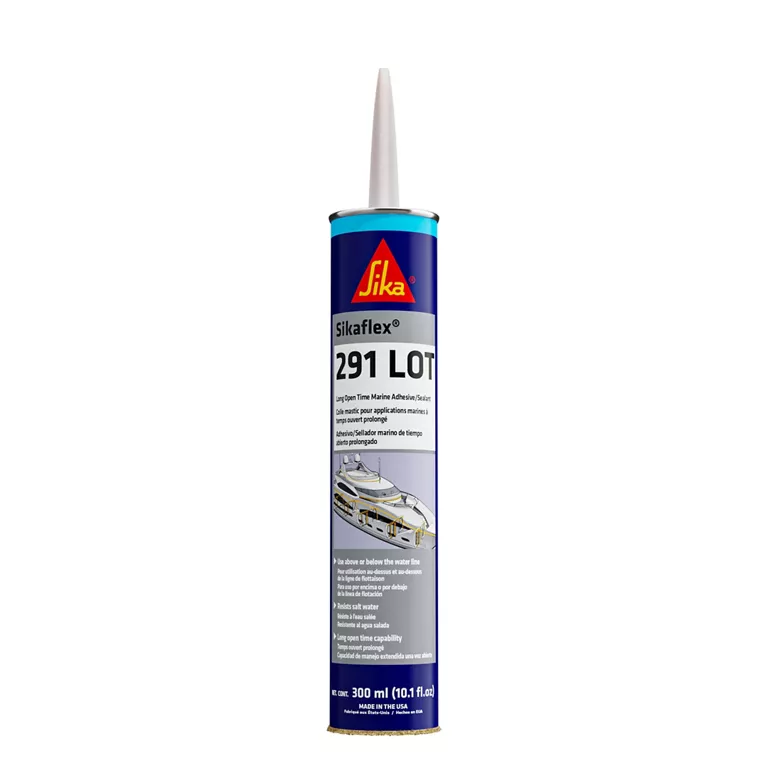
- Sika Sikaflex-291 LOT Long Open Time Marine Adhesive Sealant – 300ml Cartridge: Sika’s long open time version, with a 4 hour skin time and a mahogany color
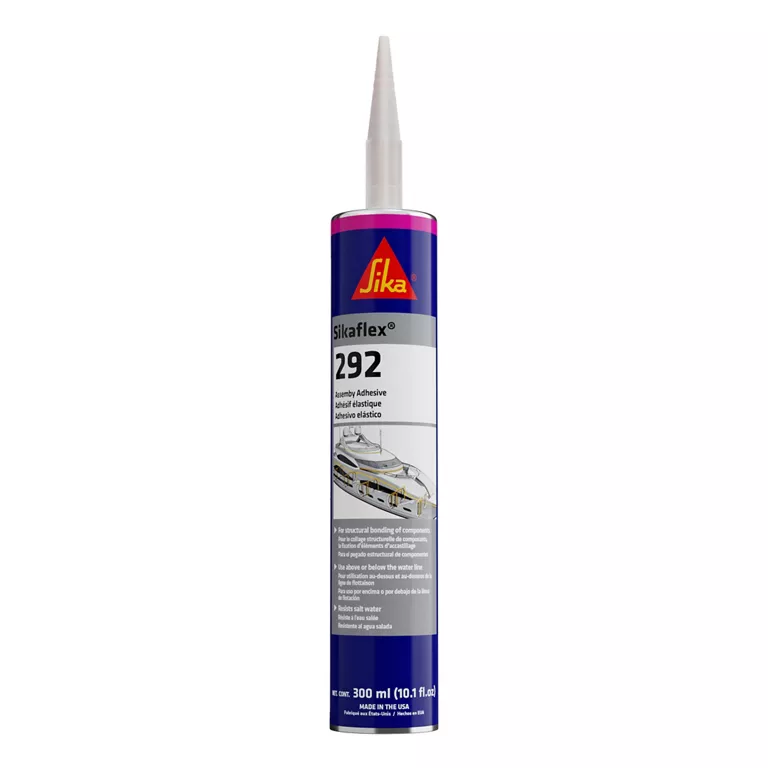
- Sika Sikaflex-292 Marine Adhesive Sealant – White – 300ml Cartridge: Sika’s structural bonding adhesive for joints under high dynamic stress
How to Apply Sikaflex 291 for Marine Sealing
These steps follow the Sika TDS. Run them on a test joint with your own substrates before production.
- Prep the surfaces. They must be clean, dry, and free of grease, oil, and dust. Pre-treatment depends on the substrate, so check Sika’s Pre-treatment Chart for 1-component polyurethanes and verify on your original substrates.
- Apply the sealant. Process between 5 and 40 °C (41 to 104 °F). Use a manual, pneumatic, or electric piston gun.
- Tool and finish inside the skin time. Sika recommends Sika® Slick as the finishing agent. Test any other finishing agent for compatibility first.
- Let it cure. Cure comes from atmospheric moisture. It runs slower at low temperatures because the air holds less water.
- Paint after a skin forms. Treating the joint surface with Sika® Aktivator-100 or Aktivator-205 can improve paint adhesion. If the paint needs a baking process above 80 °C (176 °F), let the sealant fully cure first. Test all paints under your manufacturing conditions.
- Sand if needed. Cured Sikaflex 291 sands easily.
- Clean up. Uncured sealant comes off tools and equipment with Sika® Remover-208 or another suitable solvent. Cured material can only be removed mechanically. Wash hands and exposed skin right away with an industrial hand cleaner and water, and keep solvents off skin.
Substrates covered by the TDS: wood, metals, metal primers and 2-component paint coatings, ceramic materials, and plastics such as GRP. Do not use it to seal plastics prone to stress cracking, such as Plexiglas and polycarbonate.
Frequently Asked Questions
What is Sikaflex 291 used for?
Sikaflex 291 (also called Sika 291 and Sikaflex-291) is a 1-component polyurethane marine sealant used for sealing thru-hull fittings and deck hardware, making elastic, vibration-resistant joint seals, general marine sealing, and light-duty bonding. It bonds to wood, metals, metal primers, 2-component paint coatings, ceramic materials, and GRP. This listing is the 300 ml cartridge in white or black, made in the USA.
Is Sikaflex 291 an alternative to 3M 4200?
Yes. Sika positions Sikaflex 291 against 3M 4200 for general marine sealing, light-duty bonding, and bonding alongside mechanical fasteners. Check your joint against the TDS values above and test on your own substrates. Call us if a customer spec names 4200 and you want to talk through the swap.
What is the difference between Sikaflex 291 and Sikaflex 291 LOT?
LOT stands for long open time. Per the TDS, standard 291 has a 60 minute skin time and Sikaflex 291 LOT has a 4 hour skin time, so LOT suits teak decking and large joints that need extra working time. LOT also comes in mahogany. Standard 291 comes in white and black.
What is the difference between Sikaflex 291 and Sikaflex 292?
Sikaflex 291 is Sika’s general-purpose marine sealant for thru-hull fittings, hardware, and light-duty bonding. Sikaflex 292 is the structural bonding adhesive for joints under high dynamic stress. If the joint carries load, look at 292.
Can Sikaflex 291 be used below the waterline?
Yes. Sikaflex 291 is rated for use above and below the waterline, and the TDS lists resistance to fresh water and seawater. Surface prep still depends on the substrate and has to be verified by testing, so call us with your joint if you have questions.
Is Sikaflex 291 UV resistant?
No. Sikaflex 291 does not have UV stability. The TDS lists good aging and weathering resistance but no UV resistance, and Sika recommends a UV-stable sealant such as Sikaflex-295 UV for joints that stay exposed to sun. Call us and we will match the product to the joint.
Can you paint over Sikaflex 291?
Yes. Per the TDS, Sikaflex 291 can be painted and sanded. Paint adhesion is best after a skin forms, and Sika Aktivator-100 or Aktivator-205 can improve it. If the paint needs a baking process above 80 °C, let the sealant fully cure first. Paint is usually less elastic than the sealant and can crack in the joint area, so test every paint under your production conditions.
Can Sikaflex 291 be used on acrylic or polycarbonate windows?
No. The TDS says Sikaflex 291 must not be used to seal plastics prone to stress cracking, such as Plexiglas and polycarbonate. Sika’s marine team points to Sikaflex-295 UV for acrylic and polycarbonate windows. Call us before you pick a sealant for window work.
Questions on fit for your marine sealing application? Call (800) 220-1966 or email [email protected].
3M and 4200 are trademarks of 3M Company. Sikaflex is a registered trademark of Sika Corporation. Chemical Concepts is not affiliated with 3M. Product names are used for reference only.



Reviews
There are no reviews yet.