



Description
|
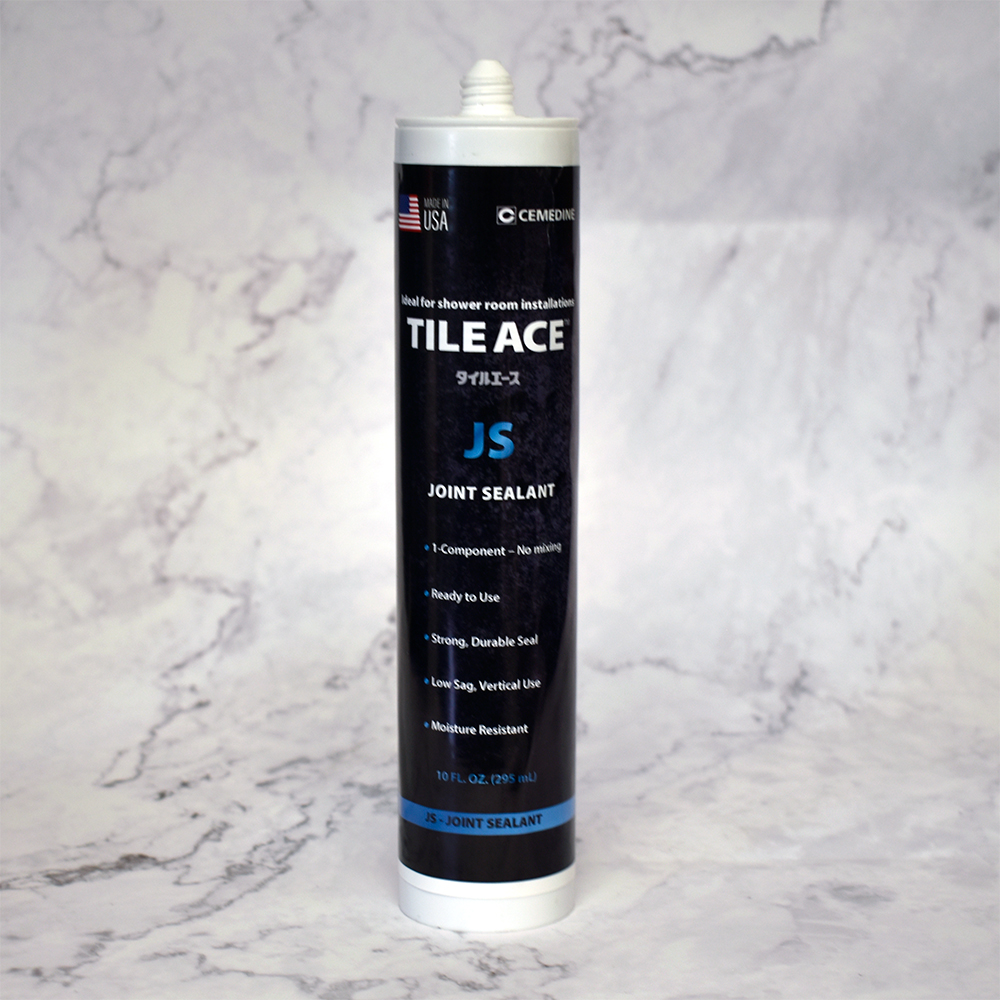
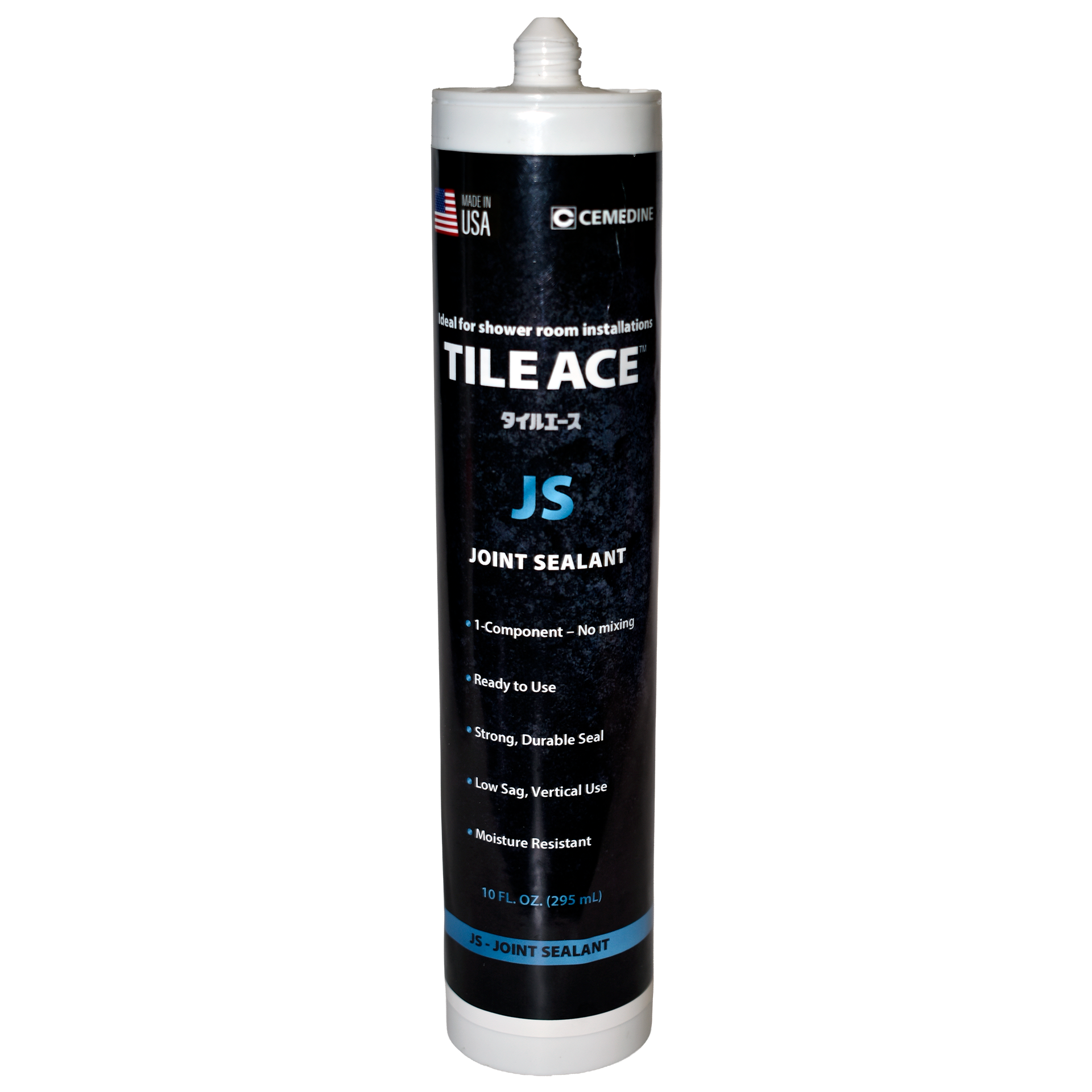
650% Elongation / Shore A 29 / VOC Under 0.1% The Waterproofing Step, Before the Tile Goes OnTile Ace JS is a one-component, moisture curing Kaneka MS Polymer backer board seam sealant for bonding and sealing waterproof membranes, foam backer board seams, fastener penetrations, and tub surrounds. It goes in before the decorative surface does, which is why it lives or dies on movement rather than strength. 650% elongation at break with a Shore A 29 durometer. That is a soft, high-movement sealant, not a stiff adhesive, which is what a corner or a change of plane actually needs. Solvent free, under 0.1% VOC, very low odor, and rated for interior and exterior use. Made in the USA by Cemedine North America. |
 |
Why 650% Elongation Matters at a Seam
A shower assembly moves. Framing shrinks, the tub deflects when it fills, the wall cycles with temperature, and every one of those movements concentrates at a joint. A seam sealant does not fail because it was not strong enough. It fails because it could not stretch.
- 650% elongation at break (ASTM D412) means the cured bead can stretch to more than six times its length before it tears.
- Shore A 29 is soft. It gives at the joint instead of transferring load into the board face or the membrane fleece.
- 1.62 MPa tensile at break is real strength for a sealant that soft, so it bonds the boards together as it seals them.
- 3 mm cure in depth at 24 hours with a 60 minute skin over time, so you get a full hour to run and tool a wall of seams before anything sets up.
Cemedine publishes no ASTM C920 sealant classification for Tile Ace JS. If your project specification calls for a C920 Type S Grade NS Class 25 sealant, JS does not carry that classification and we will not imply it does. Call us and we will tell you what does.
Where JS Goes in a Shower Assembly
Four places, and Cemedine’s own diagram shows all of them. This is the step between framing the shower and tiling it.
- Backer board seams. Apply a bead into the gap between boards or inject it, then tool it out over the joint. Cemedine’s hand peel testing on core foam backer board came back cohesion failure, meaning the adhesive tore inside itself before it released the board.
- Screw and fastener penetrations. Every screw head is a hole through the waterproofing. Seal each one.
- Waterproof membrane bonding and terminations. Bonding and sealing the membrane where it meets fixed building elements and where it ends.
- Tub surrounds and change of plane transitions. The tub flange, inside corners, and wall-to-floor, which is where the 650% elongation earns its keep.
- Then tile. JS provides the bonding and sealing before the decorative substrate goes on the wall.
How to Apply It
10 oz Cartridge
|
20 oz Foil Sausage
|
Apply between 41°F and 95°F. At 2,080,000 cP at 1 rpm it is roughly one seventh the viscosity of Tile Ace UHT, which is what makes it injectable into a seam gap and tool-able once it is there.
How JS Compares to the Other Tile Ace Grades
Four grades, same Kaneka MS Polymer chemistry, four different jobs. JS is the soft, high-movement one. Blank cells mean the figure is not published on that grade’s data sheet.
| Grade | What It Does | Tensile at Break | Elongation | Shore A |
|---|---|---|---|---|
| JS | Sealing membrane seams, fastener penetrations, corners, tub flanges | 1.62 MPa | 650% | 29 |
| UHT | High strength bead and spot bonding, panels, accessories, fixtures | 3.0 MPa | 408% | 55 |
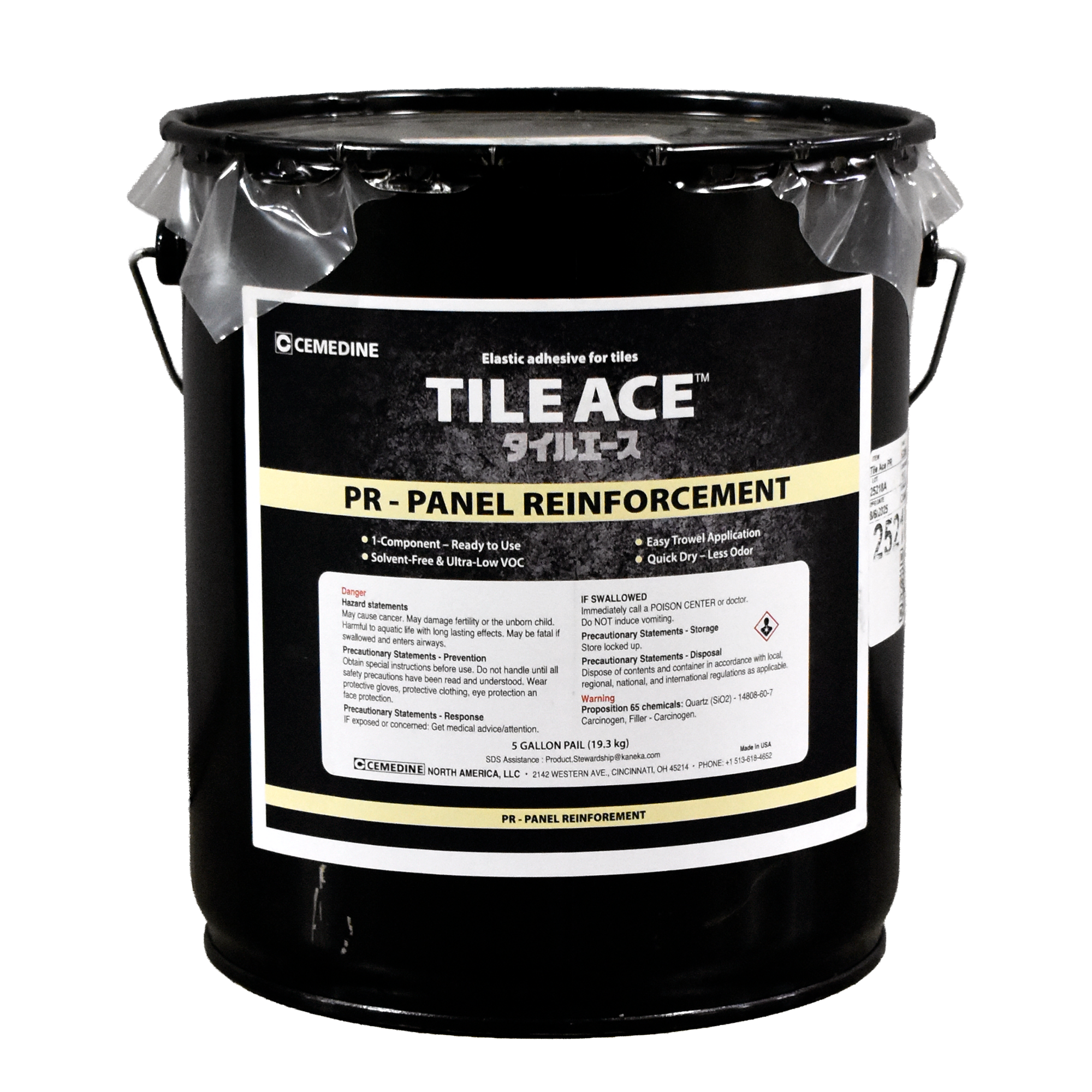
| PR | Laminating backer board to slabs in the shop | 1.23 MPa | 51 | |
| MAX | Full-spread troweled wall and ceiling tile, interior or exterior | 1.0 MPa | 80% | 50 |
Technical Specifications
| Property | Value |
|---|---|
| Adhesive Type | One component, moisture curing Kaneka MS Polymer |
| Color | White |
| Elongation at Break (ASTM D412) | 650% |
| Tensile Strength at Break (ASTM D412) | 1.62 MPa |
| Hardness (ASTM C661) | Shore A 29 |
| Skin Over Time | 60 minutes |
| Cure in Depth after 24 Hours | 3 mm |
| VOC Content | Under 0.1%, solvent free |
| Viscosity at 73°F | 2,080,000 cP at 1 rpm, 1,196,000 cP at 2 rpm, 373,600 cP at 10 rpm |
| Specific Gravity | 1.5 g/mL |
| Application Temperature | 41°F to 95°F (5°C to 35°C) |
| Temperature Resistance | -40°F to 194°F (-40°C to 90°C) |
| Storage Condition | 50°F to 95°F (10°C to 35°C) |
| Shelf Life | 12 months from date of production, unopened packaging at 73°F |
| Use | Interior and exterior |
| Country of Manufacture | United States |
| Packaging | 10 oz cartridge, 20 oz foil sausage pack |
Hand Peel Test Results by Substrate
Cemedine tested ten substrates. All ten came back CF, cohesion failure, meaning the sealant tore inside itself before it released the surface. Galvanized steel and core foam backer board on this list are the two that matter most in a shower.
| Substrate | Type of Bonding Failure |
|---|---|
| Core foam backer board | CF |
| Mortar | CF |
| Galvanized steel | CF |
| Stainless steel | CF |
| Anodized aluminum | CF |
| Glass | CF |
| Wood | CF |
| PVC | CF |
| Polycarbonate | CF |
| ABS | CF |
Common Applications
Wet Area Work
|
Beyond the Shower
|
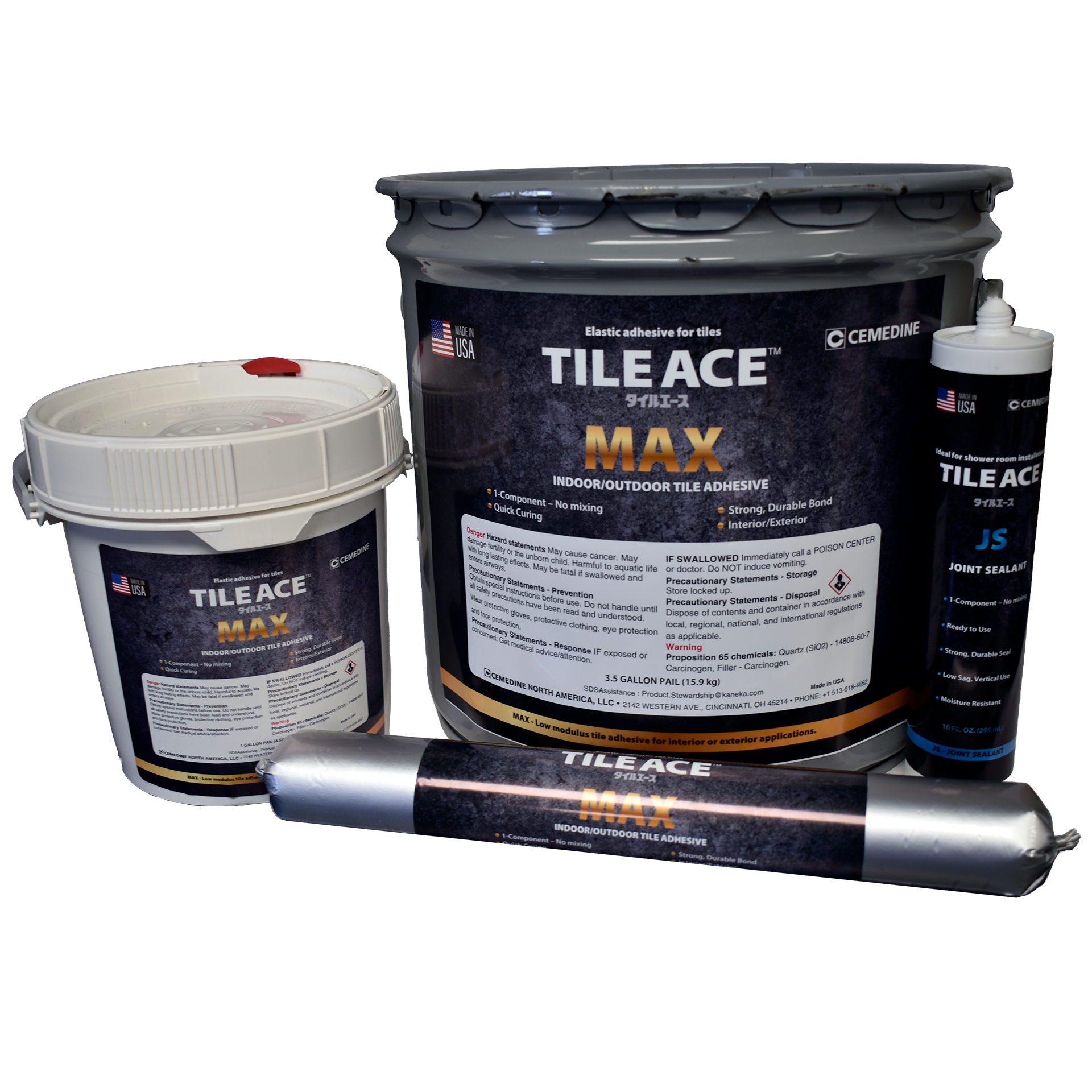
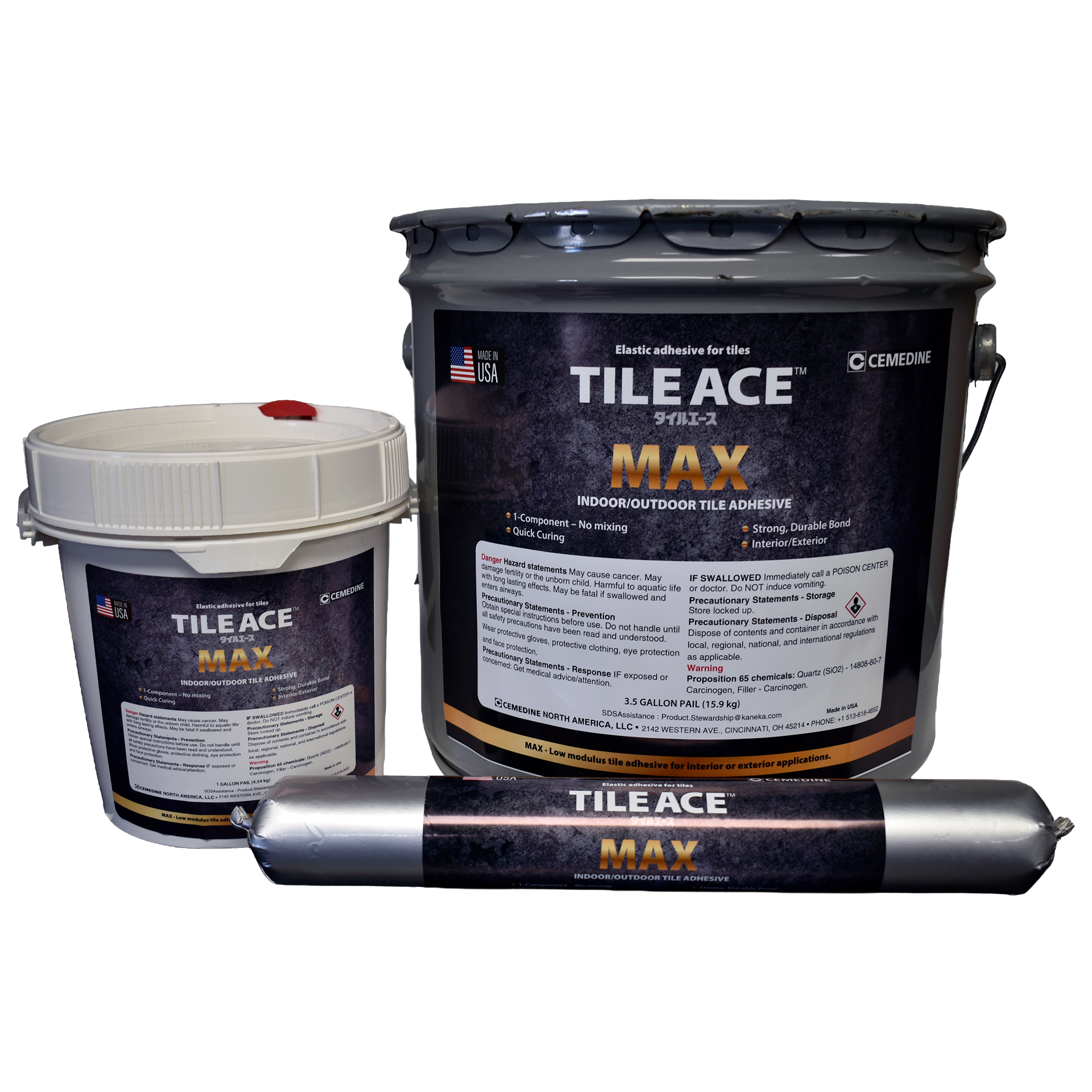
JS is a sealant and bonding compound, not a tile setting adhesive. For setting tile use Tile Ace MAX, and for spot bonding panels and accessories use Tile Ace UHT. Test on your own substrate and assembly before production.
Frequently Asked Questions
What is Tile Ace JS used for?
Tile Ace JS is a one-component MS polymer sealant for bonding and sealing waterproof membranes, foam backer board seams, screw and fastener penetrations, and tub surrounds. It is the waterproofing step that goes in before the tile does, and it is also used as a flexible joint sealant on plastics, glass, wood, and metals, interior or exterior.
Can Tile Ace JS seal foam backer board seams and screw holes?
Yes, that is its primary published application. Apply a bead into the gap between boards or inject it, tool it out over the joint, and seal every fastener penetration. Cemedine’s hand peel testing on core foam backer board came back cohesion failure, meaning the sealant tore inside itself rather than releasing from the board.
Will using Tile Ace JS affect my backer board warranty?
Check with your board manufacturer before you commit. Most foam board systems require their own branded sealant for the board warranty to stand, and some publish a list of approved alternatives. Tile Ace JS is not currently on any of those lists. If the board warranty matters on your project, use the sealant the board manufacturer names. If you are working with a generic or unbranded foam board, or warranty coverage is not part of the job, JS is a straightforward choice and we are happy to talk it through.
Is Tile Ace JS the same as silicone or caulk?
No. Silicone cures by moisture like JS does, but it cannot be painted, and it does not bond as broadly. Acrylic latex caulk dries by water loss and has neither the movement capability nor the bond strength. Tile Ace JS is an MS polymer, also called an MS hybrid or a silane modified polymer, which cures to a tough elastic solid with 650% elongation and 1.62 MPa tensile at break, with no solvents and no isocyanates.
Does Tile Ace JS meet ASTM C920?
Cemedine does not publish an ASTM C920 classification for Tile Ace JS, so we cannot claim one. C920 Type S, Grade NS, Class 25 is what a project specification usually calls for on an elastomeric joint sealant. If your job is written to it, call us at (800) 220-1966 and we will point you at a sealant that carries the classification.
What is the difference between Tile Ace JS, MAX, UHT, and PR?
JS is the soft, high-movement sealant for seams, penetrations, corners, and tub flanges at 650% elongation and Shore A 29. MAX is the full-spread troweled adhesive for setting wall and ceiling tile. UHT is the high strength bead and spot bonding grade at 3.0 MPa for panels, accessories, and fixtures. PR is the shop grade that laminates backer board to the back of a slab. Same chemistry family, four jobs.
Can Tile Ace JS be used outside?
Yes. Cemedine rates JS for interior and exterior use, with a service range of -40°F to 194°F. That is a difference from Tile Ace UHT, which is documented for interior wall surfaces only.
How long before you can tile over Tile Ace JS?
Cemedine publishes a 60 minute skin over time and 3 mm of cure in depth at 24 hours, and does not state a minimum time before tiling. Bead thickness drives it, so a tooled skim over a seam sets up faster than a full bead injected into a gap. Call us with your assembly and we will get you a straight answer from Cemedine rather than guess at it here.
Questions on fit for your shower assembly or board system? Call (800) 220-1966 or email [email protected]. Test on your own substrate before running production.



Reviews
There are no reviews yet.