



Description
|
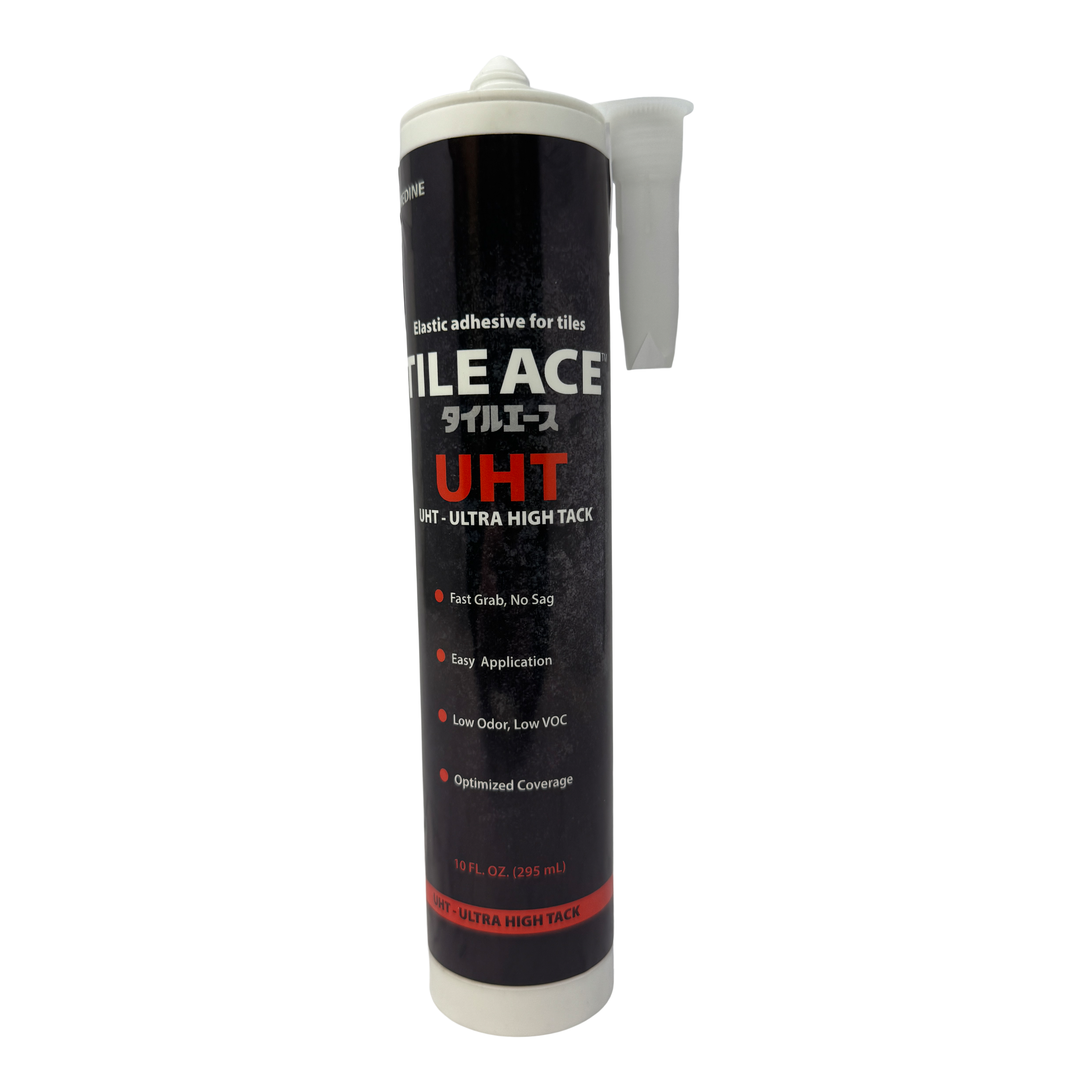
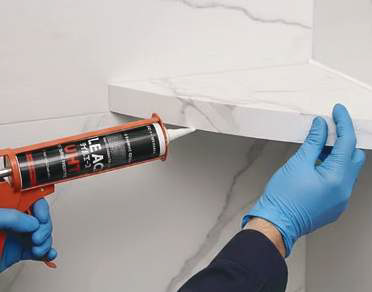
3.0 MPa / 408% Elongation / Shore A 55 The Strongest Grade in the Tile Ace LineTile Ace UHT is a one-component, moisture curing Kaneka MS Polymer adhesive with 3.0 MPa tensile strength at break and 408% elongation. It was built for the tile market as a tile spot bonding adhesive, applied in beads or blobs rather than troweled, and because it is an MS hybrid it grabs almost everything a shop or a jobsite puts in front of it: tile, stone, gypsum board, mortar, glass, stainless, anodized aluminum, PVC, ABS, PET, and polystyrene. Installers use it to spot bond composite tile panels to walls, mount corner shelves and niche shelves in showers, hang heavy fixtures, and handle general high strength bonding where a cement bed or an epoxy is the wrong tool. Made in the USA by Cemedine North America in Cincinnati, Ohio. |
 |
How UHT Compares to the Other Tile Ace Grades
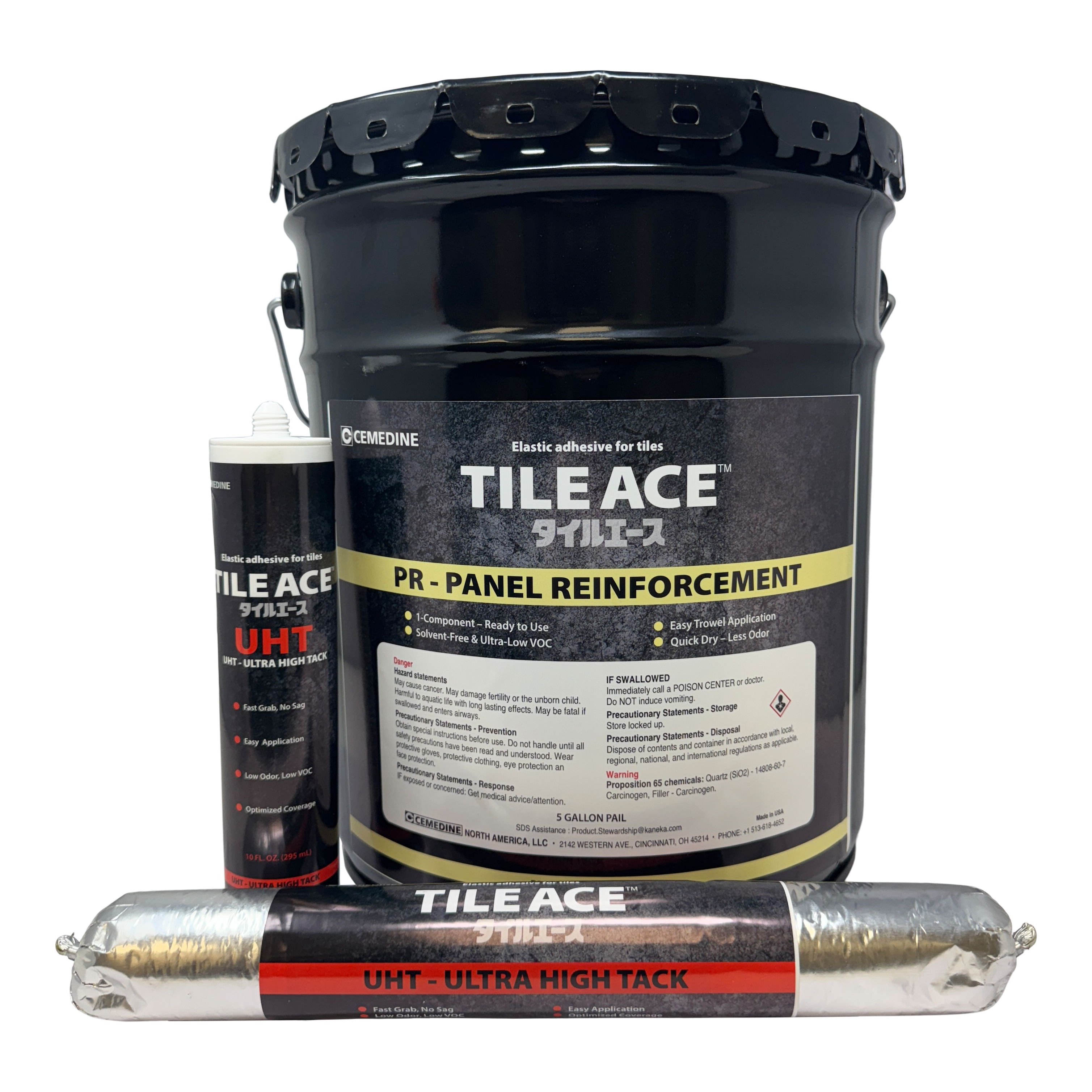
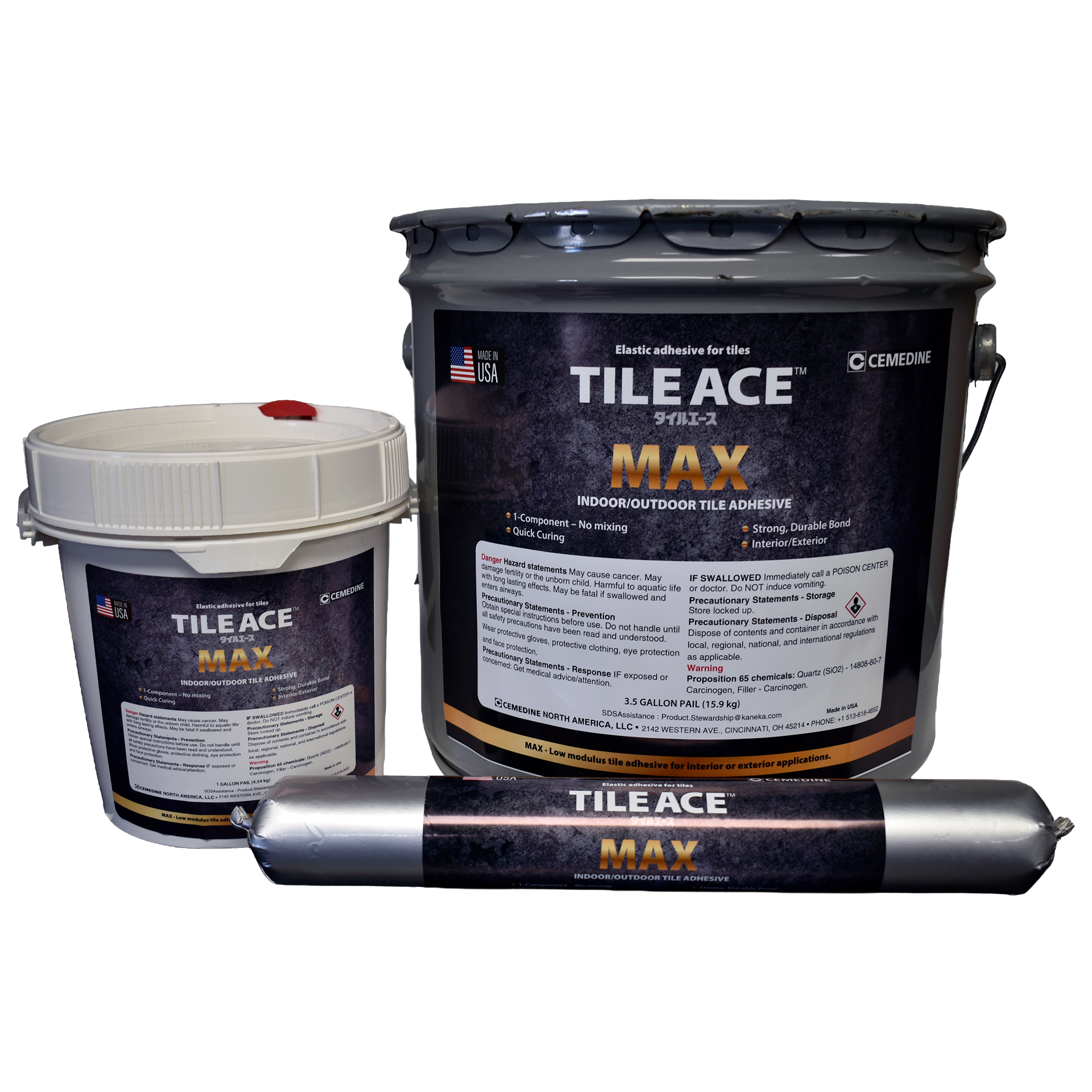
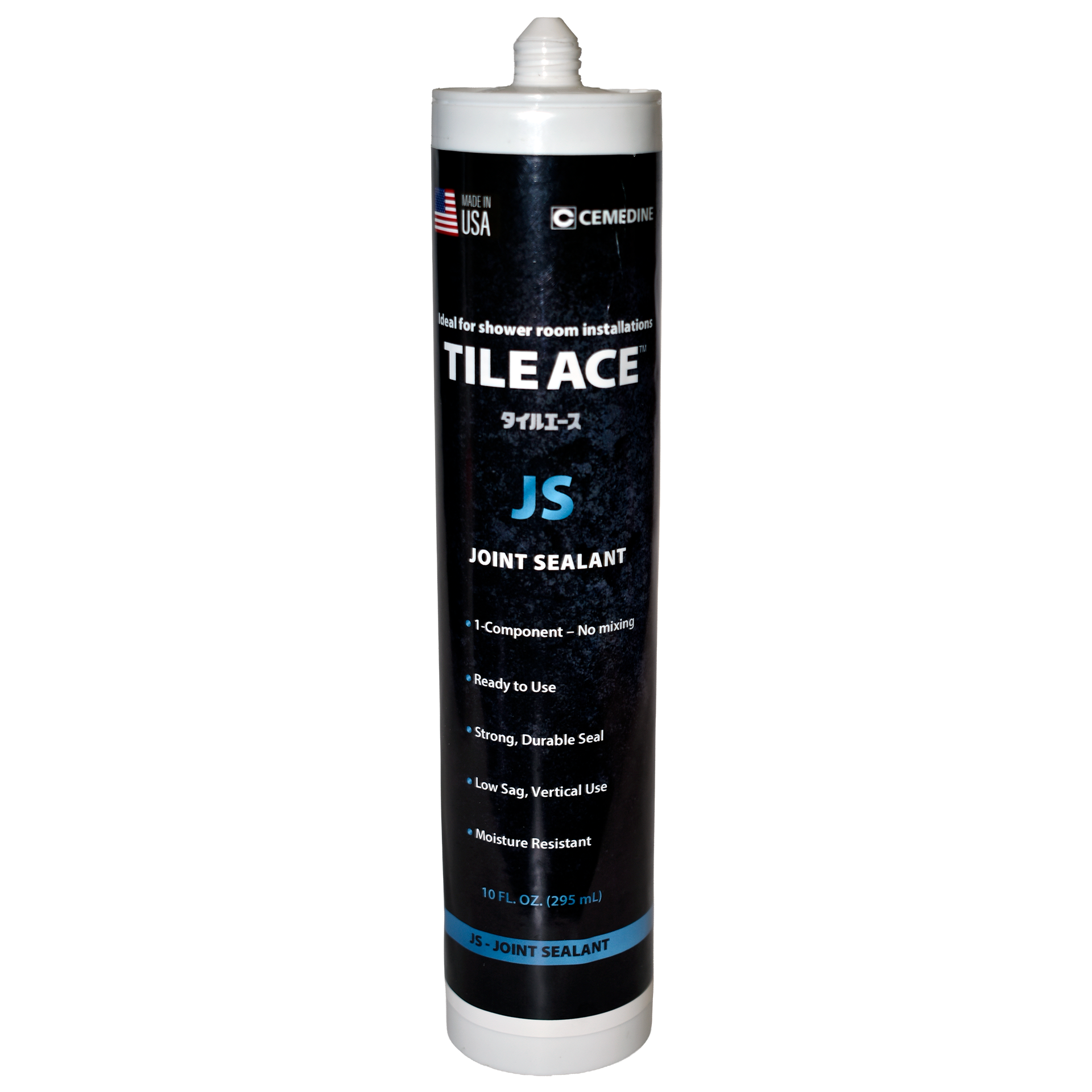
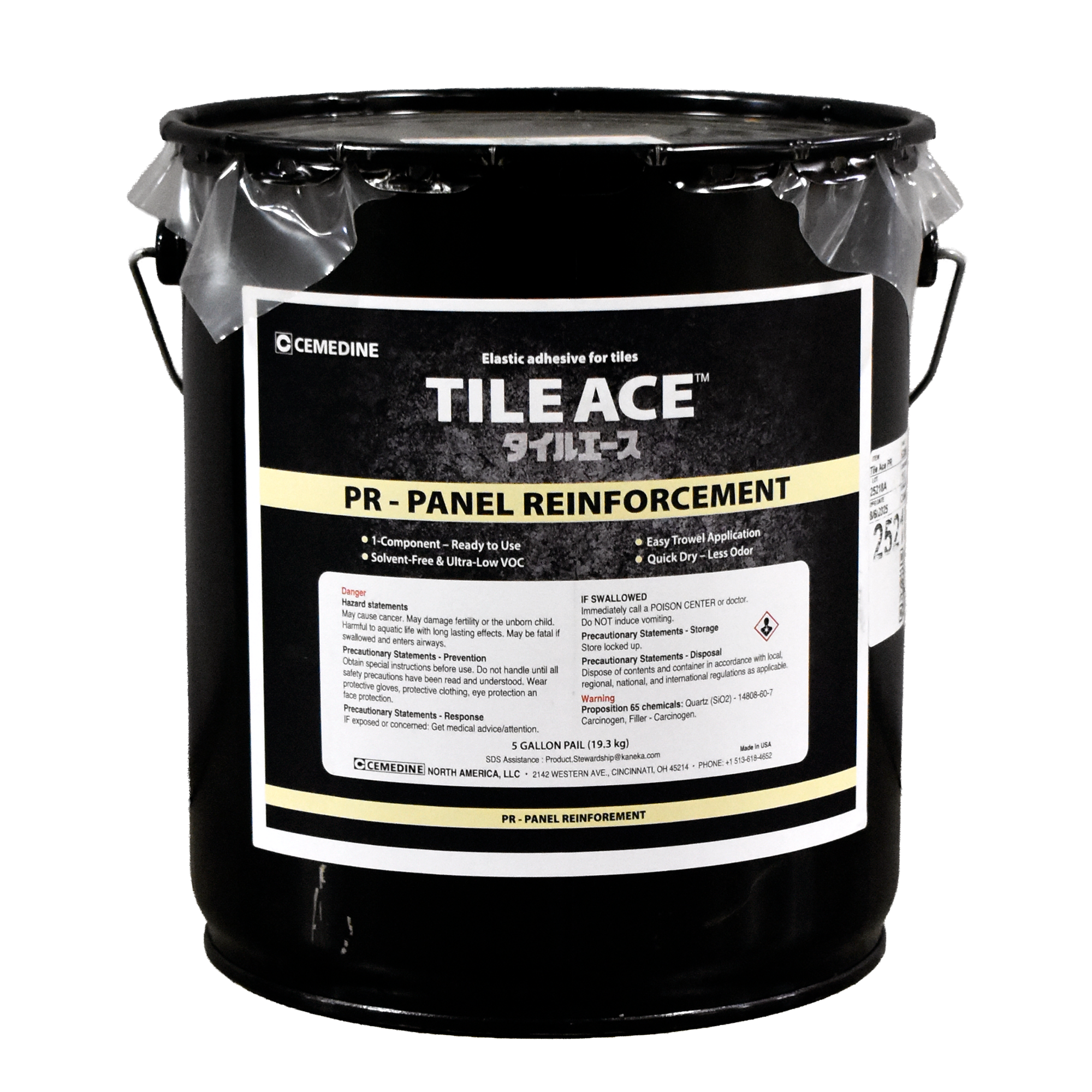
All four grades run on the same Kaneka MS Polymer chemistry. UHT is the high strength one, at three times the tensile strength at break of MAX and roughly two and a half times PR. Blank cells mean the figure is not published on that grade’s data sheet.
| Grade | What It Does | Tensile at Break | Elongation | Shore A |
|---|---|---|---|---|
| UHT | Bead and spot bonding, accessories, high strength general bonding | 3.0 MPa | 408% | 55 |
| PR | Laminating backer board to slabs in the shop | 1.23 MPa | 51 | |
| MAX | Full-spread troweled wall and ceiling tile, interior or exterior | 1.0 MPa | 80% | 50 |
| JS | Sealing membrane seams, penetrations, corners, tub flanges | 1.62 MPa | 650% | 29 |
About Spot Bonding, Since Somebody Is Going to Ask
If you have been through TCNA or CTEF training, “spot bonding” is a phrase that makes you wince, and rightly so. ANSI A108.5 and the TCNA Handbook require a minimum of 80% mortar coverage in dry areas and 95% in wet areas, on exteriors, and under large format tile. The five-dab trick with a cement mortar leaves voids, fails to support the corners, and is a documented failure mode. None of that is in dispute and we are not arguing with it.
Tile Ace UHT is not a thin-bed cement mortar, so those coverage figures are not the specification it is measured against. It is an elastic, high strength adhesive, and Cemedine publishes its own application rules, which are narrower and worth reading:
- Bead bonding tile panels: composite systems only. Cemedine states that spot or bead bonding should not be used on a non-composite porcelain tile. The panel has to be laminated to a reinforcement backer first, which is the Tile Ace PR step in the shop.
- The published figures are for a lightweight panel. Their directions size the bead pattern to a composite panel system of approximately 2.9 lbs per sq ft, and the 8% coverage figure is stated for reinforced porcelain tile at 3.1 lbs per sq ft.
- Interior only. UHT’s stated application is the interior wall surface, wet or dry. Exterior tile is Tile Ace MAX.
- Setting field tile across a wall is a different job. That is a full-spread adhesive, and that is MAX, not UHT.
Cemedine publishes no ANSI A118 or A136.1 classification for UHT, and we will not imply one. If your job is specified to an ANSI mortar standard or a TCNA method, the specification governs and UHT is not a substitute for a mortar that carries it. For accessory mounting, fixture bonding, and composite panel work outside that spec chain, it is a different conversation and a call worth making.
How to Apply It
- Clean both faces. Remove dust, oily substances, and water from the wall surface with a cloth. On a glazed tile face or a non-porous substrate, that wipe is doing most of the work.
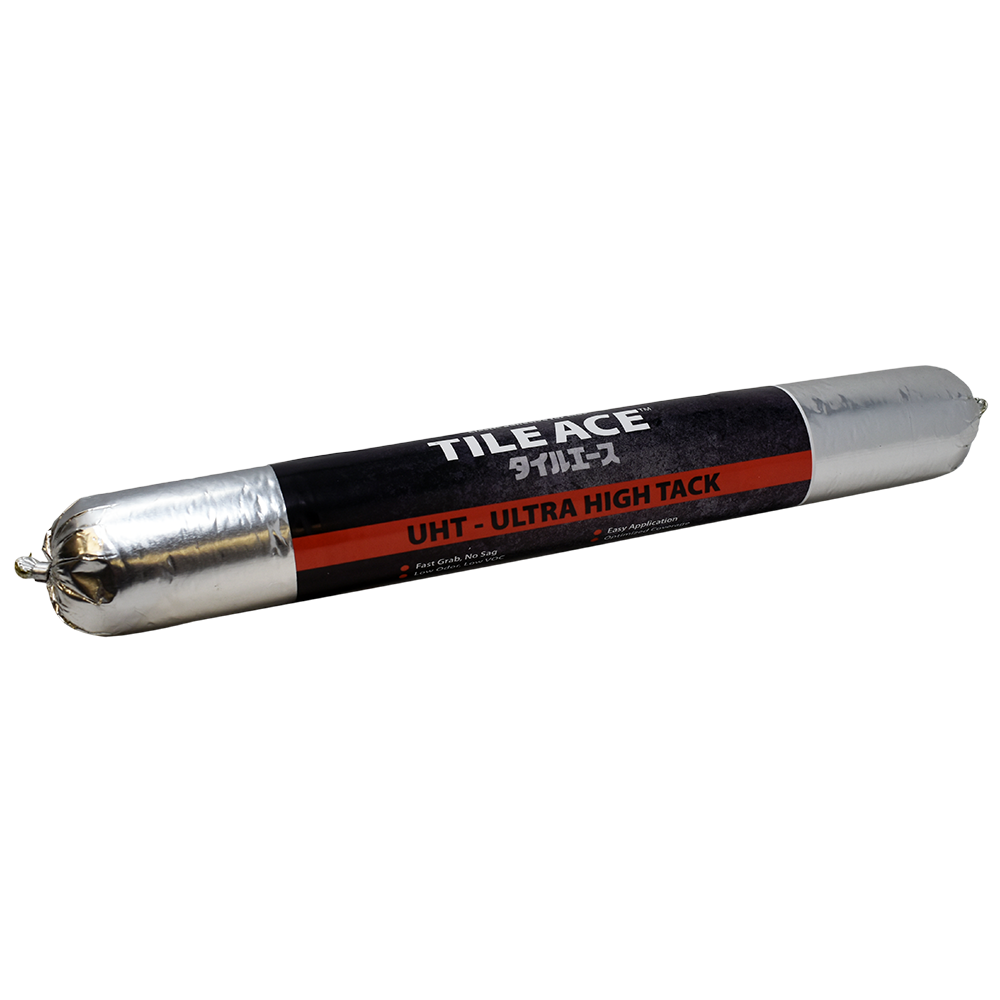
- Load the gun. Cut the tip off the foil sausage and insert it into a sausage gun, or run the 10 oz cartridge in a standard caulking gun.
- Run beads or blobs. On a composite panel, size the pattern to a panel of roughly 2.9 lbs per sq ft at about 8% surface coverage. On a shelf, a bracket, or a fixture, cover enough of the mating face to carry the load and keep the bond area away from the edges of the part.
- Press and roll. Press the piece to the wall, then use a roller or float to work pressure across it so the adhesive wets out both surfaces. Beads that never make contact carry nothing. This step is not optional and it is where most bead-bonded failures come from.
- Adjust inside the window. Reposition within the application time. Skin over is 30 minutes at 73°F.
- Grout after 24 hours, or after confirming the adhesive has hardened. Support anything heavy until it has.
What Installers Use It For
Tile and Panel Work
|
General High Strength Bonding
|
Not for exterior tile, not for setting field tile across a wall, and not for bead bonding a non-composite porcelain panel. Test on your own assembly before production.
Technical Specifications
| Property | Value |
|---|---|
| Adhesive Type | One component, moisture curing Kaneka MS Polymer |
| Color | White |
| Tensile Strength at Break (ASTM D412) | 3.0 MPa |
| Elongation at Break (ASTM D412) | 408% |
| Hardness (ASTM C661) | Shore A 55 |
| Viscosity at 73°F | 15,490,000 cP at 1 rpm, 8,944,000 cP at 2 rpm, 2,595,000 cP at 10 rpm |
| Specific Gravity | 1.6 g/mL |
| Application Method | Bead or spot, no troweling. About 8% surface coverage on a typical reinforced porcelain panel |
| Documented Panel Basis | Composite panel system of approximately 2.9 lbs/sq ft, with the 8% coverage figure stated for reinforced porcelain tile at 3.1 lbs/sq ft |
| Skin Over Time | 30 minutes at 73°F (23°C) |
| Grout | After 24 hours, or after confirming the hardened state |
| Application Temperature | 41°F to 95°F (5°C to 35°C) |
| Service Temperature | -40°F to 194°F (-40°C to 90°C) |
| Storage Condition | 50°F to 90°F (10°C to 32°C), kept tightly closed |
| Shelf Life | 12 months from date of production, unopened packaging at 73°F |
| Country of Manufacture | United States |
| Packaging | 10 oz cartridge, 20 oz foil sausage pack |
Hand Peel Test Results by Substrate
Cemedine tested ten substrates. All ten came back CF, cohesion failure, meaning the adhesive tore inside itself before it released the surface. Note what is on this list: glass, stainless, and anodized aluminum are the surfaces a cement mortar cannot hold at all.
| Substrate | Type of Bonding Failure |
|---|---|
| Ceramic tile | CF |
| Gypsum board | CF |
| Mortar | CF |
| Glass | CF |
| Stainless steel | CF |
| Anodized aluminum | CF |
| PVC | CF |
| ABS | CF |
| PET | CF |
| Polystyrene | CF |
Handling
Tile Ace UHT is solvent-free with low odor, and the SDS lists it as odorless. It is classified for industrial use. The SDS carries the signal word Danger with skin sensitization, carcinogenicity, and reproductive toxicity classifications, plus a California Proposition 65 listing for titanium dioxide.
Wear gloves, eye protection, and protective clothing, work with adequate ventilation, and read the SDS before use. Download it from the SDS/TDS tab on this page.
Frequently Asked Questions
What is Tile Ace UHT used for?
Tile Ace UHT is a high strength, one-component MS polymer adhesive applied in beads or blobs rather than troweled. It is used to spot bond composite tile panels to interior walls, mount corner shelves, niche shelves, and soap dishes onto finished tile, hang heavy wall fixtures and hardware, and for general high strength bonding on substrates a cement mortar cannot hold, including glass, stainless, anodized aluminum, and plastics.
Is Tile Ace UHT a mastic or a thinset?
Neither. Thinset is a cement mortar mixed with water on site. Mastic is an organic adhesive, the category covered by ANSI A136.1. Tile Ace UHT is a moisture curing MS polymer, also called an MS hybrid or a silyl modified polymer, which cures to a tough elastic solid rather than drying like a mastic or hydrating like a mortar. That is why it holds glass and stainless and why it stretches 408% before it breaks.
Can you spot bond tile with Tile Ace UHT, and does that meet ANSI coverage requirements?
Bead bonding with UHT is permitted by Cemedine on composite and reinforced porcelain panel systems, and not on non-composite porcelain tile. It does not meet the ANSI mortar coverage requirements, and it is not meant to, because those requirements govern thin-bed cement mortars rather than elastic adhesives. ANSI A108.5 and the TCNA Handbook call for at least 80% coverage in dry areas and 95% in wet and exterior areas, and if your job is written to an ANSI mortar standard or a TCNA method, that specification governs and UHT is not a substitute. For accessory mounting, fixture bonding, and composite panel work outside that spec chain, call us and we will talk through the assembly.
What counts as large format tile or a gauged porcelain panel?
Under ANSI A137.1, large format tile is any tile with at least one edge 15 inches or longer. Gauged porcelain tile panels and slabs, often shortened to GPTP, are defined in ANSI A137.3 as porcelain one square meter or larger in facial area, typically 3.5mm to 6.5mm thick. A composite or reinforced panel is one of those thin panels laminated to a backer board, honeycomb, or foam core so it behaves as a stiff panel instead of a fragile sheet.
Can you mount a shower shelf or a corner shelf with Tile Ace UHT?
Yes, and Cemedine names this application specifically for the 10 oz cartridge: spot bonding shower shelves, soap dishes, and heavy wall accessories. Wipe the tile face clean, apply beads across the mating surface, press the shelf in, and hold or support it until the adhesive has hardened. Skin over is 30 minutes at 73°F and full hardening should be confirmed before you load the shelf.
Can Tile Ace UHT mount a sink or a heavy fixture?
Installers do use it for heavy fixture mounting, and the numbers behind it are real: 3.0 MPa tensile at break with cohesion failure on stainless, glass, tile, and mortar. What we will not do is publish a load rating, because Cemedine does not publish one for UHT. For anything load bearing, test the actual assembly, and for undermount sink work that has to be specified or warranted, use a fastener system with published pull-out data such as our Keep-Nut anchors or glue-on sink anchors. Call us and we will tell you which one your job actually needs.
What is the difference between Tile Ace UHT, MAX, PR, and JS?
UHT is the high strength bead and spot grade for panels, accessories, and fixtures, interior only. MAX is the full-spread troweled adhesive for wall and ceiling tile, interior or exterior, at 25 to 30 sq ft per gallon with a 60 minute open time. PR is the shop grade that laminates backer board and honeycomb to the back of a slab. JS is the joint sealant for membrane seams, screw penetrations, corners, and tub flanges at 650% elongation. Same chemistry family, four different jobs.
Where is Tile Ace UHT made?
Tile Ace UHT is made in the USA by Cemedine North America in Cincinnati, Ohio, using Kaneka MS Polymer chemistry developed in Japan. Chemical Concepts distributes the full Tile Ace line in North America.
Not sure whether UHT is the right grade for what you are bonding? Call (800) 220-1966 or email [email protected]. Test on your own substrate and assembly before running production.


Reviews
There are no reviews yet.