



Description
Trimless Letter Fabrication
Chem-Set™ TrimLok™ CT45
Low viscosity toughened CA for trimless letters and tight acrylic to aluminum seams.
Chem-Set TrimLok CT45 toughened CA is a clear, low viscosity ethyl cyanoacrylate for trimless letters and other tight seams in sign fabrication. It wicks into close-fitting joints, and the toughened formula adds shock and impact resistance to the fast fixture of a standard CA.
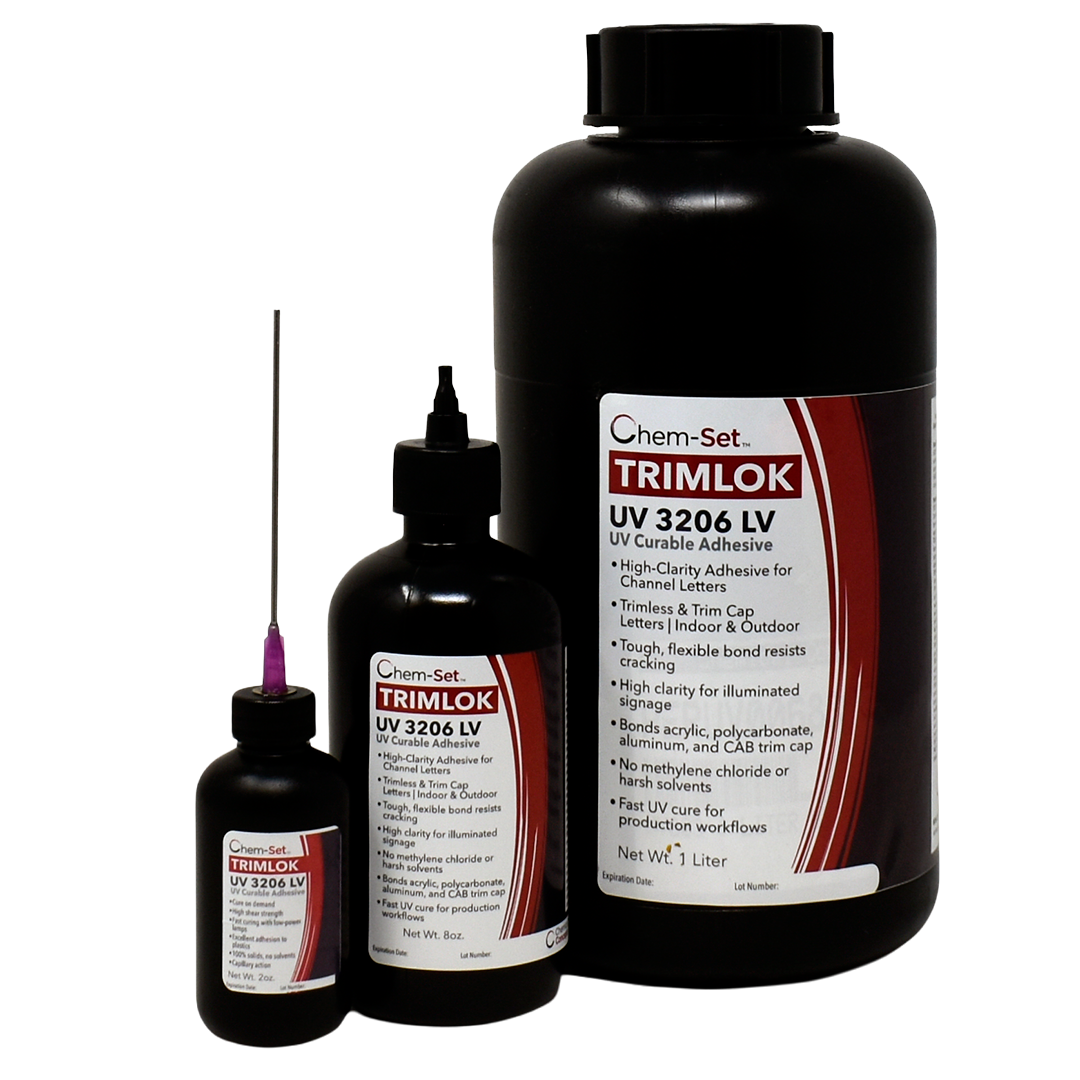
CT45 is approved for use with SDS Automation trimless letter machines and works well on interior and smaller letters. For exterior letters, use the TrimLok UV3206 LV system.

When to Use the UV System Instead
CT45 is a rigid CA bond, so it has limits.
- Exterior letters: A CA bond breaks down over time with outdoor expansion and contraction.
- Larger letters: Large letters and letters that flex take more movement than a CA bond handles. We point them to UV3206 LV with UL607.
- Visible bond lines: CAs can yellow, turn green, and bloom over time, and outdoor exposure makes it more likely.
Where CT45 Works
CT45 is made for interior and smaller trimless letters.
- Low Viscosity: Wicks into close-fitting seams on acrylic face to aluminum return joints.
- Fast Fixture: Plastics bond in seconds, so operators can handle parts quickly.
- Toughened Formula: Adds shock and impact resistance over a standard CA for letters that get moved around the shop.
- Capped Bottles: Every bottle ships with a cap, which prevents most tip clogging.
Choose the Right TrimLok Adhesive
| Adhesive | Chemistry | Viscosity | Best Fit |
|---|---|---|---|
| CT45 (this page) | Toughened ethyl cyanoacrylate | 30 to 60 cps | Interior and smaller trimless letters with tight joints |
| CT300 | Toughened ethyl cyanoacrylate | 200 to 500 cps | Interior and smaller letters where the gap is wider |
| UV3206 LV | UV-curable methacrylate ester | 50 to 100 cP | Exterior, larger, and flexing letters, used with UL607 on trimless seams |
Trimless Letter Bonding Workflows
Shop Tips
Small habits that keep CT45 working on the line.
- Cap It: CA cures on moisture in the air, so cap the bottle after each use to keep glue from hardening at the tip.
- Fixture vs Full Cure: Bonding time tells you when a part can be handled. Full cure takes 24 hours.
- Fit First: CT45 fills only small gaps, so dry fit every joint. For wider gaps, use CT300.
- O-Rings: When bonding O-rings, cut a fresh surface onto each end of the rubber.
Compatible Substrates
CT45 bonds the core materials used in sign fabrication and general assembly.
- Acrylic (PMMA)
- Polycarbonate and ABS
- Steel and aluminum
- Rubbers
- Wood, leather, ceramics, and cardboard
Running a material not listed? Call us before you run it.
Technical Specifications
| Property | Value |
|---|---|
| Chemistry | Toughened ethyl cyanoacrylate |
| Appearance | Colorless liquid |
| Viscosity (@ 25°C) | 30 to 60 cps (77°F), cone and plate |
| Gap Filling | 0.008 in (0.2 mm) |
| Tensile Shear Strength | 18 to 28 N/mm2 |
| Bonding (Fixture) Time | 2 to 18 seconds depending on substrate, see table below |
| Full Cure | 24 hours |
| Service Temperature Range | -76°F to 176°F (-60°C to 80°C) |
| Melting Point | 320°F to 338°F (160°C to 170°C) |
| Glass Transition Temperature | 248°F (120°C), ASTM E228 |
| Thermal Conductivity | 0.1 W/m·K, ASTM C177 |
| Coefficient of Thermal Expansion | 75 x 10-6 K-1, ASTM D696 |
| Dielectric Strength | 25 kV/mm, ASTM D149 |
| Volume Resistivity | 1 x 10¹⁶ ohm·cm, ASTM D257 |
| Dielectric Constant | 2.3 at 77°F (25°C), ASTM D150 |
| Approvals | Approved for use with SDS Automation trimless letter machines |
Bonding Time by Substrate
| Substrate | Bonding Time |
|---|---|
| Plastics | 2 to 5 seconds |
| Steel | 5 to 11 seconds |
| Aluminum | 8 to 10 seconds |
| Rubbers | Under 4 seconds |
| Leather | 5 to 15 seconds |
| Ceramics | 12 to 18 seconds |
Shear Strength by Substrate
| Substrate | Shear Strength, ASTM D1002 / DIN 53283 |
|---|---|
| Grit blasted steel | Over 20 N/mm2 |
| Etched aluminum | Over 18 N/mm2 |
| Rubbers | Over 22 N/mm2 |
| Wood | Over 25 N/mm2 |
| Polycarbonate | Over 12 N/mm2 |
| ABS | Over 10 N/mm2 |
Available Sizes
| Size | SKU |
|---|---|
| 2 oz Bottle | CCA-TLCT45-2OZ |
| 4 oz Tower Bottle | CCA-TLCT45-4OZ |
| 8 oz Bottle | CCA-TLCT45-8OZ |
Aging Test Results vs Standard CAs
We tested CT45 and CT300 against two standard CAs, one thick and one medium viscosity, on aluminum to acrylic joints in an accelerated heat and humidity aging test. Every product lost most of its strength. After 21 days CT45 and CT300 and the medium standard CA were all near 1 MPa, and the thick standard CA had failed.
CT45 and CT300 were tested together and are shown as one result. CT45 is low viscosity and CT300 is medium, so compare viscosity as well as strength when you choose. This is a stress test and not a service rating. It is the reason we point exterior letters to UV3206 LV.
| Product | No aging | 7 days | 14 days | 21 days |
|---|---|---|---|---|
| CT45 (low viscosity) and CT300 (medium viscosity), tested together | 10.8 | 3.2 | 1.3 | 1.1 |
| Standard CA, Thick | 9.7 | 3.1 | 0.5 | 0.0 |
| Standard CA, Medium | 11.0 | 0.0 | 0.9 | 0.9 |
Average lap shear strength in MPa after aging at 185°F (85°C) and 85% RH. A reading of 0.0 means all samples failed.
| CT45 and CT300 (tested together) | Standard CA, Thick | Standard CA, Medium |
No aging
| CT45 and CT300 | 10.8 MPa | |
| Standard CA, Thick | 9.7 MPa | |
| Standard CA, Medium | 11.0 MPa |
7 days
| CT45 and CT300 | 3.2 MPa | |
| Standard CA, Thick | 3.1 MPa | |
| Standard CA, Medium | 0.0 MPa |
14 days
| CT45 and CT300 | 1.3 MPa | |
| Standard CA, Thick | 0.5 MPa | |
| Standard CA, Medium | 0.9 MPa |
21 days
| CT45 and CT300 | 1.1 MPa | |
| Standard CA, Thick | 0.0 MPa | |
| Standard CA, Medium | 0.9 MPa |
Test method: 1 in wide aluminum and acrylic, cleaned with IPA, 0.006 in (150 micron) bond gap held with Teflon tape, bond area 1.0 in x 0.5 in (2.54 cm x 1.27 cm), cured overnight, 3 samples per condition, Instron lap shear at 10 mm/min, aged at 185°F (85°C) and 85% RH for 1, 2, and 3 weeks. Tested March 2026. These are Chemical Concepts internal results and may differ in your application, so test before production.
Trimless Letter CA FAQ
The questions sign fabricators ask before they pick a CA for trimless letters, answered from the CT45 technical data sheet and our own testing.
+What is Chem-Set TrimLok CT45 used for?
CT45 is used to bond acrylic faces to aluminum returns on interior and smaller trimless letters. It is also used for general assembly on plastics, metals, rubber, wood, leather, ceramics, and cardboard where parts fit closely.
+Can I use CT45 on exterior trimless letters?
No, we recommend UV3206 LV with UL607 for exterior letters. A CA bond is rigid, and it breaks down over time with outdoor expansion and contraction. We also point larger letters and any letter that will flex to the UV system.
+How does CT45 compare to a standard thick or medium CA?
No product held its strength in our aging test. CT45 and CT300 finished near 1 MPa alongside the medium standard CA, and the thick standard CA failed. CT45 is low viscosity, so if you run a medium CA, start with CT300. The chart and test conditions are in the aging results above.
+Should I use CT45 or CT300?
Use CT45 if your joint is tight and you want a thin, fast-wicking CA. CT45 is low viscosity and CT300 is medium viscosity, and CT300 fills a wider gap. If you are coming from a medium or thick CA, look at CT300 first.
+Why does CA turn yellow or green on trimless letters?
Yellowing, greening, and blooming are normal for cyanoacrylates over time, and outdoor exposure makes them more likely. Interior and smaller trimless letters work fine with CT45. Once a letter goes outside, the bond line can discolor, so use the UV system there.
+Why does CA harden in the bottle tip?
CA cures from moisture in the air, so glue sitting at the end of the tip hardens. CT45 bottles come with caps, and capping the bottle after each use prevents most tip clogging.
+Is CT45 approved for SDS Automation trimless letter machines?
Yes, CT45 is approved for use with SDS Automation trimless letter machines. SDS here means the machine maker and not safety data sheets.
+What materials does CT45 bond?
CT45 bonds metals, plastics, rubbers, wood, leather, ceramics, and cardboard. The shear strength table above lists steel, aluminum, rubber, wood, polycarbonate, and ABS. For a material not listed, call us before you run it.
Not Sure Which TrimLok Adhesive Fits Your Letters?
Send us your letter sizes, coil, and where the sign will hang, and we will point you to CT45, CT300, or the UV system. Call (800) 220-1966 or use the buttons below.
Chem-Set and TrimLok are trademarks of Chemical Concepts. SDS Automation is a trademark of its owner and is named here only to identify machine compatibility.



Reviews
There are no reviews yet.