



Description
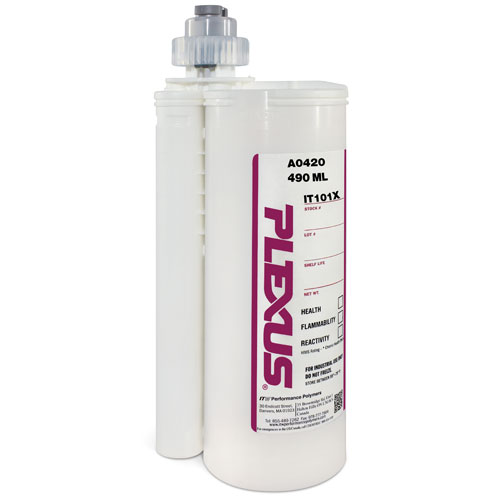
Plexus MA420 adhesive, also sold as AO420, is a two-part methacrylate (MMA) structural adhesive for bonding thermoplastics, composites, and metals. It mixes at 10:1 by volume, cures fast at room temperature, and dispenses as a non-sagging gel, so it holds a bond line on vertical and overhead joints without slumping. ITW calls it the standard choice for composite bonding in the transportation industry because it needs little or no surface preparation on most substrates. Shops running FRP panel, gelcoat, and aluminum assemblies use it where they want toughness, fatigue endurance, and impact resistance instead of a rigid bond line.
Available in cream, black, and blue 490ml cartridges, plus 5 gallon pails and 50 gallon drums for bulk meter/mix dispensing.
Key Product Details
| Property | Value |
|---|---|
| Chemistry | Two-part methacrylate (MMA) |
| Mix Ratio by Volume | 10:1 (Part A to Part B) |
| Mix Ratio by Weight | 9.00 to 1.00 |
| Color | Part A off white. Part B off white, blue, or black. Cartridges stocked in cream, black, and blue. |
| Consistency | Non-sagging gel |
| Component Viscosity, cP x1000 | Part A 100 to 125. Part B 35 to 80. |
| Component Density, g/ml | Part A 0.97. Part B 1.05. |
| Gap Tolerance | 0.03 to 0.375 in (0.75 to 9.5 mm) |
| Tensile Strength (ASTM D638 / ISO 527) | 2,430 to 2,970 psi (16.8 to 20.5 MPa) |
| Tensile Modulus | 149 to 201 kpsi (1,026 to 1,388 MPa) |
| Elongation at Break | 20 to 40% |
| Hardness | Shore D 73 |
| Peak Exotherm (10g) | 8 to 11 min to peak, about 240 °F (115 °C) |
| VOCs During Cure | Less than 2% |
| Application Temperature | 65 to 85 °F (18 to 30 °C) |
| Chemical Resistance | Good resistance to hydrocarbons, acids and bases pH 3 to 10, and salt solutions. Susceptible to strong polar solvents, strong acids, and strong bases. |
| Shelf Life | 10 months. 7 months for black. |
| Storage | 55 to 77 °F (13 to 25 °C). Cool storage at 45 to 65 °F may extend shelf life. Avoid above 100 °F. |
| Manufacturer | ITW Performance Polymers |
Cure Profile by Shop Temperature
MA420 speeds up and slows down with the room. Plan cycle times off the column that matches your shop, not off a single published number.
| Stage | 60 °F (15.6 °C) | 75 °F (23.9 °C) | 90 °F (32.2 °C) |
|---|---|---|---|
| Work time, min | 5 to 7 | 4 to 6 | 2 to 5 |
| Time to 50 psi, min | 17 to 18 | 15 to 17 | 13 to 15 |
| Time to 500 psi, min | 21 to 22 | 18 to 20 | 17 to 20 |
| Time to 1000 psi, min | 26 to 27 | 20 to 22 | 17 to 20 |
Lap Shear Strength by Substrate
Typical values per ASTM D1002. Watch the failure mode column as closely as the psi number, because on gelcoat, PU GFRP, and polyester the substrate or the fiber lets go before the adhesive does.
| Substrate | psi | MPa | Failure Mode |
|---|---|---|---|
| Aluminum | 3,852 | 26.6 | Adhesive failure |
| Aluminum, cycled | 2,821 | 19.5 | Cohesive failure |
| Carbon fiber | 3,352 | 23.1 | Cohesive failure |
| Stainless steel | 2,884 | 19.9 | Cohesive failure |
| Gel coat | 2,122 | 14.6 | Substrate failure |
| Polyester | 819 | 5.6 | Fiber tear |
| PU GFRP | 497 | 3.4 | Substrate failure |
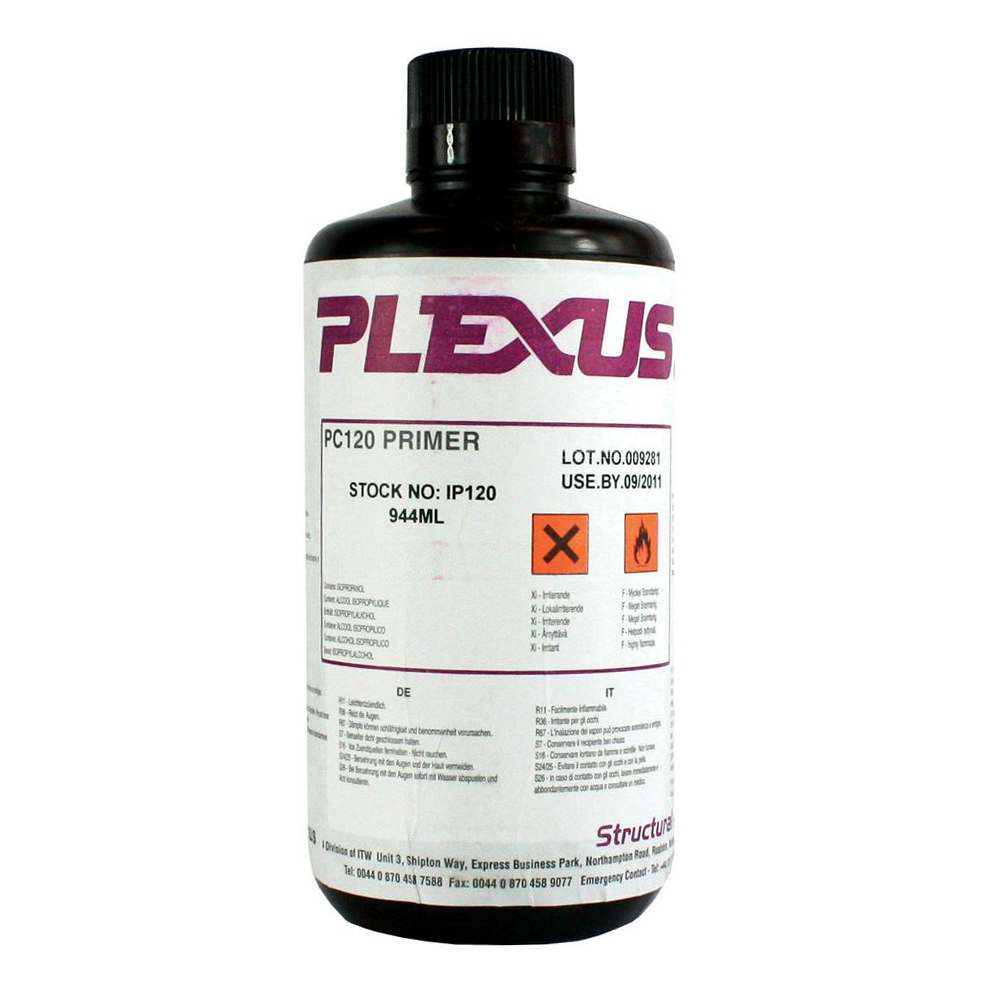
Tested on Al 6061. PC120 Cleaner Conditioner is recommended by the TDS on metal.
How Bonding With a 10:1 MMA Adhesive Works
MMA bonding replaces welding, riveting, and mechanical fastening on panel and skin assemblies. The adhesive and the activator meet in a static mixer at the nozzle, cure starts on contact, and you have a few minutes to get the parts together. The sequence on the floor looks like this.
- Prep the surface to the substrate, not to a universal rule. Plastics and coated metals usually need nothing more than a wipe with a dry rag or a light solvent. Raw metal is the same, though oxidation, scale, and residual fluids will change the result. Dust free composites can be bonded as is, or given a light abrasion to knock down mold release and add surface area. Everything should be free of grease and dirt.
- Get the shop and the material into range. Apply between 65 and 85 °F. Below that the cure drags. Above it the cure runs away and the viscosities of both parts shift. Keeping material temperature steady through the year is what keeps dispensing consistent.
- Load and purge. Drop the cartridge in the gun, pull the end caps, thread on the mixing tip, and expel a mixer’s length of adhesive before you go to the part. That first shot is off ratio.
- Lay down enough material to fill the joint. The bond line should be full once the parts are mated and clamped. Gap tolerance runs from 0.03 to 0.375 in, so this is an adhesive that fills a real gap rather than one that needs a metal-to-metal fit.
- Mate inside the work time. Four to six minutes at 75 °F. Parts that are not together and located before that lose bond strength.
- Fixture until it holds itself. At 75 °F the joint reaches 50 psi in 15 to 17 minutes and 1000 psi in 20 to 22 minutes. Size the clamp or fixture cycle off the strength you actually need to move the part.
- Clean up before it kicks. Uncured adhesive comes off with common lab solvents, citrus terpene, NMP-containing cleaners, degreasers, or soap and water. Once it has cured, you are into careful scraping followed by a wipe with a cleaning agent.
Substrates this process runs on: ABS and ABS blends, acrylics, PBT, polycarbonate, rigid PVC, TPUs, DCPD, FRP, gelcoat, phenolics, epoxy based composites, RIM, powder coated and e-coated metals, and raw metals including aluminum, stainless steel, and raw steel with PC120. ITW recommends testing your own materials to confirm the prep that works for your parts.
Performance in Production
- A non-sagging gel with Part A viscosity of 100,000 to 125,000 cP holds the bead where it was laid, so vertical seams and overhead panel joints do not need a dam or a shelf to keep the bond line in place.
- 20 to 40% elongation at break with Shore D 73 hardness means the cured joint flexes instead of cracking. That is what carries panel movement, vibration, and dynamic load on a bus skin or a trailer sidewall rather than concentrating stress at a fastener hole.
- Gap tolerance to 0.375 in lets one adhesive handle both a tight-fitting joint and a sloppy one, but the 0.03 in minimum matters too. Squeeze a joint below that and you are outside the tested range.
- Work time drops from 5 to 7 minutes at 60 °F down to 2 to 5 minutes at 90 °F. A summer afternoon in an unconditioned bay can cut your assembly window in half, so bead length and crew staging should be set for the hot end of the year, not the average.
- The exotherm is real. Peak temperature runs about 240 °F on a 10g mass, and mixing a large batch at once can release entrapped air, steam, and volatile gases. Dispense only what gets used inside the work time and keep gap thickness within the maximum.
- At 10:1 by volume, bulk users go through far more Part A than Part B. Size pail and drum orders to the ratio rather than one adhesive to one activator, and remember that on bulk the color comes from the activator you pair with it.
- Bulk equipment has to be explosion proof, with stainless steel on every wetted part. Avoid brass, carbon steel, and copper or copper-containing alloys in fittings and pumps. Seals and gaskets should be Teflon, Teflon-coated PVC foam, ethylene/propylene, or polyethylene, not Viton, BUNA-N, or Neoprene.
Common Applications
- Bus, truck, trailer, and rail body panel bonding
- Marine composite assembly and gelcoat bonding
- FRP and carbon fiber panel and skin bonding
- Aluminum and stainless steel structural bonding in place of welding or riveting
- Thermoformed and thermoplastic part assembly on ABS, acrylic, polycarbonate, and rigid PVC
- Sign, display, and enclosure fabrication
- Specialty and emergency vehicle bodies, agricultural equipment, and solar assembly
Available Sizes and Colors
| Option | Package | Stock # |
|---|---|---|
| Cream | 490ml Cartridge | IT101X |
| Black | 490ml Cartridge | 35701 |
| Blue | 490ml Cartridge | IT101BX |
| Adhesive, Part A | 5 Gallon Pail | IT102 |
| Adhesive, Part A | 50 Gallon Drum | IT100 |
| Cream Activator, Part B | 5 Gallon Pail | IT112 |
| Black Activator, Part B | 5 Gallon Pail | IT140 |
| Blue Activator, Part B | 5 Gallon Pail | IT114 |
Related Products
- PC120 Cleaner Conditioner, recommended by the MA420 TDS on metal substrates
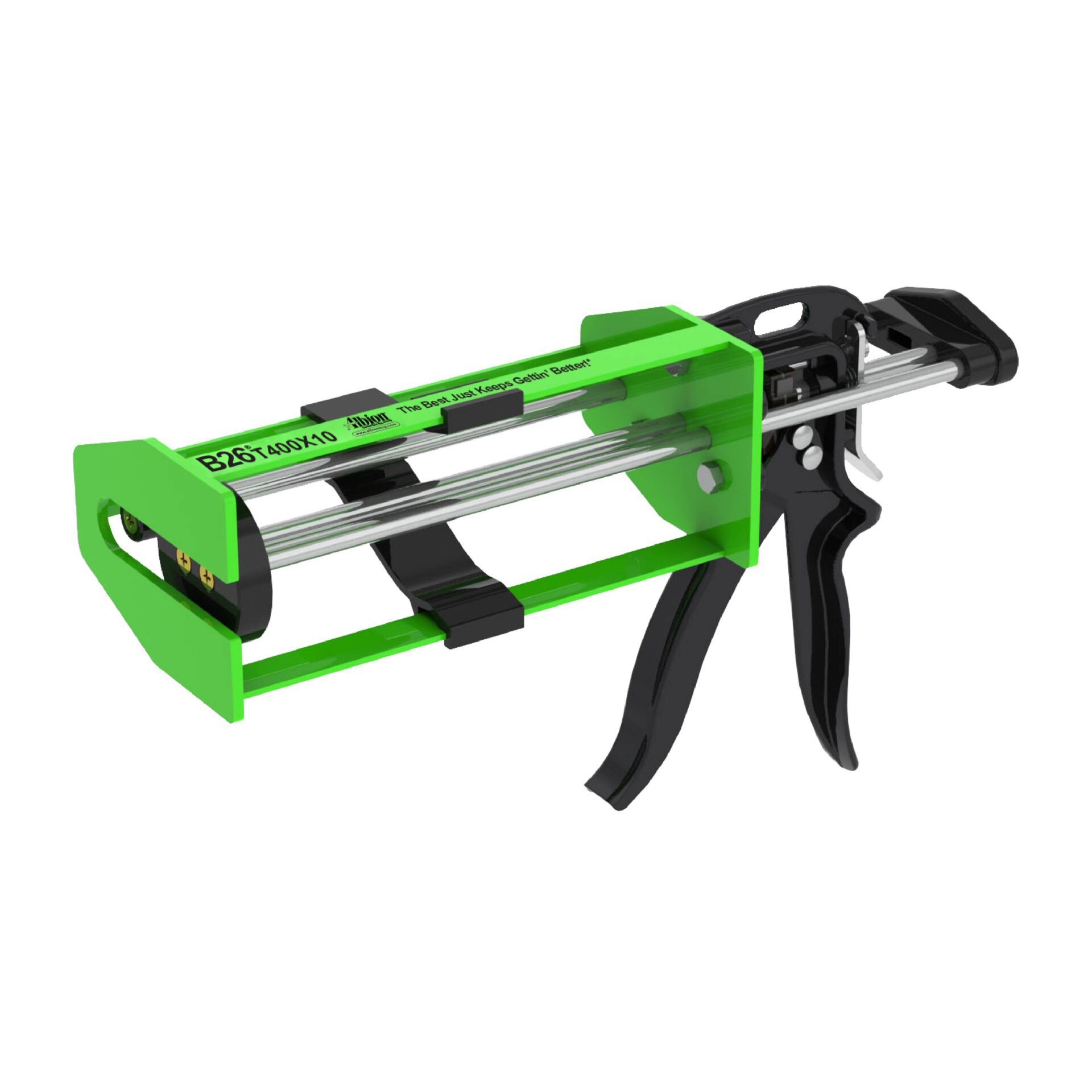
- 10:1 manual and pneumatic dispensing guns for 490ml cartridges
- 10:1 static mixing nozzles for 490ml cartridges
Frequently Asked Questions
What is Plexus MA420 used for?
Plexus MA420 is used for structural bonding of composites, thermoplastics, and metals, most often panel and skin assembly on buses, trucks, trailers, rail cars, boats, and signage. It is a two-part methacrylate that cures at room temperature and needs little or no surface preparation on most substrates, which is why it shows up as a replacement for welding, riveting, and mechanical fasteners.
Is Plexus MA420 the same as AO420?
Yes. MA420 and AO420 are the same adhesive. ITW Performance Polymers publishes one technical data sheet under both names, and the cartridge label carries AO420. Plexus MA420, Plexus AO420, and AO/MA420 all describe the same product.
Is Plexus MA420 an acrylic adhesive or a methacrylate adhesive?
Both terms point at the same chemistry. Acrylic adhesive, methacrylate adhesive, MMA adhesive, and two-part structural acrylic all describe MA420. The TDS calls it a two-part methacrylate. Buyers and shops usually just say acrylic or MMA.
What is the mix ratio of Plexus MA420?
10:1 by volume, adhesive to activator, or 9.00 to 1.00 by weight. The 490ml cartridge is pre-proportioned and mixes through a 10:1 static nozzle. On pails and drums the ratio has to be held by the meter/mix equipment, and it also means bulk users buy considerably more Part A than Part B.
What is the working time on Plexus MA420?
4 to 6 minutes at 75 °F. Work time stretches to 5 to 7 minutes at 60 °F and shortens to 2 to 5 minutes at 90 °F. The joint reaches 50 psi in 15 to 17 minutes at 75 °F and 1000 psi in 20 to 22 minutes.
Does Plexus MA420 bond aluminum and stainless steel?
Yes. Typical lap shear per ASTM D1002 is 3,852 psi on aluminum and 2,884 psi on stainless steel. PC120 Cleaner Conditioner is recommended on metal. Oxidation, scale, and residual fluids on raw metal will affect the bond, so metal surfaces should be clean and dry before application.
Do I need to prime or sand before bonding with MA420?
Usually no. Plastics, coated metals, and raw metals typically need only a wipe with a dry rag or a light solvent, and dust free composites can be bonded as is. Composites carrying mold release may need light abrasion. ITW recommends testing your own substrates to confirm the prep that gives the best result on your parts.
What sizes and colors does Plexus MA420 come in?
490ml cartridges in cream, black, and blue, plus 5 gallon adhesive pails, 5 gallon activator pails in cream, black, and blue, and 50 gallon adhesive drums. Part A is off white in every option. On bulk, the color of the cured bond line comes from the activator.
How long does Plexus MA420 last in storage?
10 months, or 7 months for black, based on continuous storage between 55 and 77 °F. Repeated or extended exposure above 80 °F cuts that short, and anything above 100 °F degrades it quickly. Cool storage between 45 and 65 °F can extend shelf life, but let the material warm back to room temperature before use.
Questions on fit for your bonding application? Call (800) 220-1966 or email [email protected].


Reviews
There are no reviews yet.