



Description
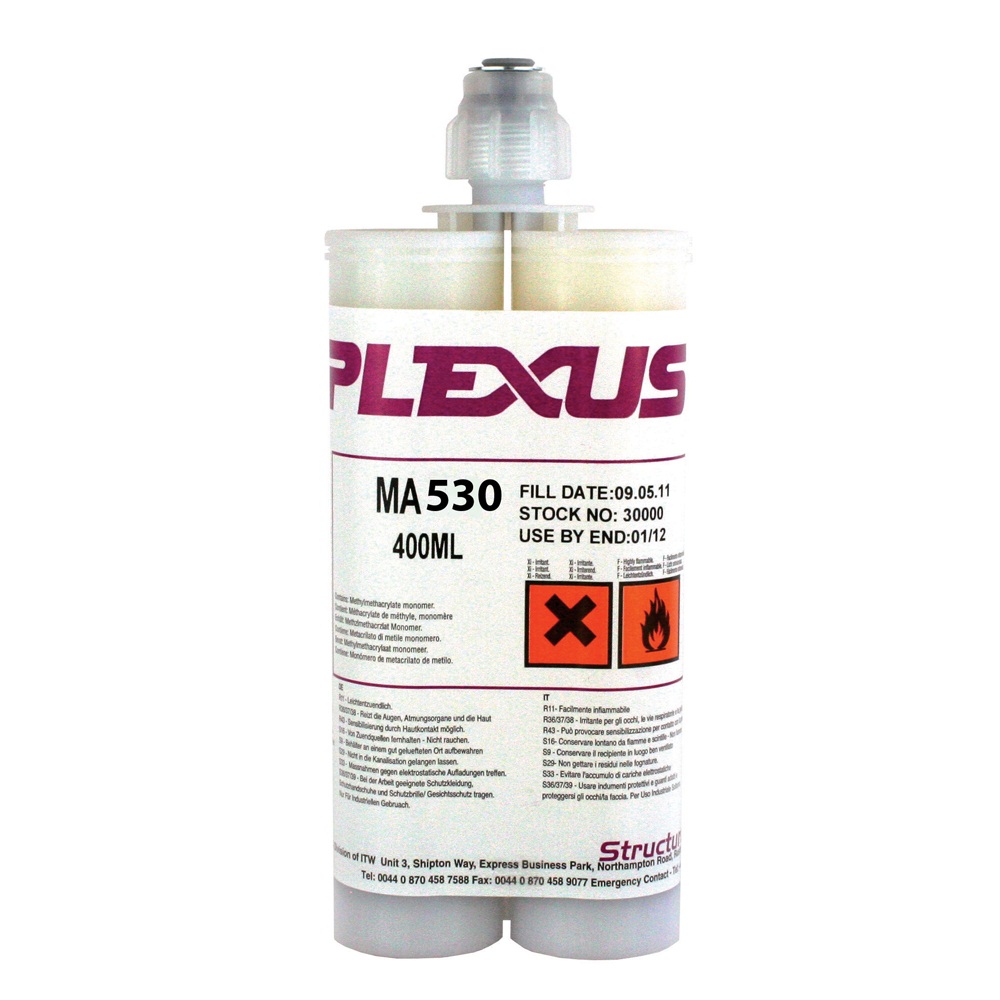
The Plexus MA530 gray 400ml cartridge is a two-part, 1:1 methacrylate (MMA) structural adhesive for bonding thermoplastic, metal, and composite assemblies. Boat builders use it on deck-to-hull joints, stringers, bulkheads, and liners. It is a moderate open time grade that dispenses as a non-sagging gel, so a fabricator can run a long bead, fill a wide gap, and still position large parts before it sets. The cartridge mixes through a static mixer as you dispense, with no hand mixing and no ratio guesswork, and one mixer ships with each cartridge. Made in the USA by ITW Performance Polymers. Also sold in white and in bulk.
Plexus MA530 Gray 400ml Key Product Details
| Property | Value |
|---|---|
| Package | 400ml twin cartridge, Part A and Part B |
| Mixed Color | Gray |
| ITW Stock Number | 53000 |
| Chemical Concepts SKU | PLX53000 |
| Included Mixer | MIXPAC MCQ 08-24T static mixer, one per cartridge |
| Chemistry | Two-part methacrylate (MMA) structural adhesive |
| Mix Ratio | 1:1 by volume, 1:1 by weight |
| Component Color | Part A white, Part B black |
| Consistency | Non-sagging gel (thixotropic) |
| Component Viscosity | Part A 130,000 to 180,000 cP. Part B 160,000 to 215,000 cP |
| Component Density | Part A 0.93 g/ml. Part B 0.95 g/ml |
| Working Time | 30 to 40 min at 75°F (23.9°C) |
| Time to 50 psi (0.3 MPa) | 75 to 85 min at 75°F (23.9°C) |
| Time to 500 psi (3.4 MPa) | 90 to 110 min at 75°F (23.9°C) |
| Time to 1,000 psi (6.9 MPa) | 150 to 160 min at 75°F (23.9°C) |
| Peak Exotherm (30 g mass) | About 200°F (93°C) at 60 to 80 min |
| Gap Tolerance | 0.03 to 0.70 in (0.75 to 18.0 mm) |
| Hardness | Shore D 70 |
| Tensile Strength (ISO 527) | 2,500 to 3,500 psi (17.2 to 24.1 MPa) |
| Tensile Modulus | 80 to 120 kpsi (551 to 827 MPa) |
| Elongation at Break | 90 to 160% |
| VOCs During Cure | Less than 0.5% |
| Recommended Application Temperature | 65°F to 85°F (18°C to 30°C) |
| Chemical Resistance | Excellent to hydrocarbons, acids and bases (pH 3 to 10), and salt solutions. Susceptible to strong polar solvents, strong acids, and bases. |
| Shelf Life | 6 months, stored continuously at 55°F to 77°F (13°C to 25°C) |
| Country of Manufacture | USA |
Cure Profile by Temperature
| Stage | 60°F (15.6°C) | 75°F (23.9°C) | 90°F (32.2°C) |
|---|---|---|---|
| Working time | 45 to 50 min | 30 to 40 min | 10 to 15 min |
| Time to 50 psi (0.3 MPa) | 100 to 105 min | 75 to 85 min | 36 to 38 min |
| Time to 500 psi (3.4 MPa) | 140 to 145 min | 90 to 110 min | 42 to 43 min |
| Time to 1,000 psi (6.9 MPa) | 160 to 170 min | 150 to 160 min | 44 min |
Lap Shear Strength by Substrate (ASTM D1002)
| Substrate | psi | MPa | Failure Mode |
|---|---|---|---|
| Aluminum | 2,087 | 14.4 | Cohesive |
| Stainless steel, cycled | 2,548 | 17.6 | Cohesive |
| Stainless steel, 500 hr salt fog | 1,778 | 12.3 | Cohesive |
| Stainless steel, 1,000 hr salt fog | 1,329 | 9.2 | Cohesive |
| Polyester | 1,079 | 7.4 | Fiber tear |
| Gel coat | 1,845 | 12.7 | Fiber tear |
| PVC | 1,237 | 8.5 | Substrate |
Fiber tear and substrate failure mean the plastic or laminate gave way before the bond did, so those numbers reflect the part, not the adhesive. The TDS notes Plexus PC120 Cleaner Conditioner alongside the metal results, so match your prep to how you test.
Performance in Production
- The 30 to 40 minute working time at 75°F gives an operator time to run long beads on a deck-to-hull seam, set stringers, and square large parts before the adhesive starts to set. ITW lists MA560-1 at 55 to 70 minutes and MA590 at 90 to 105 minutes when the seam needs more time than that.
- Plan clamp time on the 500 psi column, which is 90 to 110 minutes at 75°F. A 90°F shop cuts that to 42 to 43 minutes and the working time to 10 to 15, so open fewer beads at once in summer. A 60°F shop stretches clamp time to 140 to 145 minutes.
- MA530 dispenses as a non-sagging gel, so the bead holds its shape where you put it. Gap tolerance runs 0.03 to 0.70 in (0.75 to 18.0 mm). Apply enough adhesive to fill the joint completely when the parts are mated.
- The cured bond is tough, with Shore D 70 hardness and 90 to 160% elongation. The TDS cites fatigue endurance, impact resistance, and toughness, which suits joints that see flex, vibration, and impact.
- Peak exotherm reaches about 200°F (93°C) in a 30 g mass. A large mass mixed at once can trap air and release steam and volatiles. Dispense only what you can place within the working time, and keep the bond line within the 0.70 in gap limit.
- ITW says Plexus adhesives typically need little or no surface preparation. A dry rag or light solvent wipe may be enough on plastics, coated metals, and raw metal. Dust-free composites can be bonded as is, or lightly abraded to remove mold release. Oxidation, scale, and fluids on metal affect the bond, so test your own parts.
- One MCQ 08-24T static mixer ships with the cartridge. Expel one mixer length of adhesive to waste before bonding, and swap in a fresh mixer if the adhesive sets inside the old one.
- Hold material temperature steady through the year so beads dispense and cure the same way every shift. Apply between 65°F and 85°F. Store between 55°F and 77°F, since exposure above 80°F shortens shelf life and above 100°F degrades it quickly. Cool storage at 45°F to 65°F can extend it. Let cold cartridges come back to room temperature before dispensing.
Common Applications
- Deck-to-hull joints on composite boats
- Stringers and bulkheads in composite hulls
- Hull liners
- Composite-to-metal and composite-to-thermoplastic bonding, including FRP, gelcoat, and epoxy-based composites
- Medium-sized wind blade repairs
- Carbon fiber composite assemblies bonded in place of wet layup
- Thermoplastic assemblies in ABS and ABS blends, acrylic, PBT, polycarbonate, rigid PVC, and TPU
- Powder-coated and e-coated metal assemblies, and raw metal with PC120 Cleaner Conditioner
Available Sizes
| Package | Contents | ITW Stock # | Our SKU | Dispensing |
|---|---|---|---|---|
| 400ml Cartridge, Gray (this page) | Part A and Part B, twin cartridge | 53000 | PLX53000 | 400ml 1:1 manual or pneumatic gun, MCQ 08-24T static mixer included |
| 400ml Cartridge, White | Part A and Part B, twin cartridge | 53500 | PLX53500 | 400ml 1:1 manual or pneumatic gun, MCQ 08-24T static mixer included |
| 5 Gallon Pail | Part A adhesive | IT203 | PLX-IT203 | 1:1 meter-mix equipment |
| 5 Gallon Pail | Part B activator | IT205 | PLX-IT205 | 1:1 meter-mix equipment |
| 50 Gallon Drum | Part A adhesive | IT200 | PLX-IT200 | 1:1 meter-mix equipment |
| 50 Gallon Drum | Part B activator | IT206 | PLX-IT206 | 1:1 meter-mix equipment |
Bulk ships as two separate containers, and you need the Part A adhesive and the Part B activator to run the system.
Related Products
- Albion B26T400 manual applicator for 400ml 1:1 cartridges
- Sulzer MIXPAC DP2X-400 pneumatic gun for 400ml 1:1 cartridges in production
- MIXPAC MCQ 08-24T static mixer for replacement mixers
- Plexus PC120 Cleaner Conditioner for metal surfaces where your testing calls for it
- Plexus MA530 400ml White, the same adhesive in a white cartridge that mixes white
- Plexus MA310, the 1:1 grade with a shorter working time for smaller parts and quicker cycles
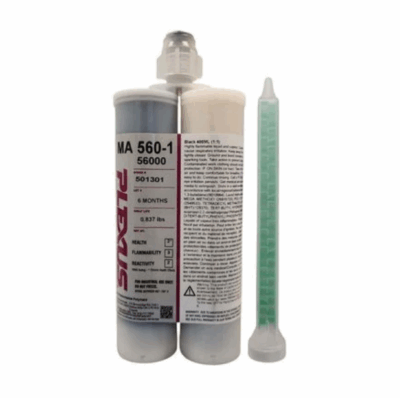
- Plexus MA560-1 and Plexus MA590, the 1:1 grades ITW lists with longer working times and wider gap fill
- The full Plexus adhesive line and our Plexus marine adhesives collection
How to Dispense and Bond Plexus MA530
MA530 is a two-part system that mixes as it dispenses. The steps below follow the ITW technical data sheet for cartridge use.
- Prep the surfaces. They should be free of grease, dirt, and other contaminants. On plastics, coated metals, and raw metal, a dry rag or light solvent wipe may be enough. Dust-free composites can be bonded as is or lightly abraded. Use Plexus PC120 Cleaner Conditioner on metal where your testing calls for it.
- Check the temperature. Apply between 65°F and 85°F.
- Load the cartridge into a 1:1 dispensing gun and remove the end caps.
- Attach the MIXPAC MCQ 08-24T static mixer and expel one mixer length of adhesive to waste.
- Apply enough adhesive to one substrate to fill the joint completely once the parts are mated.
- Mate the parts within the working time to get maximum bond strength.
- Fix the parts in position until the adhesive reaches handling strength. Use the cure profile table above to set clamp time for your shop temperature.
- Clean up before the adhesive cures. Common lab solvents, citrus terpene or NMP cleaners, degreasers, or soap and water work on wet material. Cured adhesive comes off by careful scraping followed by a cleaning wipe.
This process runs on thermoplastics, composites, coated metals, and raw metals.
Frequently Asked Questions
What is the Plexus MA530 gray 400ml cartridge used for?
The Plexus MA530 gray 400ml cartridge is used for structural bonding of thermoplastic, metal, and composite assemblies where the operator needs a moderate working time and a gap-filling gel. It is a methacrylate adhesive. Methacrylate, MMA, and structural acrylic adhesive all describe the same chemistry family. Boat builders use it on deck-to-hull joints, stringers, bulkheads, and liners, and it is also used on medium-sized wind blade repairs and carbon fiber composite assemblies.
What gun and mixer do I use for the 400ml MA530 cartridge?
A 400ml 1:1 cartridge runs in the Albion B26T400 manual applicator or the Sulzer MIXPAC DP2X-400 pneumatic gun, through a MIXPAC MCQ 08-24T static mixer. One mixer ships with each cartridge. Attach the mixer and expel one mixer length of adhesive to waste before you start bonding. Replacement mixers are here.
What is the working time and clamp time of Plexus MA530?
Working time is 30 to 40 minutes at 75°F, and the adhesive reaches 500 psi in 90 to 110 minutes. Use the 500 psi time to plan clamp time. At 90°F those drop to 10 to 15 minutes and 42 to 43 minutes. At 60°F they stretch to 45 to 50 minutes and 140 to 145 minutes.
What is the difference between Plexus MA530, MA560-1, and MA590?
The difference is open time and gap fill. All three are 1:1 Plexus methacrylates. ITW lists working time at 30 to 40 minutes for MA530, 55 to 70 minutes for MA560-1, and 90 to 105 minutes for MA590, with maximum gap fill of 0.70, 1.00, and 1.5 in. Pick MA530 for large structures that need a moderate open time, and call us if your seam or gap calls for one of the longer grades.
Does Plexus MA530 sag, and how big a gap can it fill?
No, it does not sag. MA530 dispenses as a non-sagging gel, so beads hold their shape. It fills gaps from 0.03 to 0.70 in (0.75 to 18.0 mm). Keep the bond line inside that limit, because a thicker mass builds more heat. For wider gaps, ask us about MA560-1 or MA590.
Does Plexus MA530 need a primer?
No primer is called out for plastics, coated metals, or composites. ITW says Plexus adhesives typically need little or no surface preparation, and a dry rag or light solvent wipe may be enough on plastics, coated metals, and raw metal. The TDS recommends Plexus PC120 Cleaner Conditioner on metal. Buyers often call PC120 a primer, but ITW describes it as a cleaner and conditioner. Test your own parts to confirm the prep.
What plastics, composites, and metals does Plexus MA530 bond?
ITW lists ABS and ABS blends, acrylics, PBT, polycarbonate, rigid PVC, and TPU on the plastics side. On the composites side it lists DCPD, FRP, gelcoat, phenolics, epoxy-based composites, and RIM. On metals it lists powder-coated and e-coated metals, plus aluminum, stainless steel, and raw steel with PC120. Polyethylene and polypropylene are not on the list. Call us before specifying MA530 on those or on any substrate not listed here.
Does Plexus MA530 come in white, what other sizes are there, and where is it made?
Yes. The white 400ml cartridge (stock 53500) mixes white, and this gray cartridge mixes gray. MA530 also comes in 5 gallon pails and 50 gallon drums for meter-mix equipment, shipped as a separate Part A adhesive and Part B activator, and you need both. Plexus MA530 sold in North America is made in the USA by ITW Performance Polymers.
Questions on fit for your bonding application? Call (800) 220-1966 or email [email protected].
Plexus is a registered trademark of Illinois Tool Works Inc.




Reviews
There are no reviews yet.