

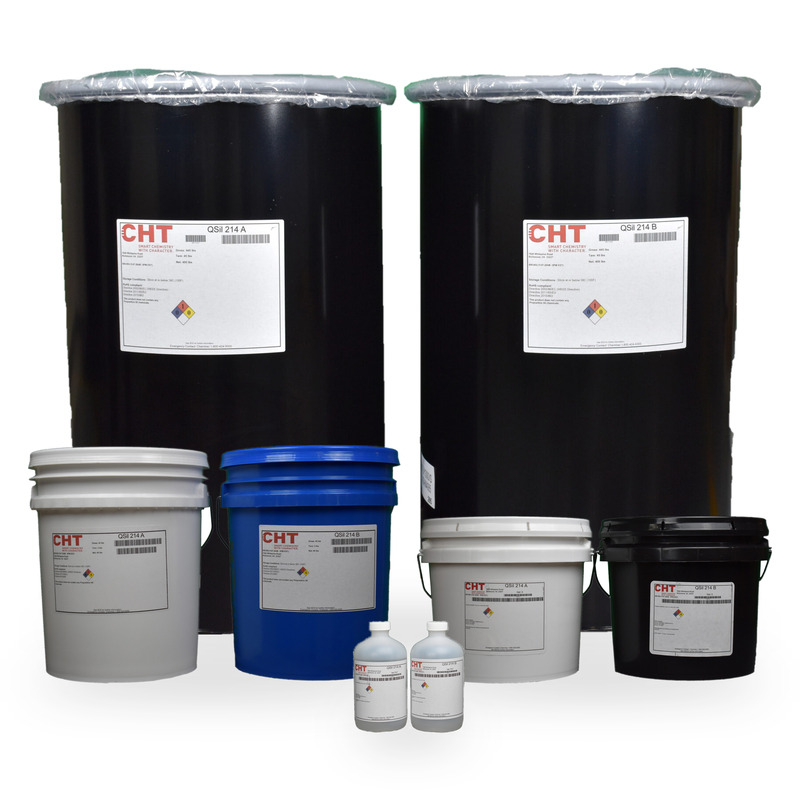


Description
QSil 214 clear potting silicone is a two-part, transparent and colorless addition cure silicone from CHT for potting electronics and optical assemblies. It flows around components and cures at room temperature or with heat, and CHT lists it among its optically clear silicone encapsulants. The cured silicone gives electrical insulation, shock resistance, and environmental protection, and CHT describes it as hydrolytically stable and reversion resistant. Made in the USA. Potting means filling an enclosure with liquid silicone that cures around the components, so the parts stay protected and, with a clear silicone, visible.
Key Product Details
| Property | Value |
|---|---|
| Chemistry | Two-part addition cure silicone elastomer, platinum catalyst in Part A |
| Mix Ratio | 1:1 by weight |
| Rheology | Liquid, Newtonian |
| Viscosity | Part A 6,000 cP, Part B 6,000 cP (Brookfield) |
| Specific Gravity | Part A 1.00, Part B 1.00 |
| Gel Time at 25 °C (77 °F) | 30 minutes |
| Cure Profile | 30 minutes at 150 °C (302 °F) |
| Cured Color | Transparent and colorless |
| Refractive Index | 1.4 |
| Hardness | 40 Shore A (ASTM D2240-95) |
| Tensile Strength | 600 psi (4.14 N/mm²), ISO 37 |
| Elongation at Break | 100% (ISO 37) |
| Linear Coefficient of Thermal Expansion | 308 ppm/°C |
| Thermal Conductivity | 0.18 W/m-K |
| Useful Temperature Range | -55 to 204 °C (-67 to 399 °F) |
| Dielectric Strength | 500 V/mil |
| UL File Number | QMFZ2.E205830 |
| Flame Rating | UL 94 HB |
| Shelf Life | 24 months |
| Maximum Storage Temperature | 38 °C (100 °F) |
| Country of Manufacture | USA |
Performance in Production
- Gel time is 30 minutes at 25 °C. CHT recommends mixing at 15 to 25 °C for adequate pot life, and chilling the components before mixing can extend pot life to several hours.
- Heat is an option. The listed cure profile is 30 minutes at 150 °C. CHT notes that the quantity of material, the size of the part, and how the heat is applied all change the time and temperature you need, so test in your own process.
- Use Part A and Part B from the same lot number. CHT says mixed lots may not reach the performance listed on the TDS.
- CHT recommends vacuum degassing at 30 to 50 mbar, applied intermittently over 5 to 10 minutes. A larger mixing vessel helps keep the material from overflowing during degassing.
- The cured silicone is transparent and colorless with a refractive index of 1.4, so potted components stay visible for inspection.
- CHT lists low linear shrinkage as a key feature. The cured material is a soft, flexible silicone at 40 Shore A with 100% elongation.
- Part A carries the platinum catalyst. In automatic dispensing, residual Part B in the equipment can cause curing, so purge with a hydrocarbon solvent or silicone fluid if in doubt.
- As an addition cure silicone, QSil 214 can be inhibited by contact with certain materials. Check the inhibition list below and keep mixing tools clean.
Common Applications
- Potting complex electronic parts where the silicone has to flow around components
- Optical assemblies that need a transparent, colorless fill
- Electrical insulation and shock protection for components
- LED lighting and display potting
- Sensors and circuit board encapsulation
- Environmental protection for electronics in harsh service conditions
Available Sizes
| Package | Contents | Mixed Total | SKU |
|---|---|---|---|
| 50 ml Cartridge | Pre-filled 1:1 dual cartridge | 50 ml (about 50 g) | QTM-QSIL214A/B-50MLC |
| 2 kg Kit (Pint Kit) | 1 kg Part A / 1 kg Part B | 2 kg (4.4 lb) | QTM-QSIL214A/B-2LBK |
| 3.6 kg Kit (Quart Kit) | 1.8 kg Part A / 1.8 kg Part B | 3.6 kg (7.9 lb) | QTM-QSIL214A/B-8LBK |
| 36 kg Kit (Pail Kit) | 18 kg Part A / 18 kg Part B | 36 kg (79 lb) | QTM-QSIL214A/B-80LBK |
| 360 kg Kit (Drum Kit) | 180 kg Part A / 180 kg Part B | 360 kg (794 lb) | QTM-QSIL214A/B-800LBK |
SKUs are unchanged from the earlier lb-labeled kits, so existing reorders use the same item numbers. For the 50 ml cartridge, call (800) 220-1966 for the matching dispensing gun and static mixer.
Related Products
- Clear Potting Silicones for Electronics: other CHT clear grades side by side
- CHT QSil Primer No. 3 Clear: silicone adhesion primer
- CHT QSil Primer No. 3UV: blue tint primer with a UV tracer for coverage checks
- All encapsulants and potting compounds
How Potting With QSil 214 Works
The steps below follow the CHT technical data sheet.
- Confirm Part A and Part B carry the same lot number.
- Stir Part A and Part B well so each is uniform.
- Weigh the two parts at 1:1 into a clean plastic or metal container about three times their combined volume, and mix until the blend is uniform. Mixing at 15 to 25 °C is recommended.
- Degas by intermittent vacuum at 30 to 50 mbar over 5 to 10 minutes. With a static mixing head, degas both components before processing.
- Pour or dispense into the assembly inside the 30 minute gel time at 25 °C.
- Let it cure at room temperature, or cure with heat, for example 30 minutes at 150 °C. Confirm time and temperature on a test part.
Cure inhibition. Keep vessels and spatulas clean and made of materials that do not interfere with the cure. CHT lists these as inhibitors of addition cure silicone: compounds of nitrogen, sulfur, phosphorus, and arsenic, organotin catalysts, PVC stabilizers, and epoxy resin catalysts. Even contact with materials that carry them can inhibit the cure, including molding clays, sulfur vulcanized rubbers, condensation-cure silicone rubbers, onion, and garlic.
Adhesion. CHT says to use a primer to obtain chemical adhesion, and to run preliminary tests when the substrate is unknown. The TDS does not name a primer, so call us before specifying one for your assembly.
Frequently Asked Questions
What is QSil 214 used for?
QSil 214 is used to pot and encapsulate electronic and optical assemblies that need a transparent, colorless silicone. Clear silicone potting compound, clear potting silicone, and silicone encapsulant all describe the same type of product, and CHT also lists QSil 214 as SilSo Pure 21214. It is a two-part, platinum cure addition system.
Is QSil 214 transparent?
Yes. QSil 214 cures transparent and colorless with a refractive index of 1.4, and CHT lists it among its optically clear silicone encapsulants. The TDS does not publish a light transmission figure.
What is the mix ratio for QSil 214?
The mix ratio is 1:1 by weight. Weigh Part A and Part B, use matching lot numbers, and mix until the blend is uniform.
How fast does QSil 214 cure?
Gel time is 30 minutes at 25 °C, and CHT lists a cure profile of 30 minutes at 150 °C. The TDS does not publish a room temperature full cure time, so confirm your schedule on a test part before production.
Does QSil 214 need a primer?
CHT says to use a primer to obtain chemical adhesion. The TDS does not name one, so call us at (800) 220-1966 for the right primer for your substrate. We carry CHT QSil Primer No. 3 Clear and Primer No. 3UV. Test on your actual parts before production.
What can inhibit the cure of QSil 214?
Compounds of nitrogen, sulfur, phosphorus, and arsenic can inhibit the cure, as can organotin catalysts, PVC stabilizers, and epoxy resin catalysts. Contact with molding clays, sulfur vulcanized rubbers, condensation-cure silicone rubbers, onion, or garlic can also do it. Use clean tools made of materials that do not interfere with the cure.
Is QSil 214 UL rated?
QSil 214 is covered under UL file number QMFZ2.E205830, and CHT’s potting guide lists it at UL 94 HB. The TDS gives the file number only, so check the UL file for the conditions behind the rating.
What sizes does QSil 214 come in?
QSil 214 comes in a 50 ml dual cartridge and four two-part kits: 2 kg, 3.6 kg, 36 kg, and 360 kg mixed total. CHT now supplies the kits in kilograms, so older purchase orders may show the earlier lb sizes.
Questions on fit for your potting or optical application? Call (800) 220-1966 or email [email protected].




Reviews
There are no reviews yet.