
High-Bond / Acrylic-Foam Tapes (VHB)
|
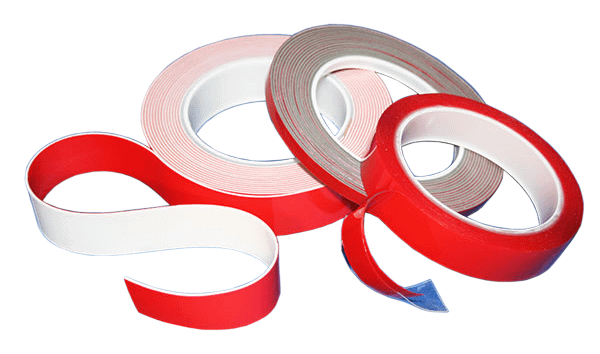
Structural Bonding Tape Double Sided Acrylic Foam TapeAcrylic foam tape is a structural fastener in tape form. The viscoelastic foam core spreads load across the entire joint instead of concentrating it at fastener points, which is what lets it replace rivets, screws, spot welds, and liquid adhesive. It bonds on contact with no cure time, no mixing, and no dispensing equipment, and it seals the joint at the same time it bonds it. Two lines stocked here. Chem-Set VST, our house label, in fifteen grades from 0.010 to 0.063 inch in clear, gray, white, and black. And tesa ACXplus where a spec calls for it. Everything sells by the single roll with no case minimum, and in-stock orders placed by 2pm Eastern ship the same day. |
 |
Start with what you’re bonding
|
Metals and rigid plastics Aluminum, stainless, galvanized steel, PVC, ABS, nylon, glass, ceramic. Bonds after an isopropanol wipe, no primer. VST6364, 6110, 6120, 6160 in gray or white. tesa 7063, 7065 in black. |
Glass and clear plastics Acrylic (PMMA) and polycarbonate where the bond line shows through the part. Clear on both faces, no read-through. VST3025, 3050, 6100, 6150. tesa 7054, 7055. |
Powder coat and hard plastics Powder coated surfaces, polypropylene, polyethylene, TPO, TPE. Standard grades need a primer here, these don’t. VST7816 to 7863 in black, gray, or white. |
Two things that change the answer. Applying below 65°F means standard acrylic adhesive is too firm to flow, so use the low temperature grades, VST8247 or VST8262, which bond from 32°F up. And thickness follows how rigid your parts are, not how strong you need the bond: rigid panel to rigid frame wants 0.045 to 0.047 inch, flexible or thin gauge parts work at 0.010 to 0.025 inch. Full selection detail and the 3M cross-reference table are in the VST selection guide.
Acrylic foam tape vs regular double sided foam tape
They look almost identical on a shelf and they are not the same product. This is the most common mix-up in the category and it’s usually the reason a bond fails.
A general purpose double sided foam tape uses a polyethylene or urethane foam carrier with adhesive coated on both sides, usually rubber based. The carrier is there to cushion and give the tape body. It’s built for light, often temporary holding: mounting a sign indoors, attaching a nameplate, holding a gasket in place. A few dollars a roll.
An acrylic foam tape is 100% acrylic all the way through. There’s no separate carrier, because the foam itself is the adhesive. That construction is what carries structural load, resists UV and solvents for years outdoors, and holds from -40°F to 212°F continuous. Twenty to seventy dollars a roll, and permanent.
If the joint carries weight, lives outdoors, or has to last, you want acrylic foam. If you’re holding something light indoors and might want it off later, a standard double sided foam tape is the right call at a fraction of the cost.
Tape, liquid adhesive, or mechanical fastener?
All three join parts. They fail differently and cost differently, so this decision usually comes before picking a product.
Acrylic foam tape wins on appearance, since nothing is visible and there’s no read-through on thin gauge metal. Speed, since it bonds on contact with no fixture time. Sealing, because the continuous bond line seals as it bonds and there’s no separate gasket. Dissimilar materials, because the foam absorbs the differential expansion that fatigues a rigid fastener. And galvanic isolation, since no dissimilar metal is in contact the way it is with a steel screw through aluminum.
A two part structural adhesive wins on gap filling, since tape will not flow to fill an uneven joint. Ultimate strength on a small footprint. Irregular geometry a flat tape can’t follow. Anywhere the parts don’t present two reasonably flat mating surfaces. See metal bonding adhesives or the 2K structural adhesive guide.
A mechanical fastener wins on immediate full strength, since tape reaches 100% at about 72 hours. Serviceability, because you can take it apart. Point loads. And any joint that has to be inspected or certified in a way an adhesive bond can’t be.
Where tape is the wrong answer: porous surfaces like wood, particleboard, or concrete unless sealed first. Very low surface energy materials such as silicone, PTFE, and EVA, which no acrylic foam tape holds reliably. Joints loaded in peel or cleavage rather than shear or tension. And anything applied below 32°F.
Chem-Set VST or tesa ACXplus?
Chem-Set VST is our house label and covers the widest range: fifteen grades from 0.010 to 0.063 inch in clear, gray, white, and black, with dedicated families for low surface energy substrates and for cold shop application. It’s the line we cross-reference to 3M VHB™ part numbers, it stocks deepest, and it’s the more economical of the two. Start here unless something points you elsewhere.
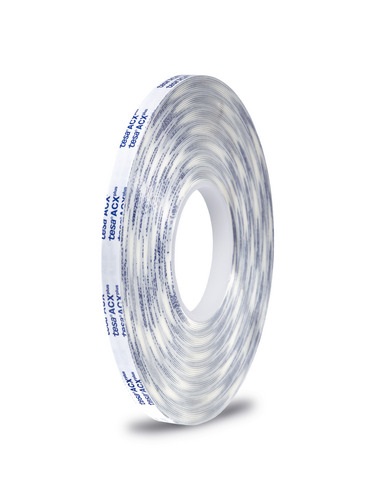
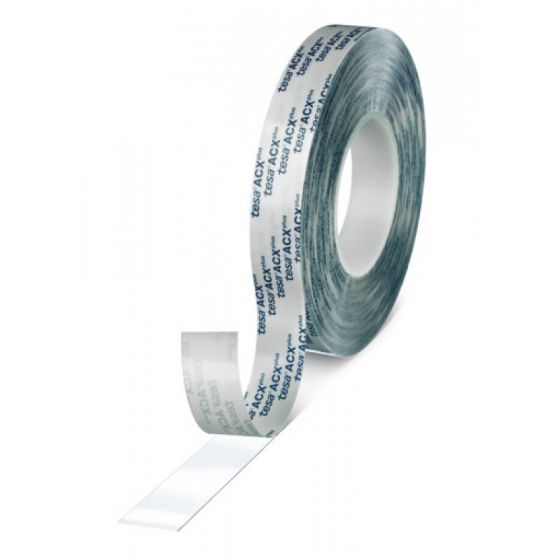
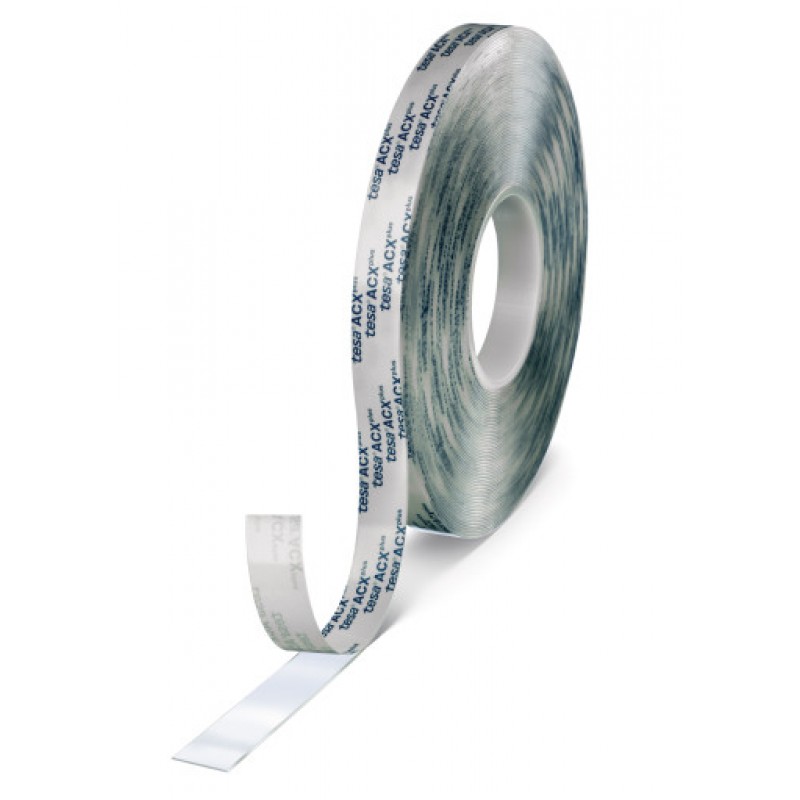
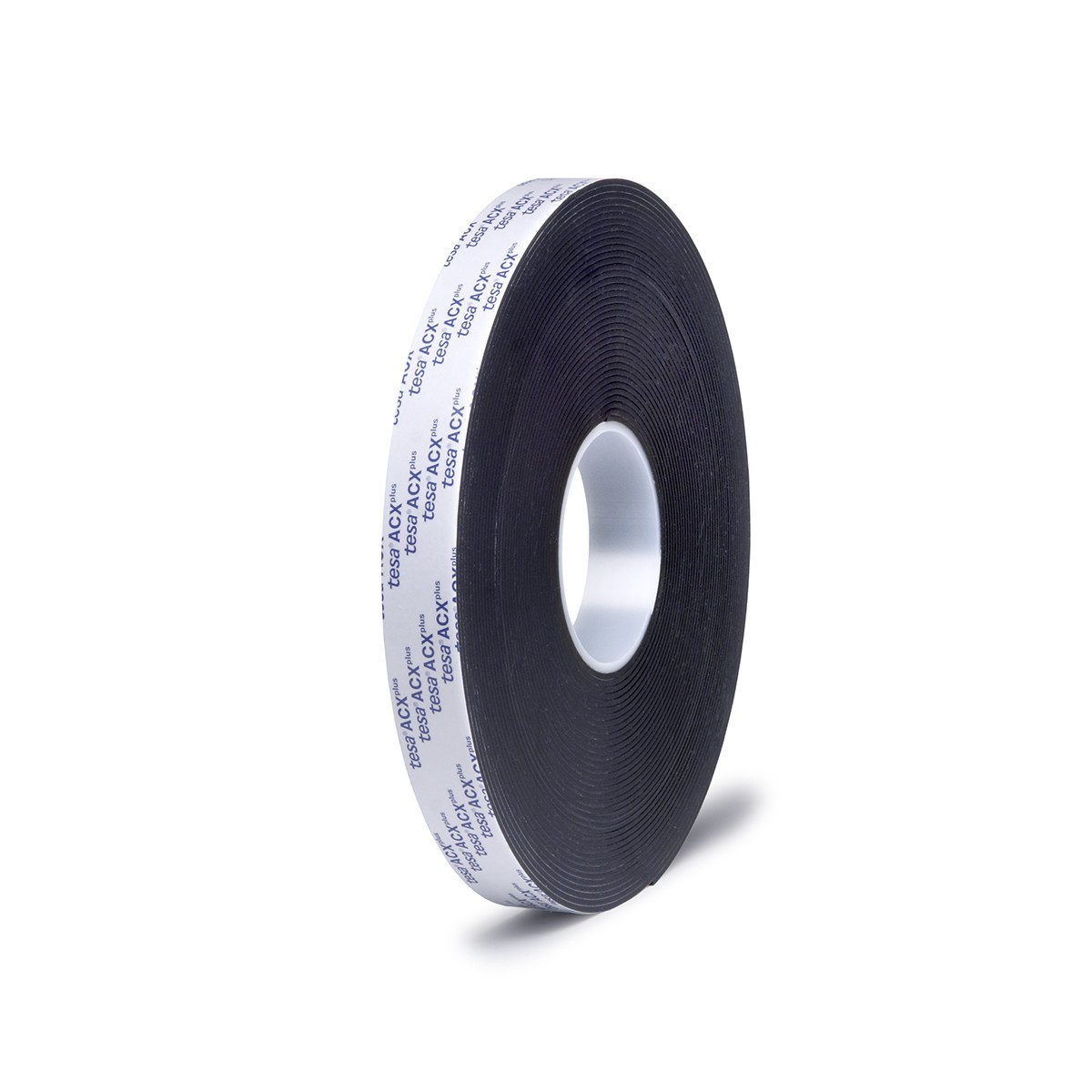
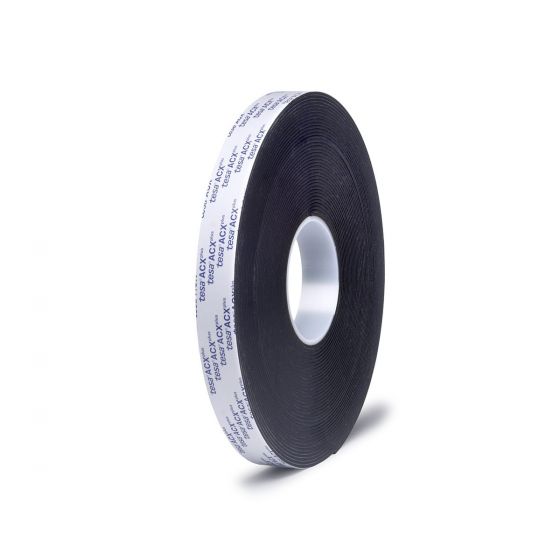
tesa ACXplus is German-made and comes in on specification-driven work, particularly signage and architectural jobs where tesa is named in the spec. We’re tesa’s signage distributor for the Northeast United States, so we can support that work directly. Stocked here in clear at 0.020 and 0.040 inch and black at 0.032 and 0.047 inch, including a tackified grade for tougher surfaces. See the ACXplus brochure and technical sheet.
If a customer or architect has specified a brand, use the specified brand. If nobody has, the decision comes down to range, availability, and price, and that usually points to VST. Call us either way and we’ll send a roll of each to test on your substrate.
If an acrylic foam tape is not the right family for the job, adhesive transfer tapes give a thinner unsupported bond line for nameplates and printed graphics, and rivet tape uses a high tack rubber adhesive to replace mechanical fasteners on panel assemblies.
|
Structural Bonding Tape Double Sided Acrylic Foam TapeAcrylic foam tape is a structural fastener in tape form. The viscoelastic foam core spreads load across the entire joint instead of concentrating it at fastener points, which is what lets it replace rivets, screws, spot welds, and liquid adhesive. It bonds on contact with no cure time, no mixing, and no dispensing equipment, and it seals the joint at the same time it bonds it. Two lines stocked here. Chem-Set VST, our house label, in fifteen grades from 0.010 to 0.063 inch in clear, gray, white, and black. And tesa ACXplus where a spec calls for it. Everything sells by the single roll with no case minimum, and in-stock orders placed by 2pm Eastern ship the same day. |
|
Start with what you’re bonding
|
Metals and rigid plastics Aluminum, stainless, galvanized steel, PVC, ABS, nylon, glass, ceramic. Bonds after an isopropanol wipe, no primer. VST6364, 6110, 6120, 6160 in gray or white. tesa 7063, 7065 in black. |
Glass and clear plastics Acrylic (PMMA) and polycarbonate where the bond line shows through the part. Clear on both faces, no read-through. VST3025, 3050, 6100, 6150. tesa 7054, 7055. |
Powder coat and hard plastics Powder coated surfaces, polypropylene, polyethylene, TPO, TPE. Standard grades need a primer here, these don’t. VST7816 to 7863 in black, gray, or white. |
Two things that change the answer. Applying below 65°F means standard acrylic adhesive is too firm to flow, so use the low temperature grades, VST8247 or VST8262, which bond from 32°F up. And thickness follows how rigid your parts are, not how strong you need the bond: rigid panel to rigid frame wants 0.045 to 0.047 inch, flexible or thin gauge parts work at 0.010 to 0.025 inch. Full selection detail and the 3M cross-reference table are in the VST selection guide.
Acrylic foam tape vs regular double sided foam tape
They look almost identical on a shelf and they are not the same product. This is the most common mix-up in the category and it’s usually the reason a bond fails.
A general purpose double sided foam tape uses a polyethylene or urethane foam carrier with adhesive coated on both sides, usually rubber based. The carrier is there to cushion and give the tape body. It’s built for light, often temporary holding: mounting a sign indoors, attaching a nameplate, holding a gasket in place. A few dollars a roll.
An acrylic foam tape is 100% acrylic all the way through. There’s no separate carrier, because the foam itself is the adhesive. That construction is what carries structural load, resists UV and solvents for years outdoors, and holds from -40°F to 212°F continuous. Twenty to seventy dollars a roll, and permanent.
If the joint carries weight, lives outdoors, or has to last, you want acrylic foam. If you’re holding something light indoors and might want it off later, a standard double sided foam tape is the right call at a fraction of the cost.
Tape, liquid adhesive, or mechanical fastener?
All three join parts. They fail differently and cost differently, so this decision usually comes before picking a product.
Acrylic foam tape wins on appearance, since nothing is visible and there’s no read-through on thin gauge metal. Speed, since it bonds on contact with no fixture time. Sealing, because the continuous bond line seals as it bonds and there’s no separate gasket. Dissimilar materials, because the foam absorbs the differential expansion that fatigues a rigid fastener. And galvanic isolation, since no dissimilar metal is in contact the way it is with a steel screw through aluminum.
A two part structural adhesive wins on gap filling, since tape will not flow to fill an uneven joint. Ultimate strength on a small footprint. Irregular geometry a flat tape can’t follow. Anywhere the parts don’t present two reasonably flat mating surfaces. See metal bonding adhesives or the 2K structural adhesive guide.
A mechanical fastener wins on immediate full strength, since tape reaches 100% at about 72 hours. Serviceability, because you can take it apart. Point loads. And any joint that has to be inspected or certified in a way an adhesive bond can’t be.
Where tape is the wrong answer: porous surfaces like wood, particleboard, or concrete unless sealed first. Very low surface energy materials such as silicone, PTFE, and EVA, which no acrylic foam tape holds reliably. Joints loaded in peel or cleavage rather than shear or tension. And anything applied below 32°F.
Chem-Set VST or tesa ACXplus?
Chem-Set VST is our house label and covers the widest range: fifteen grades from 0.010 to 0.063 inch in clear, gray, white, and black, with dedicated families for low surface energy substrates and for cold shop application. It’s the line we cross-reference to 3M VHB™ part numbers, it stocks deepest, and it’s the more economical of the two. Start here unless something points you elsewhere.
tesa ACXplus is German-made and comes in on specification-driven work, particularly signage and architectural jobs where tesa is named in the spec. We’re tesa’s signage distributor for the Northeast United States, so we can support that work directly. Stocked here in clear at 0.020 and 0.040 inch and black at 0.032 and 0.047 inch, including a tackified grade for tougher surfaces. See the ACXplus brochure and technical sheet.
If a customer or architect has specified a brand, use the specified brand. If nobody has, the decision comes down to range, availability, and price, and that usually points to VST. Call us either way and we’ll send a roll of each to test on your substrate.
If an acrylic foam tape is not the right family for the job, adhesive transfer tapes give a thinner unsupported bond line for nameplates and printed graphics, and rivet tape uses a high tack rubber adhesive to replace mechanical fasteners on panel assemblies.
Items 1–12 of 46
-
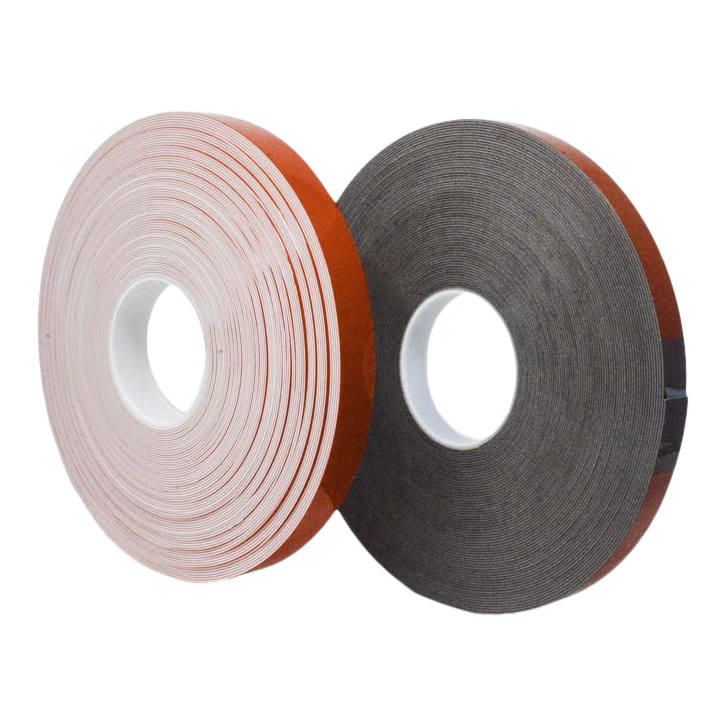
Chem-Set VST6120 High Bond Tape, 47 mil, Gray or White
SKU CCT-VST6120 Our Price Starting at $32.84 View ProductChem-Set VST6120 High Bond Tape, 47 mil, Gray or White
Gray or white 47 mil acrylic foam high bond tape in 36 yd rolls for PVC, ABS, metal, and glass. Cross-references to 3M VHB 4941. Sold by the roll.
Our Price Starting at $32.84 -
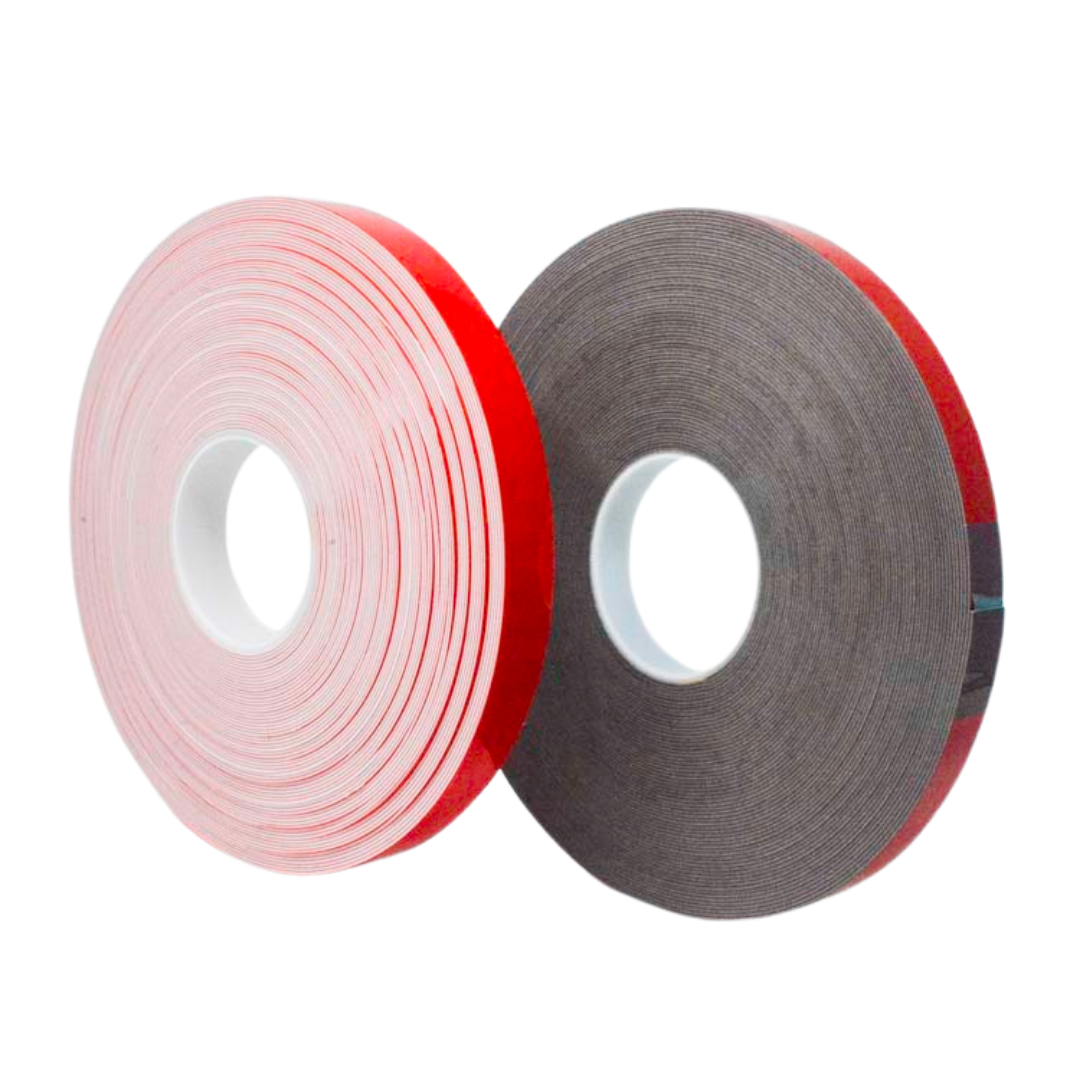
Chem-Set VST6364 General Purpose Acrylic Foam High Bond Tape, 25 mil, Gray or White
SKU CCT-VST6364W Our Price Starting at $34.59 View ProductChem-Set VST6364 General Purpose Acrylic Foam High Bond Tape, 25 mil, Gray or White
Gray or white 25 mil acrylic foam high bond tape in 36 yd rolls for PVC, ABS, metal, and glass. Cross-references to 3M VHB RP25. Sold by the roll.
Our Price Starting at $34.59 -
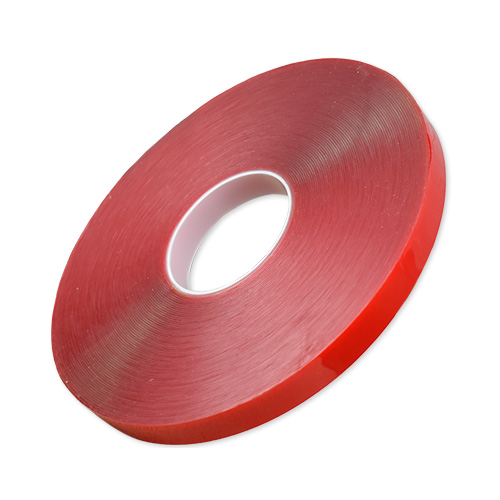
Chem-Set VST3025 Clear Ultra-Thin High Bond Tape, 10 mil
SKU CCT-VST3025C Our Price Starting at $66.73 View ProductChem-Set VST3025 Clear Ultra-Thin High Bond Tape, 10 mil
Clear 10 mil ultra-thin bonding tape in 60 yd rolls for die-cut parts, nameplates, and electronics. Cross-references to 3M 9473. Sold by the roll.
Our Price Starting at $66.73 -
Chem-Set VST6100C Clear Acrylic Foam High Bond Tape, 40 mil
SKU CCT-VST6100C Our Price Starting at $27.37 View ProductChem-Set VST6100C Clear Acrylic Foam High Bond Tape, 40 mil
Clear 40 mil acrylic foam high bond tape in 36 yd rolls for glass, acrylic, and polycarbonate. Cross-references to 3M VHB 4910. Sold by the roll.
Our Price Starting at $27.37 -
Chem-Set VST3050C Clear High Bond Tape (20 mil)
SKU CCT-VST3050C Our Price Starting at $17.30 View ProductChem-Set VST3050C Clear High Bond Tape (20 mil)
Clear 20 mil (0.020″) high bond tape in 108 ft (36 yd) rolls for glass and plastics. Strong, UV resistant, and ideal as a VHB 4905 alternative.
Our Price Starting at $17.30

Featured Products
-
UltraLok® 9102 A/B Panel Bonding Epoxy
Ultralok 9102 epoxy adhesive is engineered for strong, reliable honeycomb and composite panel bonding with fire safety and thermal resistance.
Our Price Starting at $90.16 -
CarbonBar Versatile Flat Stock
Cut and drill like wood. Support like steel. Replace heavy, expensive custom metal fabrication with aerospace-grade carbon fiber structural blanks.
- 4X stronger & 5X lighter than steel.
- Customize on-site with standard carbide tools.
- 100% weatherproof and corrosion-proof.
↑ Select your Bar Length and Profile above ↑
Our Price Starting at $25.00 -

Chem-Set VST M1V38 Male High Bond Tape Fastener – M1-V38-1/4-20×1″
SKU CCH-M1V38-1/4-20X1P Our Price Starting at $1.78
You save View ProductChem-Set VST M1V38 Male High Bond Tape Fastener – M1-V38-1/4-20×1″
Our Price Starting at $1.78
You save


-
 Expert Support.
 -
 Same-Day Shipping.
 -
 50+ Years of Service
Chemical-Concepts is a leading supplier of adhesives, chemicals and hardware for nearly every market in the industrial, government and defense sectors. Whatever your industry, we have all the hardware and adhesives you need to hold things together and keep things in place.