



Description
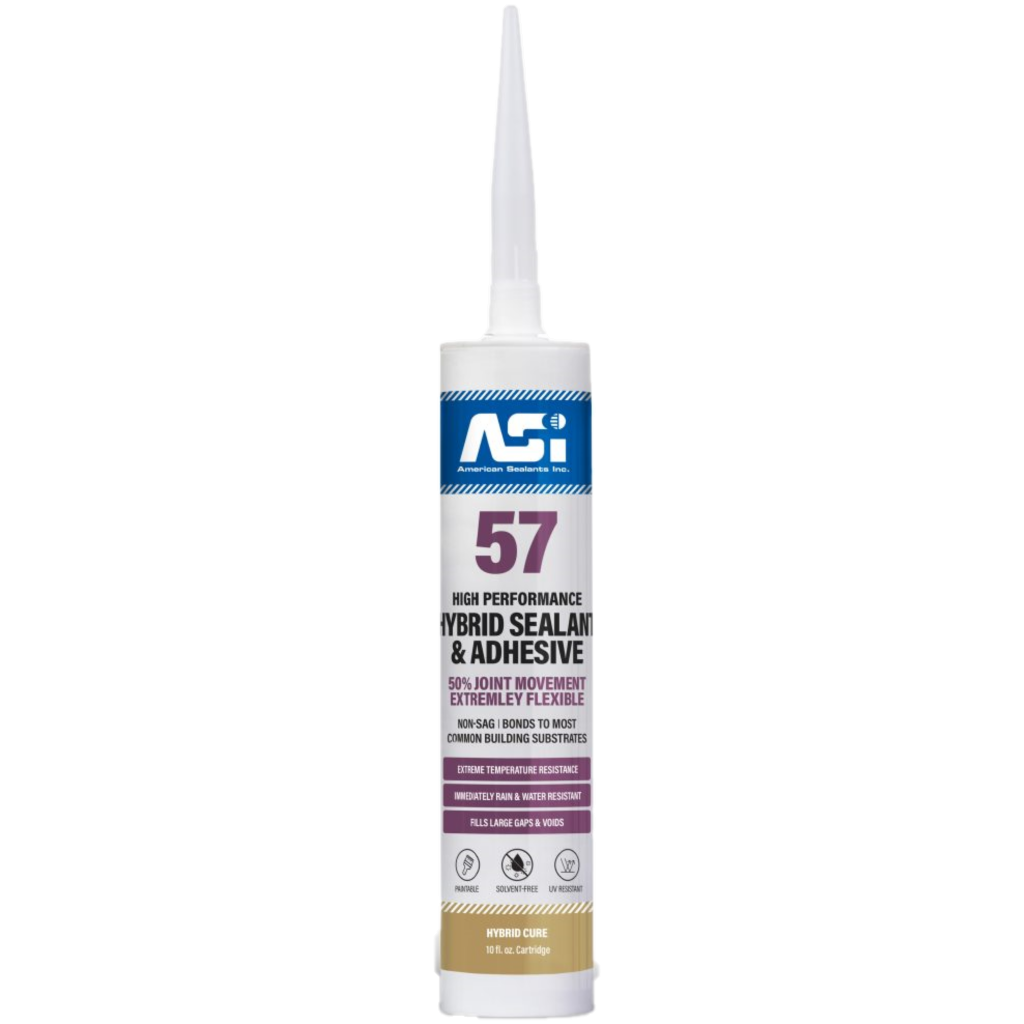
ASI 57 is a one-part, moisture-cure Class 50 hybrid sealant and adhesive based on silyl-terminated polyether technology. It is designed for industrial and construction applications where a higher degree of joint movement is required than standard Class 25 sealants can accommodate. ASI 57 reaches 50% joint moveability, twice the movement capability of ASI 55 and most standard construction sealants, making it the right choice for applications where substrates shift, settle, or expand and contract significantly over time.
Like ASI 55, it is 100% solids, contains no solvents or isocyanates, will not shrink, and can be applied to wet substrates. It cures even when moisture is present, will not wash off with rain after application, and is paintable within 24 hours. It carries ASTM C920 Class 50 certification and meets AAMA 714-19 requirements.
Key Product Details
| Property | Value |
|---|---|
| Chemistry | One-part silyl-terminated polyether (hybrid) |
| ASTM Classification | C920 Class 50 |
| Viscosity | 2,000,000 cps |
| Hardness | 27 Shore A |
| Tensile Strength | 145 PSI (ASTM D412) |
| Elongation at Break | 600% |
| Modulus 100% | 0.6 MPa |
| Lap Shear | 1.94 MPa |
| Skin Formation Time | 35 minutes at 70 degrees F, 50% RH |
| Cure In-Depth After 7 Days | 12mm at 70 degrees F, 50% RH |
| Application Temperature | 32 degrees F to 120 degrees F |
| Service Temperature | -75 degrees F to 220 degrees F (intermittent to 270 degrees F) |
| Joint Movement Capability | 50% |
| Density | 13.5 lbs/gal |
| VOC Content | 17 grams/liter (ASTM D2369) |
| Paintable | Within 24 hours of application |
| Package | 10.2 oz cartridge |
| Case Quantity | 24 per case |
| Shelf Life | 12 months from date of shipment in cartridges when stored at 70 degrees F, 50% RH; 6 months in pails and drums |
| Compliances | ASTM C920 Type S Grade NS Class 50 Uses NT, T, M, G, A and O; ASTM E84 Class A Flame Spread 0 Smoke Developed 0; AAMA 714-19; California Proposition 65; USDA Non-Food Contact; CARB and SCAQMD; VOC Compliant |
ASI 57 vs ASI 55: When to Choose Which
Both ASI 55 and ASI 57 are one-part hybrid sealants from the same product family. The key difference is joint movement capability. ASI 55 is Class 25, rated for 25% joint movement, which covers the majority of standard construction and industrial sealing applications. ASI 57 is Class 50, rated for 50% joint movement, which is the right choice when the joint is subject to greater thermal expansion and contraction, substrate settlement, or structural movement over time.
If the joint is in a high-movement application, such as expansion joints in larger structures, metal panel systems with wide thermal cycling, or any application where a Class 25 sealant has failed or cracked over time due to movement, ASI 57 is the correct product. ASI 57 also has a higher elongation at break of 600% compared to 300% for ASI 55, and a higher lap shear of 1.94 MPa compared to 0.90 MPa, which reflects its more aggressive adhesion profile.
For standard joint sealing where 25% movement is sufficient, ASI 55 covers the application at a lower price point. When movement requirements exceed that threshold, ASI 57 is the answer.
When Standard Silicone or Urethane Isn’t the Right Fit
The same limitations that make silicone and standard urethane sealants problematic in general construction work are compounded in high-movement applications. Standard silicone cannot be painted and has limited adhesive strength. One-part urethane sealants contain isocyanates, can bubble or outgas in the presence of moisture, and many shrink during cure because they are not 100% solids, which is a significant problem in a high-movement joint where dimensional stability matters.
ASI 57 addresses all of those issues in a single one-part product. It bonds and seals with higher elongation and lap shear than standard silicone, contains no isocyanates, cures in the presence of moisture without bubbling, does not shrink, and is paintable. For buyers asking whether there is a one-component high-movement sealant that performs better than silicone and avoids the shrinkage and isocyanate issues of construction urethanes, ASI 57 is a direct answer to that question.
Performance in Production
- 50% joint movement capability covers applications where standard Class 25 sealants are insufficient.
- 600% elongation at break supports bonding on substrates subject to significant flex, vibration, or movement.
- Non-slump consistency holds position on vertical and overhead surfaces without repositioning.
- Cures to wet substrates without bubbling or outgassing, and withstands immediate rain after application.
- 100% solids formulation does not shrink during cure.
- UV-resistant formulation does not yellow, chalk, or degrade with long-term outdoor exposure.
- Contains no solvents or isocyanates. Low odor supports use in occupied or enclosed spaces.
- Paintable within 24 hours using most consumer and industrial latex paints.
- MEKO-free. Compatible with electronics per manufacturer documentation.
- Allow 7 days for maximum strength before testing. Lower temperatures and humidity slow skin and cure times.
- Surfaces should be clean before application. IPA or acetone recommended for surface prep; do not use petroleum-based solvents. Priming is not normally required.
- Do not use on polyethylene, polypropylene, or TPO without prior testing.
Available Colors
ASI 57 is available in 4 colors: Clear, White, Black, and Grey. Select your color from the product options. Additional colors may be available through special order; contact [email protected] or call 800-220-1966.
Common Applications
- High-movement expansion joint sealing in commercial and industrial construction
- Window and door installation and manufacturing
- Trailer and RV manufacturing
- Walk-in freezer manufacturing and installation
- HVAC and appliance manufacturing
- Roofing and weather sealing
- Solar panel installation
- Pre-cast concrete and masonry applications
- Metal panel system sealing with wide thermal cycling
- General industrial manufacturing bonding and sealing
Common Substrates
Glass, ceramic, fiberglass, wood, EPDM, porcelain, PVC and other plastics, aluminum, galvanized metal, Kynar coated substrates, marble, granite, concrete, brick, and EPS or Styrofoam insulation.
Related Products


Reviews
There are no reviews yet.