


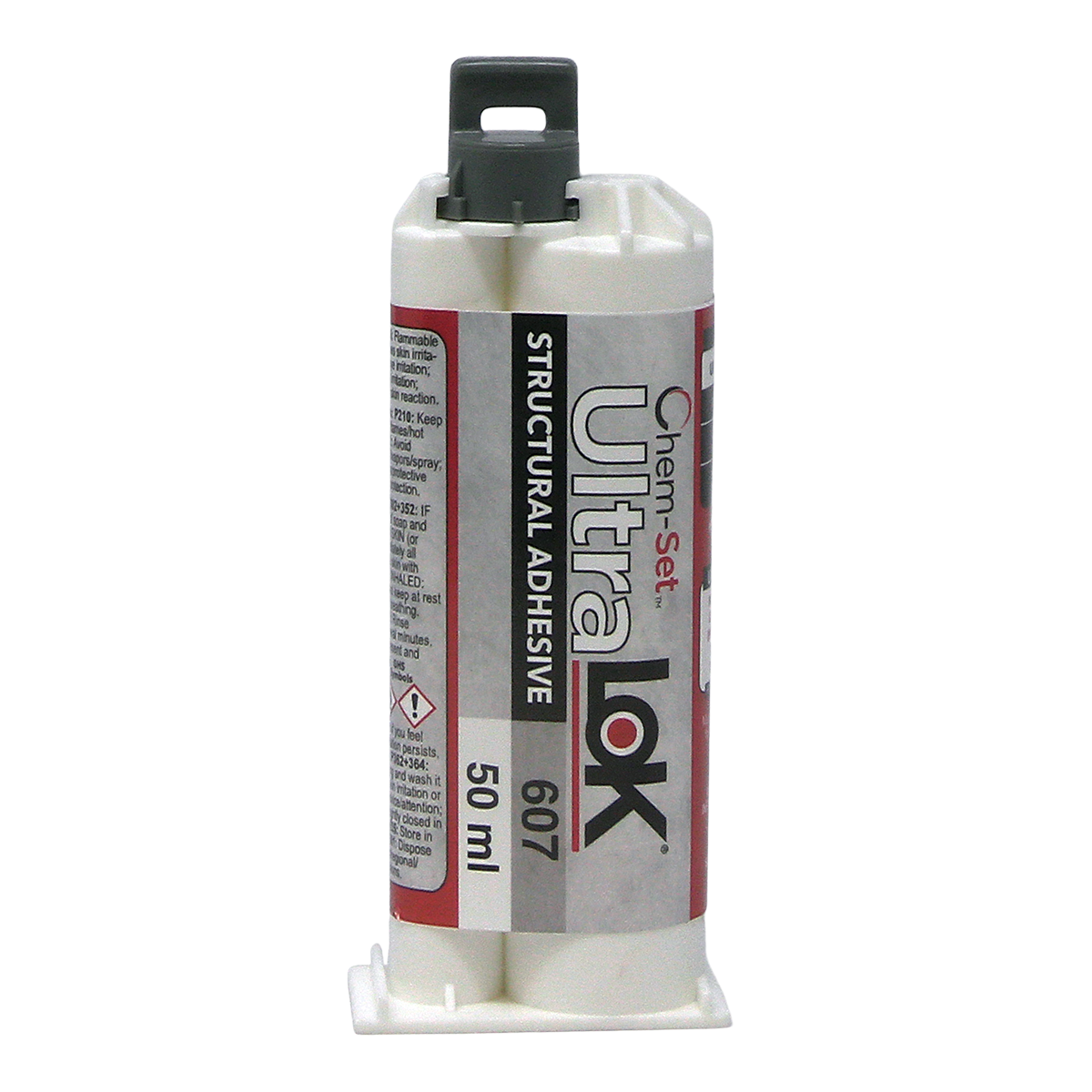
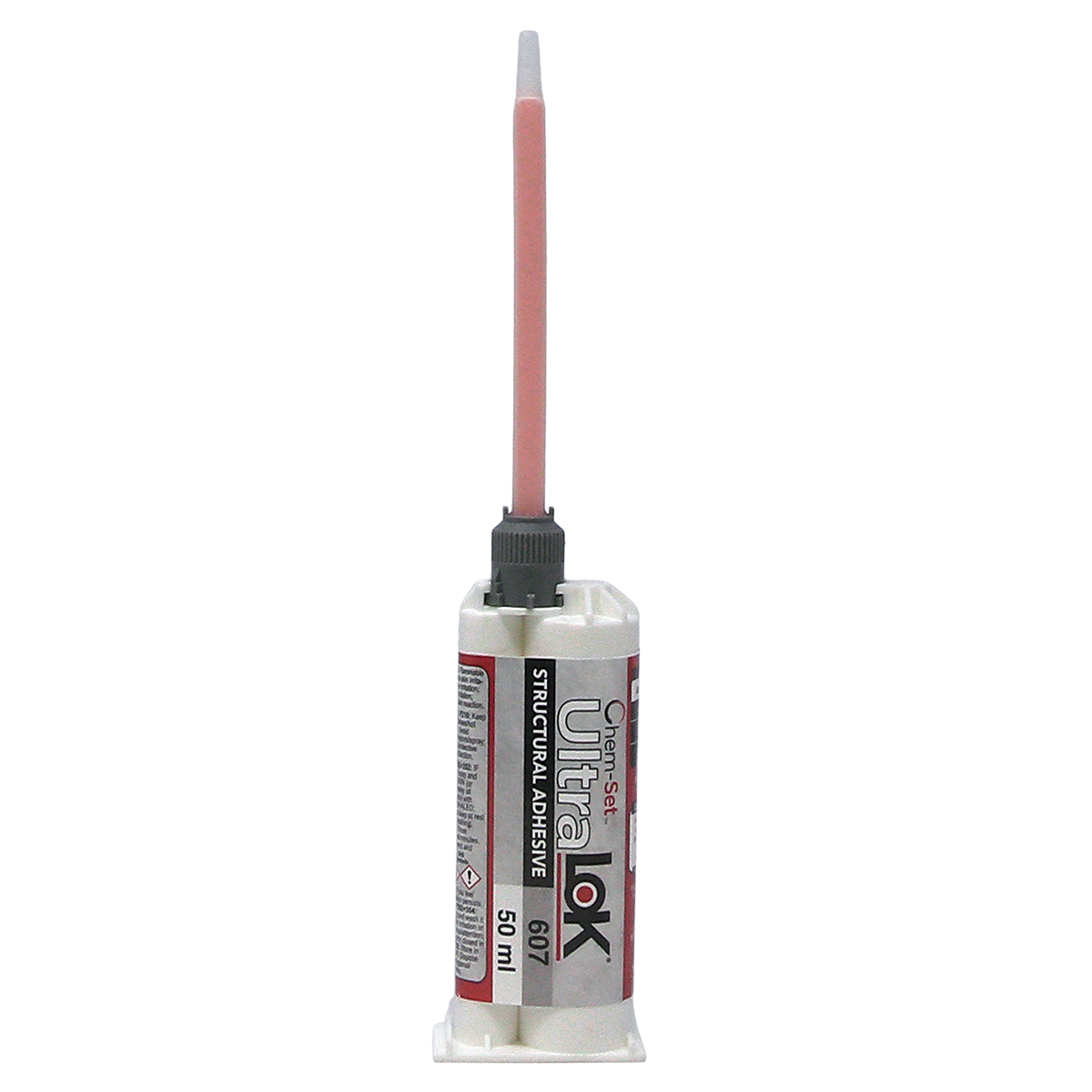


Description
UltraLok 607 clear structural adhesive is a 10:1 two-part methacrylate for bonding acrylic, polycarbonate, ABS, and aluminum in sign, display, and electronics work. It is used where the bond line shows and the joint still has to carry load. The process is mix-at-the-tip: clean the surfaces, run the cartridge through a static mixer, mate the parts inside the working time, and leave the joint alone until it can be handled.
Key Product Details
| Property | Value |
|---|---|
| Chemistry | Two-part methacrylate (MMA) |
| Mix Ratio (by volume) | 10:1 |
| Color | Clear (resin and activator) |
| Resin Viscosity | 75,000 to 100,000 cps |
| Activator Viscosity | 25,000 to 30,000 cps |
| Working Time | 6 to 9 minutes |
| Handling (Fixture) Time | 14 to 18 minutes |
| Set Time at 77°F (25°C) | 2 to 3 hours |
| Full Cure | 24 hours |
| Hardness | 50 to 60 Shore D |
| Modulus @ 1% Strain | 81,000 to 86,000 psi |
| Elongation | 5 to 10% |
| Service Temperature | -55°F to 250°F (-48°C to 121°C) |
| VOC (mixed) | Less than 50 g/L (per SDS) |
| Resin Flash Point | About 75°F (24°C), estimated (per SDS) |
| Country of Manufacture | USA |
| Available Sizes | 50ml cartridge, 500ml cartridge |
Overlap Shear Strength (ASTM D1002)
| Substrate Pair | Shear Strength (psi) | Failure Mode |
|---|---|---|
| Plexiglas to Plexiglas | 1,275 | Substrate failure |
| Polycarbonate to polycarbonate | 1,150 | Substrate failure |
| ABS to ABS | 1,375 | Substrate failure |
| ABS to aluminum | 1,450 | Substrate failure |
| Acrylic to aluminum | 1,050 | Substrate failure |
| Polycarbonate to aluminum | 1,150 | Substrate failure |
Performance in Production
- The 6 to 9 minute working time gives a tech room to run a bead around a face, mate it to the return, and square it up before the adhesive starts to set.
- Handling strength at 14 to 18 minutes lets letters and displays come off the bench and move to the next station without a long wait on fixtures.
- The TDS lists substrate failure on all six tested pairs, which means the plastic or the aluminum gave way before the adhesive bond did.
- Hardness of 50 to 60 Shore D with 5 to 10% elongation describes a firm, toughened bond line. On large parts that expand at very different rates, a higher elongation grade such as UltraLok 3121 may suit the joint better.
- The TDS calls for clean, dry surfaces free of contamination and only minimal surface preparation, so there is little work ahead of the bead.
- Cure speed follows shop temperature. The TDS says cure slows below 55°F and speeds up above 85°F, and heating the joint to 120 to 140°F (49 to 60°C) for 15 minutes accelerates it.
Common Applications
- Channel letter assembly
- Bonding acrylic and polycarbonate to aluminum in sign and display fabrication
- Plastic-to-plastic bonding of acrylic, polycarbonate, and ABS
- Display fabrication where the bond line is visible
- Plastic-to-metal bonding in electronics assemblies
- Seam sealing in trimless letter bonding with the TrimLok adhesive system
Available Sizes
- 50ml Cartridge, SKU CCA-UL607-50
- 500ml Cartridge, SKU CCA-UL607-500
Both cartridges are 10:1 and need a 10:1 gun sized to the cartridge plus a 10:1 static mixer. Here is what runs with each size.
- 50ml: DS51 10:1 50ml gun with the MBQX 05-24L static mixer
- 500ml: the MFHX 10-18T static mixer with the Albion B26T400X10 manual gun, the Mixpac DM2X 400 10:1 manual gun, or the Mixpac DP2X 400 10:1 pneumatic gun
Related Products
- Chem-Set TrimLok adhesive system for trimless letter and trim cap bonding
- UltraLok 3121 for large parts that need higher elongation
- UltraLok UL4005 for galvanized steel channel letter assembly
- Bonding clear acrylic and polycarbonate adhesive selection guide
- Sign and display adhesives and tapes
How Clear Structural Bonding Works on Sign and Display Assemblies
Clear structural bonding of acrylic, polycarbonate, ABS, and aluminum follows the same shop steps on a channel letter, a display, or an electronics enclosure.
- Clean the bonding surfaces. They need to be clean, dry, and free of contamination.
- Load the cartridge in a 10:1 gun and attach a static mixer. Dispense until the adhesive comes out of the mixer a uniform color.
- Dispense enough adhesive to completely fill the joint when the parts are clamped.
- Mate the parts inside the working time. Surfaces mated after the working time will not reach the highest bond strength.
- Hold the parts undisturbed between the working time and the fixture time. Heat building up during and after mixing is normal.
- Handle the parts once the fixture time has passed. Full cure takes 24 hours at room temperature.
- Clean up excess adhesive, the work area, and the equipment before the adhesive cures. Remove the static mixer after use and cap the cartridge.
The substrates in the TDS shear data are Plexiglas (acrylic), polycarbonate, ABS, and aluminum. If the bond line will be visible, make a test joint on your own parts before you run production.
Frequently Asked Questions
What is UltraLok 607 used for?
UltraLok 607 is used to bond acrylic, polycarbonate, ABS, and other plastics to themselves and to metals, and the TDS lists channel letter assembly as a primary use. Sign and display shops choose it where the bond line shows. It also goes into electronics assemblies that join plastic to metal.
What clear adhesive bonds acrylic and polycarbonate to aluminum?
UltraLok 607 is a clear two-part methacrylate made for that joint. The TDS lists 1,050 psi overlap shear on acrylic to aluminum and 1,150 psi on polycarbonate to aluminum, and both ended in substrate failure. The TDS also lists excellent UV resistance and excellent humidity and water resistance. Make a test joint on your own parts if the bond line will be visible.
Is UL607 the same as UltraLok 607 and Chem-Set 607?
Yes. UL607, UltraLok 607, UltraLok UL607, and Chem-Set 607 all describe the same clear two-part structural adhesive. Our product name says acrylic and the chemistry is methacrylate (MMA), and shops use both words for the same adhesive. It mixes 10:1 by volume.
What sizes does UltraLok 607 come in, and what gun does it need?
UltraLok 607 comes in a 50ml cartridge (SKU CCA-UL607-50) and a 500ml cartridge (SKU CCA-UL607-500). Both are 10:1. The 50ml cartridge runs in the DS51 10:1 50ml gun with the MBQX 05-24L mixer. The 500ml cartridge uses the MFHX 10-18T mixer with the Albion B26T400X10 or DM2X 400 manual gun, or the DP2X 400 pneumatic gun. Call (800) 220-1966 and we will match the gun and tip to your setup.
How fast does UL607 cure, and does shop temperature matter?
UL607 reaches handling strength in 14 to 18 minutes at room temperature and fully cures in 24 hours. Shop temperature does matter. The TDS says cure slows below 55°F and speeds up above 85°F, and heating the joint to 120 to 140°F (49 to 60°C) for 15 minutes accelerates it. Keep the parts undisturbed between the working time and the fixture time.
Does UL607 bond PETG, PVC, FRP, or stainless steel?
Call us before you commit. The TDS shear data covers Plexiglas, polycarbonate, ABS, and aluminum, so we confirm other materials with you before we recommend UL607. Call (800) 220-1966 and tell us what you are bonding. For galvanized steel, look at UltraLok UL4005.
Is UltraLok 607 made in the USA?
Yes. The country of manufacture for UltraLok 607 is the USA.
How should I handle and store UL607?
Wear nitrile gloves and eye protection, work with ventilation, and keep the resin away from heat, sparks, and open flame. The SDS classifies the resin as a flammable liquid with an estimated flash point near 75°F, and it lists both the resin and the activator as able to cause an allergic skin reaction. Store cartridges in a cool, dry place out of direct sunlight, and read the SDS before use.
Questions on fit for your sign or display application? Call (800) 220-1966 or email [email protected].


Reviews
There are no reviews yet.