


Description
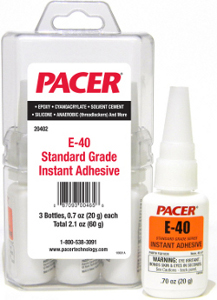
This 1 lb (453 g) bottle of Pacer E-40 is the production volume size of Pacer’s low viscosity ethyl cyanoacrylate, 30 to 70 cP with .004 in gap capability. At 453 g it holds about 23 times what the 20 gram bottle does, which makes it the size for a line that bonds every day, a cell feeding automatic dispensing equipment, or a shop filling its own applicator bottles off a bulk container. E-40 carries the highest tensile and impact figures in the E Series, 4700 psi on steel and 7 to 10 ft-lbs, so it’s the grade to standardize on when finished assemblies get handled or shipped.
Package Details
| Property | Value |
|---|---|
| Product | Pacer E-40 Low Viscosity Cyanoacrylate Adhesive |
| Package | 1 lb (453 g) Bottle |
| Net Weight | 1 lb (453 g) |
| Chemical Concepts SKU | PAC-FG01023 |
| Pacer Part No. | FG01023 |
| UPC | 0 87093 00206 7 |
| Chemistry | Single component ethyl cyanoacrylate |
| Viscosity | 30 to 70 cP |
| Typical Gap | .004 in |
| Fixture Time | 1 to 5 minutes |
| Tensile, Steel | 4700 psi (+/- 10%), ASTM D2095 |
| Impact | 7 to 10 ft-lbs, ASTM 950 |
| Specification Compliance | MIL-A-46050C Type II, Class 1; A-A-3097 Type II, Class 1 |
| Related Composite Product | Pacer E-40 Low Viscosity Cyanoacrylate Adhesive (30-70 cP) |
Full physical properties, cured state data, tensile shear numbers by substrate, and the viscosity selector for the whole series are on the main Pacer E-40 product page, or in the Pacer E Series technical data sheet (PDF).
Choosing the 1 lb Over the 20 Gram
Same adhesive in both sizes, so the decision comes down to how fast the bottle empties.
- 453 g against 20 g, or 16 oz against 0.70 oz, about 23 times the material. If a small bottle lasts your shop a week or less, this is the size and the reorder cycle alone justifies it.
- This is a bulk container, not a bench bottle. Most shops draw from it to fill smaller applicator bottles or to charge a dispensing system, rather than handing the 1 lb to an operator.
- Refrigeration matters more at this size. A cold 1 lb bottle takes real time to reach room temperature, and opening it before it does pulls condensation into a lot of material at once. Plan the warm-up.
- Pacer’s one year shelf life is stated for unopened material stored per the data sheet. Buying more than a year of consumption does not save money.
- If you’re still qualifying E-40 on your substrates, start with the 20 gram and step up once the joint design is settled.
- Worth knowing if you’re standardizing across viscosities: E-5, E-40, and E-100 all come in a 1 lb. E-1500, the thick grade, is 20 gram only.
Performance in Production
- Enough volume to feed a daily bonding operation without a purchase order every other week, which is usually where the real cost of the small size shows up.
- 4700 psi tensile on steel and 7 to 10 ft-lbs impact, both the highest in the E Series. If assemblies get packed, shipped, and handled, that impact figure is what keeps them together.
- One free-falling drop covers about one square inch of bond area, so 453 g carries a substantial part count on small joints.
- Pacer states E Series cyanoacrylates are suitable for dispensing from the bottle or through automatic equipment, so bulk material fits both a manual line and an automated cell.
- .004 in gap capability covers ordinary machined and molded fit-up. Design the bond line as thin as the parts allow, since tensile shear drops as the bond line thickens.
- Fixture in 1 to 5 minutes and 80% of strength in 15 to 30 minutes keeps a bonding station moving inside one takt without a fixture bank.
- At 30 to 70 cP this is still a flowing liquid. Build the station around a horizontal or fixtured joint, because it will run on a vertical face before it cures.
- Decant only what gets used in a shift and keep transfer containers dry and capped. Cure rate tracks relative humidity, so open material in a humid shop behaves differently than the data sheet suggests.
Common Applications
- Daily production bonding where joints are loaded in tension
- Assemblies that see handling, packing, and shipping loads
- Feeding automatic dispensing equipment on a bonding cell
- Filling shop applicator bottles from bulk
- Rubber to metal and rubber to plastic bonding at volume
- Small metal and ceramic part bonding on steel and aluminum
- Contract manufacturing calling out MIL-A-46050C Type II, Class 1 or A-A-3097 Type II, Class 1
Related Products
- Pacer E-40 Low Viscosity Cyanoacrylate Adhesive (30-70 cP), full specs and both sizes
- Pacer E-5 Instant Adhesive (2-10 cP), water-thin wicking grade, also available in 1 lb
- Pacer E-100 Instant Adhesive (80-120 cP), general purpose middle grade, also available in 1 lb
- Pacer E-1500 Instant Adhesive (1300-1700 cP), thickest grade in the E Series, 20 gram bottle only
- Pacer Premium Acetone Accelerator, speeds full cure through larger gaps
- All cyanoacrylate instant adhesives
Frequently Asked Questions
How much adhesive is in a 1 lb bottle of Pacer E-40?
Net weight is 1 lb (453 g), about 23 times the 20 gram (0.70 oz) bottle. Pacer’s guidance is one free-falling drop per square inch of bond area, but Pacer does not publish a coverage figure per gram or a drop count. If you need to budget material against a part count, send us the part and we’ll help you work it out from a sample.
Is the 1 lb Pacer E-40 the same adhesive as the 20 gram?
Yes, identical. Same ethyl cyanoacrylate, same 30 to 70 cP viscosity, same .004 in gap capability, same MIL-A-46050C Type II, Class 1 and A-A-3097 Type II, Class 1 compliance. Only the container changes. Nothing needs requalifying when you step up from the small bottle.
Which Pacer E Series grades come in a 1 lb bottle?
E-5, E-40, and E-100 are all available in a 1 lb bottle. E-1500, the thick 1300 to 1700 cP grade, is currently 20 gram only. If you’re standardizing a process on the thick grade and need bulk quantity, call us first.
Why is E-40 the strongest grade in the E Series?
Pacer publishes 4700 psi tensile on steel for E-40 against 4000 for every other grade in the family, and 7 to 10 ft-lbs impact against 3 to 5 for E-5 and E-100. Part of the picture is bond line thickness: thinner grades produce thinner bond lines, and cured cyanoacrylate carries load better in a thin film than a thick one. E-40 sits at the point where the adhesive is thin enough to give a strong bond line but not so thin that it needs the near-perfect fit-up a wicking grade demands.
Can I decant Pacer E-40 into smaller applicator bottles?
Pacer’s data sheet does not cover decanting, so treat this as shop practice rather than a manufacturer instruction. Shops do it routinely with bulk CA. The practical cautions are to keep transfer containers clean and dry, cap them between uses, and move only what gets consumed in a shift, since cure rate depends on relative humidity. If you need Pacer’s formal position on repackaging for a quality system, we’ll ask them.
Should a 1 lb bottle of Pacer E-40 be refrigerated?
Pacer recommends refrigerating unopened cyanoacrylate at 40F (4C) for optimum results, then bringing it to room temperature before opening. This matters more on a 1 lb than on a small bottle, because the larger mass takes longer to warm and opening it cold pulls condensation into a lot of material at once. Once opened, store in a cool, dry location. Stored per the data sheet, expect a one year shelf life.
What is the part number for the 1 lb Pacer E-40?
Our SKU is PAC-FG01023. The Pacer part number is FG01023 and the UPC is 0 87093 00206 7. On older Pacer paperwork the same item shows as Pacer item number 11740013.
Questions on Fit
Questions on fit for your bonding process, or on volume for a production line? Call (800) 220-1966 or email [email protected].



Reviews
There are no reviews yet.