

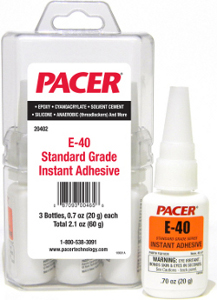


Description
Pacer E-40 cyanoacrylate adhesive is a low viscosity single component ethyl cyanoacrylate that runs 30 to 70 cP and fills to .004 in. It is the strongest grade in Pacer’s General Purpose E Series on paper: 4700 psi tensile on steel against 4000 for every other grade in the family, and 7 to 10 ft-lbs impact strength against 3 to 5 for the thin and medium grades. That combination makes E-40 the grade to reach for when the joint has to take a hit, not just hold still. It bonds plastics, rubber, metal, and ceramic, fixtures in 1 to 5 minutes, and dispenses from the bottle or through automatic equipment. E-40 meets MIL-A-46050C Type II, Class 1 and A-A-3097 Type II, Class 1.
Key Product Details
| Property | Value |
|---|---|
| Chemistry | Single component ethyl cyanoacrylate |
| Grade | General Purpose, E Series |
| Color | Clear transparent liquid |
| Viscosity | 30 to 70 cP |
| Typical Gap | .004 in |
| Fixture Time | 1 to 5 minutes |
| Strength Development | 80% of full strength in 15 to 30 minutes |
| Cured Temperature Range | -65F to +180F (-54C to +82C) |
| Heat Distortion | 250F / 121C |
| Softening Point | 306F / 153C |
| Glass Transition | 342F / 172C |
| Boiling Point | 365F / 185C |
| Flashpoint | 185F / 85C |
| Specific Gravity | 1.06 |
| Refractive Index | 1.45 (n20C/D, +/- .03) |
| Solubility Parameter | 10.7 |
| Vapor Pressure | 10 mm Hg at 70C |
| Volume Shrinkage | 13% |
| Rockwell Hardness | M 74 |
| Elongation | Less than 2% |
| Outgassing | 0 (at 10^-6 mmHg, 72F) |
| Dielectric Constant | 3.90 at 1 MHz |
| Volume Resistivity | 8.5 x 10^12 ohm-cm |
| Tensile, Steel | 4700 psi (+/- 10%), ASTM D2095 |
| Impact | 7 to 10 ft-lbs, ASTM 950 |
| Soluble In, Liquid State | Pacer X-9 Debonder, acetone, MEK, nitromethane |
| Soluble In, Cured State | Pacer X-9 Debonder, acetone, nitromethane |
| Specification Compliance | MIL-A-46050C Type II, Class 1; A-A-3097 Type II, Class 1 |
| Shelf Life | One year unopened, stored per the TDS |
| Country of Manufacture | USA |
| Available Sizes | 20 Gram (0.70 oz) Bottle, 1 lb (453 g) Bottle |
Full property data for every grade in the series is in the Pacer E Series technical data sheet (PDF). The data sheet covers grades and package sizes beyond what we currently stock. Of the E Series, Chemical Concepts carries E-5, E-40, E-100, and E-1500.
Tensile Shear Strength by Substrate
Tested per ASTM D1002. Where the table reads substrate failure, the part broke before the bond did.
| Substrate | Tensile Shear, psi (+/- 10%) |
|---|---|
| Steel | 2700 |
| Aluminum | 1600 |
| ABS | Substrate failure |
| Nylon | Substrate failure |
| Rigid PVC | Substrate failure |
| SBR | Substrate failure |
| EPDM | 100 |
How Bond Line Thickness Affects Cyanoacrylate Strength
The single most common reason a cyanoacrylate joint comes apart is too much adhesive, not too little. Look at Pacer’s own numbers across the E Series and the pattern is clear: tensile shear on steel runs 2700 psi for E-5 and E-40, 2400 for E-100, 2200 for E-1500. The thinner the grade, the thinner the bond line it produces, and the stronger the joint.
- Cured cyanoacrylate is rigid and brittle, with elongation under 2%. A thick bond line has more material to crack and it carries load worse than a thin one.
- Pick the thinnest grade your fit-up allows. E-40 fills to .004 in, which covers ordinary machined and molded tolerances without needing the near-perfect fit E-5 demands at .002 in.
- Use one free-falling drop per square inch of bond area. Over-application does not add strength, it subtracts it, and then it squeezes out where you have to clean it off.
- Apply to one surface only. Coating both faces doubles the bond line thickness and slows cure at the same time.
- Close the joint promptly and hold it. Pressure during fixture pushes the bond line down to where the published numbers were measured.
- If a gap is genuinely too wide for the grade, step up a viscosity rather than laying on more adhesive. A properly filled .010 in gap in E-1500 beats a starved .010 in gap in E-40.
- Clean both faces first. Oil, grease, mold release, and cutting fluid all keep the bond from developing regardless of how well you control thickness.
Fixture and full cure both move with temperature, relative humidity, bondline thickness, and the substrate pair. Test on actual parts before you lock in a production process.
Choosing a Viscosity in the E Series
All four grades are the same ethyl cyanoacrylate chemistry. Viscosity is what changes, and it drives how much gap you can bridge, whether the adhesive stays put, and how strong the finished joint is.
| Grade | Viscosity | Typical Gap | Impact | Best For |
|---|---|---|---|---|
| E-5 | 2 to 10 cP | .002 in | 3 to 5 ft-lbs | Wicking into already-assembled joints |
| E-40 | 30 to 70 cP | .004 in | 7 to 10 ft-lbs | Highest tensile and impact in the series, ordinary fit-up |
| E-100 | 80 to 120 cP | .005 in | 3 to 5 ft-lbs | General purpose, the default when nothing else is called out |
| E-1500 | 1300 to 1700 cP | .010 in | 4 to 6 ft-lbs | Looser fit-up and vertical joints, 20 gram bottle only |
If your parts fit reasonably well and you want the strongest joint the E Series will give you, E-40 is the grade. For a true gel that will not move at all on an overhead joint, see Pacer RX-50M Gel. For porous, acidic, or contaminated substrates where any standard cyanoacrylate struggles, Pacer RX-50 runs the same 30 to 70 cP in the non-surface-sensitive Range Extended chemistry.
Performance in Production
- 4700 psi tensile on steel is the highest figure in the E Series, 700 psi above every other grade in the family. If the joint is loaded in tension, this is the grade.
- 7 to 10 ft-lbs impact strength against 3 to 5 for E-5 and E-100. More than double the impact resistance of the general purpose grade, which matters on parts that get dropped, handled roughly, or see shock loads in service.
- 2700 psi tensile shear on steel, tied with E-5 for the highest in the series and well above E-100 at 2400.
- At 30 to 70 cP it flows into a joint without the near-perfect fit-up E-5 requires, and .004 in of gap capability covers ordinary machined and molded tolerances.
- Fixture in 1 to 5 minutes and 80% of strength in 15 to 30 minutes, the same as the rest of the E Series, so a bench operator can bond and hand off inside one cycle.
- This is still a low viscosity liquid. It will run on a vertical or overhead face before it cures, and it migrates along seams. Fixture flat and keep it clear of threads and cosmetic surfaces.
- On ABS, nylon, rigid PVC, and SBR the part failed before the bond in D1002 testing, so on those plastics your joint strength is set by the substrate. EPDM is the exception at 100 psi and needs joint design and testing to match.
- Elongation under 2% and a 250F heat distortion point make this a rigid bond despite the impact numbers. It resists shock better than the other E grades, but it is not a flexible adhesive and it is not for peel loading.
- Zero outgassing at 10^-6 mmHg, 8.5 x 10^12 ohm-cm volume resistivity, and a 3.90 dielectric constant give you published figures for vacuum and electrically sensitive assemblies.
Common Applications
- Production bonding where the joint is loaded in tension
- Assemblies that see handling, shock, or drop loads in service
- Bonding molded plastic parts with ordinary fit-up
- Rubber to metal and rubber to plastic bonding
- Small metal part bonding on steel and aluminum
- Ceramic bonding and repair
- Automated dispensing on production lines, or bottle dispensing at the bench
- Work calling out MIL-A-46050C Type II, Class 1 or A-A-3097 Type II, Class 1
- Vacuum and electrically sensitive assemblies, based on the published outgassing and resistivity data
Available Sizes
| Size | Net Weight | SKU | Pacer Part No. | UPC |
|---|---|---|---|---|
| 20 Gram Bottle | 0.70 oz (20 g) | PAC-FG01020 | FG01020 | 0 87093 00203 6 |
| 1 lb Bottle | 1 lb (453 g) | PAC-FG01023 | FG01023 | 0 87093 00206 7 |
Related Products
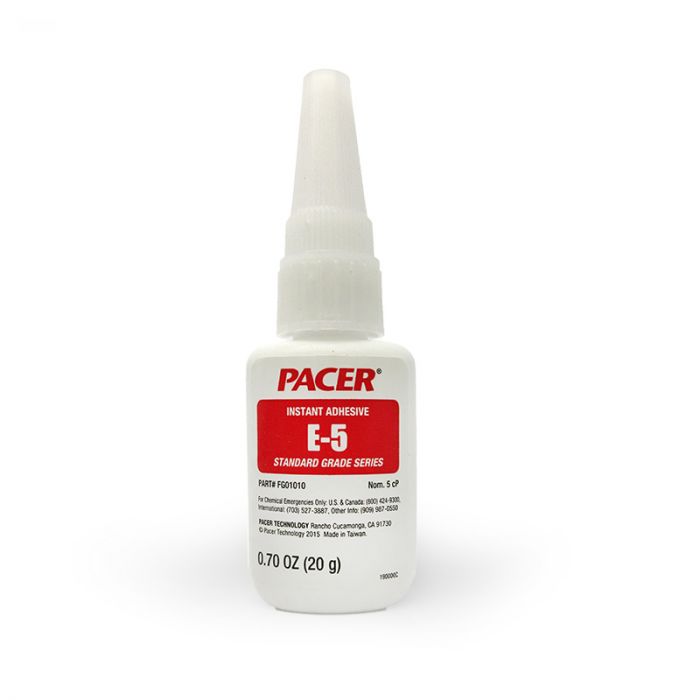
- Pacer E-5 Instant Adhesive (2-10 cP), water-thin wicking grade for already-assembled joints, .002 in gap, also in a 5 gram bottle
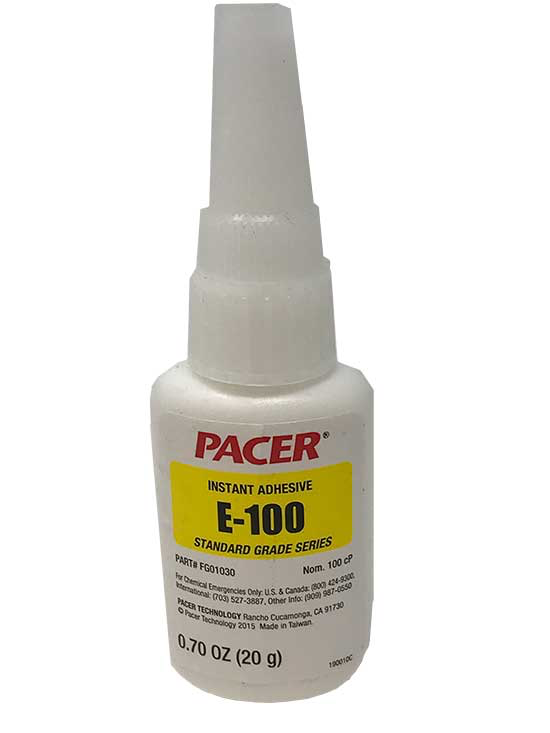
- Pacer E-100 Instant Adhesive (80-120 cP), general purpose middle grade, .005 in gap
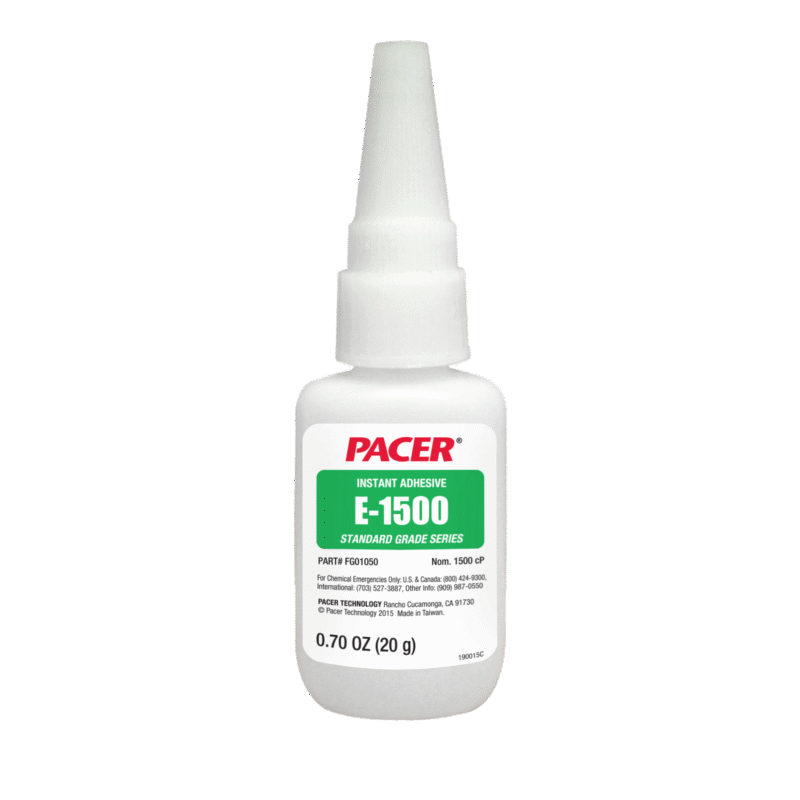
- Pacer E-1500 Instant Adhesive (1300-1700 cP), thickest grade in the E Series, .010 in gap, 20 gram bottle only
- Pacer RX-50 Range Extended (30-70 cP), same viscosity as E-40 but non-surface-sensitive, for porous, acidic, or contaminated substrates
- Pacer RX-50M Gel, a true gel for vertical and overhead joints
- Pacer Premium Acetone Accelerator, speeds full cure through larger gaps
- All cyanoacrylate instant adhesives
Frequently Asked Questions
What is Pacer E-40 used for?
Pacer E-40 is used for general purpose bonding of plastics, rubber, metal, and ceramic where the joint needs strength. At 30 to 70 cP it flows into ordinary machined and molded fit-up without demanding the near-perfect tolerances a wicking grade needs, and it carries the highest tensile and impact figures in Pacer’s E Series. It’s sold in 20 gram (0.70 oz) and 1 lb (453 g) bottles.
Which Pacer E Series grade is strongest?
E-40. It gives 4700 psi tensile on steel against 4000 for E-5, E-100, and E-1500, and 7 to 10 ft-lbs impact strength against 3 to 5 for E-5 and E-100 and 4 to 6 for E-1500. On tensile shear it ties E-5 at 2700 psi on steel. That said, strength on the data sheet only shows up on your parts if the fit-up suits the grade, so match viscosity to gap first and take the strength as a bonus.
Is Pacer E-40 impact resistant?
Relative to the rest of the E Series, yes. 7 to 10 ft-lbs per ASTM 950 is more than double E-100’s 3 to 5. But cured cyanoacrylate is a rigid material with elongation under 2%, so E-40 is the toughest grade in a family of brittle adhesives, not a flexible or shock-absorbing one. If your joint sees real peel or repeated flexing, ask us about Pacer’s HP Series, which publishes T-Peel data the E Series does not.
What materials does Pacer E-40 bond?
Pacer E-40 bonds plastics, rubber, metal, and ceramic. In ASTM D1002 testing it gives 2700 psi tensile shear on steel and 1600 psi on aluminum, and on ABS, nylon, rigid PVC, and SBR the substrate fails before the bond does. EPDM comes in at 100 psi. For porous, acidic, or contaminated surfaces, Pacer’s RX Range Extended series is the non-surface-sensitive option at the same viscosity.
How much gap will Pacer E-40 fill?
Typical gap capability is .004 in. That’s the practical middle of the E Series: looser than E-5 at .002 in, tighter than E-100 at .005 in and E-1500 at .010 in. Past .004 in the joint starves for surface moisture and cure slows, so step up a grade rather than applying more adhesive.
Will Pacer E-40 run on a vertical surface?
Yes. At 30 to 70 cP this is a low viscosity liquid and it will run down a vertical or overhead face before it cures. Fixture the part flat, mist with a Pacer accelerator to set the surface, or move to E-1500 at 1300 to 1700 cP. For a joint where the adhesive cannot move at all, RX-50M Gel is a true gel.
Does Pacer E-40 meet MIL-A-46050C?
Yes. Pacer lists E-40 as meeting MIL-A-46050C Type II, Class 1 and A-A-3097 (Commercial Spec) Type II, Class 1. Class 1 covers the thin viscosity band, which is why E-5 also falls under Class 1 while E-100 is Class 2 and E-1500 is Class 3. If your job needs a certificate of conformance, ask for it when you order.
How should Pacer E-40 be stored, and what is the shelf life?
Refrigerate unopened bottles at 40F (4C) for best results, then let the adhesive come up to room temperature before opening. Opening a cold bottle pulls condensation into the material. Once opened, store in a cool, dry location. Stored that way, expect a one year shelf life.
Questions on Fit
Questions on fit for your bonding process? Call (800) 220-1966 or email [email protected].



Reviews
There are no reviews yet.