

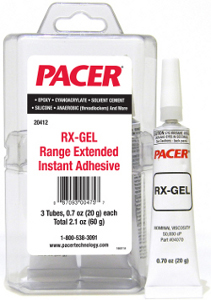


Description
Pacer RX-50M gel cyanoacrylate is a non-sag, non-running instant adhesive gel that fills to .020 in and does not move once you place it. It is the only grade in Pacer’s cyanoacrylate line specifically rated for vertical applications, which makes it the answer to the problem every other CA creates: a liquid adhesive runs down the part before it cures. RX-50M also carries the Range Extended chemistry, so it bonds porous, acidic, and contaminated substrates including plated parts and surfaces with silicone grease, oil, or release agent on them. It gives 2400 psi shear on steel, the highest figure in the RX Series, and fails the substrate before the bond on ABS, rigid PVC, nylon, polycarbonate, SBR, and EPDM. One important limitation: RX-50M meets A-A-3097 Type II, Class 5 but is not certified to MIL-A-46050C.
Key Product Details
| Property | Value |
|---|---|
| Chemistry | Ethyl hybrid cyanoacrylate |
| Grade | Range Extended gel, RX Series |
| Consistency | Non-sag, non-running gel |
| Surface Sensitivity | Virtually non-surface sensitive |
| Color | Translucent |
| Typical Gap | .020 in |
| Fixture Time | 1 to 5 minutes |
| Strength Development | 80% of full strength in 15 to 30 minutes |
| Cured Temperature Range | -65F to +180F (-54C to 82C) |
| Softening Point | 303F / 151C |
| Melting Point | 365F |
| Glass Transition | 347F / 175C |
| Flashpoint | 185F / 85C |
| Specific Gravity | 1.12 |
| Vapor Pressure | 8 mmHg at 70C |
| Rockwell Hardness | M 74 |
| Outgassing | 0 (at 10^-6 mmHg, 72F) |
| Dielectric Constant | 3.98 at 1 MC |
| Volume Resistivity | 8.4 x 10^12 ohm-cm |
| Tensile, Steel | 4000 psi (+/- 10%), ASTM D-2095 |
| Bonds Through | Silicone greases, oils, release agents, plated surfaces |
| Soluble In, Uncured | Acetone, MEK |
| Soluble In, Cured State | Pacer X-9 Debonder, acetone, nitropropane |
| Specification Compliance | A-A-3097 Type II, Class 5. Not certified to MIL-A-46050C. |
| Shelf Life | One year, stored per the TDS |
| Available Sizes | 20 Gram (0.70 oz) Tube, 200 Gram (7 oz) Tube |
Full property data for every grade in the series is in the Pacer RX Series technical data sheet (PDF). We are confirming the published viscosity range for this grade with Pacer. Call us if you need a figure for a specification and we’ll get it in writing.
Shear Strength by Substrate
Tested per ASTM D-1002. Where the table reads substrate failure, the part broke before the bond did.
| Substrate | Shear Strength, psi (+/- 10%) |
|---|---|
| Steel | 2400 |
| Aluminum | 1600 |
| Copper | 1400 |
| ABS | Substrate failure |
| Rigid PVC | Substrate failure |
| Nylon | Substrate failure |
| Polycarbonate | Substrate failure |
| SBR | Substrate failure |
| EPDM | Substrate failure |
2400 psi on steel is the highest figure in the RX Series, where every liquid grade comes in at 2300. That runs against the usual pattern, since thicker adhesives normally give up shear strength, so it is worth knowing you are not trading strength for the gel consistency here.
How to Bond a Vertical or Overhead Joint
Every liquid cyanoacrylate has the same problem on a vertical face: gravity moves the adhesive off the joint before it cures. Fixture time is 1 to 5 minutes, which is plenty of time for a 100 cP liquid to run several inches down a part, wick into a thread, or drip onto a finished surface. A non-sag gel removes that failure mode by not flowing at all.
- Clean both faces first. A wider gap gives contamination more room to sit in, and gel does not self-level over debris the way a liquid partly can.
- Apply to one surface only. With a gel the bead stays where you lay it, so place it deliberately rather than flooding the joint and closing it.
- Position the part before the adhesive sets. Because the gel does not run, you get working time to align the joint that a liquid on a vertical face simply does not allow. This is the practical benefit buyers report and it comes from the non-sag consistency, not from a faster or slower cure.
- Hold or clamp through fixture, 1 to 5 minutes, then give it 15 to 30 minutes to reach 80% of full strength before loading the joint.
- Expect the center of a .020 in bond line to cure last. Cyanoacrylate cures from surface moisture inward, so a full gap takes the longer end of the range.
- A Pacer accelerator is more relevant here than on any thin grade, since Pacer specifically recommends accelerators to speed full cure through larger gaps. Accelerator over exposed adhesive can leave a white frost called chlorosis, removable with Pacer X-9 Debonder on a cotton swab, and overall cure strength can drop.
- Do not use gel to compensate for a joint that needs a structural adhesive. .020 in is the limit. Wider than that and cyanoacrylate leaves an uncured core no matter how much you apply.
- Test on actual parts before committing a process. Test in the actual orientation too, since a joint that holds flat on a bench behaves differently at 90 degrees.
Choosing a Viscosity in the RX Series
Every grade in the RX Series runs the same non-surface-sensitive ethyl hybrid cyanoacrylate chemistry and the same -65F to +180F cured range. Consistency and gap are what change.
| Grade | Viscosity | Typical Gap | Vertical Use | MIL-A-46050C |
|---|---|---|---|---|
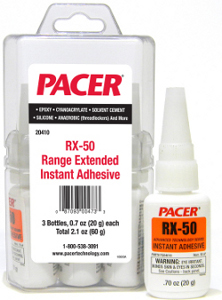
| RX-50 | 30 to 70 cP | .004 in | No, it runs | Type II, Class 1 |
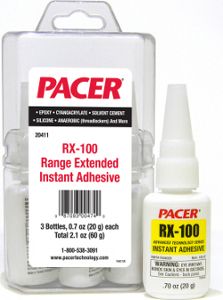
| RX-100 | 80 to 120 cP | .005 in | No, it runs | Type II, Class 2 |
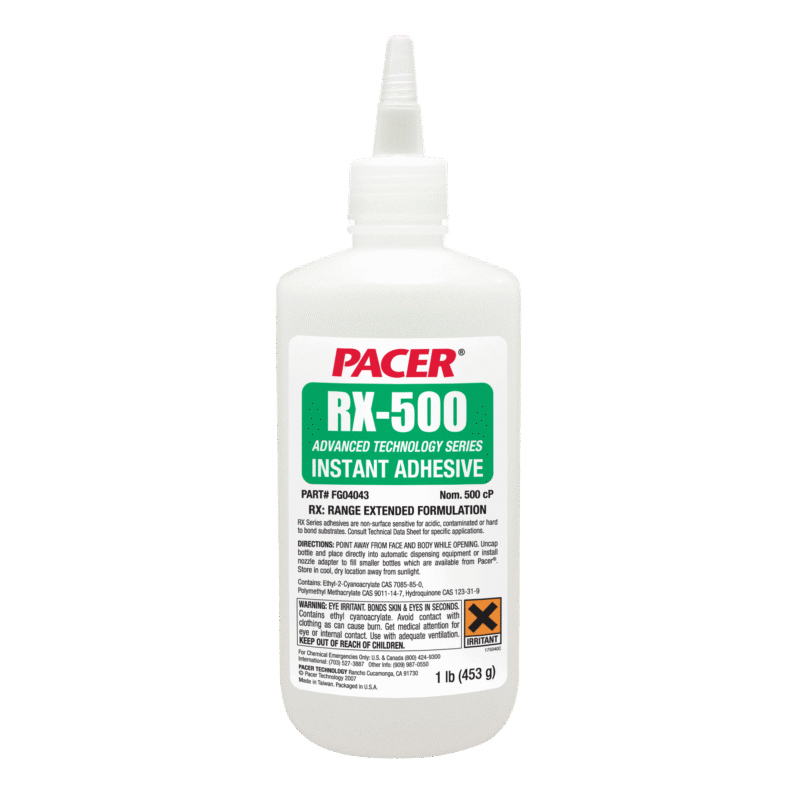
| RX-500 | 350 to 550 cP | .008 in | Not rated for it | Type II, Class 3 |
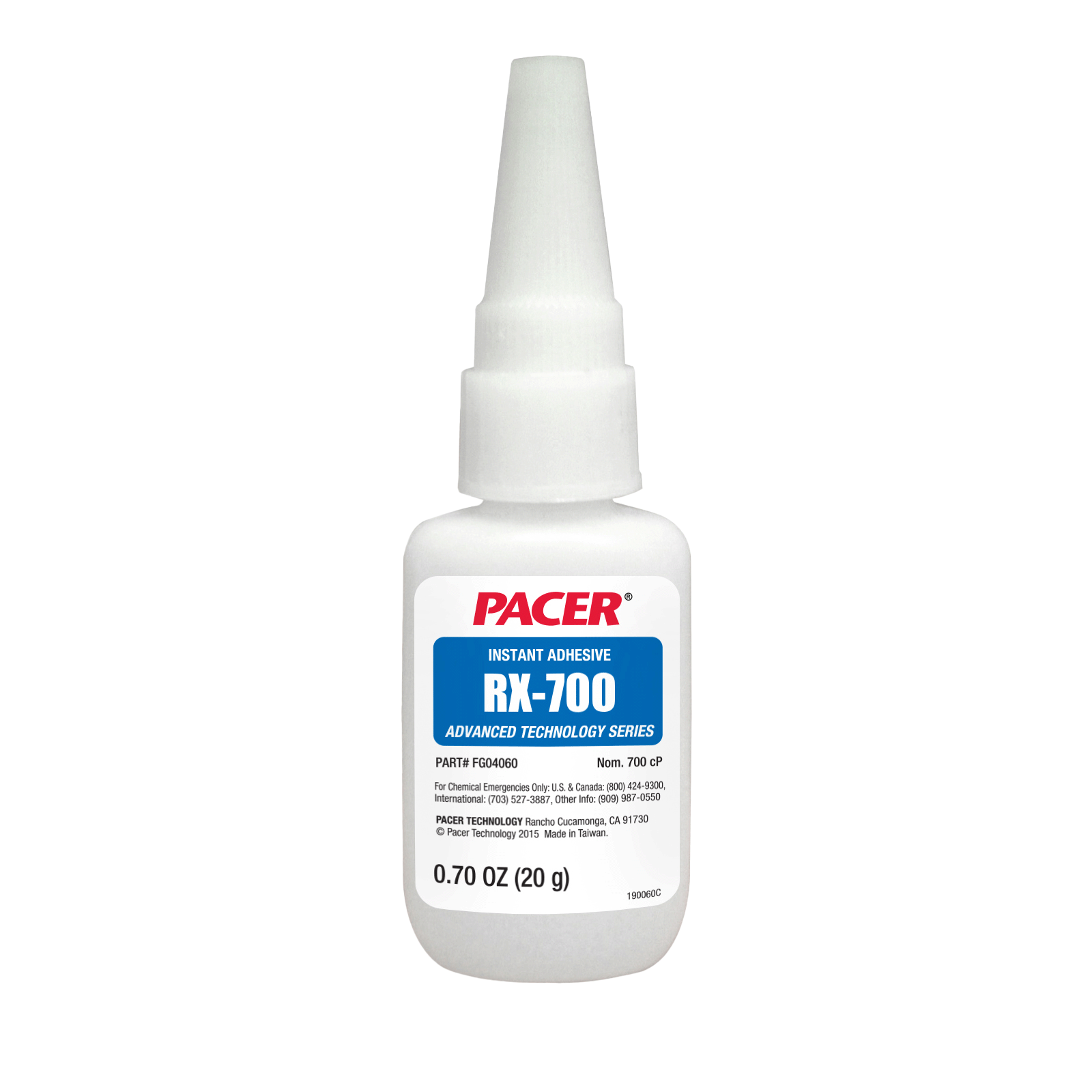
| RX-700 | 600 to 800 cP | .010 in | Not rated for it | Type II, Class 3 |
| RX-50M Gel | Non-running gel | .020 in | Yes, rated non-sag | Not certified |
Read the last two columns together, because they are the whole decision. RX-50M is the only grade you can use on a vertical or overhead joint, and it is the only grade Pacer does not certify to MIL-A-46050C. If your job calls out that MIL spec and the part is vertical, call us before you order, because you cannot have both from this series.
Pacer’s data sheet covers grades beyond what we currently stock. Chemical Concepts carries RX-50, RX-100, RX-500, RX-700, and this gel. RX-5, the water-thin grade, has been discontinued.
Performance in Production
- Non-sag and non-running, rated by Pacer for vertical applications. This is the only grade in the Pacer cyanoacrylate line carrying that rating, and it is the reason to specify it.
- .020 in gap capability, double RX-700 and four times RX-100. On parts that do not mate cleanly, that is the difference between a bond and a starved joint.
- 2400 psi shear on steel, the highest in the RX Series. You are not giving up strength for the gel consistency.
- Substrate failure on ABS, rigid PVC, nylon, polycarbonate, SBR, and EPDM. On all six the part fails before the bond, which covers both rubbers and the difficult engineering plastics.
- Non-surface-sensitive, so it bonds through silicone greases, oils, and release agents and onto plated parts. A gel that also tolerates contamination is a genuinely narrow combination.
- Because the bead stays put, you get time to position the part that a liquid on a vertical face does not allow. Place, align, then hold through fixture.
- Fixture in 1 to 5 minutes and 80% of strength in 15 to 30 minutes, though a full .020 in gap cures from the outside in, so allow the longer end before loading.
- A Pacer accelerator is more useful here than with any thin grade, since Pacer recommends accelerators specifically to speed cure through larger gaps.
- Not certified to MIL-A-46050C. Check your job requirement before you specify it, because every other RX grade carries that certification and this one does not.
- Supplied in tubes rather than bottles, in 20 gram and 200 gram, which suits a gel far better than a squeeze bottle would.
Common Applications
- Vertical and overhead joints where a liquid cyanoacrylate runs off before it cures
- Parts that cannot be reoriented or laid flat for bonding
- Field and service repair where you work on the part where it sits
- Loose or inconsistent fit-up needing up to .020 in of gap
- Uneven and irregular mating surfaces
- EPDM and SBR rubber, gaskets, seals, and trim
- Plated parts, and surfaces carrying oil, silicone grease, or release agent
- Polycarbonate and nylon, where the substrate fails before the bond
- Assemblies needing working time to align after the adhesive is placed
- Work calling out A-A-3097 Type II, Class 5
Available Sizes
| Size | Net Weight | SKU | Pacer Part No. | UPC |
|---|---|---|---|---|
| 20 Gram Tube | 0.70 oz (20 g) | PAC-FG04070 | FG04070 | 0 87093 00248 7 |
| 200 Gram Tube | 7 oz (200 g) | PAC-FG04072 | FG04072 | 0 87093 00250 0 |
The 20 gram tube is sold in case quantity of 10. The 200 gram tube sells individually. Call us if you need a single 20 gram tube to trial on a part and we’ll work something out.
Related Products
- Pacer RX-700 Range Extended (600-800 cP), the thickest RX liquid at .010 in gap, and MIL-A-46050C certified if the spec matters more than the orientation
- Pacer RX-100 Range Extended (80-120 cP), the broad use RX grade, 20 gram and 1 lb
- Pacer RX-500 Range Extended, .008 in gap, 20 gram and 1 lb
- Pacer E-1500 Instant Adhesive (1300-1700 cP), the thickest general purpose grade, MIL-A-46050C Class 3, for clean surfaces where the joint is only partly vertical
- Pacer Premium Acetone Accelerator, speeds full cure through larger gaps, most relevant to this grade
- All cyanoacrylate instant adhesives
Frequently Asked Questions
What is a non-sag cyanoacrylate gel used for?
Vertical and overhead joints, and loose fit-up. Every liquid cyanoacrylate runs off a vertical face during the 1 to 5 minutes it needs to fixture, which is why a joint that bonds fine flat on a bench fails at 90 degrees. A non-sag gel does not flow, so it stays on the joint and gives you time to position the part. RX-50M is the only grade in Pacer’s cyanoacrylate line rated for vertical applications.
Will Pacer RX-50M Gel stay put on a vertical surface?
Yes. Pacer rates it as a non-sag, non-running formula for vertical applications, which is a manufacturer specification rather than a technique claim. It is the only grade across Pacer’s E, RX, MR, PX, TX, and HP cyanoacrylate families carrying that rating. Test in the actual part orientation before committing a process, since a bead that holds on a wall behaves differently overhead.
How much gap will Pacer RX-50M Gel fill?
Typical gap capability is .020 in, the widest in the RX Series. That is double RX-700 at .010 in and four times RX-100 at .005 in. Past .020 in, cyanoacrylate is the wrong chemistry: cure runs on surface moisture reaching the middle of the bond line, and a wider gap leaves an uncured core. For anything past that, ask us about a two part structural adhesive.
Does Pacer RX-50M Gel meet MIL-A-46050C?
No. RX-50M is the one grade in the RX Series Pacer does not certify to MIL-A-46050C. It carries A-A-3097 Type II, Class 5 only. Every other RX grade holds both certifications, so if your job calls out the MIL spec you need a liquid grade, and RX-700 at 600 to 800 cP is the thickest MIL-certified option. Call us if the part is vertical and the spec is mandatory, because that combination is not available from this series.
Is a gel cyanoacrylate weaker than a liquid?
Not in this series. RX-50M gives 2400 psi shear on steel against 2300 for every liquid RX grade, and 4000 psi tensile on steel, the same as the rest of the family. That runs against the usual pattern, where a thicker adhesive and a thicker bond line give up shear strength. You are not trading strength for the gel consistency here.
Will Pacer RX-50M Gel bond oily or plated parts?
Yes. RX-50M carries the Range Extended chemistry, so it bonds surfaces contaminated with silicone greases, oils, and release agents, along with plated parts, porous materials, and acidic substrates that inhibit a conventional cyanoacrylate. A gel that also tolerates contamination is a narrow combination, and it is the main reason to choose this over a general purpose thick grade. Parts should still be as clean as you can get them.
Does Pacer RX-50M Gel bond EPDM rubber?
Yes. In ASTM D-1002 testing it gives substrate failure on EPDM, meaning the rubber tears before the bond line lets go, and SBR is the same. Pacer’s general purpose E Series grades reach only 100 psi on EPDM. For rubber gaskets, seals, and trim on a vertical surface, this is the grade.
How should Pacer RX-50M Gel be stored, and what is the shelf life?
Refrigerate unopened tubes for optimal results. Once opened, store in a cool, dry location away from heat sources. Stored that way, expect a one year shelf life.
Questions on Fit
Bonding something you can’t lay flat? Call (800) 220-1966 or email [email protected] and tell us the substrate and the orientation.



Reviews
There are no reviews yet.