


Description
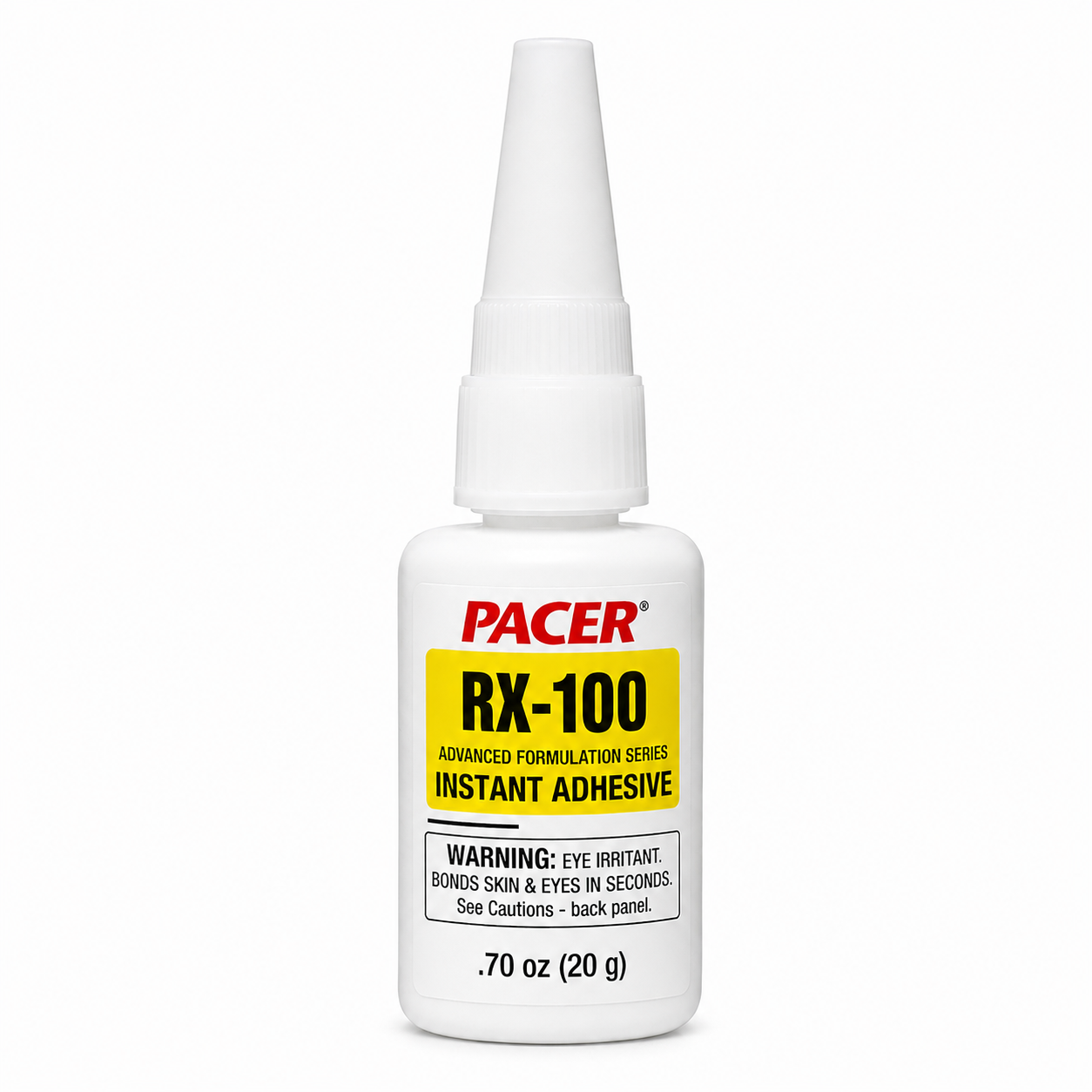
Pacer RX-100 cyanoacrylate adhesive is a virtually non-surface-sensitive instant adhesive that runs 80 to 120 cP and fills to .005 in. It exists for one reason: standard cyanoacrylate fails on some surfaces no matter how good your technique is, and RX chemistry bonds anyway. Porous substrates, acidic substrates, plated parts, and surfaces carrying silicone grease, oil, or release agent are all cases where a conventional CA either cures slowly or never grabs at all. RX-100 gets an instant, high strength bond on those parts and cuts the surface prep that would otherwise be the only way through. It also outperforms Pacer’s general purpose grades on rubber: EPDM fails the substrate before the bond, where a standard E Series grade reaches only 100 psi. RX-100 meets MIL-A-46050C Type II, Class 2 and A-A-3097 Type II, Class 2.
Key Product Details
| Property | Value |
|---|---|
| Chemistry | Ethyl hybrid cyanoacrylate |
| Grade | Range Extended, RX Series |
| Surface Sensitivity | Virtually non-surface sensitive |
| Color | Translucent liquid |
| Viscosity | 80 to 120 cP |
| Typical Gap | .005 in |
| Fixture Time | 1 to 5 minutes |
| Strength Development | 80% of full strength in 15 to 30 minutes |
| Cured Temperature Range | -65F to +180F (-54C to 82C) |
| Softening Point | 306F / 152C |
| Melting Point | 365F / 185C |
| Glass Transition | 347F / 175C |
| Flashpoint | 185F / 85C |
| Specific Gravity | 1.07 |
| Vapor Pressure | 8 mmHg at 70C |
| Rockwell Hardness | M 74 |
| Outgassing | 0 (at 10^-6 mmHg, 72F) |
| Dielectric Constant | 3.98 at 1 MC |
| Volume Resistivity | 8.4 x 10^12 ohm-cm |
| Tensile, Steel | 4000 psi (+/- 10%), ASTM D-2095 |
| Bonds Through | Silicone greases, oils, release agents, plated surfaces |
| Soluble In, Liquid State | Acetone, MEK |
| Soluble In, Cured State | Pacer X-9 Debonder, acetone, nitropropane |
| Specification Compliance | MIL-A-46050C Type II, Class 2; A-A-3097 Type II, Class 2 |
| Shelf Life | One year, stored per the TDS |
| Available Sizes | 20 Gram (0.70 oz) Bottle, 1 lb (453 g) Bottle |
Shear Strength by Substrate
Tested per ASTM D-1002. Where the table reads substrate failure, the part broke before the bond did.
| Substrate | Shear Strength, psi (+/- 10%) |
|---|---|
| Steel | 2300 |
| Aluminum | 1600 |
| Copper | 1400 |
| ABS | Substrate failure |
| Rigid PVC | Substrate failure |
| Nylon | Substrate failure |
| Polycarbonate | Substrate failure |
| SBR | Substrate failure |
| EPDM | Substrate failure |
The EPDM row is worth a second look if you bond rubber. Pacer’s general purpose E-100 reaches 100 psi on EPDM. RX-100 fails the rubber before the bond. On steel the comparison runs the other way, 2300 psi here against 2400 for E-100, so the RX chemistry costs you a little on metal and buys a great deal on elastomers and difficult surfaces.
How Non-Surface-Sensitive Cyanoacrylate Works
A standard cyanoacrylate needs a cooperative surface. Cure is triggered by the trace moisture on your parts, and that reaction is held back by acidic surfaces and blocked outright by an oily or greasy film. That’s why the same bottle that bonds clean ABS in seconds will sit wet on a plated fitting or a mold-released part and never grab. RX chemistry is formulated to cure on those surfaces anyway.
- Recognize the symptom first. If a standard CA takes far longer than it should on a specific part, or cures at the edges and stays wet in the middle, or grabs on some parts from a batch and not others, the surface is the problem and no amount of technique fixes it.
- Check what the part has been through. Plating, mold release, silicone-based lubricants, cutting oil, and acidic surface treatments are all standard-CA killers.
- Clean the parts anyway. Pacer’s own guidance still says parts should be clean and free from oil, grease, and other contaminants. RX-100 tolerates contamination that would stop a conventional grade, so it buys you margin, not permission to skip prep.
- Apply to one surface only and mate the parts promptly. One free-falling drop covers roughly one square inch of bond area, and over-application is difficult to remove from where you did not want it.
- Work flat or clamped where you can. At 80 to 120 cP this is a flowing liquid and it will run on a vertical face before it sets.
- Fixture in 1 to 5 minutes, 80% of full strength in 15 to 30 minutes. Those rates move with temperature, relative humidity, bondline thickness, and the substrate pair.
- Test on your actual parts before committing a process. That’s true of every cyanoacrylate and doubly true when the whole reason you’re here is a difficult surface.
- Where RX chemistry earns its cost is the prep you stop doing. If your current process is degrease, abrade, prime, then bond, and RX-100 lets you bond directly, that’s labor and cycle time off every part.
Choosing a Viscosity in the RX Series
Every grade in the RX Series runs the same non-surface-sensitive ethyl hybrid cyanoacrylate chemistry, the same -65F to +180F cured range, and the same shear strength figures. Viscosity and gap are what change, so pick by fit-up and part orientation.
| Grade | Viscosity | Typical Gap | MIL-A-46050C | Best For |
|---|---|---|---|---|
| RX-50 | 30 to 70 cP | .004 in | Type II, Class 1 | Close fit-up on difficult surfaces, 20 gram only |
| RX-100 | 80 to 120 cP | .005 in | Type II, Class 2 | Broad use, the default RX grade, 20 gram and 1 lb |
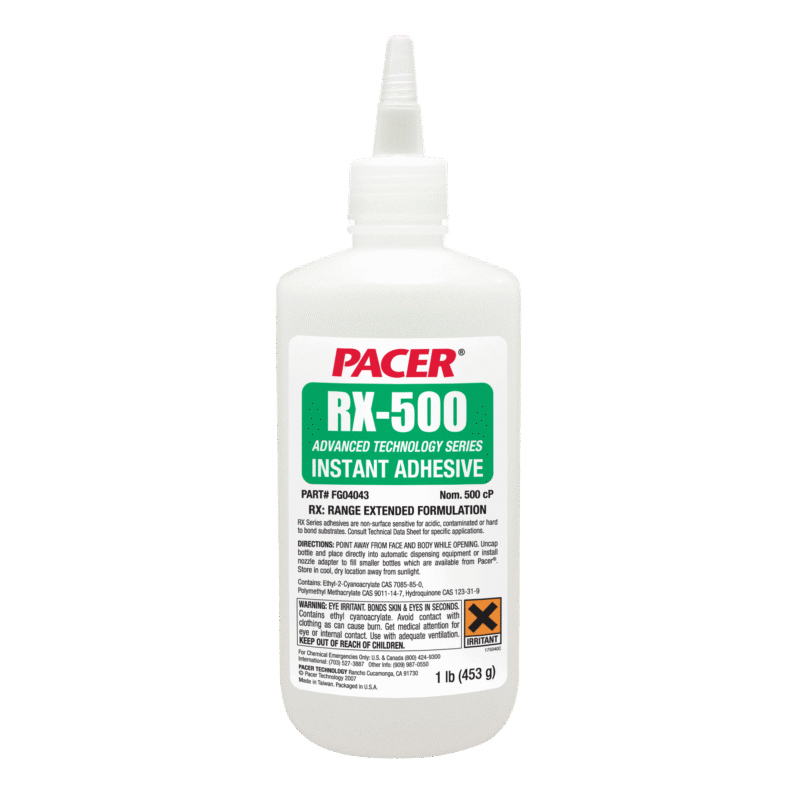
| RX-500 | 350 to 550 cP | .008 in | Type II, Class 3 | Looser fit-up, 20 gram and 1 lb |
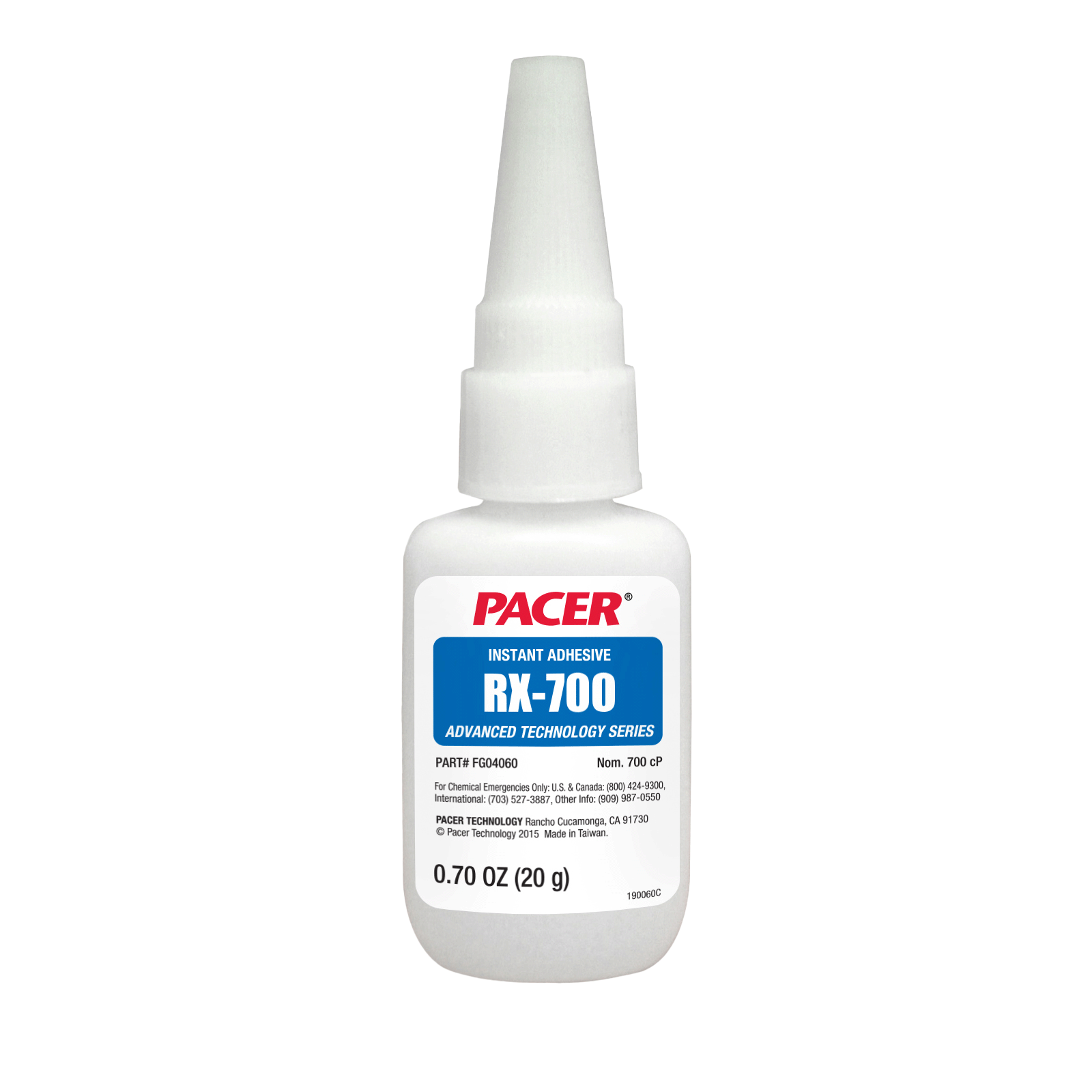
| RX-700 | 600 to 800 cP | .010 in | Type II, Class 3 | Uneven surfaces, 20 gram only |
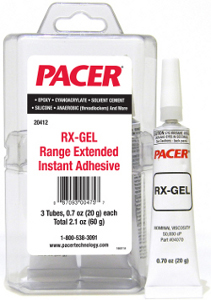
| RX Gel | Non-running gel | .020 in | A-A-3097 Class 5 only | Vertical and overhead work, 20 gram and 200 gram |
Two things worth knowing from that table. The gel is the only grade in the series rated non-sag and non-running for vertical applications, and it is also the only one Pacer does not certify to MIL-A-46050C, carrying A-A-3097 Type II, Class 5 instead. If your job calls out the MIL spec, the gel is not the grade.
Pacer’s data sheet for this series covers grades beyond what we currently stock. Chemical Concepts carries RX-50, RX-100, RX-500, RX-700, and the RX Gel. RX-5, the water-thin 2 to 10 cP grade, has been discontinued, so the series now starts at RX-50.
Across families, RX-100 and Pacer E-100 share the same 80 to 120 cP viscosity, the same .005 in gap, the same 4000 psi tensile on steel, and the same MIL-A-46050C Type II, Class 2 rating. The difference is surface tolerance and elastomer performance. If your parts are clean, your substrates are metal or rigid plastic, and E-100 is already working, there is no reason to pay for RX.
Performance in Production
- Bonds through silicone greases, oils, and release agents, and onto plated parts. That’s the reason to specify it, and it’s a documented property rather than a technique claim.
- Handles acidic substrates that inhibit a conventional cyanoacrylate. If a part sometimes bonds and sometimes doesn’t with a standard grade, this is usually the fix.
- Substrate failure on ABS, rigid PVC, nylon, polycarbonate, SBR, and EPDM. On all six your joint strength is set by the part, not the adhesive, which is a wider list than the general purpose E Series covers and includes both rubbers.
- 1400 psi on copper, a figure the E Series data sheet does not publish at all. Useful if you bond copper or brass fittings.
- Cuts surface preparation. Degreasing, abrading, and priming steps that exist only to make a standard CA work can often come out of the process, which is labor and cycle time on every part.
- Same 80 to 120 cP and .005 in gap as E-100, so a shop already running the general purpose grade can switch problem parts to RX-100 without redesigning the joint or changing dispensing.
- Fixture in 1 to 5 minutes and 80% of strength in 15 to 30 minutes, the same across every grade in the RX Series.
- At 80 to 120 cP it is a flowing liquid, not a gel. It will run on a vertical or overhead face before it cures. For those joints use the RX Gel, which is rated non-sag.
- Zero outgassing at 10^-6 mmHg, 8.4 x 10^12 ohm-cm volume resistivity, and a 3.98 dielectric constant for vacuum and electrically sensitive assemblies.
Common Applications
- Bonding plated parts and fittings
- Bonding surfaces carrying silicone grease, oil, or release agent
- EPDM and SBR rubber bonding, gaskets, and seals
- Acidic substrates that inhibit standard cyanoacrylate cure
- Porous materials where a conventional CA soaks away without bonding
- Hard-to-bond plastics, including polycarbonate and nylon
- Copper and brass fittings
- Mold-released parts going straight from molding to assembly
- Eliminating degrease, abrade, and prime steps from an existing bonding process
- Work calling out MIL-A-46050C Type II, Class 2 or A-A-3097 Type II, Class 2
Available Sizes
| Size | Net Weight | SKU | Pacer Part No. | UPC |
|---|---|---|---|---|
| 20 Gram Bottle | 0.70 oz (20 g) | PAC-FG04020 | FG04020 | 0 87093 00227 2 |
| 1 lb Bottle | 1 lb (453 g) | PAC-FG04023 | FG04023 | 0 87093 00231 9 |
The 20 gram bottle is sold in case quantity of 10. Call us if you need a single bottle to trial on a problem part and we’ll work something out. Across the series, RX-100 and RX-500 are the two grades offered in a 1 lb bulk bottle.
Related Products
- Pacer RX-50 Range Extended (30-70 cP), thinner, .004 in gap, for closer fit-up on difficult surfaces
- Pacer RX-500 Range Extended, thicker at .008 in gap, also available in a 1 lb
- Pacer RX-700 Range Extended (600-800 cP), .010 in gap for uneven surfaces
- Pacer RX Gel, non-sag non-running gel for vertical applications, .020 in gap
- Pacer E-100 Instant Adhesive (80-120 cP), the general purpose equivalent at the same viscosity and gap, for clean surfaces
- Pacer Premium Acetone Accelerator, speeds full cure through larger gaps
- All cyanoacrylate instant adhesives
Frequently Asked Questions
What does non-surface-sensitive cyanoacrylate mean?
It means the adhesive still cures on surfaces that would stop a conventional cyanoacrylate. Standard CA cure is inhibited by acidic surfaces and blocked by oily or greasy films, which is why the same bottle can bond one part in seconds and sit wet on another. Non-surface-sensitive grades, which Pacer calls Range Extended, are formulated to bond anyway. RX-100 handles silicone greases, oils, release agents, plated parts, porous materials, and acidic substrates.
Why won’t regular super glue stick to my parts?
Usually the surface, not the adhesive. The most common causes are an oily or greasy film, silicone-based lubricant, mold release, plating, or an acidic surface treatment, all of which either block or slow cyanoacrylate cure. The giveaway is inconsistency: a standard grade bonds some parts from a batch and not others, or cures at the edges and stays wet in the middle. RX-100 is the same 80 to 120 cP viscosity as a general purpose grade but formulated to cure on those surfaces. If you’re not sure that’s your problem, send us the part and we’ll help you work it out.
What is the difference between Pacer RX-100 and E-100?
Surface tolerance and rubber performance. Both run 80 to 120 cP, both fill to .005 in, both give 4000 psi tensile on steel, and both meet MIL-A-46050C Type II, Class 2. RX-100 also bonds oily, plated, porous, and acidic surfaces, and on EPDM it fails the rubber before the bond where E-100 reaches 100 psi. E-100 is slightly stronger on steel shear, 2400 psi against 2300. If E-100 is working on your parts, stay with it. If it fails, works inconsistently, or you’re bonding EPDM, switch to RX-100 without changing your joint design or dispensing.
Will Pacer RX-100 bond oily or greasy parts?
Yes. Pacer states the RX chemistry achieves instant, high strength bonds on surfaces contaminated with silicone greases, oils, and release agents, as well as on plated parts. That’s the whole purpose of the series. It does not mean prep is pointless: Pacer’s own application guidance still calls for parts to be clean and free from oil and grease, so RX-100 buys you margin rather than a licence to skip cleaning. Test on your actual parts before committing a production process.
Does Pacer RX-100 bond EPDM rubber?
Yes, and this is one of its strongest cases. In ASTM D-1002 testing RX-100 gives substrate failure on EPDM, meaning the rubber tears before the bond line lets go. SBR is the same. For comparison, Pacer’s general purpose E Series grades reach only 100 psi on EPDM. If you bond EPDM gaskets, seals, or trim, the RX Series is the family to specify.
How much gap will Pacer RX-100 fill?
Typical gap capability is .005 in, the same as the general purpose E-100. If your parts sit looser than that, RX-500 fills to .008 in and RX-700 to .010 in, and the RX Gel allows .020 in, four times RX-100.
Will Pacer RX-100 run on a vertical surface?
Yes. At 80 to 120 cP RX-100 is a flowing liquid and it will run down a vertical or overhead face before it cures. Fixture the part flat where you can. If the part cannot be reoriented, the RX Gel is the grade to use, and Pacer specifically rates it as a non-sag, non-running formula for vertical applications. Note that the gel carries A-A-3097 Type II, Class 5 and is not certified to MIL-A-46050C.
How should Pacer RX-100 be stored, and what is the shelf life?
Refrigerate unopened bottles for optimal results. Once opened, store in a cool, dry location away from heat sources. Stored that way, expect a one year shelf life.
Questions on Fit
Got a part a standard cyanoacrylate won’t bond? Call (800) 220-1966 or email [email protected] and tell us what the surface has been through.


Reviews
There are no reviews yet.