



Description
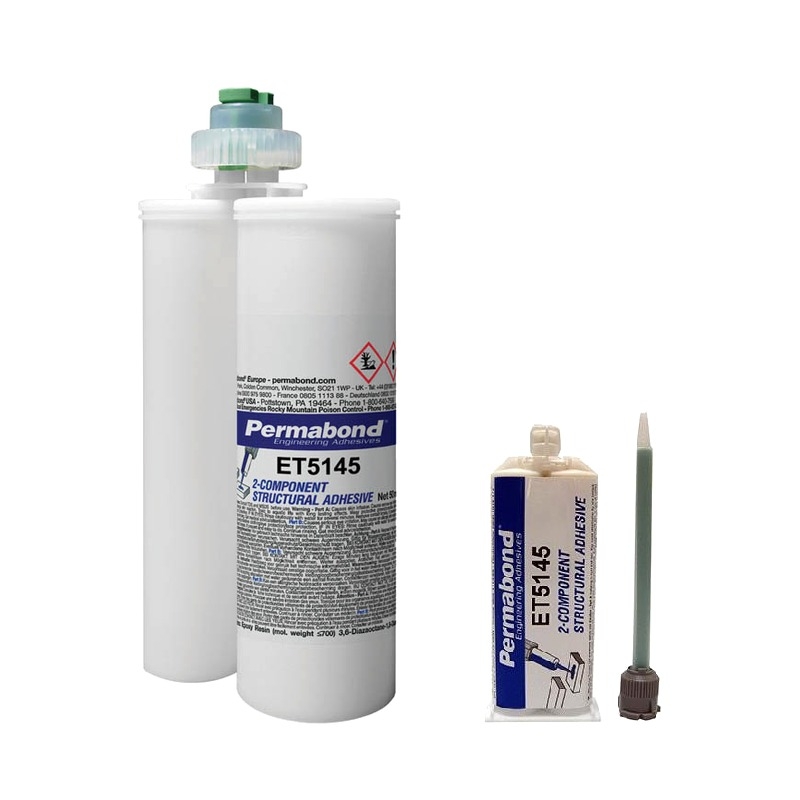
Permabond ET5145 food grade epoxy is a 1:1 two-part epoxy adhesive formulated for FDA and EU food contact use (FDA 175.105 and 175.300, EU Plastics Regulation 10/2011). It is designed for structural bonding of metal, wood, composites, and certain plastics where the cured adhesive contacts food or beverage, and Permabond also recommends it for food-grade ceramic bonding.
Typical uses include bonding and sealing food contact equipment, appliances, and filters, strainers, and sieves. Each cartridge ships with a static mixer. You dispense through it, join the parts inside the pot life, and clamp until the adhesive reaches handling strength.
Key Product Details
| Property | Value |
|---|---|
| Chemistry | Two-component epoxy (Part A epoxy resin, Part B polyamine hardener) |
| Mix Ratio by Volume | 1:1 |
| Color | Part A white, Part B ivory (mixed: off-white) |
| Mixed Consistency | Thixotropic paste |
| Viscosity at 77°F (25°C), Part A | 20 rpm: 50,000-80,000 mPa.s (cP) 2 rpm: 200,000-300,000 mPa.s (cP) |
| Viscosity at 77°F (25°C), Part B | 20 rpm: 100,000-200,000 mPa.s (cP) 2 rpm: 250,000-400,000 mPa.s (cP) |
| Specific Gravity | 1.3 (Part A and Part B) |
| Maximum Gap Fill | 0.08 in (2 mm) |
| Pot Life at 73°F (23°C), 1 g + 1 g | 50-80 minutes |
| Handling Time at 73°F (23°C) | 3-5 hours |
| Working Strength | 16 hours at 73°F (23°C) 30 minutes at 140°F (60°C) |
| Full Cure | 72 hours at 73°F (23°C) 1 hour at 140°F (60°C) |
| Shear Strength, Mild Steel (ISO 4587) | 2800-3000 psi (19-21 N/mm²) |
| Shear Strength, Stainless Steel | 2600-3000 psi (18-21 N/mm²) |
| Shear Strength, Aluminum | 1450-2000 psi (10-14 N/mm²) |
| Peel Strength, Aluminum (ISO 4578) | 7-11 PIW (30-50 N/25 mm) |
| Hardness (ISO 868) | 75-85 Shore D |
| Glass Transition Temperature (Tg) | 104-122°F (40-50°C) |
| Dielectric Strength | 15-25 kV/mm |
| Temperature Range | -40 to +175°F (-40 to +80°C) |
| Food Contact Compliance | FDA 175.105 and 175.300; EU Plastics Regulation 10/2011 (a sub-section of EU Framework Regulation 1935/2004) |
| Storage Temperature | 41 to 77°F (5 to 25°C) |
| Packaging | 50ml cartridge, 400ml cartridge |
Performance in Production
- The 50 to 80 minute pot life gives you time to apply to one substrate and join the parts. Per the TDS, parts must be joined inside that window, and larger mixed quantities or higher temperatures shorten it.
- Handling time is 3 to 5 hours, and the TDS calls for clamping for 5 hours or until handling strength is reached. Plan fixture time and cure racks around that, not around the 72 hour full cure.
- Heat shortens the schedule. A 30 minute cure at 140°F (60°C) reaches working strength that takes 16 hours at room temperature, and per the TDS every 8°C increase halves the cure time. Cooler shops cure slower.
- Each cartridge ships with a static mixer, and the 1:1 ratio is set by the dual cartridge, so you do not weigh or hand mix.
- Thixotropic paste with a 0.08 in (2 mm) maximum gap fill stays where you put it on the joint. Gaps wider than that are outside the data, so call us before bonding loose-fitting parts.
- Joint strength drops as temperature rises. The TDS hot strength curve (tested on mild steel) shows strength retention falling with temperature, and brief higher exposures such as paint baking or wave soldering are acceptable only if the joint is not unduly stressed. Test at your service temperature.
- Permabond describes the cured adhesive as a rigid, non-porous solid that can be easily cleaned, with resistance to water, food, cleaning fluids, and heat. Test it against your own cleaning chemicals before you commit to production.
Common Applications
- Bonding and sealing food contact equipment
- Appliance assembly where the cured adhesive contacts food or beverage
- Filters, strainers, and sieves: mesh screens to frames and filter media to end caps
- Structural bonding of metal, wood, composites, and certain plastics
- Stainless steel, mild steel, and aluminum assemblies
- Food-grade ceramic and glass bonding
Available Sizes
| Package | SKU | Manufacturer Number | Includes |
|---|---|---|---|
| 50ml Cartridge | PERET05145K050C0101 | ET05145K050C0101 | Static mixer |
| 400ml Cartridge | PERET05145K400C0101 | ET05145K400C0101 | Static mixer |
Related Products
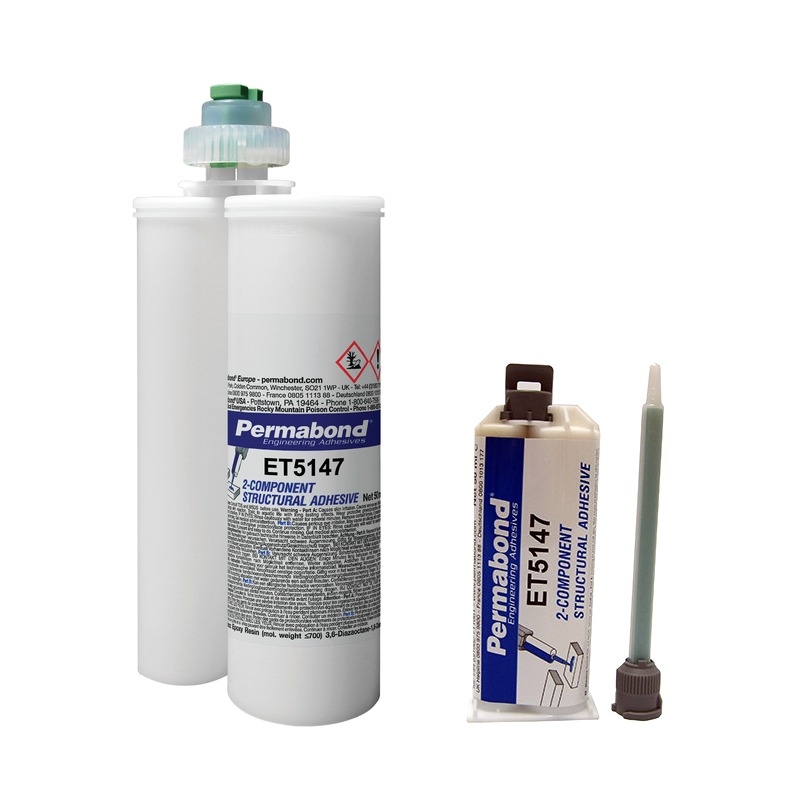
- Permabond ET5147 Food Grade Epoxy (2:1 mix ratio, compared below)
- Extra mixers and guns for 50ml cartridges: Sulzer Medmix MBQ 05-24L static mixer; Chem-Set Pak-50 dispense gun; 50ml combo 1:1 / 2:1 dispensing gun
- Extra mixers and guns for 400ml cartridges: MFH 08-24T static mixer; Sulzer Mixpac DM2X manual gun; Albion B26T400 manual gun; Newborn VR400-XSP manual gun; Sulzer Mixpac DP2X pneumatic gun; Albion 400 Series AT line pneumatic gun; Albion E18T400 battery gun (18 volt); EF DualUltra 400 MR battery kit
How to Bond With a Food Grade Two-Part Epoxy
Bonding with ET5145 follows the standard two-part epoxy sequence in the Permabond TDS: clean the surfaces, mix through a static mixer, join inside the pot life, clamp, and let it cure.
- Clean and degrease. Surfaces should be clean, dry, and grease-free. Use a suitable solvent such as acetone or isopropanol.
- Abrade where the substrate needs it. Aluminum, copper, and copper alloys benefit from light abrasion with emery cloth or similar to remove the oxide layer. For ceramic, Permabond says to remove the glaze by abrasion or grit-blasting, remove loose particles with acetone or isopropanol, and let the solvent fully evaporate before applying adhesive, since solvent can stay trapped in the pores.
- Load the cartridge. Insert the dual cartridge into the application gun and guide the plunger into the cartridge. Remove the cap and dispense until both sides are flowing, then attach the static mixer that ships with the cartridge and start dispensing.
- Apply to one substrate.
- Join the parts within the 50 to 80 minute pot life.
- Clamp for 5 hours or until handling strength is reached.
- Let it cure. Full cure takes 72 hours at room temperature. Heat can be used to accelerate the cure.
Permabond publishes shear strength data for mild steel, stainless steel, and aluminum. The TDS also lists wood, composites, and certain plastics, and Permabond lists ceramic and glass. Do not use ET5145 with strong oxidizing materials.
Frequently Asked Questions
What is Permabond ET5145 food grade epoxy used for?
ET5145 is used for structural bonding of metal, wood, composites, and certain plastics where the cured adhesive may contact food or beverage. Permabond lists food contact equipment, appliances, and filters as typical uses, and recommends it for food-grade ceramic bonding. Two-part epoxy, 2-component epoxy, and 1:1 epoxy all describe the same type of product.
Is Permabond ET5145 FDA and EU compliant and food safe?
Yes. ET5145 is formulated to meet FDA 175.105 and 175.300 and EU Plastics Regulation 10/2011, a sub-section of EU Framework Regulation 1935/2004. Food grade epoxy, food safe epoxy, and food contact epoxy are used interchangeably in the trade. If your customer or auditor needs documentation, call us and we will get it from Permabond.
Can ET5145 be used on filters, strainers, and sieves?
Yes. Permabond lists its food grade two-part epoxies for filters, strainers, and equipment where the adhesive contacts food and drink, including mesh screens bonded to frames and filter media bonded to end caps. Stainless steel is a common filter substrate and the TDS publishes 2600 to 3000 psi shear on it. Call us with your assembly so we can confirm the grade.
How long does ET5145 take to cure?
At room temperature ET5145 reaches working strength in 16 hours and full cure in 72 hours. At 140°F (60°C) working strength takes 30 minutes and full cure takes 1 hour. Pot life is 50 to 80 minutes at 73°F (23°C), so join the parts inside that window.
Can ET5145 bond stainless steel?
Yes. The TDS lists 2600 to 3000 psi shear strength on stainless steel, 2800 to 3000 psi on mild steel, and 1450 to 2000 psi on aluminum. Results vary with surface preparation and bond gap, so test on your parts.
Will ET5145 bond ceramic or glass?
Yes for ceramic, and Permabond lists glass among the substrates for its food grade epoxies. Permabond recommends ET5145 for food-grade ceramic applications: remove the glaze by abrasion or grit-blasting, remove loose particles with acetone or isopropanol, and let the solvent evaporate before bonding. Test on your glass or ceramic part before you commit to production.
What temperature can ET5145 handle?
Permabond lists a temperature range of -40 to +175°F (-40 to +80°C) for ET5145. The cured adhesive has a glass transition temperature of 104 to 122°F (40 to 50°C), and the TDS hot strength curve shows strength falling as temperature rises. Brief higher exposures such as paint baking and wave soldering are acceptable if the joint is not unduly stressed, so test at your service temperature.
What is the difference between ET5145 and ET5147?
The mix ratio is the first difference: ET5145 is 1:1 and Permabond ET5147 is 2:1. The table below compares the two food grade epoxies using Permabond TDS values and the Permabond food grade flyer for the temperature range. See the ET5147 page for its full data.
| Property | Permabond ET5145 | Permabond ET5147 |
|---|---|---|
| Mix Ratio by Volume | 1:1 | 2:1 |
| Mixed Consistency | Thixotropic paste | Thixotropic paste |
| Maximum Gap Fill | 0.08 in (2 mm) | 0.08 in (2 mm) |
| Pot Life at 73°F (23°C) | 50-80 minutes | 40-60 minutes |
| Working Strength at 73°F (23°C) | 16 hours | 16 hours |
| Working Strength at 140°F (60°C) | 30 minutes | 30 minutes |
| Hardness (Shore D) | 75-85 | 68-72 |
| Shear Strength, Mild Steel | 2800-3000 psi (19-21 N/mm²) | 2600-2900 psi (18-20 N/mm²) |
| Shear Strength, Stainless Steel | 2600-3000 psi (18-21 N/mm²) | 2200-2800 psi (15-19 N/mm²) |
| Peel Strength, Aluminum | 7-11 PIW (30-50 N/25 mm) | 9-16 PIW (40-70 N/25 mm) |
| Glass Transition Temperature (Tg) | 104-122°F (40-50°C) | 122-140°F (50-60°C) |
| Temperature Range | -40 to +175°F (-40 to +80°C) | -40 to +250°F (-40 to +120°C) |
Questions on fit for your food contact bonding application? Call (800) 220-1966 or email [email protected].


Reviews
There are no reviews yet.