



Description
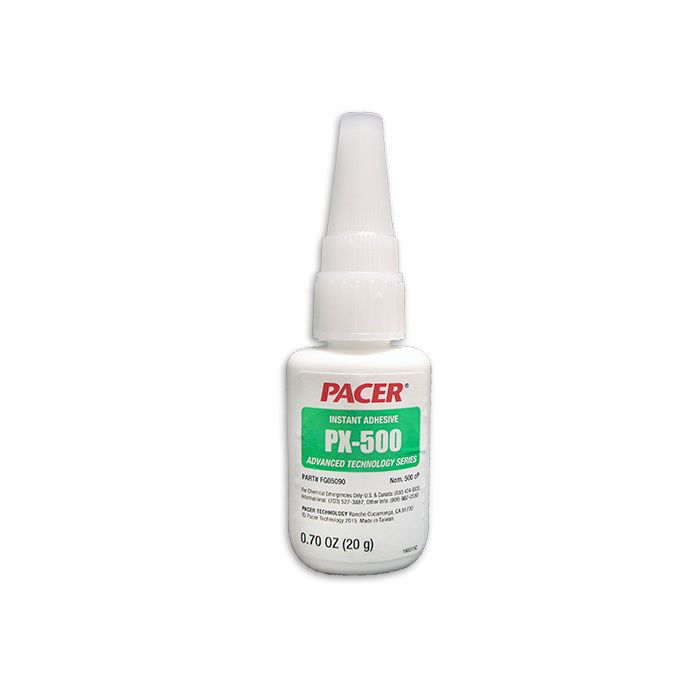
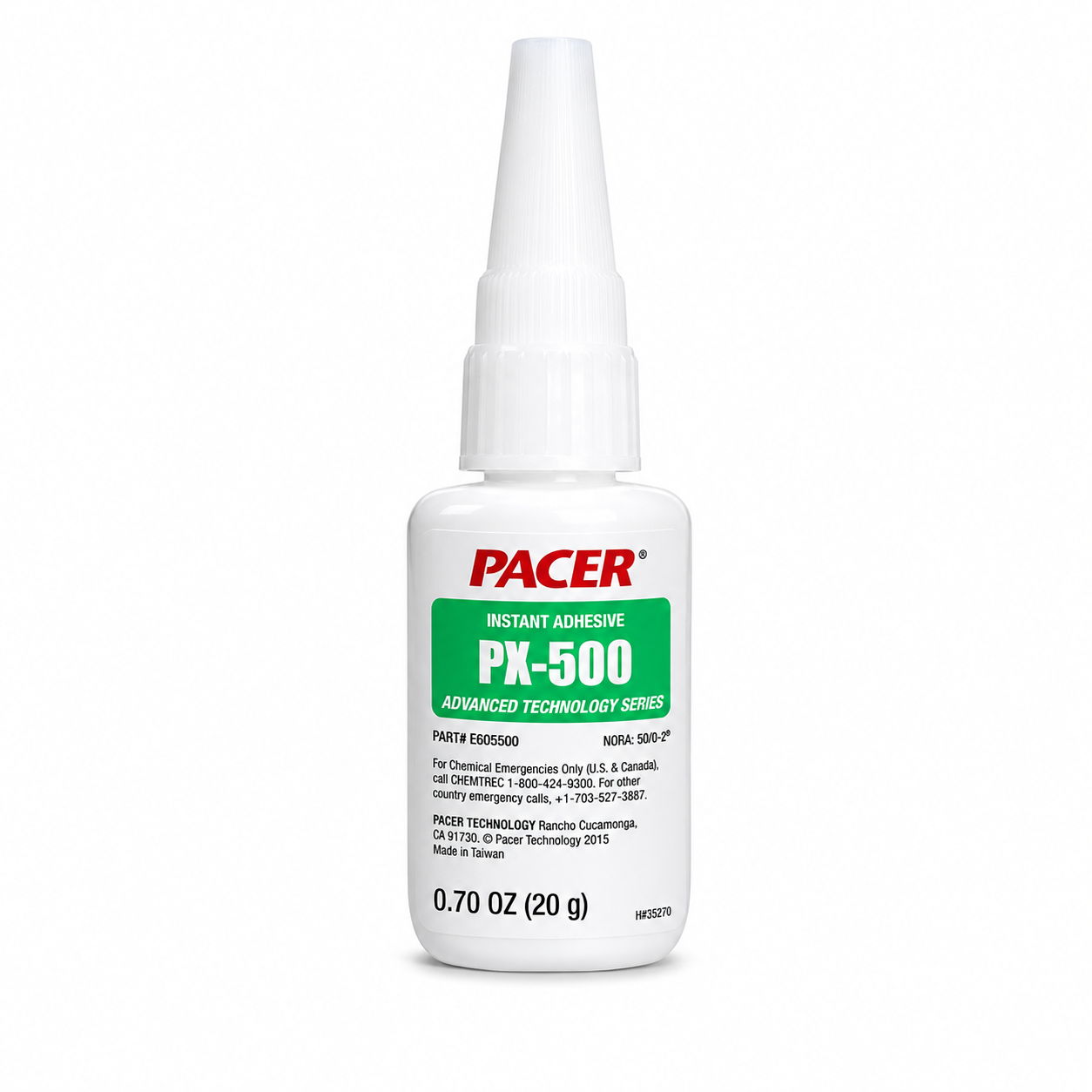
This 20 gram (0.70 oz) bottle of Pacer PX-500 is the bench and trial size of Pacer’s thicker plastics cyanoacrylate, 400 to 600 cP with .008 in gap fill. It’s the bottle for moulded parts that do not mate cleanly, which is most of them once shrink, warp, and tolerance stack are accounted for. PX is the only Pacer family built on ethyl propyl rather than ethyl or ethyl hybrid, and on ABS and rigid PVC it gives substrate failure, meaning the plastic breaks before the bond. Dispenses straight from the bottle. Sold in case quantity of 10.
Package Details
| Property | Value |
|---|---|
| Product | Pacer PX-500 Plastic Performance Cyanoacrylate Adhesive |
| Package | 20 Gram (0.70 oz) Bottle |
| Net Weight | 0.70 oz (20 g) |
| Chemical Concepts SKU | PAC-FG05090 |
| Pacer Part No. | FG05090 |
| UPC | 0 87093 00289 0 |
| Chemistry | Ethyl propyl cyanoacrylate |
| Viscosity | 400 to 600 cP |
| Typical Gap Fill | .008 in |
| Fixture Time | 1 to 5 minutes |
| Temperature Range | -65F to +200F (-54C to +93C) |
| Tensile Strength, Steel | 4400 psi (+/- 10%) |
| Tensile Shear, ABS and PVC | Substrate failure |
| Tensile Shear, Steel | 2700 psi (+/- 10%) |
| Tensile Shear, Aluminum | 700 psi (+/- 10%) |
| Specification Compliance | MIL-A-46050C Type II, Class 2; A-A-3097 Type II, Class 2 |
| Shelf Life | One year, stored per the TDS |
| Order Quantity | Case of 10 |
| Related Composite Product | Pacer PX-500 Plastic Performance Cyanoacrylate Adhesive (400-600 cP) |
Full property data, the substrate table, and guidance on measuring gap across a run of moulded parts are on the main Pacer PX-500 product page, or in the Pacer PX Series technical data sheet (PDF).
When This Is the Right Bottle
- Your moulded parts do not close cleanly. .008 in gap fill is double PX-50 and covers the shrink, warp, and tolerance stack you get across a real production run.
- You’re bonding ABS or rigid PVC, where this gives substrate failure rather than a number.
- Not for aluminum. At 700 psi this is the weakest grade in the entire Pacer cyanoacrylate line on light alloy, so a plastic-to-aluminum joint needs a different family.
- If your fit-up is actually good, use PX-50 instead. It’s the same chemistry with a better aluminum figure at 1000 psi, and a thick adhesive in a close joint holds the parts apart.
- Trial here first. Moulded plastic varies with release agent and regrind content, so prove the bond on parts from real production before you commit to the 1 lb.
- Sold in case quantity of 10, which suits stocking several stations or a moulding cell rather than a single-bottle purchase.
Performance in Production
- Dispenses straight from the bottle. No gun, no mixer, and small enough to keep at a moulding cell or in a rework kit.
- .008 in gap fill absorbs part-to-part variation rather than requiring consistent shots off the tool.
- Substrate failure on ABS and rigid PVC, so joint strength is set by the plastic rather than the adhesive.
- 4400 psi tensile and 2700 psi tensile shear on steel, identical to PX-50, so the wider gap costs nothing on plastics or steel.
- 700 psi on aluminum, the lowest figure Pacer publishes. Check this before putting PX-500 anywhere near light alloy.
- Fixture in 1 to 5 minutes, 80% of strength in 15 to 30 minutes. A filled .008 in gap cures from the outside in, so allow the longer end.
- Elongation under 2%. Rigid bond, designed for shear rather than peel or flex.
- At 400 to 600 cP it moves slowly but Pacer publishes no sag figure. Hold the part flat or clamp it.
- Test on real production parts, not clean sample plaques. Mould release and regrind content both change how a plastic surface bonds.
- Keep the tip clean and the cap on. A CA bottle that clogs is almost always a bottle that sat open.
Common Applications
- Bonding moulded ABS parts with inconsistent fit-up
- Rigid PVC assembly where joints do not close cleanly
- Plastic parts that warp out of flat even when dimensionally in spec
- Rework and repair where the original fit has been lost
- Plastic to steel joints
- Trialling PX chemistry before committing a moulding cell to bulk
- Service kits and tool trays, one bottle per station
- Bench work calling out MIL-A-46050C Type II, Class 2
Related Products
- Pacer PX-500 Plastic Performance Cyanoacrylate Adhesive, full detail and both sizes
- Pacer PX-50 Plastic Performance, 30 to 80 cP, .004 in gap, better on aluminum
- Pacer RX-500 Range Extended, same viscosity and gap, plus nylon and polycarbonate data and 1600 psi on aluminum
- Pacer E-1500 Instant Adhesive (1300-1700 cP), the general purpose thick grade at .010 in gap
- Pacer Premium Acetone Accelerator, speeds full cure through larger gaps
- All cyanoacrylate instant adhesives
Frequently Asked Questions
Can I buy a single 20 gram bottle of Pacer PX-500?
This size is sold in case quantity of 10. If you need one bottle to trial on your moulded parts, call or email us and we’ll work something out. The 1 lb bottle sells individually if a larger package works for you.
What is the difference between PX-500 and PX-50?
Gap and aluminum performance. PX-500 fills .008 in at 400 to 600 cP, PX-50 fills .004 in at 30 to 80 cP. Everything else on plastics and steel is identical. Aluminum drops from 1000 psi on PX-50 to 700 on PX-500. Measure your worst-case gap across a real run and pick from that.
Is Pacer PX-500 good for bonding metal?
Steel yes at 2700 psi, aluminum no at 700 psi. That aluminum figure is the lowest Pacer publishes anywhere in its cyanoacrylate line. If your joint involves aluminum, use a different family. This is a plastics adhesive that happens to work on steel.
Does Pacer PX-500 bond nylon or polycarbonate?
Pacer’s PX data sheet publishes shear figures for ABS and PVC only, so we can’t give you a number for nylon or polycarbonate on this grade. Pacer RX-500 runs the same viscosity and gap and does publish substrate failure on both. Tell us the exact plastic and we’ll get you a figure or a sample.
Is the 20 gram the same adhesive as the 1 lb?
Yes, identical. Same ethyl propyl chemistry, same 400 to 600 cP viscosity, same .008 in gap fill, same MIL-A-46050C Type II, Class 2 rating. Only the container and the order quantity change.
How should Pacer PX-500 be stored, and what is the shelf life?
Refrigerate unopened bottles at 40F (4C) for optimum results, then let the adhesive come up to room temperature before opening. Once opened, store in a cool, dry location. Stored that way, expect a one year shelf life.
What is the part number for the 20 gram Pacer PX-500?
Our SKU is PAC-FG05090. The Pacer part number is FG05090 and the UPC is 0 87093 00289 0. On older Pacer paperwork the same item shows as Pacer item number 11740072.
Questions on Fit
Measure your worst-case gap and tell us which plastic you’re bonding. Call (800) 220-1966 or email [email protected].



Reviews
There are no reviews yet.