

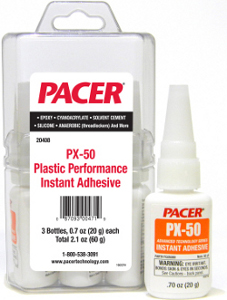
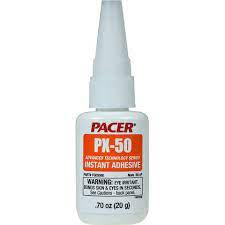


Description
Pacer PX-50 cyanoacrylate adhesive is an ethyl propyl cyanoacrylate formulated to give maximum strength bonding plastics and elastomers, either to each other or to other substrates. That chemistry is what sets the PX Series apart. Every other Pacer cyanoacrylate family runs an ethyl or ethyl hybrid base, and PX is the only one built on ethyl propyl. At 30 to 80 cP it fills to .004 in and gives 4400 psi tensile on steel, with substrate failure on both ABS and rigid PVC, meaning the plastic breaks before the bond does. It is rated -65F to +200F and meets MIL-A-46050C Type II, Class 1 and A-A-3097 Type II, Class 1. One thing to know before you specify it: on aluminum PX-50 gives 1000 psi shear, the lowest figure in Pacer’s cyanoacrylate line, so this is a plastics adhesive rather than a general purpose one.
Key Product Details
| Property | Value |
|---|---|
| Chemistry | Ethyl propyl cyanoacrylate |
| Grade | Plastic Performance, PX Series |
| Color | Clear, translucent liquid |
| Viscosity | 30 to 80 cP |
| Typical Gap Fill | .004 in |
| Fixture Time | 1 to 5 minutes |
| Strength Development | 80% of full strength in 15 to 30 minutes |
| Temperature Range | -65F to +200F (-54C to +93C) |
| Softening Point | 303F / 151C |
| Melting Point | 363F / 184C |
| Flashpoint | 186F |
| Specific Gravity | 1.04 at 25C |
| Vapor Pressure | 7 mmHg at 70C |
| Rockwell Hardness | M 70 |
| Elongation | Less than 2% |
| Outgassing | 0 (at 10^-6 mmHg, 72F) |
| Tensile Strength, Steel | 4400 psi (+/- 10%) |
| Soluble In, Liquid State | Acetone, MEK, nitromethane |
| Soluble In, Cured State | Pacer X-9 Debonder, acetone, nitromethane |
| Specification Compliance | MIL-A-46050C Type II, Class 1; A-A-3097 Type II, Class 1 |
| Shelf Life | One year, stored per the TDS |
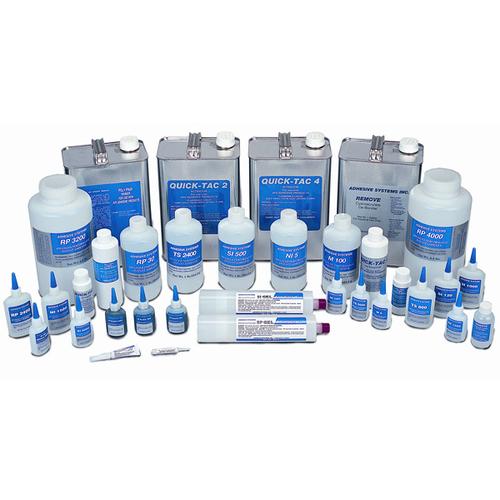
| Available Sizes | 20 Gram (0.70 oz) Bottle, 1 lb (453 g) Bottle |
Full property data for every grade in the series is in the Pacer PX Series technical data sheet (PDF). The data sheet covers grades and package sizes beyond what we currently stock. Chemical Concepts carries PX-50 and PX-500.
Tensile Shear Strength by Substrate
All figures +/- 10%. Where the table reads substrate failure, the part broke before the bond did.
| Substrate | Tensile Shear, psi |
|---|---|
| ABS | Substrate failure |
| PVC | Substrate failure |
| Steel | 2700 |
| Aluminum | 1000 |
Read that table for what it is. On plastics PX-50 does exactly what a plastics adhesive should, failing the substrate rather than the bond. On steel 2700 psi is competitive with anything in the Pacer line. On aluminum 1000 psi is the lowest figure Pacer publishes, against 1600 for the E and RX families and 1950 to 2200 for the MR grades. If your joint is aluminum, or plastic to aluminum, look at E-40 at the same viscosity or MR-290 for the highest aluminum figures.
Worth being straight about a gap in the data too. Pacer describes the PX Series as being for plastics and elastomers, but the published shear figures cover ABS and PVC only. There is no elastomer data on the sheet, and no nylon or polycarbonate either, both of which the E, RX, and MR sheets do include. If you are bonding a specific plastic or rubber and need a number, call us and we will ask Pacer directly rather than guess.
What Substrate Failure Means for Your Joint Design
Most of Pacer’s plastic results across every family read substrate failure rather than a psi number. That is a better outcome than a high figure, and it changes how you should design and test the joint.
- Substrate failure means the test broke the plastic before the adhesive let go. There is no number to report because the adhesive was never the limit.
- So on ABS and PVC, your joint strength is a property of your part, not of the adhesive. Two shops bonding different ABS grades with the same adhesive will get different joint strengths, and neither result tells you anything about the glue.
- Design against the plastic. Look up the tensile strength of your specific material and size the bond area so the joint carries less than the part can. Chasing a stronger adhesive gains you nothing once you are past substrate failure.
- Test to failure on real parts and watch where the break happens. If the plastic tears and the bond line stays intact, you are done. If the bond line separates cleanly, something else is wrong: surface contamination, a starved joint, or a gap wider than .004 in.
- Mixed joints follow the weaker side. Plastic to steel is limited by whichever fails first, and plastic to aluminum with PX-50 will be limited by the 1000 psi aluminum figure, not by the plastic.
- Molded parts vary. Mold release, regrind content, and moulding stress all affect how a plastic surface bonds, so test parts from real production rather than clean sample plaques.
- Keep the bond line thin. Cured cyanoacrylate has elongation under 2%, so a thick bond line carries load worse than a thin one. .004 in is the working limit for this grade.
Choosing a Grade in the PX Series
Both current PX grades share the same ethyl propyl chemistry, the same -65F to +200F range, and the same 2700 psi shear on steel. Viscosity, gap, and spec class separate them.
| Grade | Viscosity | Gap Fill | Aluminum Shear | MIL Class |
|---|---|---|---|---|
| PX-50 | 30 to 80 cP | .004 in | 1000 psi | Class 1 |
| PX-500 | 400 to 600 cP | .008 in | 700 psi | Class 2 |
PX-50 is the default. Move to PX-500 when your fit-up runs past .004 in, but note its aluminum figure drops further to 700 psi. Pacer’s data sheet also lists PX-5 at 2 to 5 cP, which we no longer stock, so the series now starts at PX-50.
Across families, if your plastics work also needs something PX does not offer: Pacer’s RX Series handles plated, oily, and acidic surfaces and publishes substrate failure on nylon, polycarbonate, SBR, and EPDM as well as ABS and PVC. The MR Series is rated to +260F with published immersion data. And if the joint sees peel or flexing, ask us about the HP Series, which publishes T-Peel figures.
Performance in Production
- Ethyl propyl chemistry, the only base in Pacer’s cyanoacrylate line that is not ethyl or ethyl hybrid, formulated specifically for plastics and elastomers.
- Substrate failure on both ABS and rigid PVC, meaning the plastic breaks before the bond and your joint strength is set by the part.
- 4400 psi tensile on steel and 2700 psi tensile shear on steel, competitive with the strongest grades Pacer offers.
- 1000 psi on aluminum, the lowest figure in the Pacer cyanoacrylate line. This is the number to check before specifying PX for anything involving light alloy.
- At 30 to 80 cP it flows into a close joint. .004 in gap capability means fit-up needs to be reasonably good, which is normal for injection-moulded parts.
- Rated -65F to +200F, 20 degrees above the E and RX families at +180F, though below the MR Series at +260F.
- Fixture in 1 to 5 minutes and 80% of strength in 15 to 30 minutes, the same across the PX Series.
- Elongation under 2% and Rockwell M 70. This is a rigid bond, so it is not the pick for a joint that flexes or peels.
- Still a low viscosity liquid. It will run on a vertical or overhead face before it cures, and Pacer publishes no sag figure. Fixture flat or clamp.
- Available in a 20 gram bottle and a 1 lb bulk bottle, so you can trial it and then standardize without changing grade.
Common Applications
- Bonding ABS parts to each other or to other substrates
- Rigid PVC assembly and fabrication
- Injection-moulded plastic assembly on a production line
- Plastic to plastic joints where maximum strength matters
- Plastic to steel joints, at 2700 psi on the metal side
- Elastomer bonding, subject to testing since Pacer publishes no elastomer figures
- Rework and repair of moulded plastic components
- Assemblies running up to +200F
- Work calling out MIL-A-46050C Type II, Class 1 or A-A-3097 Type II, Class 1
Available Sizes
| Size | Net Weight | SKU | Pacer Part No. | UPC |
|---|---|---|---|---|
| 20 Gram Bottle | 0.70 oz (20 g) | PAC-FG05080 | FG05080 | 0 87093 00286 9 |
| 1 lb Bottle | 1 lb (453 g) | PAC-FG05083 | FG05083 | 0 87093 00287 6 |
The 20 gram bottle is sold in case quantity of 10. The 1 lb bottle sells individually. The 5 gram bottle, part FG05085, has been discontinued.
Related Products
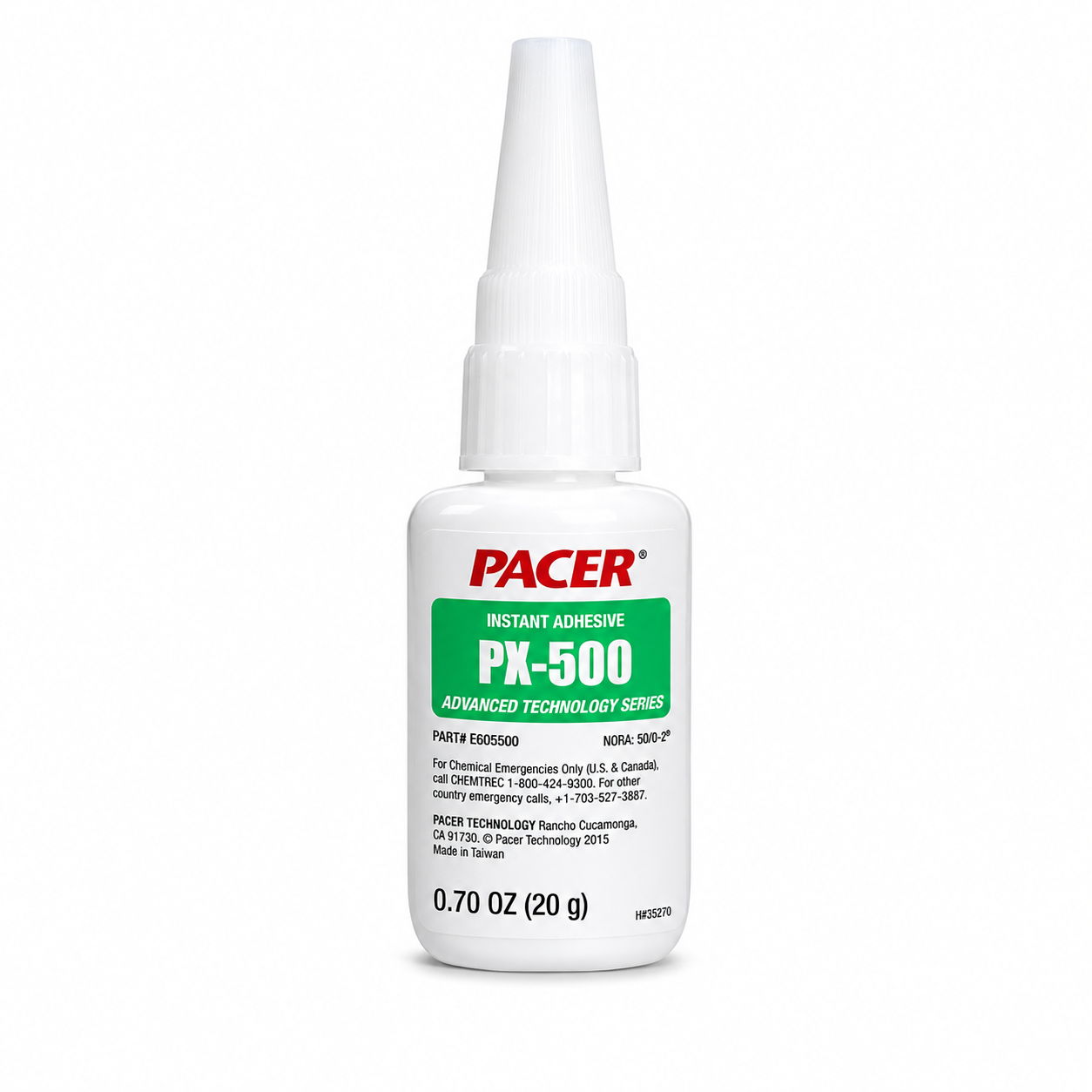
- Pacer PX-500 Plastic Performance, 400 to 600 cP, .008 in gap, the thicker PX grade for looser fit-up
- Pacer RX-100 Range Extended (80-120 cP), publishes substrate failure on nylon, polycarbonate, SBR, and EPDM as well as ABS and PVC, and handles plated or oily surfaces
- Pacer E-40 Instant Adhesive (30-70 cP), the general purpose grade at the same viscosity, stronger on aluminum at 1600 psi
- Pacer MR-290 Moisture Resistant, rated to +260F with published immersion data, and 2100 psi on aluminum
- Pacer Premium Acetone Accelerator, speeds full cure through larger gaps
- All cyanoacrylate instant adhesives
Frequently Asked Questions
What is Pacer PX-50 used for?
Pacer PX-50 is used for bonding plastics and elastomers, either to each other or to other substrates. It is an ethyl propyl cyanoacrylate formulated specifically for that job, and it gives substrate failure on both ABS and rigid PVC, meaning the plastic breaks before the bond. At 30 to 80 cP it fills to .004 in and comes in a 20 gram bottle and a 1 lb bulk bottle.
What is ethyl propyl cyanoacrylate?
It is a different cyanoacrylate base chemistry from the ethyl and ethyl hybrid formulations Pacer uses everywhere else. The PX Series is the only Pacer cyanoacrylate family built on ethyl propyl, and Pacer formulated it to give maximum strength on plastics and elastomers. Practically, it applies and cures like any other cyanoacrylate: one surface only, mate promptly, fixture in 1 to 5 minutes.
Is Pacer PX-50 good for bonding metal?
On steel yes, on aluminum no. Steel comes in at 2700 psi tensile shear, which is competitive with anything in the Pacer line. Aluminum comes in at 1000 psi, the lowest figure Pacer publishes, against 1600 for the E and RX families and up to 2200 for the MR grades. If your joint involves aluminum or another light alloy, use a different family. This is a plastics adhesive that happens to be fine on steel, not a general purpose metal adhesive.
What does substrate failure mean on the data sheet?
It means the test broke the plastic before the adhesive let go, so there is no psi figure to report because the adhesive was never the limiting factor. On ABS and PVC your joint strength becomes a property of your part rather than of the glue. Design the bond area against the tensile strength of your specific plastic, and test on parts from real production rather than clean sample plaques, since mould release and regrind content both affect how a surface bonds.
Does Pacer PX-50 bond nylon or polycarbonate?
Pacer’s PX data sheet publishes shear figures for ABS and PVC only, so we cannot give you a number for nylon or polycarbonate on this grade. Pacer’s RX Series does publish substrate failure on nylon and polycarbonate along with ABS, PVC, SBR, and EPDM, so if you need documented performance on those materials that is the family to look at. Tell us the exact plastic and we will get you a figure or a sample.
How much gap will Pacer PX-50 fill?
Typical gap fill is .004 in, which suits the fit-up you normally get off injection-moulded parts. If your parts sit looser, PX-500 fills .008 in in the same chemistry, though its aluminum figure drops to 700 psi. Adding more adhesive does not bridge a wider gap, it leaves an uncured core.
What temperature can Pacer PX-50 handle?
-65F to +200F (-54C to +93C), which is 20 degrees above Pacer’s E and RX families. Softening point is 303F and melting point 363F. If you need more, the MR Series is rated to +260F, and the TX Series is built for continuous elevated temperature.
Does Pacer PX-50 come in a 5 gram bottle?
Not any more. The 5 gram, part FG05085, has been discontinued. PX-50 is now offered in a 20 gram bottle sold in case quantity of 10, and a 1 lb bulk bottle sold individually. Call us if you need a small quantity for a trial and we will work something out.
How should Pacer PX-50 be stored, and what is the shelf life?
Refrigerate unopened bottles at 40F (4C) for optimum results, then let the adhesive come up to room temperature before opening. Opening a cold bottle draws condensation into the material. Once opened, store in a cool, dry location. Stored that way, expect a one year shelf life.
Questions on Fit
Tell us which plastic you’re bonding and we’ll tell you straight whether this is the right grade. Call (800) 220-1966 or email [email protected].


Reviews
There are no reviews yet.