



Description
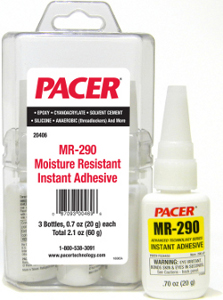
Pacer MR-290 cyanoacrylate adhesive is a moisture resistant instant adhesive built to hold its strength in conditions that break a standard cyanoacrylate. It is rated -65F to +260F, 80 degrees higher than any grade in Pacer’s E or RX families, and it is one of only three Pacer cyanoacrylates with published hot water immersion and thermal cycling data. After 30 days submerged at 104F it still holds 1500 psi on steel, and after 20 cycles from -22F to 158F it retains 2700 of its initial 2800 psi. At 250 to 350 cP it fills to .012 in, which is a wider gap than Pacer’s thickest general purpose grade manages at four times the viscosity. MR-290 meets MIL-A-46050C Type II, Class 2 and A-A-3097 Type II, Class 2, and with MR-10 discontinued it is now the thinnest grade in the MR Series.
Key Product Details
| Property | Value |
|---|---|
| Chemistry | Ethyl hybrid cyanoacrylate |
| Grade | Moisture Resistant, MR Series |
| Color | Clear, transparent liquid |
| Viscosity | 250 to 350 cP |
| Typical Gap | .012 in |
| Fixture Time | 1 to 5 minutes |
| Strength Development | 80% of full strength in 15 to 30 minutes |
| Temperature Use Range | -65F to +260F (-54C to +127C) |
| Softening Point | 300F / 149C |
| Melting Point | 361F / 183C |
| Flashpoint | 185F |
| Specific Gravity | 1.05 at 20C |
| Vapor Pressure | 6 mm Hg at 70C |
| Rockwell Hardness | M 67 |
| Outgassing | 0 (at 10^-6 mmHg, 72F) |
| Tensile Strength, Steel | 4500 psi |
| Soluble In, Liquid State | Acetone, MEK, nitromethane |
| Soluble In, Cured State | Pacer X-9 Debonder, acetone, nitromethane |
| Specification Compliance | MIL-A-46050C Type II, Class 2; A-A-3097 Type II, Class 2 |
| Shelf Life | One year, stored per the TDS |
| Available Sizes | 20 Gram (0.70 oz) Bottle, 1 lb (453 g) Bottle |
Full property data for every grade in the series is in the Pacer MR Series technical data sheet (PDF). The data sheet covers grades and package sizes beyond what we currently stock. Chemical Concepts carries MR-290 and MR-3000. MR-10, the water-thin grade, has been discontinued.
Shear Strength by Substrate
Tested per ASTM D-1002, all figures +/- 10%. Where the table reads substrate failure, the part broke before the bond did.
| Substrate | Shear Strength, psi |
|---|---|
| Steel | 2800 |
| Aluminum | 2100 |
| ABS | Substrate failure |
| Rigid PVC | Substrate failure |
| Nylon | Substrate failure |
| SBR | Substrate failure |
| EPDM | 100 |
2800 psi on steel and 2100 psi on aluminum are near the top of everything Pacer publishes across its cyanoacrylate line, where the E grades run 2200 to 2700 on steel and 1600 on aluminum, and the RX grades 2300 and 1600. The aluminum figure in particular is worth knowing if you bond light alloy. The exception is EPDM at 100 psi. If your joint is EPDM rubber, Pacer’s RX Series fails the substrate before the bond and is the better family for that substrate.
Hot Water Immersion and Thermal Cycling
This is the data the MR Series exists for, and no Pacer family outside MR publishes anything comparable. Both tests are on steel, per ASTM D-1002, +/- 10%.
| Condition | Shear, psi | Retained |
|---|---|---|
| Initial | 2800 | Baseline |
| Hot water immersion, 7 days at 104F (40C) | 1800 | 64% |
| Hot water immersion, 14 days at 104F | 1600 | 57% |
| Hot water immersion, 30 days at 104F | 1500 | 54% |
| Cold and heat cycling, 10 cycles | 2700 | 96% |
| Cold and heat cycling, 20 cycles | 2700 | 96% |
One cycle is 3 hours at -22F followed by 3 hours at 158F. Retained percentages are calculated from Pacer’s published figures. The cycling result is the one worth dwelling on: 96% strength retention after 20 full swings, and the curve is flat between 10 and 20 cycles, which suggests the loss happens early and then stops rather than degrading steadily.
How Moisture and Thermal Cycling Break a Cyanoacrylate Bond
A cyanoacrylate joint that passes on the bench can still fail in service, and the two usual causes are water and temperature swings. Neither shows up in a shear test on a dry coupon at room temperature, which is why most CA data sheets tell you nothing about them.
- Water attacks the bond line over time, not instantly. A standard cyanoacrylate joint can look fine for weeks and then let go, which is why an immersion test runs 30 days rather than 30 minutes.
- Heat makes it worse. Pacer’s immersion test is at 104F, not room temperature, because warm water works faster than cold. That combination is what a washdown line, a pool or spa component, or a marine fitting actually sees.
- Temperature cycling is a different failure mode. Cured cyanoacrylate is rigid with elongation under 2%, so it cannot flex to absorb the differential expansion between two dissimilar materials. Each swing loads the bond line, and repeated swings fatigue it.
- Pacer’s cycling test swings 180 degrees, from -22F to 158F, six hours per cycle. That is more aggressive than most equipment sees, which is what makes 96% retention a meaningful number.
- Read the retention percentage, not just the initial figure. A grade at 2800 psi that drops to 800 after immersion is worse in service than one that starts at 2400 and holds 1800.
- Design the bond area against the degraded number if the assembly will see the exposure. Sizing a wet joint against the dry 2800 psi figure is how a joint that tested fine fails in year two.
- None of this changes the application process. Clean both faces, apply to one surface only, mate promptly, fixture 1 to 5 minutes, allow 15 to 30 minutes to 80% strength. Moisture resistance is a property of the cured adhesive, not a technique.
- Test on actual parts in actual conditions before committing a process. If the assembly gets wet, get a sample wet.
Choosing a Grade in the MR Series
Both current MR grades share the same ethyl hybrid chemistry, the same -65F to +260F range, and the same 4500 psi tensile on steel. Viscosity, gap, and durability figures are what separate them.
| Grade | Viscosity | Typical Gap | Steel Shear | 30 Days at 104F | MIL Class |
|---|---|---|---|---|---|
| MR-290 | 250 to 350 cP | .012 in | 2800 psi | 1500 psi (54%) | Class 2 |
| MR-3000 | 2500 to 3500 cP | .020 in | 2900 psi | 1850 psi (64%) | Class 3 |
| MR-10, discontinued | 6 to 12 cP | .002 in | 2800 psi | 1400 psi (50%) | Class 1 |
MR-290 is the default. It is the thinnest grade the family still offers, it carries both a 20 gram and a 1 lb bottle, and .012 in of gap already covers most fit-up. Go to MR-3000 if the gap runs wider than that or if the joint will be genuinely wet for extended periods, since its 1850 psi after 30 days immersion is the best figure Pacer publishes anywhere.
Worth putting the gap figure in context. MR-290 fills .012 in at 250 to 350 cP, where Pacer’s E-1500 needs 1300 to 1700 cP to reach only .010 in, and RX-700 needs 600 to 800 cP for the same .010 in. So MR-290 gives you more gap at lower viscosity than anything else in the Pacer line, which makes it easier to dispense and easier to wet a joint with.
Performance in Production
- Rated -65F to +260F, which is 80 degrees above every grade in Pacer’s E and RX families. If the assembly runs warm in service, this is the family to specify.
- Holds 1500 psi on steel after 30 days submerged at 104F, and 2700 psi after 20 thermal cycles from -22F to 158F. Published durability data rather than a general claim about weather resistance.
- .012 in gap capability at only 250 to 350 cP, the widest gap Pacer offers below 2500 cP. Wide enough for ordinary fit-up variation, thin enough to dispense from a bottle without fighting it.
- 2800 psi shear on steel and 2100 psi on aluminum, both near the top of the Pacer range and well above the 1600 psi aluminum figure typical of the E and RX grades.
- 4500 psi tensile on steel, shared across the MR Series and above the 4000 psi typical elsewhere.
- Fixture in 1 to 5 minutes and 80% of strength in 15 to 30 minutes. A filled .012 in gap cures from the outside in, so allow the longer end before loading a wide joint.
- Rockwell M 67, softer than the thin grades across the Pacer line, which is consistent with a thicker bond line in a wider gap.
- At 250 to 350 cP it is still a liquid. Pacer publishes no sag figure, so plan on a horizontal or clamped joint rather than assuming it holds on a vertical face.
- EPDM comes in at 100 psi, the same as the E Series. If EPDM is your substrate, the RX Series is the better family since it fails the rubber before the bond.
- Available in both a 20 gram bottle and a 1 lb bulk bottle, so a shop can trial it and then standardize without changing grade.
Common Applications
- Assemblies that get wet in service, including washdown environments
- Marine components and fittings
- Pool, spa, and plumbing hardware
- Outdoor equipment exposed to humidity and temperature swings
- Joints running warm, up to +260F
- Dissimilar material joints that see freeze and heat cycling
- Aluminum and light alloy bonding, where the 2100 psi figure is well above the rest of the Pacer line
- Steel bonding at 2800 psi shear and 4500 psi tensile
- Parts with fit-up variation up to .012 in
- Work calling out MIL-A-46050C Type II, Class 2 or A-A-3097 Type II, Class 2
Available Sizes
| Size | Net Weight | SKU | Pacer Part No. | UPC |
|---|---|---|---|---|
| 20 Gram Bottle | 0.70 oz (20 g) | PAC-FG04450 | FG04450 | 0 87093 00271 5 |
| 1 lb Bottle | 1 lb (453 g) | PAC-FG04453 | FG04453 | 0 87093 00272 2 |
The 20 gram bottle is sold in case quantity of 10. The 1 lb bottle sells individually. Pacer’s data sheet also lists a 5 gram in this grade, part FG04455, which was not on our last price list. Ask us if you need it.
Related Products
- Pacer MR-3000 Moisture Resistant, 2500 to 3500 cP, .020 in gap, and the best hot water immersion figures Pacer publishes at 1850 psi after 30 days
- Pacer MR-10, the discontinued water-thin MR grade, specifications retained for reference
- Pacer RX-100 Range Extended (80-120 cP), if the problem is a plated, oily, or acidic surface rather than moisture, and the better family for EPDM rubber
- Pacer E-100 Instant Adhesive (80-120 cP), the general purpose Class 2 grade for dry indoor service
- Pacer Premium Acetone Accelerator, speeds full cure through larger gaps
- All cyanoacrylate instant adhesives
Frequently Asked Questions
What is Pacer MR-290 used for?
Pacer MR-290 is used for bonding assemblies that get wet, run warm, or go through temperature swings in service. It is rated -65F to +260F and Pacer publishes hot water immersion and thermal cycling data for it, which no other Pacer cyanoacrylate family provides. At 250 to 350 cP it fills to .012 in, and it comes in a 20 gram bottle and a 1 lb bulk bottle.
Will cyanoacrylate hold up in water?
A moisture resistant grade will, to a documented degree. Pacer publishes hot water immersion data for the MR Series, and MR-290 holds 1500 psi on steel after 30 days submerged at 104F, down from 2800 psi initially, so roughly 54% retention. Most cyanoacrylates publish nothing on immersion at all, which is not the same as passing. If your joint will be wet in service, design the bond area against the degraded figure rather than the dry one, and get a sample wet before you commit.
What temperature can Pacer MR-290 handle?
-65F to +260F (-54C to +127C). That is 80 degrees higher than every grade in Pacer’s E and RX families, which top out at +180F. Softening point is 300F and melting point 361F. If you need more than +260F, ask us about Pacer’s TX Series, which is built for continuous elevated temperature and publishes hot strength data tested at temperature.
How much gap will Pacer MR-290 fill?
Typical gap capability is .012 in, which is the widest gap Pacer offers in any grade below 2500 cP. For comparison, E-1500 reaches only .010 in at 1300 to 1700 cP and RX-700 reaches .010 in at 600 to 800 cP. If you need more, MR-3000 fills .020 in. Past that, cyanoacrylate leaves an uncured core and a two part structural adhesive is the answer.
What is the difference between MR-290 and MR-3000?
Viscosity, gap, and water resistance. MR-290 is 250 to 350 cP filling .012 in, MR-3000 is 2500 to 3500 cP filling .020 in. MR-3000 also holds up better wet, 1850 psi after 30 days immersion against MR-290’s 1500. Both share the -65F to +260F range, the same 4500 psi tensile, and the same 96% retention through thermal cycling. Use MR-290 unless the gap is wide or the joint will be genuinely submerged.
Does Pacer MR-290 bond EPDM rubber?
Only to 100 psi, the same as Pacer’s general purpose E Series. That is the one substrate where the MR Series is not the strong choice. If you are bonding EPDM or SBR, Pacer’s RX Series fails the rubber before the bond, so it is the better family. If you need EPDM performance and moisture resistance together, call us, because no single Pacer grade covers both.
Does Pacer MR-290 meet MIL-A-46050C?
Yes, at Type II, Class 2, and it also meets A-A-3097 Type II, Class 2. Pacer states it will certify compliance. MR-3000 is Class 3 and the discontinued MR-10 was Class 1. Ask for the certificate of conformance when you place the order rather than after the parts arrive.
Will Pacer MR-290 stay put on a vertical surface?
Better than a thin grade, but it is not rated for it. At 250 to 350 cP it moves more slowly than a water-thin cyanoacrylate, and Pacer publishes no sag or slump figure for it. Plan on a horizontal or clamped joint. If the part cannot be reoriented, the only Pacer cyanoacrylate rated non-sag is the RX Gel, though it does not carry the MR moisture and thermal performance.
How should Pacer MR-290 be stored, and what is the shelf life?
Refrigerate unopened bottles at 40F (4C) for optimum results, then let the adhesive come up to room temperature before opening. Opening a cold bottle draws condensation into the material. Once opened, store in a cool, dry location. Stored that way, expect a one year shelf life.
Questions on Fit
Bonding something that gets wet or runs hot? Call (800) 220-1966 or email [email protected] and tell us what the assembly sees in service.


Reviews
There are no reviews yet.