

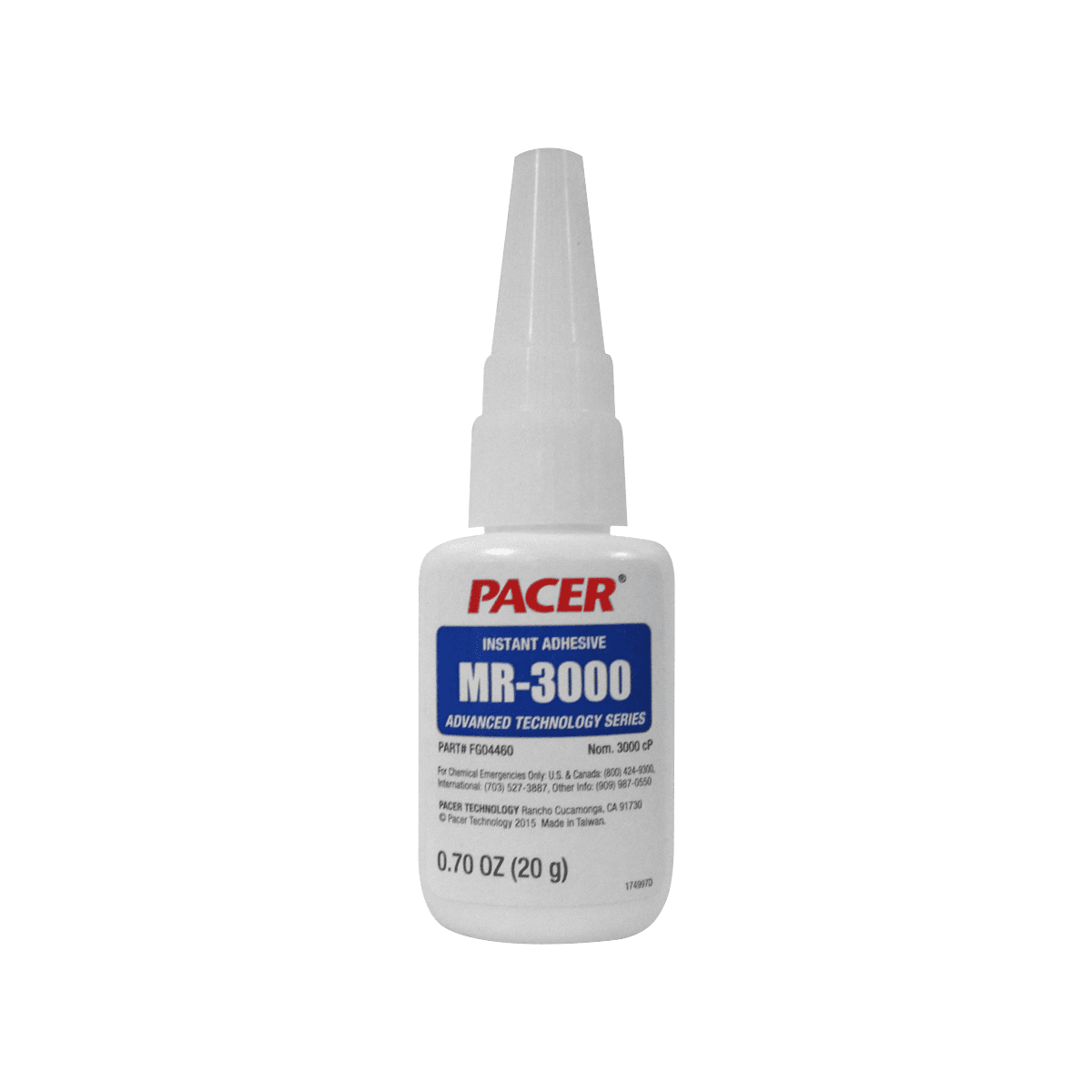


Description
Pacer MR-3000 cyanoacrylate adhesive is the thickest and most durable grade in Pacer’s Moisture Resistant series. At 2500 to 3500 cP it fills to .020 in, and it carries the strongest published figures across Pacer’s cyanoacrylate line: 2900 psi shear on steel and 2200 psi on aluminum, matched only by the TX Series high temperature grades. Where it stands alone is durability. After 30 days submerged at 104F it still holds 1850 psi, 64% of its initial strength and the best hot water immersion result Pacer publishes anywhere. It is rated -65F to +260F and retains 2700 psi after 20 thermal cycles from -22F to 158F. MR-3000 meets MIL-A-46050C Type II, Class 3 and A-A-3097 Type II, Class 3, and comes in a 20 gram bottle and a 1 lb bulk bottle.
Key Product Details
| Property | Value |
|---|---|
| Chemistry | Ethyl hybrid cyanoacrylate |
| Grade | Moisture Resistant, MR Series |
| Color | Clear, transparent liquid |
| Viscosity | 2500 to 3500 cP |
| Typical Gap | .020 in |
| Fixture Time | 1 to 5 minutes |
| Strength Development | 80% of full strength in 15 to 30 minutes |
| Temperature Use Range | -65F to +260F (-54C to +127C) |
| Softening Point | 296F / 147C |
| Melting Point | 356F / 180C |
| Flashpoint | 185F |
| Specific Gravity | 1.05 at 20C |
| Vapor Pressure | 6 mm Hg at 70C |
| Rockwell Hardness | M 64 |
| Outgassing | 0 (at 10^-6 mmHg, 72F) |
| Tensile Strength, Steel | 4500 psi |
| Soluble In, Liquid State | Acetone, MEK, nitromethane |
| Soluble In, Cured State | Pacer X-9 Debonder, acetone, nitromethane |
| Specification Compliance | MIL-A-46050C Type II, Class 3; A-A-3097 Type II, Class 3 |
| Shelf Life | One year, stored per the TDS |
| Available Sizes | 20 Gram (0.70 oz) Bottle, 1 lb (453 g) Bottle |
Full property data for every grade in the series is in the Pacer MR Series technical data sheet (PDF). The data sheet covers grades beyond what we currently stock. Chemical Concepts carries MR-290 and MR-3000. MR-10, the water-thin grade, has been discontinued.
Shear Strength by Substrate
Tested per ASTM D-1002, all figures +/- 10%. Where the table reads substrate failure, the part broke before the bond did.
| Substrate | Shear Strength, psi |
|---|---|
| Steel | 2900 |
| Aluminum | 2200 |
| ABS | Substrate failure |
| Rigid PVC | Substrate failure |
| Nylon | Substrate failure |
| SBR | Substrate failure |
| EPDM | 100 |
2900 psi on steel and 2200 psi on aluminum are the highest figures Pacer publishes across its cyanoacrylate families, matched only by TX-2000 in the high temperature series. The E grades run 2200 to 2700 on steel with 1600 on aluminum, and the RX grades 2300 and 1600. That aluminum figure is 38% above the E and RX families, which matters if you bond light alloy. The exception is EPDM at 100 psi. If your joint is EPDM or SBR rubber, Pacer’s RX Series fails the substrate before the bond and is the better family for that substrate.
Hot Water Immersion and Thermal Cycling
This is where MR-3000 separates itself, not just from the rest of the Pacer line but from most cyanoacrylates on the market, because almost none publish immersion data at all. Both tests are on steel, per ASTM D-1002, +/- 10%.
| Condition | Shear, psi | Retained |
|---|---|---|
| Initial | 2900 | Baseline |
| Hot water immersion, 7 days at 104F (40C) | 2060 | 71% |
| Hot water immersion, 14 days at 104F | 1900 | 66% |
| Hot water immersion, 30 days at 104F | 1850 | 64% |
| Cold and heat cycling, 10 cycles | 2700 | 93% |
| Cold and heat cycling, 20 cycles | 2700 | 93% |
One cycle is 3 hours at -22F followed by 3 hours at 158F. Retained percentages are calculated from Pacer’s published figures.
Two things worth reading off that table. The immersion curve flattens: most of the loss happens in the first week, then it settles, holding 1850 psi at 30 days against 2060 at 7 days. And the cycling figure is identical at 10 and 20 cycles, which points to the same pattern. Across the MR family, MR-3000’s 64% retention beats MR-290’s 54% and the discontinued MR-10’s 50%, so if the joint will genuinely be wet for extended periods, this is the grade regardless of what gap you need.
Bonding Dissimilar Materials Through Temperature Swings
Two different materials bonded together expand and contract at different rates. Aluminum moves roughly twice as much as steel for the same temperature change, and most plastics move several times more than either. In a rigid bond line, every temperature swing loads the joint, and that is a failure mode a room-temperature shear test will never show you.
- Work out whether your joint actually cycles. A part that lives indoors at a stable temperature does not need this. A part that sits outside, gets washed down with hot water, or runs next to a heat source does.
- Identify the mismatch. Metal to plastic is the worst case, metal to a different metal is milder, same material to itself is not a concern at all.
- Do not starve the joint. MR-3000’s .020 in gap capability lets you run a full bond line rather than clamping two dissimilar parts down to metal-on-metal contact, and Pacer’s cycling data was measured on a real bond line.
- Size the bond area against the cycled figure, 2700 psi, not the initial 2900. And if the joint is also wet, size against 1850.
- Cure normally. Clean both faces, apply to one surface only, mate promptly, fixture 1 to 5 minutes, allow 15 to 30 minutes to 80% strength. A filled .020 in gap cures from the outside in, so give a wide joint the longer end of that range.
- Consider a Pacer accelerator at this gap. Pacer recommends accelerators specifically to speed cure through larger gaps, at the cost of possible white frosting on exposed adhesive and some loss of cure strength.
- Test through the actual range, not just at room temperature. Cycle a sample from your real low to your real high before you commit a process.
- If the joint needs to flex rather than just survive expansion, cyanoacrylate is the wrong chemistry regardless of grade. Ask us about Pacer’s HP Series, which publishes T-Peel data, or a flexible structural adhesive.
Choosing a Grade in the MR Series
Both current MR grades share the same ethyl hybrid chemistry, the same -65F to +260F range, and the same 4500 psi tensile on steel. Viscosity, gap, and durability figures separate them.
| Grade | Viscosity | Typical Gap | Steel Shear | 30 Days at 104F | MIL Class |
|---|---|---|---|---|---|
| MR-290 | 250 to 350 cP | .012 in | 2800 psi | 1500 psi (54%) | Class 2 |
| MR-3000 | 2500 to 3500 cP | .020 in | 2900 psi | 1850 psi (64%) | Class 3 |
| MR-10, discontinued | 6 to 12 cP | .002 in | 2800 psi | 1400 psi (50%) | Class 1 |
MR-3000 wins on every performance column. The reason not to use it is viscosity: at 2500 to 3500 cP it is thick, and a close-fitting joint does not want a thick adhesive holding the parts apart. If your fit-up is good, MR-290 at 250 to 350 cP is the sensible grade and its 54% immersion retention is still far beyond anything Pacer publishes outside the MR family. Use MR-3000 when the gap runs past .012 in, or when the joint will be genuinely wet for weeks at a time.
.020 in is the widest gap Pacer offers in any cyanoacrylate, tied with the RX Gel and TX-2000. Past that, cyanoacrylate leaves an uncured core no matter how much you apply, and a two part structural adhesive is the right tool.
Performance in Production
- 2900 psi shear on steel and 2200 psi on aluminum, the highest figures Pacer publishes across its cyanoacrylate line and matched only by TX-2000. The aluminum number is 38% above the E and RX families.
- Holds 1850 psi after 30 days submerged at 104F, 64% retention and the best immersion result Pacer publishes anywhere. Most of the loss happens in week one, then the curve flattens.
- Retains 2700 psi after 20 thermal cycles from -22F to 158F, and the figure is identical at 10 and 20 cycles.
- Rated -65F to +260F, 80 degrees above every grade in Pacer’s E and RX families.
- .020 in gap capability, the widest in the Pacer cyanoacrylate line, which covers badly mating parts and lets you run a full bond line on a dissimilar-material joint.
- 4500 psi tensile on steel, shared across the MR Series and above the 4000 psi typical elsewhere.
- Fixture in 1 to 5 minutes and 80% of strength in 15 to 30 minutes. A filled .020 in gap cures from the outside in, so allow the longer end before loading.
- Rockwell M 64, the softest of the MR grades, consistent with a thicker bond line in a wider gap.
- At 2500 to 3500 cP it is thick but Pacer publishes no sag figure and does not rate it for vertical work. Plan on a horizontal or clamped joint, or use the RX Gel if the part cannot be reoriented.
- EPDM comes in at 100 psi. If EPDM is your substrate, the RX Series is the better family.
- Available in a 20 gram bottle and a 1 lb bulk bottle, so a shop can trial it and then standardize without changing grade.
Common Applications
- Assemblies that stay wet for extended periods, including submerged components
- Marine hardware and fittings
- Pool, spa, and plumbing components
- Washdown environments and food processing equipment
- Outdoor equipment through freeze and heat cycles
- Dissimilar material joints that see temperature swings
- Aluminum and light alloy bonding at 2200 psi shear
- Joints running warm, up to +260F
- Badly mating parts needing up to .020 in of gap
- Work calling out MIL-A-46050C Type II, Class 3 or A-A-3097 Type II, Class 3
Available Sizes
| Size | Net Weight | SKU | Pacer Part No. | UPC |
|---|---|---|---|---|
| 20 Gram Bottle | 0.70 oz (20 g) | PAC-FG04460 | FG04460 | 0 87093 00274 6 |
| 1 lb Bottle | 1 lb (453 g) | PAC-FG04463 | FG04463 | 0 87093 00275 3 |
The 20 gram bottle is sold in case quantity of 10. The 1 lb bottle sells individually. Both MR grades are available in a 1 lb, so you can standardize either at production volume.
Related Products
- Pacer MR-290 Moisture Resistant, 250 to 350 cP, .012 in gap, the thinner MR grade for close-fitting joints
- Pacer MR-10, the discontinued water-thin MR grade, specifications retained for reference
- Pacer RX Gel, the same .020 in gap and the only Pacer grade rated non-sag for vertical work, though without the MR moisture and thermal performance
- Pacer RX-100 Range Extended (80-120 cP), if the problem is a plated, oily, or acidic surface, and the better family for EPDM rubber
- Pacer E-1500 Instant Adhesive (1300-1700 cP), the general purpose Class 3 grade for dry indoor service
- Pacer Premium Acetone Accelerator, speeds full cure through larger gaps, relevant at this gap
- All cyanoacrylate instant adhesives
Frequently Asked Questions
What is Pacer MR-3000 used for?
Pacer MR-3000 is used for bonding assemblies that stay wet, run warm, or cycle through temperature, where the parts also fit loosely. At 2500 to 3500 cP it fills to .020 in, the widest gap Pacer offers, and it is rated -65F to +260F. It holds 1850 psi on steel after 30 days submerged at 104F, the best immersion figure Pacer publishes, and gives 2900 psi shear on steel and 2200 psi on aluminum.
Will cyanoacrylate hold up underwater?
A moisture resistant grade will, to a documented degree, and MR-3000 is the best Pacer offers. It holds 1850 psi on steel after 30 days submerged at 104F, down from 2900 psi initially, so 64% retention. Most cyanoacrylates publish nothing at all on immersion, which is not the same as passing. Note that the loss is front-loaded: 71% retained at 7 days, 64% at 30 days, so the bond stabilizes rather than degrading steadily. Size the bond area against the degraded figure and get a sample wet before you commit a process.
Which Pacer cyanoacrylate is strongest?
On shear strength, MR-3000 and TX-2000 tie at 2900 psi on steel and 2200 psi on aluminum, the highest figures Pacer publishes. Several HP Series grades also reach 2900 psi on steel. For comparison, the E grades run 2200 to 2700 on steel and the RX grades 2300. On tensile strength, E-40 leads at 4700 psi while the MR grades sit at 4500. Which one is right for your joint depends on fit-up and service conditions more than on the headline number.
How much gap will Pacer MR-3000 fill?
Typical gap capability is .020 in, the widest Pacer offers in any cyanoacrylate, tied with the RX Gel and TX-2000. Past .020 in, cyanoacrylate is the wrong chemistry: cure runs on surface moisture reaching the middle of the bond line and a wider gap leaves an uncured core. Ask us about a two part structural adhesive instead.
What is the difference between MR-3000 and MR-290?
Viscosity, gap, and water resistance. MR-3000 is 2500 to 3500 cP filling .020 in, MR-290 is 250 to 350 cP filling .012 in. MR-3000 holds up better wet, 1850 psi after 30 days immersion against MR-290’s 1500, and is slightly stronger at 2900 psi steel shear against 2800. Both share the -65F to +260F range and the same 4500 psi tensile. Use MR-290 if your fit-up is good, since a thick adhesive in a close joint holds the parts apart. Use MR-3000 when the gap runs past .012 in or the joint will be submerged for weeks.
What temperature can Pacer MR-3000 handle?
-65F to +260F (-54C to +127C), which is 80 degrees higher than every grade in Pacer’s E and RX families. Softening point is 296F and melting point 356F. It also retains 93% of its shear strength through 20 cycles from -22F to 158F. If you need continuous service above +260F, ask us about Pacer’s TX Series, which publishes hot strength data tested at temperature.
Does Pacer MR-3000 bond EPDM rubber?
Only to 100 psi, the same as Pacer’s general purpose E Series. That is the one substrate where the MR Series is not the strong choice. If you are bonding EPDM or SBR, Pacer’s RX Series fails the rubber before the bond. If you need EPDM performance and moisture resistance together, call us, because no single Pacer grade covers both.
Will Pacer MR-3000 stay put on a vertical surface?
Better than a thin grade, but it is not rated for it. At 2500 to 3500 cP it moves slowly, and Pacer publishes no sag or slump figure for it. Plan on a horizontal or clamped joint. The only Pacer cyanoacrylate rated non-sag and non-running is the RX Gel, which shares the .020 in gap but does not carry the MR moisture and thermal performance.
How should Pacer MR-3000 be stored, and what is the shelf life?
Refrigerate unopened bottles at 40F (4C) for optimum results, then let the adhesive come up to room temperature before opening. A thick grade takes longer to warm through than a thin one, so give it time, since opening it cold draws condensation into the material. Once opened, store in a cool, dry location. Stored that way, expect a one year shelf life.
Questions on Fit
Bonding something that gets wet, runs hot, or cycles through temperature? Call (800) 220-1966 or email [email protected] and tell us what the assembly sees in service.



Reviews
There are no reviews yet.