

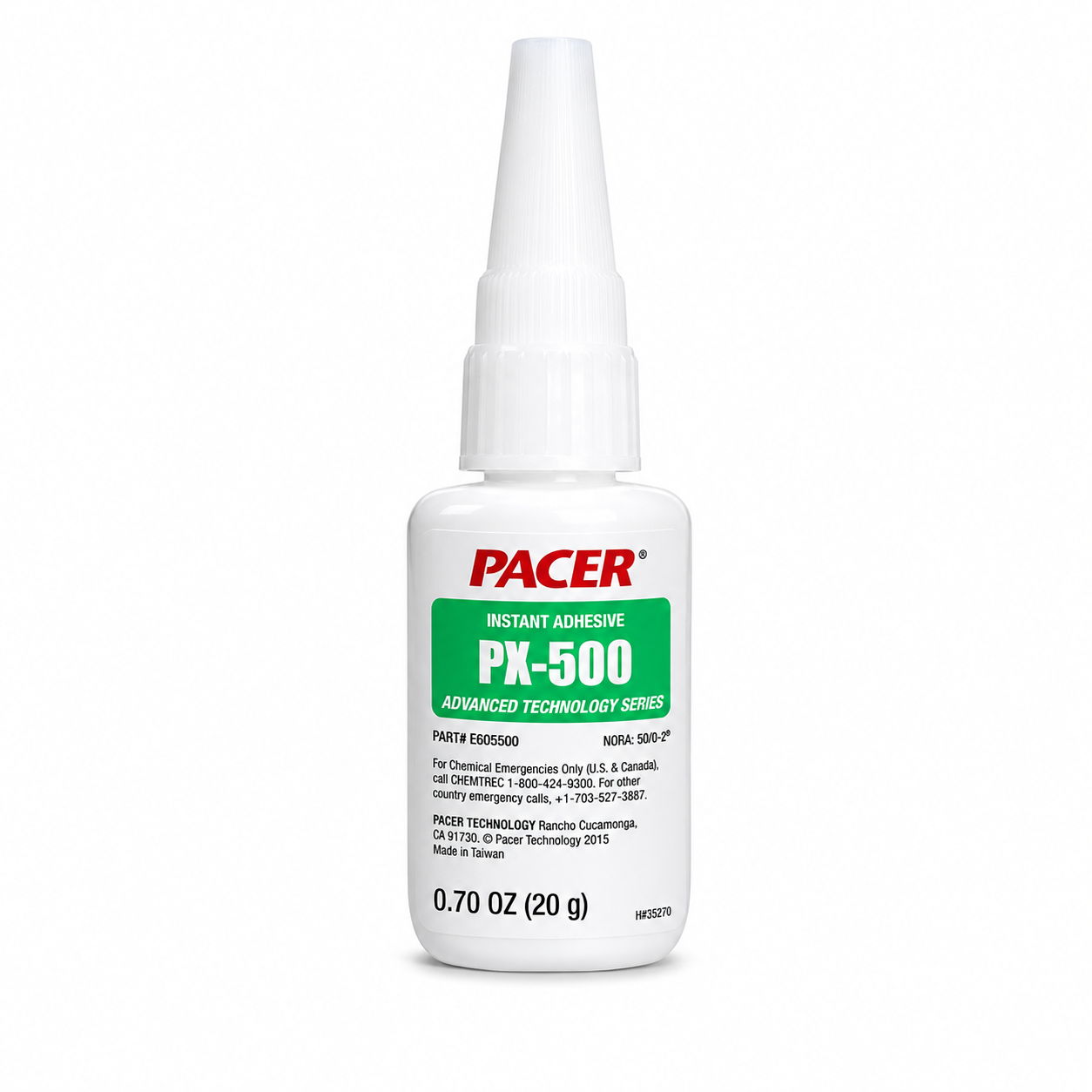
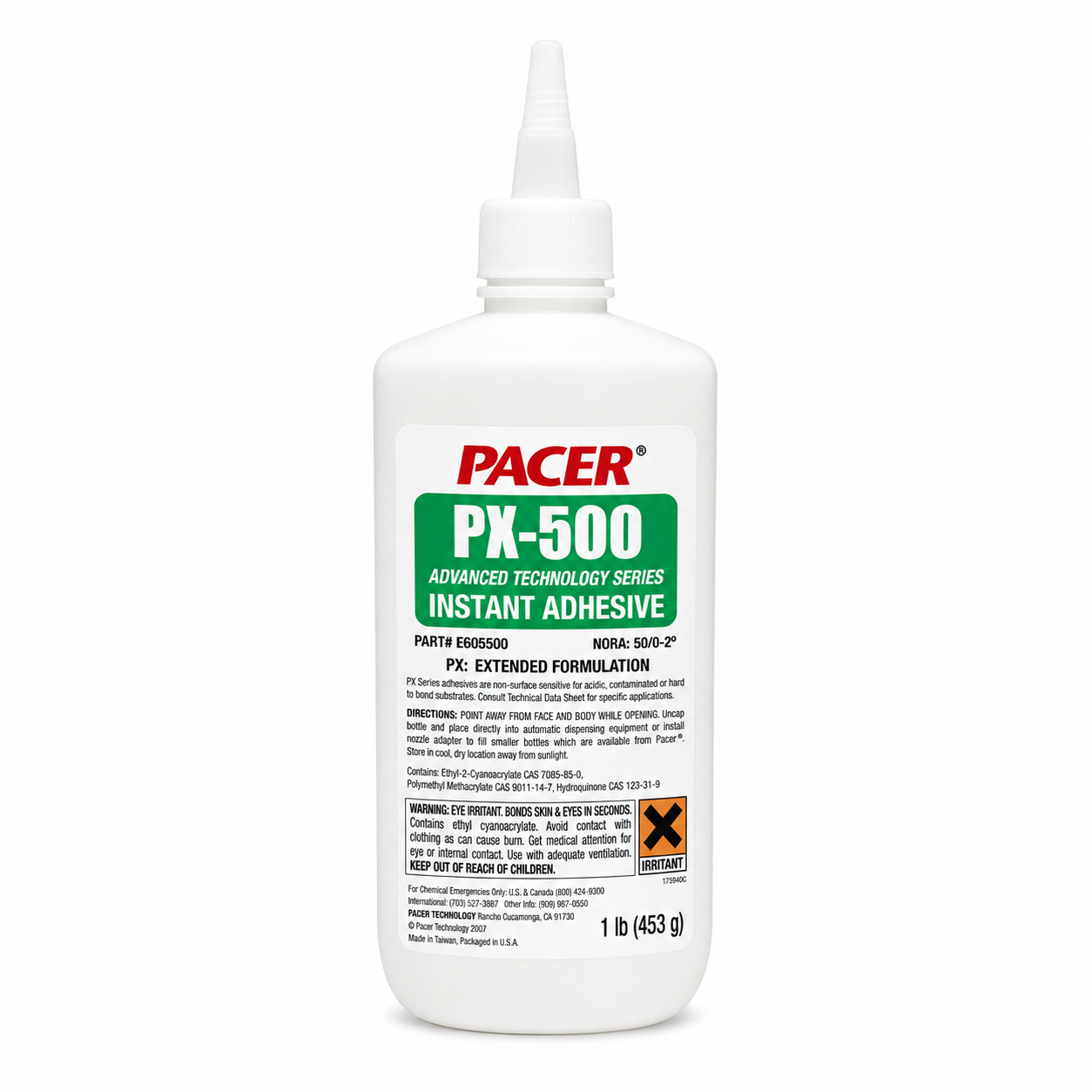


Description
Pacer PX-500 cyanoacrylate adhesive is the thicker grade in Pacer’s PX Series, an ethyl propyl cyanoacrylate formulated for maximum strength on plastics and elastomers. At 400 to 600 cP it fills to .008 in, double what PX-50 handles, which makes it the grade for moulded parts that do not mate as cleanly as the drawing says they should. On ABS and rigid PVC it gives substrate failure, meaning the plastic breaks before the bond, and on steel it gives 2700 psi tensile shear and 4400 psi tensile. It is rated -65F to +200F and meets MIL-A-46050C Type II, Class 2 and A-A-3097 Type II, Class 2. One number to check before you specify it: aluminum comes in at 700 psi, the lowest figure in Pacer’s cyanoacrylate line, so keep this off light alloy joints.
Key Product Details
| Property | Value |
|---|---|
| Chemistry | Ethyl propyl cyanoacrylate |
| Grade | Plastic Performance, PX Series |
| Color | Clear, translucent liquid |
| Viscosity | 400 to 600 cP |
| Typical Gap Fill | .008 in |
| Fixture Time | 1 to 5 minutes |
| Strength Development | 80% of full strength in 15 to 30 minutes |
| Temperature Range | -65F to +200F (-54C to +93C) |
| Softening Point | 303F / 151C |
| Melting Point | 363F / 184C |
| Flashpoint | 186F |
| Specific Gravity | 1.04 at 25C |
| Vapor Pressure | 7 mmHg at 70C |
| Rockwell Hardness | M 70 |
| Elongation | Less than 2% |
| Outgassing | 0 (at 10^-6 mmHg, 72F) |
| Tensile Strength, Steel | 4400 psi (+/- 10%) |
| Soluble In, Liquid State | Acetone, MEK, nitromethane |
| Soluble In, Cured State | Pacer X-9 Debonder, acetone, nitromethane |
| Specification Compliance | MIL-A-46050C Type II, Class 2; A-A-3097 Type II, Class 2 |
| Shelf Life | One year, stored per the TDS |
| Available Sizes | 20 Gram (0.70 oz) Bottle, 1 lb (453 g) Bottle |
Full property data for every grade in the series is in the Pacer PX Series technical data sheet (PDF). The data sheet covers grades and package sizes beyond what we currently stock. Chemical Concepts carries PX-50 and PX-500.
Tensile Shear Strength by Substrate
All figures +/- 10%. Where the table reads substrate failure, the part broke before the bond did.
| Substrate | Tensile Shear, psi |
|---|---|
| ABS | Substrate failure |
| PVC | Substrate failure |
| Steel | 2700 |
| Aluminum | 700 |
The plastics results are the same as PX-50, and so is steel at 2700 psi. Aluminum is where PX-500 differs: 700 psi against PX-50’s 1000, and the lowest figure Pacer publishes anywhere in its cyanoacrylate line. The E and RX families give 1600 psi on aluminum and the MR grades up to 2200. If your joint involves aluminum in any form, look at E-1500 for a similar gap capability or MR-290 for the strongest aluminum figures.
The same data gap applies as on PX-50. Pacer describes the PX Series as being for plastics and elastomers, but the published shear figures cover ABS and PVC only. There is no elastomer data on the sheet, and no nylon or polycarbonate either, both of which the E, RX, and MR sheets include. If you need a documented figure on a specific plastic or rubber, call us and we’ll ask Pacer directly rather than guess.
Why Moulded Parts Don’t Fit the Way the Drawing Says
PX-500 exists because injection-moulded parts vary, and a .004 in adhesive on a joint that sometimes opens to .007 in gives you a starved bond line and an intermittent failure that nobody can trace. Doubling the gap capability to .008 in is a cheaper fix than tightening a moulding process.
- Moulded parts shrink as they cool, and the amount depends on wall thickness, gate location, and how long the part sat in the tool. Two shots from the same mould are not identical.
- Warp is worse than shrink for bonding. A part can be dimensionally in spec and still not sit flat against its mate, which opens the joint at one end while closing it at the other.
- Tolerance stacks up. Two parts each within a few thousandths can combine into a joint that varies by twice that across a production run.
- Tools wear. A gap that was fine at first article can open up over a few hundred thousand shots, and the adhesive is usually blamed before the tool is.
- Regrind content changes both shrinkage and surface condition, so a run using regrind may bond differently from a run on virgin material.
- Measure the real range before picking a grade. Take a sample across a run, close the joints, and check the worst case rather than the nominal. If the worst case is past .004 in, PX-500 is the grade.
- Do not use extra adhesive to compensate. Applying more of a thin grade into a wide gap leaves an uncured core, because cyanoacrylate cure depends on surface moisture reaching the middle of the bond line.
- If the worst case runs past .008 in, cyanoacrylate is reaching its limit on plastics. Call us and we’ll look at a two part structural adhesive.
Choosing a Grade in the PX Series
Both current PX grades share the same ethyl propyl chemistry, the same -65F to +200F range, the same 4400 psi tensile, the same 2700 psi shear on steel, and substrate failure on ABS and PVC. Viscosity, gap, aluminum performance, and spec class are what separate them.
| Grade | Viscosity | Gap Fill | Aluminum Shear | MIL Class |
|---|---|---|---|---|
| PX-50 | 30 to 80 cP | .004 in | 1000 psi | Class 1 |
| PX-500 | 400 to 600 cP | .008 in | 700 psi | Class 2 |
Straightforward decision. Measure your worst-case gap across a real production run. Under .004 in, use PX-50 and keep the better aluminum figure. Over it, use PX-500. Pacer’s data sheet also lists PX-5 at 2 to 5 cP, which we no longer stock, so the series runs PX-50 and PX-500.
Across families, if your plastics work needs something PX does not cover: Pacer RX-500 runs the same 400 to 600 cP range with .008 in gap, publishes substrate failure on nylon, polycarbonate, SBR, and EPDM as well as ABS and PVC, gives 1600 psi on aluminum, and bonds plated or oily surfaces. On the numbers it is the stronger all-round choice unless you specifically want the ethyl propyl plastics chemistry.
Performance in Production
- .008 in gap fill, double PX-50, which absorbs the fit-up variation you get across a run of moulded parts rather than requiring consistent shots.
- Ethyl propyl chemistry, the only base in Pacer’s cyanoacrylate line that is not ethyl or ethyl hybrid, formulated for plastics and elastomers.
- Substrate failure on ABS and rigid PVC, so your joint strength is set by the part rather than the adhesive.
- 4400 psi tensile and 2700 psi tensile shear on steel, identical to PX-50, so the wider gap costs you nothing on plastics or steel.
- 700 psi on aluminum, the lowest figure in the Pacer cyanoacrylate line. This is the number that should keep PX-500 off any light alloy joint.
- Fixture in 1 to 5 minutes and 80% of strength in 15 to 30 minutes. A filled .008 in gap cures from the outside in, so allow the longer end before loading.
- A Pacer accelerator is worth having at hand near the top of the gap range, since Pacer recommends accelerators specifically to speed cure through larger gaps.
- Elongation under 2% and Rockwell M 70. Rigid bond, designed for shear rather than peel or flex.
- At 400 to 600 cP it moves more slowly than a thin grade but Pacer publishes no sag figure and does not rate it for vertical work. Plan on a horizontal or clamped joint.
- Available in a 20 gram bottle and a 1 lb bulk bottle, so you can trial it and then standardize without changing grade.
Common Applications
- Bonding moulded ABS parts with inconsistent fit-up
- Rigid PVC assembly and fabrication where joints do not close cleanly
- Plastic parts that warp out of flat even when dimensionally in spec
- Production runs where gap varies across shots or across a tool’s life
- Plastic to plastic joints with uneven mating surfaces
- Plastic to steel joints, at 2700 psi on the metal side
- Rework and repair of moulded plastic components where the original fit has been lost
- Assemblies running up to +200F
- Work calling out MIL-A-46050C Type II, Class 2 or A-A-3097 Type II, Class 2
Available Sizes
| Size | Net Weight | SKU | Pacer Part No. | UPC |
|---|---|---|---|---|
| 20 Gram Bottle | 0.70 oz (20 g) | PAC-FG05090 | FG05090 | 0 87093 00289 0 |
| 1 lb Bottle | 1 lb (453 g) | PAC-FG05093 | FG05093 | 0 87093 00290 6 |
The 20 gram bottle is sold in case quantity of 10. The 1 lb bottle sells individually. Pacer’s data sheet also lists a 20 kg container as FG05094, which we do not stock. Ask us if you need that quantity.
Related Products
- Pacer PX-50 Plastic Performance, 30 to 80 cP, .004 in gap, and a better aluminum figure at 1000 psi
- Pacer RX-500 Range Extended, same viscosity and gap, plus nylon and polycarbonate data, 1600 psi on aluminum, and non-surface-sensitive on plated or oily parts
- Pacer E-1500 Instant Adhesive (1300-1700 cP), the general purpose thick grade at .010 in gap with 1600 psi on aluminum
- Pacer MR-290 Moisture Resistant, .012 in gap, rated to +260F, and 2100 psi on aluminum
- Pacer Premium Acetone Accelerator, speeds full cure through larger gaps
- All cyanoacrylate instant adhesives
Frequently Asked Questions
What is Pacer PX-500 used for?
Pacer PX-500 is used for bonding plastics where the parts do not mate cleanly. At 400 to 600 cP it fills to .008 in, double what PX-50 handles, which suits moulded parts that shrink, warp, or vary across a production run. It is an ethyl propyl cyanoacrylate formulated for plastics and elastomers and gives substrate failure on ABS and rigid PVC.
What is the difference between PX-500 and PX-50?
Gap and aluminum performance. PX-500 is 400 to 600 cP filling .008 in, PX-50 is 30 to 80 cP filling .004 in. Everything else on plastics and steel is identical: same chemistry, same 4400 psi tensile, same 2700 psi shear on steel, same substrate failure on ABS and PVC. The one thing you lose going to PX-500 is aluminum, which drops from 1000 psi to 700. Measure your worst-case gap across a real run and pick from that.
Is Pacer PX-500 good for bonding metal?
Steel yes at 2700 psi, aluminum no at 700 psi. That aluminum number is the lowest Pacer publishes across its entire cyanoacrylate line, against 1600 for the E and RX families and up to 2200 for the MR grades. If your joint involves aluminum or another light alloy, use a different family. This is a plastics adhesive that happens to work on steel.
How much gap will Pacer PX-500 fill?
Typical gap fill is .008 in. Measure the worst case across a real production run rather than the nominal, since moulded parts vary with shrink, warp, and tolerance stack. If the worst case runs past .008 in you are at the limit of cyanoacrylate on plastics: adding more adhesive leaves an uncured core rather than bridging the gap, so call us about a two part structural adhesive.
Does Pacer PX-500 bond nylon or polycarbonate?
Pacer’s PX data sheet publishes shear figures for ABS and PVC only, so we cannot give you a number for nylon or polycarbonate on this grade. Pacer RX-500 runs the same 400 to 600 cP viscosity and the same .008 in gap, and it does publish substrate failure on nylon and polycarbonate along with ABS, PVC, SBR, and EPDM. If you need documented performance on those materials, that is the better grade to specify.
Should I use PX-500 or RX-500?
On the published numbers, RX-500 is the stronger all-round choice. Same viscosity, same .008 in gap, but it adds nylon, polycarbonate, SBR, and EPDM data, gives 1600 psi on aluminum against PX-500’s 700, and bonds plated, oily, and acidic surfaces. PX-500’s case is the ethyl propyl chemistry itself, which Pacer formulated specifically for maximum strength on plastics and elastomers. If you have qualified PX on a part and it works, stay with it. If you are choosing fresh and the substrate list matters, look at RX-500 first.
What temperature can Pacer PX-500 handle?
-65F to +200F (-54C to +93C), which is 20 degrees above Pacer’s E and RX families. Softening point is 303F and melting point 363F. If you need more, the MR Series is rated to +260F with published immersion data, and the TX Series is built for continuous elevated temperature.
How should Pacer PX-500 be stored, and what is the shelf life?
Refrigerate unopened bottles at 40F (4C) for optimum results, then let the adhesive come up to room temperature before opening. Opening a cold bottle draws condensation into the material. Once opened, store in a cool, dry location. Stored that way, expect a one year shelf life.
Questions on Fit
Measure your worst-case gap and tell us which plastic you’re bonding. Call (800) 220-1966 or email [email protected].



Reviews
There are no reviews yet.