What Is VHB Tape, and Is There a Difference Between Brands?
VHB tape is 3M’s trademarked line of double-sided acrylic foam tape. It bonds panels, trim, and hardware without screws, rivets, or welds, and it carries load across the whole bond area instead of at a few fastener points. VHB stands for Very High Bond.
The reason people ask what is VHB tape, and whether there is any real difference between one roll and the next, is that VHB is a trademark and not a product category. The generic category is acrylic foam tape, also sold as high bond tape, and several manufacturers build it. The practical questions follow from that: how strong the tape actually is, what it will and will not bond to, how it differs from a plain foam mounting tape, and how to get it off when the time comes.
What Is VHB Tape Made Of?
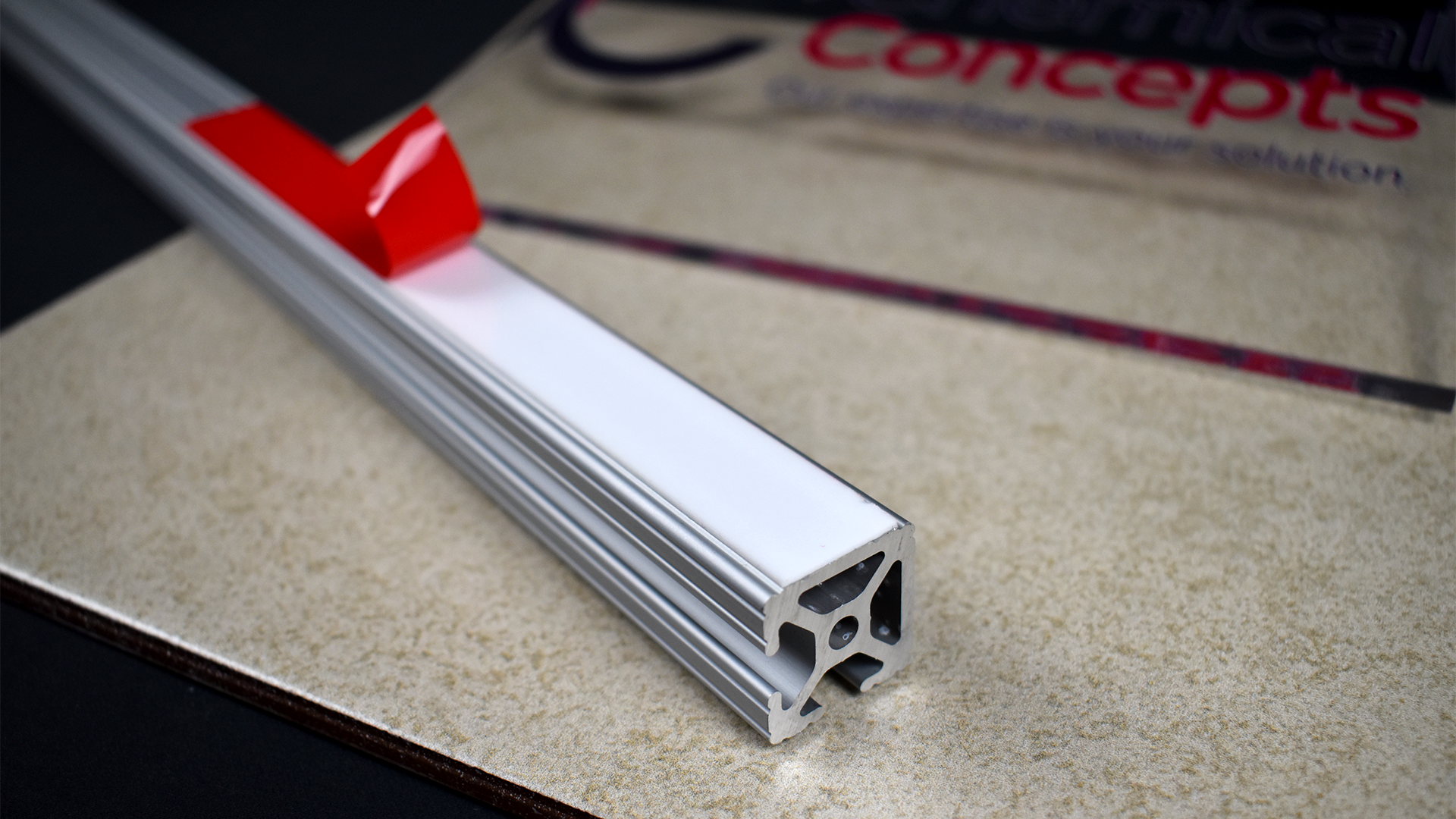
Every acrylic foam tape shares the same three-part build. A closed-cell acrylic foam core sits in the middle, a pressure-sensitive acrylic adhesive covers both faces, and a release liner protects one side until you are ready to apply it.
The core does the engineering work. It is viscoelastic, which means it behaves partly like a solid and partly like a very thick fluid. Under sudden impact it stiffens and resists. Under slow, sustained movement, such as an aluminum panel expanding against a steel frame on a hot afternoon, it flows and relieves the stress instead of passing it into the joint. That is why these tapes work on assemblies built from materials with different expansion rates, a job that a rigid fastener does badly.
The adhesive itself is an acrylic. That matters, because acrylic pressure-sensitive adhesives keep gaining strength after the parts go together, as the adhesive wets out into the texture of the surface. It is the reason acrylic foam tape is specified with a dwell period before the assembly takes load, and the reason a bond that feels ordinary at the bench feels very different the next day. Our guide to acrylic adhesives covers that chemistry in more detail.
Thickness is the variable you choose. Our Chem-Set VST line runs from 10 mil clear up to 47 mil gray, and thickness drives how much surface irregularity and movement the tape can absorb. A thicker core is more forgiving of a wavy panel and fills more gap. A thinner core gives a tighter bond line and demands better-fitting parts.
VHB Is a Trademark. Acrylic Foam Tape Is the Category.
This is where the confusion lives, and there is money attached to it.
VHB is a 3M trademark. When a drawing calls out VHB, it is calling out a 3M product, the same way a drawing calling out Loctite calls out a Henkel product. When a buyer asks for VHB tape on the phone, they usually mean acrylic foam tape and are reaching for the best-known name for it, the way people say Sharpie when they mean a marker.
That distinction has three practical consequences. A print that specifies 3M VHB 5952 by name has specified a single source, and substituting it requires an engineering sign-off. A print that specifies a black acrylic foam tape of a stated thickness with given peel and shear values has specified a performance envelope, and more than one product can meet it. And a purchase order that says VHB out of habit is buying on name recognition rather than on a spec comparison, which may or may not be the right call for that joint.
We stock both sides of it. 3M VHB 5952 is here for the prints that name 3M. The Chem-Set VST line is here for the prints that specify a construction and a performance range. Both sit in our high-bond acrylic foam tape category.
How Strong Is VHB Tape?
Strong enough that an honest answer has to come with the conditions attached.
Tape strength gets reported two ways, and they answer different questions. Peel adhesion is measured under ASTM D3330, which pulls the tape off a panel at a set angle and reports force per unit width. Static shear, or holding power, is measured under ASTM D3654, which hangs a constant load parallel to the bond and reports how long the tape holds it. For a mounted panel, static shear is the relevant number. Peel tells you how hard the tape will be to remove, which is closer to a handling property than a design property.
Both ASTM methods describe themselves as quality-assurance tools for checking consistency within and between production lots. D3330 states plainly that its methods cannot reliably compare different tapes of the same type from different manufacturers. A peel figure from one brand’s datasheet and a peel figure from another’s are not a fair head-to-head, even when the units match.
The practical move is to size the joint by bond area. Work out the load, pick a stress the tape can carry continuously at your service temperature, and give the joint enough square inches to get there. Then test the real assembly, with the real substrates, the real surface prep, and the real dwell time. One bonded sample will tell you more than two datasheets.
Two conditions are worth stating flatly. Sustained load capacity falls as temperature rises, so the figure that holds at room temperature is not the figure that holds on a south-facing panel in August. And a bond that has not had its dwell time has not reached the strength on the datasheet, no matter how solid it feels.
What Substrates Does Acrylic Foam Tape Bond?
Surface energy decides more of this than material family does.
High surface energy surfaces take acrylic foam tape well. That covers bare and anodized aluminum, stainless and mild steel, galvanized steel, glass, and most painted metal. These are the straightforward cases, and a general purpose construction such as Chem-Set VST6110 at 31 mil handles them.
Low surface energy surfaces resist it. Polypropylene, polyethylene, TPO, some powder coats, and many textured or heavily pigmented paints fall in this group. A general purpose acrylic foam tape will stick to them, feel fine at the bench, and let go in service. These need either an LSE-specific construction or an adhesion promoter. Chem-Set VST7825 is the LSE tape in our line, at 25 mil.
Clear and translucent panels add a cosmetic constraint on top of the adhesion question. A gray or black core telegraphs through translucent material, so clear constructions such as Chem-Set VST3050C exist for signage, display, and glazing trim.
Some surfaces are out regardless of which tape you pick. Untreated silicone, PTFE, plasticized vinyl that keeps migrating plasticizer, and any surface carrying mold release, oil, or a loose coating. Bonding to a coating means trusting that coating’s grip on the substrate, and a tape bond stronger than the paint adhesion will simply take the paint with it.
If you are not sure which group your substrate falls into, our adhesive selection guide walks the decision.
Double Sided Tape for Metal: What Changes
Metal is the most common substrate for these tapes, and it brings two specific problems.
Thermal movement is the first. Aluminum moves about twice as much as steel for the same temperature swing, so an aluminum skin on a steel frame shifts against that frame every day of its life. A rigid bond line fights the movement and eventually fails at the ends. This is the case the viscoelastic core was built for, and it is one reason a bonded panel can outlast a riveted one.
Contamination is the second. Mill finish, cold-rolled, and machined metal all arrive with something on the surface, and rolling oil or a rust preventive will kill an acrylic bond. Metal gets cleaned before the tape goes on, every time. Our metal bonding guide covers prep by alloy and finish, and the learning center has the general surface preparation sequence.
Galvanized and powder-coated metal deserve a second look before a production run. Galvanizing oxidizes and can form a loose white product on the surface. Powder coats vary widely in surface energy from one formulation to the next. Both are worth a test panel.
Foam Tape vs VHB: Where the Line Falls
Both are double-sided foam tapes, which is why the names get swapped. The difference is what the foam is there to do.
Acrylic foam tape, meaning VHB and its equivalents, uses an acrylic foam core that is part of the load path. The bond is structural and it is meant to be permanent.
A double-coated foam tape uses a polyethylene or urethane foam carrier whose job is gap filling and cushioning, with a separate adhesive layer applied to each side. It mounts things. It seals and gaskets, and it damps vibration. It is not holding a panel onto the side of a truck.
Choose a plain foam tape when the part is light, the bond is there for position rather than load, the surface is uneven, or the part may need to come off later. That covers most point-of-purchase displays, interior trim, nameplates, and gasketing. Choose acrylic foam tape when the joint carries load continuously, the assembly sees weather and temperature cycling, or the alternative on the table is rivets or welding. Exterior building panels, trailer and truck body panels, bumper molding, and screwless trailer construction are the usual cases. Our double-sided foam tapes and our full tape range are separate listings for exactly this reason.
Cost follows the same line. A foam mounting tape is the cheaper answer to a mounting job, and an acrylic foam tape on a mounting job is capacity you paid for and will not use.
How to Remove VHB Tape
Acrylic foam tape is designed not to come off, so removal is a process rather than a pull. This is the question we field most often once the bond has done its job.
- Heat the bond line. A heat gun on low, or a hair dryer, softens the acrylic and drops its shear strength, which is the property you are fighting. Work one section at a time and keep the heat moving so you do not damage paint or plastic.
- Separate the parts in shear, not in peel. Slow, steady sideways tension beats pulling. Running a length of heavy monofilament or a wire tape cutter back and forth through the foam core will split the core, which is far easier than breaking either adhesive face. On a thick core this is the fastest route.
- Roll off the residue. A rubber eraser wheel in a drill is the production answer. A plastic razor blade is the hand answer. Do not put a steel blade on painted or soft substrates.
- Soften what is left. A citrus or petroleum-based adhesive remover will handle the film the wheel leaves behind. Test any solvent on a hidden area first, because some will attack plastics and clear coats.
- Wipe the surface clean. Finish with a clean solvent wipe so the area is ready if something is going back on.
What not to do: do not try to peel a fully cured acrylic foam tape off a thin panel cold. The tape will win and you will bend the part.
Which Tape Should You Specify?
By application, these are the calls we make most often.
| Application | What to specify | Why |
|---|---|---|
| Sign face or lettered panel on aluminum or painted backer | General purpose acrylic foam tape, 25 to 31 mil | High surface energy substrates, permanent, no visible fasteners |
| Clear or translucent panel, glazing trim, acrylic display | Clear acrylic foam tape | A gray or black core shows through the panel |
| Polypropylene, TPO, textured or heavily pigmented powder coat | LSE acrylic foam tape, or general purpose plus adhesion promoter | Low surface energy will release a general purpose tape in service |
| Print names a 3M part number | 3M VHB 5952 | Single-source callout, substitution needs engineering approval |
| Trailer or truck body panel, exterior, full weather exposure | Thicker general purpose acrylic foam tape, up to 47 mil | More core to absorb panel movement and surface irregularity |
| Light interior mounting, gasketing, temporary display | Double-coated foam tape | Structural capacity is not needed and costs more |
Frequently Asked Questions
What does VHB stand for?
Very High Bond. It is 3M’s trademark for their acrylic foam tape family, so VHB names a brand while acrylic foam tape and high bond tape name the product category.
Is VHB tape stronger than screws or rivets?
It depends on the joint and on how the load is applied. A fastener concentrates load at a point and puts a hole in the part. A tape bond spreads the same load across the full bond area and leaves the panel sealed and unpierced. A correctly sized tape joint can replace mechanical fasteners in a great many panel applications, which is why bonded trailer and transit construction became standard practice. It is not a substitute for a structural weld in a load-bearing frame member, and no credible datasheet claims otherwise.
Can acrylic foam tape be used outdoors?
Yes, and this is where it separates from rubber-adhesive tapes. Acrylic adhesive holds up to UV, moisture, and temperature cycling, which is why it is used on building panels and vehicle exteriors. Service limits are specific to the product, so check the datasheet for the temperature range and for whether an adhesion promoter is called for on your substrate.
How long does acrylic foam tape take to reach full strength?
Longer than it feels like. The adhesive keeps building strength after application as it wets out into the surface, and the dwell time for a given product is on its datasheet. It varies with temperature and with the pressure applied at install. Plan for the assembly to sit before it sees full load, and roll or press the full length of the bond path firmly when you apply it, because application pressure does more for the bond than time alone.
Is there a generic equivalent to VHB tape?
Yes. Acrylic foam tape is made by several manufacturers, and our Chem-Set VST line covers the common constructions in clear, gray, white, and black. Whether it is a drop-in depends on how the drawing reads. If the print names a 3M part number, changing it needs engineering approval. If the print states a thickness, color, and performance range, a comparable construction can usually be qualified against it. Send us the print and we will tell you which of those two you are dealing with.
Getting Help With a Specific Joint
Tell us the substrates, the load, and whether the part sees weather, and we will tell you which construction fits and whether you need a general purpose, LSE, or clear tape. If the joint is unusual, we can put samples together so you can test the real assembly before committing to a production run. Call 800-220-1966, email [email protected], or use our contact page.