



Description
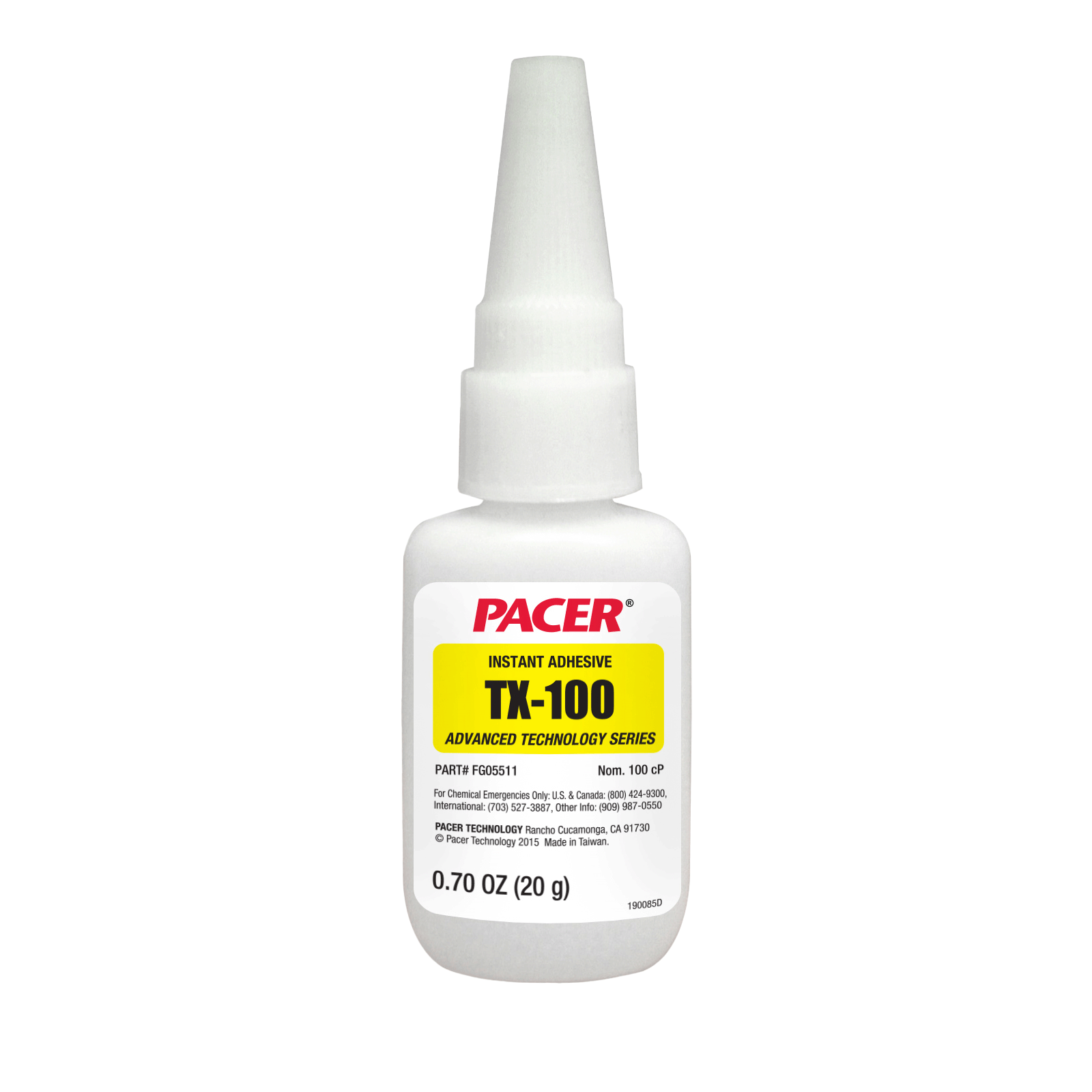
Pacer TX-100 cyanoacrylate adhesive is built for joints that get hot and stay hot. It is rated -65F to +280F continuous and +300F intermittent, the highest temperature range in Pacer’s cyanoacrylate line, and it is the only Pacer family that publishes hot strength: what the joint actually holds while it is at temperature, not just what it holds after cooling back down. Pacer names the applications specifically, and they are electronics work: wire and component tacking to circuit boards ahead of wave soldering, high speed printer heads, and components sitting close to power supplies, laser lamps, and similar heat sources. At 80 to 150 cP TX-100 fills to .004 in and gives 2700 psi shear on steel and 2000 psi on aluminum. It meets MIL-A-46050C Type II, Class 2 and A-A-3097 Type II, Class 2.
Key Product Details
| Property | Value |
|---|---|
| Chemistry | Ethyl hybrid cyanoacrylate |
| Grade | High Temperature, TX Series |
| Color | Clear, transparent liquid |
| Viscosity | 80 to 150 cP |
| Typical Gap | .004 in |
| Fixture Time | 1 to 5 minutes |
| Strength Development | 80% of full strength in 15 to 30 minutes |
| Temperature Range, Continuous | -65F to +280F (-54C to +138C) |
| Temperature Range, Intermittent | -65F to +300F (-54C to +149C) |
| Softening Point | 310F / 154C |
| Melting Point | 368F / 187C |
| Flashpoint | 185F / 85C |
| Specific Gravity | 1.05 at 20C |
| Vapor Pressure | 6 mm Hg at 70C |
| Rockwell Hardness | M 70 |
| Outgassing | 0 (at 10^-6 mmHg, 72F) |
| Tensile Strength, Steel | 3500 psi |
| Soluble In, Liquid State | Acetone, MEK, nitromethane |
| Soluble In, Cured State | Pacer X-9 Debonder, acetone, nitromethane |
| Specification Compliance | MIL-A-46050C Type II, Class 2; A-A-3097 Type II, Class 2 |
| Shelf Life | One year, stored per the TDS |
| Available Sizes | 20 Gram (0.70 oz) Bottle, 1 lb (453 g) Bottle |
Full property data for every grade in the series is in the Pacer TX Series technical data sheet (PDF). The data sheet covers grades and package sizes beyond what we currently stock. Chemical Concepts carries TX-100, TX-750, and TX-2000.
Tensile Shear Strength by Substrate
Tested per ASTM D-1002, all figures +/- 10%. Where the table reads substrate failure, the part broke before the bond did.
| Substrate | Tensile Shear, psi |
|---|---|
| Steel | 2700 |
| Aluminum | 2000 |
| ABS | Substrate failure |
| Rigid PVC | Substrate failure |
| Nylon | Substrate failure |
| SBR | Substrate failure |
| EPDM | 100 |
2000 psi on aluminum is worth noting. That is well above the 1600 psi the E and RX families give and second only to the MR grades in the Pacer line, which matters because aluminum shows up constantly in heat sinks and electronics enclosures. Room temperature tensile is 3500 psi, lower than the 4000 to 4500 psi elsewhere in the Pacer line, so TX trades some cold strength for heat performance. EPDM is 100 psi, the same as most Pacer families, so if EPDM is your substrate the RX Series is the better choice since it fails the rubber before the bond.
Hot Strength, Tested at Temperature
These figures are the reason to specify TX. The samples were pulled while still at the stated temperature, so this is what the joint actually holds when it is hot. No other Pacer cyanoacrylate family publishes this test. All on steel, per ASTM D-1002, +/- 10%.
| Test Condition | Shear, psi | Retained |
|---|---|---|
| Initial, room temperature | 2700 | Baseline |
| Tested at 248F (120C) after 1 hour | 1500 | 56% |
| Tested at 275F (135C) after 1 hour | 1400 | 52% |
| Tested at 302F (150C) after 1 hour | 800 | 30% |
Note where the curve holds and where it drops. Between 248F and 275F it barely moves, 1500 down to 1400. Above the continuous rating of 280F it falls off, reaching 800 psi at 302F. That is consistent with the softening point at 310F, and it is why Pacer separates the continuous rating at +280F from the intermittent one at +300F.
Heat Aging Resistance
A different question from hot strength: how much strength does the joint permanently lose after sitting at temperature for days or weeks? These samples were aged hot, then cooled and pulled at room temperature. All on steel, +/- 10%.
| Aging Condition | 7 Days | 14 Days |
|---|---|---|
| At 212F (100C) | 2000 psi | 1650 psi |
| At 248F (120C) | 1800 psi | 1400 psi |
| At 285F (141C) | 1275 psi | 800 psi |
Against the 2700 psi baseline, that is 74% retained after a week at 212F and 61% after two weeks. At 285F, just above the continuous rating, it is 47% after a week and 30% after two. Both trends are steady rather than sudden, which tells you the degradation is gradual and predictable rather than a cliff.
How to Read Heat Aging Against Hot Strength
Those two tables answer different questions and getting them mixed up is how a joint gets specified wrong. Almost every adhesive data sheet gives you a temperature rating and nothing else, so most buyers have never had to tell these apart.
- Hot strength answers: what does the joint hold right now, while it is hot? The sample was pulled at temperature. Use this figure if the joint carries load while the assembly is running warm. TX-100 gives 1500 psi at 248F.
- Heat aging answers: how much did the joint permanently lose from having been hot? The sample was aged hot, cooled, then pulled cold. Use this figure if the assembly gets hot in service but carries its real load cold, or if you need to know what is left after months of thermal exposure. TX-100 retains 1800 psi after a week at 248F.
- Notice they can both apply to the same joint. An assembly that runs at 248F and also has to survive a drop test needs to pass on the hot figure while running and the aged figure when cold.
- A temperature rating on its own tells you almost nothing about either. It says the adhesive will not fail outright, not what it will hold. That is why a rating of +280F and a hot strength of 1400 psi at 275F are both worth having.
- Size the bond area against whichever figure matches your load case, and against the worse of the two if you are not sure.
- Watch the difference between continuous and intermittent. TX-100 is +280F continuous and +300F intermittent. A part that spikes through 300F briefly is a different specification from one that sits at 300F all shift.
- Test in your own thermal profile before committing a process. Neither table replaces putting a real assembly through your real cycle.
Choosing a Grade in the TX Series
All three current TX grades share the same ethyl hybrid chemistry and the same temperature ratings, -65F to +280F continuous and +300F intermittent. Viscosity, gap, and spec class separate them.
| Grade | Viscosity | Typical Gap | Hot Shear at 248F | MIL Class |
|---|---|---|---|---|
| TX-100 | 80 to 150 cP | .004 in | 1500 psi | Class 2 |
| TX-750 | 650 to 850 cP | .010 in | 1600 psi | Class 3 |
| TX-2000 | 1500 to 2500 cP | .020 in | 1650 psi | Class 3 |
Unusually for a cyanoacrylate family, hot strength goes up slightly as the grades get thicker rather than down, so choosing TX-100 for its viscosity costs you nothing meaningful in heat performance. Pick on gap. TX-100 at .004 in suits electronics work and close-fitting parts, TX-750 at .010 in and TX-2000 at .020 in handle looser fit-up.
Across families, if you need heat and something TX does not offer: Pacer’s MR Series is rated to +260F and adds published hot water immersion data, so it is the better choice if the joint gets both hot and wet. And the RX Series is the family for plated, oily, or acidic surfaces and for EPDM rubber, though it is rated only to +180F.
Performance in Production
- Rated -65F to +280F continuous and +300F intermittent, the highest temperature range in Pacer’s cyanoacrylate line. The MR Series stops at +260F and the E and RX families at +180F.
- Holds 1500 psi tested at 248F and 1400 psi at 275F, measured while the joint was hot. No other Pacer family publishes hot strength at all.
- Retains 1800 psi after a week at 248F and 1650 psi after two weeks at 212F, so you can predict what is left after long thermal exposure.
- Pacer names the applications directly: wire and component tacking to circuit boards ahead of wave soldering, high speed printer heads, and components near power supplies and laser lamps.
- 2000 psi on aluminum, well above the 1600 psi typical of the E and RX families, which matters on heat sinks and enclosures.
- Zero outgassing at 10^-6 mmHg, which combined with the temperature rating suits vacuum and thermally loaded assemblies.
- Room temperature tensile is 3500 psi, lower than the 4000 to 4500 psi elsewhere in the Pacer line. You are trading cold tensile for heat performance, so check that the cold figure still covers your load case.
- .004 in gap capability means fit-up needs to be reasonably good, which suits electronics work and machined parts.
- Fixture in 1 to 5 minutes and 80% of strength in 15 to 30 minutes, the same across the TX Series.
- At 80 to 150 cP it is a flowing liquid. It will run on a vertical face before it cures and Pacer publishes no sag figure, so fixture flat or clamp.
- EPDM at 100 psi. If EPDM is your substrate, the RX Series is the better family.
Common Applications
- Wire and component tacking to circuit boards ahead of wave soldering
- High speed printer heads
- Electronic components mounted close to power supplies
- Components near laser lamps and similar heat sources
- Assemblies running continuously up to +280F
- Joints that spike briefly to +300F
- Heat sink and enclosure work on aluminum, at 2000 psi shear
- Vacuum and thermally loaded assemblies, based on the zero outgassing figure
- Motors, lighting, and process equipment where the joint runs warm
- Work calling out MIL-A-46050C Type II, Class 2 or A-A-3097 Type II, Class 2
Available Sizes
| Size | Net Weight | SKU | Pacer Part No. | UPC |
|---|---|---|---|---|
| 20 Gram Bottle | 0.70 oz (20 g) | PAC-FG05511 | FG05511 | 0 87093 00296 8 |
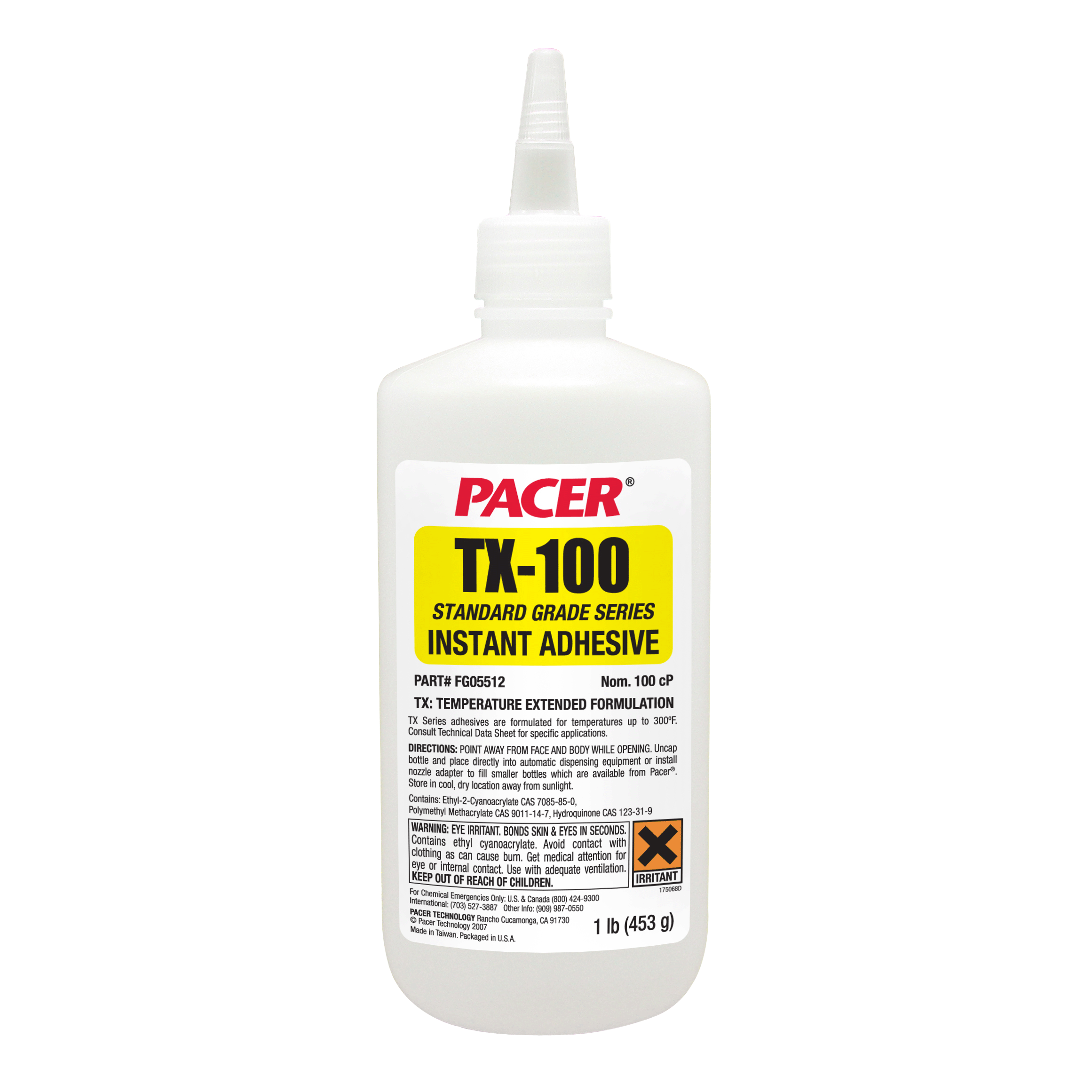
| 1 lb Bottle | 1 lb (453 g) | PAC-FG05512 | FG05512 | 0 87093 00297 5 |
The 20 gram bottle is sold in case quantity of 10. The 1 lb bottle sells individually. Pacer’s data sheet also lists a 20 kg container as FG05513, which we do not stock. Ask us if you need that quantity.
Related Products
- Pacer TX-750 High Temperature, 650 to 850 cP, .010 in gap, same temperature ratings
- Pacer TX-2000 High Temperature, 1500 to 2500 cP, .020 in gap, the thickest TX grade
- Pacer MR-290 Moisture Resistant, rated to +260F with published hot water immersion data, for joints that get hot and wet
- Pacer E-100 Instant Adhesive (80-120 cP), the general purpose grade at a similar viscosity, rated to +180F, with higher room temperature tensile
- Pacer RX-100 Range Extended (80-120 cP), for plated, oily, or acidic surfaces and for EPDM rubber
- Pacer Premium Acetone Accelerator, speeds full cure through larger gaps
- All cyanoacrylate instant adhesives
Frequently Asked Questions
What is Pacer TX-100 used for?
Pacer TX-100 is used for joints that run hot. Pacer names the applications specifically: wire and component tacking to circuit boards ahead of wave soldering, high speed printer heads, and electronic components mounted close to power supplies, laser lamps, and similar heat sources. It is rated -65F to +280F continuous and +300F intermittent, at 80 to 150 cP with .004 in gap capability.
What temperature can Pacer TX-100 handle?
-65F to +280F (-54C to +138C) continuous, and -65F to +300F (-54C to +149C) intermittent. That is the highest range in Pacer’s cyanoacrylate line, above the MR Series at +260F and well above the E and RX families at +180F. Softening point is 310F and melting point 368F. The distinction matters: a part that sits at 280F all shift is a different specification from one that spikes briefly through 300F.
How much strength does Pacer TX-100 hold when it is hot?
1500 psi on steel tested at 248F, 1400 psi at 275F, and 800 psi at 302F, all measured while the samples were still at temperature. Against a 2700 psi room temperature baseline that is 56%, 52%, and 30% retained. TX is the only Pacer cyanoacrylate family that publishes this test, which matters because a temperature rating on its own tells you the adhesive will not fail outright, not what the joint will actually hold.
What is the difference between hot strength and heat aging?
Hot strength is what the joint holds while it is hot, measured by pulling the sample at temperature. Heat aging is how much strength the joint lost permanently from having been hot, measured by aging the sample hot, cooling it, then pulling it cold. Use hot strength if the joint carries load while the assembly is running warm. Use heat aging if the assembly gets hot but carries its real load cold, or if you need to know what is left after months in service. TX-100 gives 1500 psi at 248F for the first, and 1800 psi after a week at 248F for the second.
Can Pacer TX-100 survive wave soldering?
Pacer names wire and component tacking to circuit boards prior to wave soldering as an application for the TX Series, so the cured adhesive is intended to go through that process. Whether it survives your specific thermal profile depends on your preheat and pot temperatures and dwell times, which vary by line. Send us your profile and we will go through the hot strength and heat aging figures against it, or better, run a board and check.
Which Pacer TX grade should I use?
Pick on gap, not on heat, since all three grades share the same temperature ratings and their hot strength figures are within 150 psi of each other. TX-100 fills .004 in and suits electronics work and close-fitting parts. TX-750 fills .010 in and TX-2000 fills .020 in for looser fit-up. TX-100 and TX-750 are Class 2 and Class 3 respectively under MIL-A-46050C, so check your spec callout too.
Is Pacer TX-100 weaker than a general purpose grade at room temperature?
On tensile, yes. TX-100 gives 3500 psi tensile on steel against 4000 psi for the E Series and 4500 for the MR grades. Tensile shear is the same at 2700 psi, and aluminum is actually better at 2000 psi against 1600. So you are trading room temperature tensile for heat performance. If your joint never gets hot, a general purpose grade is the cheaper and slightly stronger choice.
Does Pacer TX-100 meet MIL-A-46050C?
Yes, at Type II, Class 2, and it also meets A-A-3097 Type II, Class 2. TX-750 and TX-2000 are both Class 3. Pacer states it will certify compliance, so ask for the certificate of conformance when you place the order rather than after the parts arrive.
How should Pacer TX-100 be stored, and what is the shelf life?
Refrigerate unopened bottles at 40F (4C) for optimum results, then let the adhesive come up to room temperature before opening. Opening a cold bottle draws condensation into the material. Once opened, store in a cool, dry location. Stored that way, expect a one year shelf life.
Questions on Fit
Tell us your thermal profile and we’ll go through the hot strength and heat aging figures against it. Call (800) 220-1966 or email [email protected].


Reviews
There are no reviews yet.