





Description
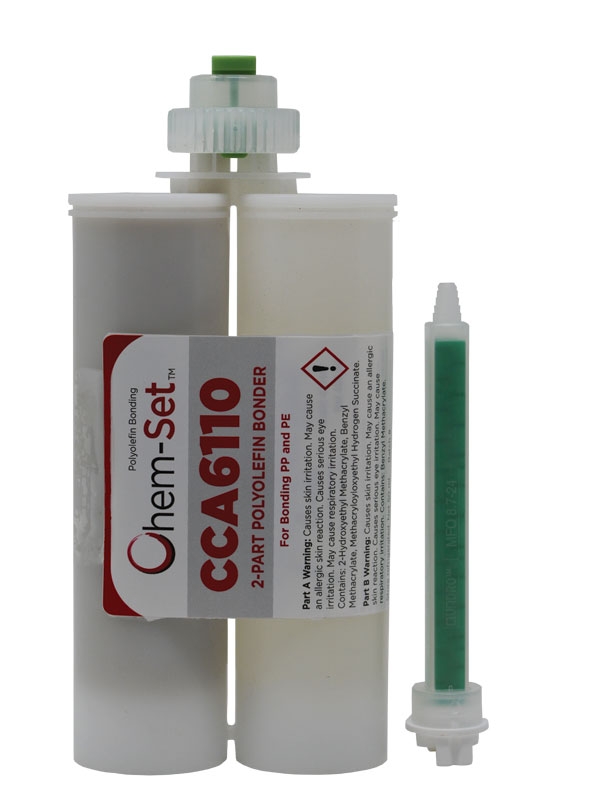
Chem-Set 6110 polyolefin bonder is a two-part, 1:1 toughened acrylic for HDPE, polypropylene, and polyethylene that gives you more open time than Chem-Set 6105 and needs no primer and no flame, plasma, or corona treatment.
HDPE, polypropylene, and polyethylene have low surface energy, so most adhesives do not wet out on them without a surface treatment or primer. 6110 skips that step. A longer pot life than 6105 gives you more time to place parts and work longer seams.
The TDS also lists water resistance and underwater bonding, and lap shear values on stainless steel, mild steel, fiberglass (GRP and epoxy FRP), and carbon fiber. It comes in 50ml and 400ml cartridges, and each cartridge includes a mixing nozzle.
Key Product Details
| Property | Value |
|---|---|
| Chemistry | Two-part toughened acrylic, methacrylate (Part A and Part B) |
| Mix Ratio | 1:1 |
| Color | Part A off-white, Part B almost colorless, mixed off-white |
| Viscosity at 25°C | Part A 200,000 to 500,000 mPa.s (cP), thixotropic paste. Part B 20,000 to 30,000 mPa.s (cP) |
| Specific Gravity | 1.0 (both parts) |
| Maximum Gap Fill | 1 mm (0.04 in), contains microparticles to control gap |
| Pot Life (2 g + 2 g) at 23°C | 5 to 8 minutes |
| Fixture Time at 23°C (0.1 N/mm² shear strength) | 12 to 15 minutes |
| Handling Time at 23°C (0.3 N/mm² shear strength) | 40 to 50 minutes |
| Working Strength at 23°C | 6 to 8 hours |
| Full Cure at 23°C | 48 hours |
| Minimum Service Temperature | -55°C (-67°F), depending on the materials bonded |
| Storage Temperature | Cartridges: 5 to 25°C (41 to 77°F) |
| Country of Manufacture | Italy |
Typical lap shear strength (ISO 4587)
| Substrate | Shear Strength (N/mm²) | Shear Strength (psi) | Substrate Failure Observed |
|---|---|---|---|
| Polypropylene | 8 | 1,200 | Yes |
| Polyethylene | 7 | 1,000 | Yes |
| HDPE | 15 | 2,175 | Not reported |
| PTFE | 2 | 290 | Yes |
| Mild steel to PTFE | 2 | 290 | Yes |
| Mild steel to polypropylene | 7 | 1,015 | Not reported |
| Mild steel to HDPE | 7 | 1,015 | Not reported |
| Stainless steel | 5 | 725 | Not reported |
| Stainless steel to polypropylene | 5 | 725 | Not reported |
| Stainless steel to HDPE | 5 | 725 | Not reported |
| Aluminum to polypropylene | 4 | 580 | Not reported |
| Aluminum to HDPE | 4 | 580 | Not reported |
| Carbon fiber | 8 | 1,160 | Not reported |
| Epoxy FRP | 13 | 1,885 | Not reported |
| Polyester GRP | 10 | 1,450 | Not reported |
| ABS | 4 | 580 | Yes |
| Polycarbonate | 5 | 725 | Yes |
| PVC | 5 | 725 | Yes |
| EPDM | 3.5 | 500 | Yes |
| Nylon (PA6) | 5 | 725 | Not reported |
| PET-G | 5 | 725 | Yes |
| PET-P | 5 | 725 | Yes |
Values are from the Chem-Set 6110 technical data sheet. Substrate failure means the plastic gave way before the adhesive did. Surface condition, surface preparation, glue-line thickness, substrate thickness, pull speed, batch variation, cure time, and temperature all affect shear strength results.
Performance in Production
- A longer pot life than 6105 gives you more time to place parts and work longer seams before the adhesive starts to set. Mix through the nozzle and still assemble the joint promptly.
- Fixture and handling strength come later than with 6105, so plan for longer clamp time. Hold pressure until handling strength is reached.
- Working strength arrives at 6 to 8 hours and full cure takes 48 hours at 23°C, so plan your production schedule and service loading around both.
- The TDS lists bonds underwater and great water resistance. Test your own assembly in its service conditions before you specify it.
- The TDS reports substrate failure on polypropylene, polyethylene, PTFE, ABS, polycarbonate, PVC, EPDM, PET-G, and PET-P. In those tests the plastic gave way before the adhesive did.
- HDPE carries the highest lap shear value in the table, 15 N/mm² (2,175 psi). Surface and prep affect results, so test on your own HDPE grade.
- The TDS lists lap shear values on epoxy FRP, polyester GRP, and carbon fiber, so it covers composite parts as well as plastics and metals.
- Temperature affects cure speed. The TDS gives its cure times at 23°C, so check your schedule if the shop runs colder or warmer.
- The TDS lists good impact strength and good chemical resistance. It does not list individual chemicals, so test against your own cleaners and fluids before production.
Common Applications
- HDPE and polypropylene sheet bonded to stainless steel, mild steel, and aluminum
- Marine and wet-service assemblies where water resistance matters
- Fiberglass (polyester GRP and epoxy FRP) and carbon fiber parts
- Larger parts and longer seams where more open time helps with placement
- EPDM rubber, nylon (PA6), PET-G, and PET-P bonding
- ABS, polycarbonate, and PVC parts, with lap shear values listed above
- Dissimilar-material joints such as plastic to metal or plastic to composite
- Fabrication and repair jobs where a flame, plasma, or corona treatment step is not wanted
Available Sizes
| Package | SKU | Includes |
|---|---|---|
| 50ml Cartridge | CCA6110-50 | Two-part 1:1 cartridge, one mixing nozzle |
| 400ml Cartridge | CCA6110-400 | Two-part 1:1 cartridge, one mixing nozzle |
Alternative to 3M Scotch-Weld DP8010
Chem-Set 6110 is offered as an alternative to 3M Scotch-Weld DP8010 for bonding low surface energy plastics. They are different products, so mix ratio and cure profile are not identical. Chem-Set 6110 mixes 1:1 and runs in 1:1 cartridge guns. Confirm fit on your parts before you change a process.
Related Products
Chem-Set 6110 and Chem-Set 6105 use the same guns and mixing tips.
- Chem-Set 6105 LSE Polyolefin Bonder: the companion 1:1 grade with a shorter pot life and faster set, for jobs that need quicker handling
| Property at 23°C | Chem-Set 6110 | Chem-Set 6105 |
|---|---|---|
| Pot life (2 g + 2 g) | 5 to 8 minutes | 2 to 4 minutes |
| Fixture time (0.1 N/mm² shear strength) | 12 to 15 minutes | 5 to 10 minutes |
| Handling time (0.3 N/mm² shear strength) | 40 to 50 minutes | 20 to 25 minutes |
| Working strength | 6 to 8 hours | 2 to 4 hours |
| Package | Extra Mixing Tips | Manual Gun | Battery or Pneumatic Gun |
|---|---|---|---|
| 50ml | Sulzer MBQ 05-16L mixing tips | CCH50G 50ml manual dispensing gun | Chem-Set PAK 50 electric 50ml battery gun |
| 400ml | Sulzer MFQ 08-24T mixing tips | Albion B26T400 manual applicator | Sulzer Mixpac DP2X 400 pneumatic gun |
How to Bond HDPE, Polypropylene, and Polyethylene Without Flame Treatment
Chem-Set 6110 replaces the flame, plasma, corona, or primer step with a clean, dry, grease-free surface. The shop steps are:
- Clean the surfaces. Polyolefin parts can carry traces of mold release. Wipe with isopropanol (IPA) and let it evaporate fully before bonding.
- Prep metal if you are bonding to it. Aluminum, copper, and copper alloys benefit from light abrasion with emery cloth or similar to remove the oxide layer.
- Load the cartridge and fit a mixing nozzle. The 50ml and 400ml cartridges use different guns and tips, listed under Related Products above.
- Apply a thin bead of adhesive mixed through the static mixer nozzle. Use the longer pot life to place the parts, then bring them together.
- Assemble the parts and clamp.
- Hold pressure until handling strength is reached. The time depends on the joint design and the surfaces being bonded.
- Allow 48 hours at 23°C for full cure before the joint sees service load. Excess adhesive outside a closed joint cures more slowly and may feel soft from air contact. Adhesive inside the joint cures solid.
The process runs on polypropylene, polyethylene and HDPE, stainless steel, mild steel, aluminum, fiberglass, carbon fiber, ABS, polycarbonate, PVC, EPDM, nylon (PA6), PET-G, and PET-P. For a substrate that is not in the table, call us before you specify.
Check compatibility on your own substrate. The TDS notes that 6110 may affect some thermoplastics and is not recommended in contact with strong oxidizing materials. Storage temperature is in the table above. If the product separates slightly in storage, invert the container to redisperse it.
Frequently Asked Questions
What is Chem-Set 6110 used for?
Chem-Set 6110 is a 1:1 toughened acrylic used to bond HDPE, polypropylene, and polyethylene with no primer or surface treatment. Polyolefin bonder, LSE plastic adhesive, and polyolefin adhesive all describe the same type of product.
It also bonds stainless steel, mild steel, aluminum, carbon fiber, fiberglass (polyester GRP and epoxy FRP), ABS, polycarbonate, PVC, EPDM, nylon (PA6), PET-G, and PET-P. The shear strength table above lists values for each. PTFE and mild steel to PTFE bond at lower strength, so test them or call us before you specify.
Is Chem-Set 6110 an alternative to 3M Scotch-Weld DP8010?
Chem-Set 6110 is offered as an alternative to 3M Scotch-Weld DP8010 for bonding low surface energy plastics with no primer or surface treatment. It is a different product, so mix ratio and cure speed are not identical. 6110 mixes 1:1 and runs in 1:1 cartridge guns. Test on your parts before you change a process.
What is the difference between Chem-Set 6110 and Chem-Set 6105?
6110 is the longer-open-time grade. Both are 1:1 toughened acrylic polyolefin bonders, but 6110 has the longer pot life, fixture time, handling time, and working strength, as shown in the comparison table above. Chem-Set 6105 sets faster. They use the same guns and mixing tips.
Do I need to flame treat, plasma treat, or prime before using Chem-Set 6110?
No. Chem-Set 6110 is developed to bond HDPE, polypropylene, and polyethylene with no primer or surface treatment. The surfaces still need to be clean, dry, and grease-free. Wipe polyolefin parts with isopropanol and let it evaporate fully, since mold release can leave a residue. Light abrasion helps on aluminum, copper, and copper alloys.
Can Chem-Set 6110 bond underwater or be used on a boat?
The 6110 technical data lists bonding underwater and great water resistance. Boat builders and fabricators bond HDPE sheet with Chem-Set polyolefin bonders. The TDS does not give a salt or UV rating, so test your assembly in its service conditions or call us to talk through the application.
Should I use Chem-Set 6105 or 6110 on King StarBoard?
King Plastic names Chem-Set 6105 Polyolefin Bonder among the adhesives to use on King StarBoard when an adhesive is necessary, and does not name 6110. 6110 also bonds HDPE, with an HDPE lap shear value in its data, so the choice comes down to open time. See Chem-Set 6105 and King Plastic’s StarBoard adhesive guidance, or call us to talk through your application.
What gun and mixing tip do I need for Chem-Set 6110?
The 50ml cartridge runs in a 50ml 1:1 dispensing gun, and the 400ml cartridge runs in a 400ml manual or pneumatic gun. Each cartridge includes one mixing nozzle. Extra tips and the guns we carry for each size are listed under Related Products above.
Where is Chem-Set 6110 made?
Chem-Set 6110 is made in Italy. Chemical Concepts supplies it in 50ml and 400ml cartridges.
Questions on fit for your polyolefin bonding application? Call (800) 220-1966 or email [email protected].
3M and Scotch-Weld are trademarks of 3M. King StarBoard is a registered trademark of King Plastic Corporation. Chem-Set is a trademark of Chemical Concepts, Inc. Chemical Concepts is not affiliated with 3M or King Plastic Corporation.


Reviews
There are no reviews yet.