


Description
This 1 lb (453 g) bottle of Pacer RX-100 is the production volume size of Pacer’s non-surface-sensitive cyanoacrylate, 80 to 120 cP with .005 in gap capability. It’s the size for a line that has already settled the question: you know a standard cyanoacrylate won’t hold your parts, you’ve proven RX-100 does, and now you need it in quantity. At 453 g it holds about 23 times what the 20 gram bottle does, which suits a daily bonding operation, a cell feeding dispensing equipment, or a shop filling its own applicator bottles from bulk.
Package Details
| Property | Value |
|---|---|
| Product | Pacer RX-100 Range Extended Cyanoacrylate Adhesive |
| Package | 1 lb (453 g) Bottle |
| Net Weight | 1 lb (453 g) |
| Chemical Concepts SKU | PAC-FG04023 |
| Pacer Part No. | FG04023 |
| UPC | 0 87093 00231 9 |
| Chemistry | Ethyl hybrid cyanoacrylate, Range Extended |
| Surface Sensitivity | Virtually non-surface sensitive |
| Viscosity | 80 to 120 cP |
| Typical Gap | .005 in |
| Fixture Time | 1 to 5 minutes |
| Cured Temperature Range | -65F to +180F (-54C to 82C) |
| Shear Strength, Steel | 2300 psi (+/- 10%), ASTM D-1002 |
| Bonds Through | Silicone greases, oils, release agents, plated surfaces |
| Specification Compliance | MIL-A-46050C Type II, Class 2; A-A-3097 Type II, Class 2 |
| Shelf Life | One year, stored per the TDS |
| Related Composite Product | Pacer RX-100 Range Extended Cyanoacrylate Adhesive (80-120 cP) |
Full shear strength figures by substrate, the RX viscosity selector, and guidance on diagnosing a bond failure are on the main Pacer RX-100 product page.
Choosing the 1 lb Over the 20 Gram
- 453 g against 20 g, or 16 oz against 0.70 oz, about 23 times the material. If a small bottle lasts a week or less, this is the size.
- Prove the chemistry first. RX is specified to solve a specific bonding failure, so run the 20 gram on the actual part and confirm the bond before you buy a pound of it.
- This is a bulk container, not a bench bottle. Most shops draw from it to fill smaller applicator bottles or to charge a dispensing system.
- Cyanoacrylate cure is driven by moisture and an opened bottle works against ambient humidity from day one. Buying more than you consume in a reasonable window does not save money.
- Worth knowing across the RX family: RX-100 and RX-500 are the two grades offered in a 1 lb. RX-50 and RX-700 are 20 gram only, and the RX Gel comes in 20 gram and 200 gram. If you need a different RX viscosity at volume, call us first.
Performance in Production
- Enough volume to feed a daily bonding operation without a purchase order every other week.
- Bonds through silicone greases, oils, and release agents, and onto plated parts, which is what lets you take degrease, abrade, and prime steps out of the process entirely.
- Substrate failure on ABS, rigid PVC, nylon, polycarbonate, SBR, and EPDM. If you run rubber parts at volume, that EPDM result is the reason to standardize on this family.
- Same 80 to 120 cP and .005 in gap as E-100, so a line already running the general purpose grade can move problem parts to RX-100 without changing joint design or dispensing hardware.
- One free-falling drop covers about one square inch of bond area, so 453 g carries a substantial part count on small joints.
- Fixture in 1 to 5 minutes, 80% of strength in 15 to 30 minutes, which keeps a bonding station moving inside one takt.
- At 80 to 120 cP this is a flowing liquid. Build the station around a horizontal or fixtured joint, because it will run on a vertical face before it cures.
- Clean the parts anyway. This buys process margin on a difficult surface rather than removing the value of prep.
- Decant only what gets used in a shift and keep transfer containers dry and capped. Cure rate tracks relative humidity, so open material in a humid shop behaves differently than a fresh bottle.
Common Applications
- Daily production bonding of plated parts and fittings
- EPDM and SBR rubber, gaskets, and seals at volume
- Lines bonding mold-released parts straight from molding
- Assemblies where oil or silicone lubricant is present by design
- Feeding automatic dispensing equipment on a bonding cell
- Filling shop applicator bottles from bulk
- Removing surface preparation steps from an existing bonding process
- Contract manufacturing calling out MIL-A-46050C Type II, Class 2
Related Products
- Pacer RX-100 Range Extended Cyanoacrylate Adhesive (80-120 cP), full detail and both sizes
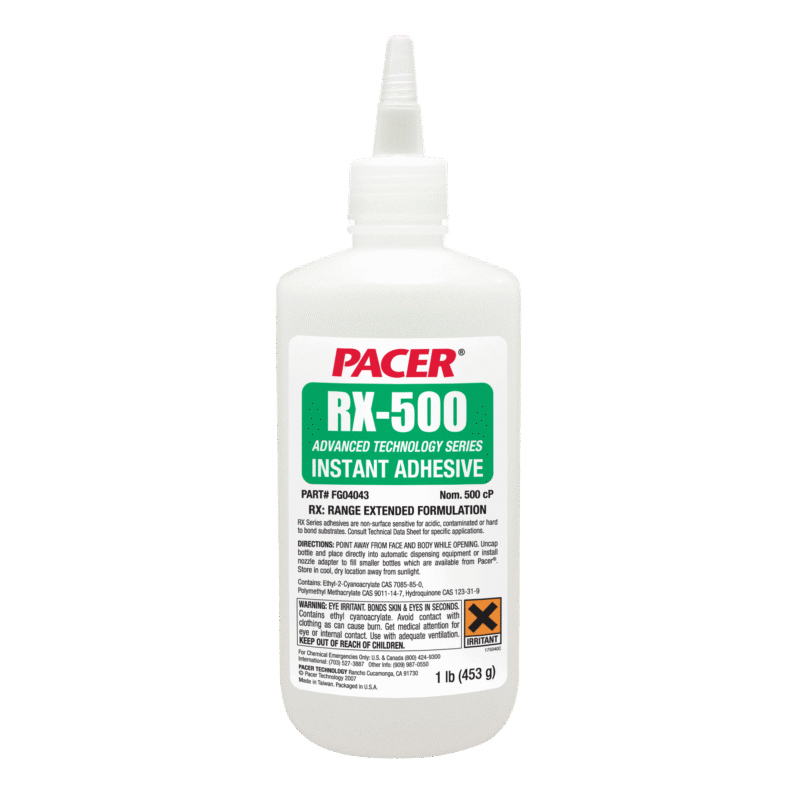
- Pacer RX-500 Range Extended, thicker at .008 in gap, also available in a 1 lb
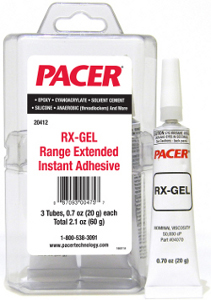
- Pacer RX Gel, non-sag non-running gel for vertical applications, .020 in gap
- Pacer E-100 Instant Adhesive (80-120 cP), general purpose equivalent for clean surfaces, also in a 1 lb
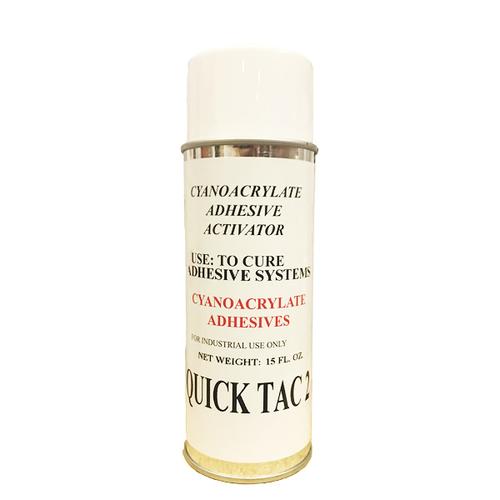
- Pacer Premium Acetone Accelerator, speeds full cure through larger gaps
- All cyanoacrylate instant adhesives
Frequently Asked Questions
How much adhesive is in a 1 lb bottle of Pacer RX-100?
Net weight is 1 lb (453 g), about 23 times the 20 gram (0.70 oz) bottle. Pacer’s guidance is one free-falling drop per square inch of bond area, but Pacer does not publish a coverage figure per gram. If you need to budget material against a part count, send us the part and we’ll help you work it out from a sample.
Is the 1 lb Pacer RX-100 the same adhesive as the 20 gram?
Yes, identical. Same non-surface-sensitive chemistry, same 80 to 120 cP viscosity, same .005 in gap capability, same MIL-A-46050C Type II, Class 2 rating. Only the container changes, and the 20 gram is sold in case quantity of 10 while this is a single bottle. Nothing needs requalifying when you step up.
Which Pacer RX grades come in a 1 lb bottle?
RX-100 and RX-500. RX-50 and RX-700 are currently offered in a 20 gram bottle only, and the RX Gel comes in 20 gram and 200 gram tubes. If you’re standardizing a production process on one of those viscosities and need volume, call us first so we can look at what’s available before you build the process around it.
Does Pacer RX-100 bond EPDM rubber?
Yes. In ASTM D-1002 testing RX-100 gives substrate failure on EPDM, meaning the rubber tears before the bond does, and SBR is the same. Pacer’s general purpose E Series grades reach only 100 psi on EPDM. If you bond rubber gaskets, seals, or trim at volume, this is the family to specify.
Can I decant Pacer RX-100 into smaller applicator bottles?
Shops do it routinely with bulk CA, and Pacer’s published guidance does not cover decanting, so treat it as shop practice rather than a manufacturer instruction. Keep transfer containers clean, dry, and capped, and move only what gets consumed in a shift, since cure rate depends on relative humidity. If you need Pacer’s formal position on repackaging for a quality system, we’ll ask them.
Should I buy the 1 lb or trial the small bottle first?
Trial first. RX chemistry gets specified to solve a specific bonding failure, and the only way to know it solves yours is to put it on the actual part. Run the 20 gram, confirm the bond on the real substrate in your real conditions, then buy the pound. Send us the part and we’ll help you set up the test.
How should Pacer RX-100 be stored, and what is the shelf life?
Refrigerate unopened bottles for optimal results. A 1 lb bottle takes longer to reach room temperature than a small one, so let it warm through before opening. Once opened, store in a cool, dry location away from heat sources. Stored that way, expect a one year shelf life.
What is the part number for the 1 lb Pacer RX-100?
Our SKU is PAC-FG04023. The Pacer part number is FG04023 and the UPC is 0 87093 00231 9. On older Pacer paperwork the same item shows as Pacer item number 11740033.
Questions on Fit
Questions on fit for your bonding process, or on volume for a production line? Call (800) 220-1966 or email [email protected].


Reviews
There are no reviews yet.